What will cause a $100 core i5 to happen?

Page 3 - Seeking answers? Join the AnandTech community: where nearly half-a-million members share solutions and discuss the latest tech.

tential

Diamond Member
May 13, 2008
7,348
642
121
Hi I just started my BSc in Computer Engineering which features some economics and lots of CPU architecture + electrical engineering etc

We should start these courses in January. I am currently reading up on an information systems management book.

A Simple Lesson in Economics
http://www.amazon.com/Economics-One-.../dp/0517548232

Seriously will be helpful for you in understanding how markets work. Even as a person who majored in it, it still was a good read.

Also there were like a billion articles on the PS3 cell architecture. Since you didn't read any, I suggest you do to understand why you can't simply just compare core counts.

http://electronics.howstuffworks.com/playstation-three1.htm

That's just the first one I found.
 

tential

Diamond Member
May 13, 2008
7,348
642
121
^ thanks dude much appreciated. Just ordered it was really cheap aswell.

Reading that book should teach you the basics of how economies/markets work.

It's an actual book you can read and isn't something you have to solve equations at or anything. It makes its point and illustrates it very well and the background/history you'll get is quite useful too. And it's not very long either.

Concise and to the point.
 

ShintaiDK

Lifer
Apr 22, 2012
20,378
146
106
Do you guys think that if intel wanted, they could bring a 100% performance increase in Skylake? that is if they focused strictly on desktop market.

Absolutely not. It would be the exact same IPC improvements and frequency wise you may get a few 100Mhz extra for a TDP increased to 130W or so.
 

ShintaiDK

Lifer
Apr 22, 2012
20,378
146
106
Well it for sure is about making profit. That is the whole point of a business isn't it? I am not saying there is anything wrong with that though.

If you wish to survive, then you first pay R&D before you make profit.

The first one to tank for a 100$ i5 would be profit, then R&D.
 

witeken

Diamond Member
Dec 25, 2013
3,899
193
106
There's no such thing as a "nice" company. AMD, just like "evil" Intel, is out to maximize profits for its shareholders -- Intel just happens to be far better at its job than AMD is.

What about Google? They don't have dividends, as far as I know, so how could they maximize profits for shareholders? Why would any company even want to maximize profits for shareholders? It isn't like those shareholders have ROI like employees do that would make it worth giving them money; investors aren't going to build the next microarchitecture or process fab.
 

ShintaiDK

Lifer
Apr 22, 2012
20,378
146
106
What about Google? They don't have dividends, as far as I know, so how could they maximize profits for shareholders? Why would any company even want to maximize profits for shareholders? It isn't like those shareholders have ROI like employees do that would make it worth giving them money; investors aren't going to build the next microarchitecture or process fab.

Stock price like any other company. Stock buyback is another option for example. Unless the stocks goes up satisfyingly fast on its own. And ofcourse dividends, forced or free will.

And Google will pay dividends, its just a matter of when.
 
Last edited:

witeken

Diamond Member
Dec 25, 2013
3,899
193
106
but performance is quite close.

If suddenly games start to make good use of the CPUs, then we may get i5 for $100.
Only because the AMD CPU has 2X the number of integer cores and a higher clock speed.
 

witeken

Diamond Member
Dec 25, 2013
3,899
193
106
Although you may have the perception that you can hold onto a processor for x years so long as it has enough cores, it's not realistic. Even if you had 8 cores from 2005, you'd still end up with a slideshow trying to play Starcraft 2, which is almost 5 years old at this point. A single modern core has far more throughput than Cell's 7 "cores" combined.

Except then that it isn't a modern core. It are 6 3-issue cores at half the clock speed of the PS3. It's hardly an improvement. The only improvement is that ISA.
 

witeken

Diamond Member
Dec 25, 2013
3,899
193
106
Absolutely not. It would be the exact same IPC improvements and frequency wise you may get a few 100Mhz extra for a TDP increased to 130W or so.

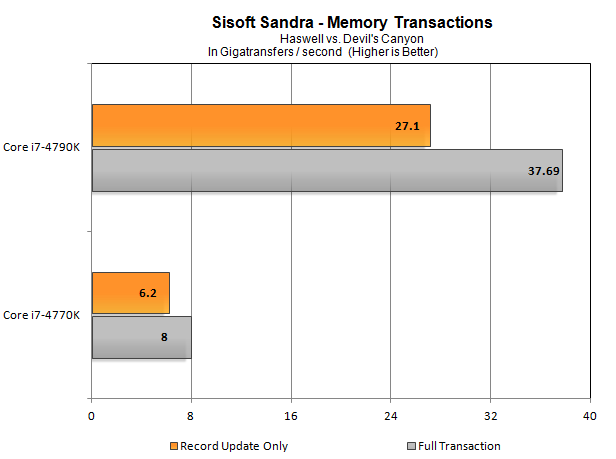
It depends on the software. Intel could surely release Skylake with some nice ISA improvements and cherry pick those benchmarks that show 100+% improvements in those specific use cases; just like they did with Haswell:

SiSoftSandra.png


Haswell'Broadwell's TSX will substantially improve performance of programs built to make use of the feature. Another example would be ARMv8's 825% AES improvement.

But indeed, it wouldn't be a huge general purpose improvement. I do think, however, if they designed a Core specifically for overclocking, it might reach a higher clock speed than Haswell.
 

witeken

Diamond Member
Dec 25, 2013
3,899
193
106
Stock price like any other company. Stock buyback is another option for example. Unless the stocks goes up satisfyingly fast on its own. And ofcourse dividends, forced or free will.

And Google will pay dividends, its just a matter of when.

Without a stock market, companies would also try to grow and increase profitability and health.
 

dealcorn

Senior member
May 28, 2011
247
4
76
What would it take to bring down a i5 to $100?

I5 is a premium brand. Do you want the I5 brand name at $100 or do you want I5 quad core performance at $100? Between ticks, tocks, 3 D NAND, improved instruction set wild cards, and the mystery behind Door 3, 15% per year performance improvements are reasonable for Intel. In 5 years big core performance should double. In a different context BK said that Atom may target 50% of big core performance. It sounds like I5 quad core performance for less than $100 should hit 2019-2020 but it will be branded under the Atom family.

Brand names are expensive and consumers get confused when price fluctuates. Looking forward, there is a question how to brand the benefits of a SoC with on package 3D NAND. However, I do not see why Intel would want to move I5 branding to a $100 price point.

Survivor wisdom is never get into a price war with the low cost producer. Due to some combination of an integrated foundry model, better density caused by a smaller node, more efficient transistors, and more transistor efficient designs, Intel is a lower cost producer than AMD. Absent alien technology, "Hit them where they ain't" (aka Niche Marketing) is the viable strategy for AMD. Dr. Su is not stupid and she will not launch a Kamikaze Style attack on the I5. The I5 is too strongly defended. As long as there are areas where Intel ain't. AMD has better opportunities.

Know your enemy is always good advice. I suspect BK agrees with Linus that long term discrete graphics cards are a declining segment that will ultimately be trivialized by IGD. I also suspect BK agrees with IDC that from a resource allocation perspective it is inefficient for every foundry to throw money at advanced process technologies. It would be more efficient if every customer for advanced nodes just moved their business to the Intel foundry model. Long term that is the goal but, for example, Nvidia is a bad candidate because their efforts with Fermi in the HPC space conflict with Xeon Phi.

Back before the day, IBM forced Intel to license X86 to a 3rd party as a precondition to IBM PC production. Intel selected AMD as a licensee based on their perceived incompetence to do anything threatening with the license. Today, from BK's perspective, ATI looks a lot like AMD once did to GM. Moving ATI's fab business to Intel is helpful. There may be many billions of foundry revenue before IGD's wipe out discrete graphics. Enthusiasts will benefit if Intel foundry performs well for ATI.
 
Last edited:

john5220

Senior member
Mar 27, 2014
551
0
0
^ curious about something after reading your post

How would ATI have turned out if it was acquired by intel instead of AMD?

This is assuming they went all out and even re branded ATI as intel Radeon
 

tential

Diamond Member
May 13, 2008
7,348
642
121
What about Google? They don't have dividends, as far as I know, so how could they maximize profits for shareholders? Why would any company even want to maximize profits for shareholders? It isn't like those shareholders have ROI like employees do that would make it worth giving them money; investors aren't going to build the next microarchitecture or process fab.

Dividends isn't the only way you increase value for shareholders.
It's natural to NOT pay dividends, especially in an area like Tech. If you were to pay dividends, you would increase the shareholder's value today, but in the longer term, that money could have went into R&D. So when that money isn't spent in R&D, you get less competitive products and the stock price drops. So it's more beneficial to the shareholder to have the company not pay a dividend and instead invest that money in R&D.
Dividends are by no means mandatory for any company to pay and many companies do NOT pay them.

Yahoo did an article on it actually today:
http://finance.yahoo.com/news/biggest-companies-dont-pay-dividends-180000561.html

Companies that aren't paying dividends (as well as those that haven't and may start to).

Why would any company maximize profits for shareholders?
I'm not sure if this is a serious question or not, but shareholders OWN THE COMPANY. So they kind of have to do this.

As for Google specifically. Again, as a shareholder you can gain money from a stock price increase or dividends. So Google has deemed it's more beneficial to invest their cash into new products in order to increase their share price. They have done the math and decided "We could pay a dividend and our investors could get money now, but we wouldn't be as competitive in teh future, or we could invest that money, and our stock price will increase more than what investors would have gained in a dividend".
 
Mar 10, 2006
11,715
2,012
126
What about Google? They don't have dividends, as far as I know, so how could they maximize profits for shareholders? Why would any company even want to maximize profits for shareholders? It isn't like those shareholders have ROI like employees do that would make it worth giving them money; investors aren't going to build the next microarchitecture or process fab.

When you're a growth company, you maximize profits for shareholders by improving your profits/revenues, which should lead to a higher stock price.

Once that growth wanes, then the next way to try to boost shareholder return/share price is through, as ShintaiDK stated, buybacks and/or dividends.

Buybacks create value by reducing the share count and thus increasing the earning-per-share possible per dollar of net income. Dividends create value in a few ways. First, the company is literally handing shareholders money every quarter. Secondly, many investors will "buy yield." If a company sets the dividend payout per share to make the dividend yield attractive enough, this gets a number of buyers on board, thus increasing the share price.

To answer your question of why a company would want to maximize profits for their shareholders, the answer is literally that it is the job of the management team to do so.
 

tential

Diamond Member
May 13, 2008
7,348
642
121
When you're a growth company, you maximize profits for shareholders by improving your profits/revenues, which should lead to a higher stock price.

Once that growth wanes, then the next way to try to boost shareholder return/share price is through, as ShintaiDK stated, buybacks and/or dividends.

Buybacks create value by reducing the share count and thus increasing the earning-per-share possible per dollar of net income. Dividends create value in a few ways. First, the company is literally handing shareholders money every quarter. Secondly, many investors will "buy yield." If a company sets the dividend payout per share to make the dividend yield attractive enough, this gets a number of buyers on board, thus increasing the share price.

To answer your question of why a company would want to maximize profits for their shareholders, the answer is literally that it is the job of the management team to do so.

Thanks. A much better and concise way of trying to say what I wanted.
 
Mar 10, 2006
11,715
2,012
126
What about Google?

Google is in its growth phase, so the organic growth of the business and the buzz around what it does is enough to keep the share price performing relatively well.

Once that growth phase starts slowing down, investors will complain that the stock has been underperforming (in fact, YTD, GOOG/GOOGL has been a poor performer, so what I am describing is probably not too far off), and will eye the ~$52 billion in net cash that Google has sitting on its balance sheet.

Google will probably start with a dividend first, and will pay out in dividends most of its domestic free cash flow. If that, coupled with business performance, isn't enough to satisfy investors, then expect to see Google take out debt against its foreign cash hoard and use that cash to buy-back shares.
 

Yuriman

Diamond Member
Jun 25, 2004
5,530
141
106
^ curious about something after reading your post

How would ATI have turned out if it was acquired by intel instead of AMD?

This is assuming they went all out and even re branded ATI as intel Radeon


Fun tidbit, as I understand it AMD approached nVidia first, but NV's terms were that their CEO would run the combined company, so they bought Ati instead.

At first I was optimistic, because the new combined AMD/ATI had an in-house fab and could potentially design their products and process together, but then AMD spun off their foundry, probably because they almost ran themselves into the ground buying ATI. Honestly, they probably would've been better had they not.
 
Last edited:
Mar 10, 2006
11,715
2,012
126
Fun tidbit, as I understand it AMD approached nVidia first, but NV's terms were that their CEO would run the combined company, so they bought Ati instead.

Jen-Hsun in charge of a combined AMD/NVIDIA at the time would have been very interesting to see.
 

john5220

Senior member
Mar 27, 2014
551
0
0
I think Jen-Hsun might have done a much better Job managing AMD

too bad it didn't turn out that way. Imagine what the outcome would have been today eh?
 

witeken

Diamond Member
Dec 25, 2013
3,899
193
106
Dividends isn't the only way you increase value for shareholders.
It's natural to NOT pay dividends, especially in an area like Tech. If you were to pay dividends, you would increase the shareholder's value today, but in the longer term, that money could have went into R&D. So when that money isn't spent in R&D, you get less competitive products and the stock price drops. So it's more beneficial to the shareholder to have the company not pay a dividend and instead invest that money in R&D.
Dividends are by no means mandatory for any company to pay and many companies do NOT pay them.

Yahoo did an article on it actually today:
http://finance.yahoo.com/news/biggest-companies-dont-pay-dividends-180000561.html

Companies that aren't paying dividends (as well as those that haven't and may start to).
Interesting. Then why does Intel spend such a ludicrous amount of money that they could invest in better yields, better process nodes, better everything, if it's such a natural thing to do for tech companies?

exh99151.jpg


We can only wonder what Intel could have done with that $100B (including 2014), for example not missing mobile, and how much revenue they would have (which I guess would increase shareholder profit).

Why would any company maximize profits for shareholders?
I'm not sure if this is a serious question or not, but shareholders OWN THE COMPANY. So they kind of have to do this.
What if they (or Intel) don't pay dividends or buy shares back? It seems like a better thing to do to me because you can use that money to innovate.

As for Google specifically. Again, as a shareholder you can gain money from a stock price increase or dividends. So Google has deemed it's more beneficial to invest their cash into new products in order to increase their share price. They have done the math and decided "We could pay a dividend and our investors could get money now, but we wouldn't be as competitive in teh future, or we could invest that money, and our stock price will increase more than what investors would have gained in a dividend".
I'm not too knowledgeable about the financial side of things, so thanks for your reply.
 
Mar 10, 2006
11,715
2,012
126
Interesting. Then why does Intel spend such a ludicrous amount of money that they could invest in better yields, better process nodes, better everything, if it's such a natural thing to do for tech companies?

exh99151.jpg


We can only wonder what Intel could have done with that $100B (including 2014), for example not missing mobile, and how much revenue they would have (which I guess would increase shareholder profit).

What if they (or Intel) don't pay dividends or buy shares back? It seems like a better thing to do to me because you can use that money to innovate.


I'm not too knowledgeable about the financial side of things, so thanks for your reply.

If Intel didn't buy back shares/pay a dividend, the excess cash would just pile up on the balance sheet.

Intel, like every other company, spends what it needs on R&D, MG&A, etc. and then whatever is left over (i.e. profit) belongs to the shareholders. A business that just invests to the point where it is perpetually unprofitable is a very poor business.

Intel underinvested in low-power IP and SoCs, I 100% agree. However, if Intel had not bought back shares/paid the dividends, Intel would probably still be in the exact same place because all of that profit would have just sat on the balance sheet as "cash and equivalents."
 

Denithor

Diamond Member
Apr 11, 2004
6,298
23
81
Indeed. I thought, at the time, that AMD/nVidia made a lot more sense than AMD/ATi. If that had gone forward, an Intel/ATi combination might have taken place and the CPU/GPU world would be a very different place than it is today.
 

witeken

Diamond Member
Dec 25, 2013
3,899
193
106
[...]
To answer your question of why a company would want to maximize profits for their shareholders, the answer is literally that it is the job of the management team to do so.

I guess that makes sense, but does that mean that Intel views itself as a non-growth company? That sort of goes against Moore's Law, out of which it follows that computing will become ever more ubiquitous, so there's plenty room for growth. Moore's Law also isn't free; it will become more expensive so you need ever more money to sustain it.
 
Mar 10, 2006
11,715
2,012
126
I guess that makes sense, but does that mean that Intel views itself as a non-growth company? That sort of goes against Moore's Law, out of which it follows that computing will become ever more ubiquitous, so there's plenty room for growth. Moore's Law also isn't free; it will become more expensive so you need ever more money to sustain it.

Intel's R&D budget has continued to increase over time, so Intel is investing at the proper levels.

A well-managed business grows R&D/SG&A expenses alongside revenues. In particular, Intel targets 30% of revenue for R&D and MG&A spending. This means that if Intel achieves its goal, it will spend a constant percentage of revenues investing in its business, but as the business grows, the spending in absolute dollar terms grows too.