• We’re currently investigating an issue related to the forum theme and styling that is impacting page layout and visual formatting. The problem has been identified, and we are actively working on a resolution. There is no impact to user data or functionality, this is strictly a front-end display issue. We’ll post an update once the fix has been deployed. Thanks for your patience while we get this sorted.

Question Western Digital PC SN730 NVMe SSD Reviews?

Hello, I recently ordered an Alienware Area-51m R2 laptop and it comes with this configuration for SSDs: Western Digital PC SN730 NVMe SSD 2TB (2x 1TB PCIe M.2 SSD) RAID 0 [Boot] + 2TB (2x 1TB PCIe M.2 SSD) Non-Raid [Storage]

I am still awaiting delivery but meanwhile I tried looking up reviews Western Digital PC SN730 NVMe SSD and found none.

Does anyone have an idea bout this SSD? is it supposed to be a good SSD or just a below average SSD that OEMs use? Dell also offers the Toshiba XG6 SSD on this laptop with the same configuration but I got the WD SN730 with mine.
 
SN730 should be the BiCS4/96L variant of the SN720, which is the OEM/client SKU for the SN750 (newer WD Black model). This would be similar to how the SN550 is the 96L version of the SN500 (which was based on the OEM/client SN520).

The newer flash is a bit faster but also usually denser with less interleaving, however in general using the reviews for the SN550 & SN750 should tell you the story. It's a bit much in RAID-0/stripe, although I have 2x1TB SN750s in such a configuration for a workspace. Regardless, good drives. The XG6 uses similar flash and is also OEM/client-oriented but is not as fast overall due to its controller.
 
SN730 should be the BiCS4/96L variant of the SN720, which is the OEM/client SKU for the SN750 (newer WD Black model). This would be similar to how the SN550 is the 96L version of the SN500 (which was based on the OEM/client SN520).

The newer flash is a bit faster but also usually denser with less interleaving, however in general using the reviews for the SN550 & SN750 should tell you the story. It's a bit much in RAID-0/stripe, although I have 2x1TB SN750s in such a configuration for a workspace. Regardless, good drives. The XG6 uses similar flash and is also OEM/client-oriented but is not as fast overall due to its controller.
Oh thanks a lot! So I'll just look at reviews for the SN750 then. I thought the XG6 is better and that's what was my original order but Dell changed them to the WD SN730 so I was thinking I got some inferior drive.

Just saw the review of the SN750 on Anandtech. Looks like a decent drive.
 
Last edited:
I'm not 100% sure about the flash on the SN730 in terms of density but it is, essentially, an updated SN750.
 
I'm not 100% sure about the flash on the SN730 in terms of density but it is, essentially, an updated SN750.
Oh updated? I would've thought that it's an older version due to the lower number. Also, what did you mean when you said "usually denser with less interleaving ". Could you please elaborate?
 
In my original reply I stated how the numbering goes. The SN720 is the OEM/client version of the SN750, as the SN520 is for the retail SN500. The SN500 was then updated to 96L flash for retail with the SN550, while the OEM/client SN720 was updated with that flash to the SN730. Admittedly that is a bit confusing...

The 96L flash on the SN550 has double the density of the 64L on the SN500/SN520/SN750 which means less interleaving per die (and therefore GB). For example, the 500GB SN550 is slower in sequential TLC writes than the 500GB SN500 (it's about as fast as the 250GB SN500). However, the 96L flash also comes in the original density, which they may be using on the SN730 (I haven't seen it tested).

In any case, it's likely superior to the XG6.
 
In my original reply I stated how the numbering goes. The SN720 is the OEM/client version of the SN750, as the SN520 is for the retail SN500. The SN500 was then updated to 96L flash for retail with the SN550, while the OEM/client SN720 was updated with that flash to the SN730. Admittedly that is a bit confusing...

The 96L flash on the SN550 has double the density of the 64L on the SN500/SN520/SN750 which means less interleaving per die (and therefore GB). For example, the 500GB SN550 is slower in sequential TLC writes than the 500GB SN500 (it's about as fast as the 250GB SN500). However, the 96L flash also comes in the original density, which they may be using on the SN730 (I haven't seen it tested).

In any case, it's likely superior to the XG6.
Thanks a lot for helping me solve this mystery as I couldn't find this info anywhere when I Googled it which is why I joined the forum. Cheers.
 
I got the laptop @NewMaxx

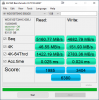
AS SSD Benchmark - 2x Western Digital PC SN730 NVMe SSDs in RAID 0 [64K Data Strip Size]

[IMG]


AS SSD Benchmark - Single Western Digital PC SN730 NVMe SSD

[IMG]


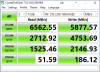
CrystalDiskMark- 2x Western Digital PC SN730 NVMe SSDs in RAID 0 [64K Data Strip Size]

[IMG]


CrystalDiskMark - Single Western Digital PC SN730 NVMe SSD

[IMG]
 
Looks more or less correct. You won't gain much from striping not least because there's limited bandwidth to the chipset anyway and you probably won't hit high queues/threads. In any case, I've included my 2x1TB SN750 RAID-0 results below, although I'm using Windows striping currently (128KB).

AS_SSD_Benchmark_7JyWKiFxwy.pngDiskMark64_U7GCQAgOmm.png

If you would like to learn more about the differences in the flash, I have links to articles here: 64L/BiCS3 vs. 96L/BiCS4
 
Looks more or less correct. You won't gain much from striping not least because there's limited bandwidth to the chipset anyway and you probably won't hit high queues/threads. In any case, I've included my 2x1TB SN750 RAID-0 results below, although I'm using Windows striping currently (128KB).

View attachment 27484View attachment 27485

If you would like to learn more about the differences in the flash, I have links to articles here: 64L/BiCS3 vs. 96L/BiCS4
Amazing numbers!

What I don't get is how come the single drive benchmarks have a much higher 4k-64 write
 
I actually had no such issue, I only tested in stripe (AS SSD reads Windows stripe wrong). Seems like you benefited more at LQD though, might be an implementation difference.
 
Last edited:
Found a Sn730 in my new laptop and care less about performance than power consumption. At first I thought the SN730 would have a similar power profile than the SN750 considering that the SN730 is supposedly an OEM version of the SN750 but thats farthest from the case. I even purchased just now an SK Hynix P31 Gold based on reviews claiming excellent efficiency scores but not sure if worth the effort. Found the PS 0-5 scores for the SN730, SN750, and P31 Gold and here they are in order. What do you think?

5.4w 6 6.3
3.7. 3.5 2.4
2.2. 3 1.9
30mw. 100mw. 50mw
3.5mw. 2.5mw. 4mw
 
Back
Top