Given the risks NV is taking and the problems foundries are having with 14/16nm even Q4 2016 is very, very optimistic for such a card to be available or at that price. 14 nm will be more expensive than 28 nm.
Compared to early 28nm GPUs (680), mid-range Pascal will blow them away, but it's likely going to be a much more modest increase over the high end of Maxwell. And I don't think we'll see the big chip Pascal until 2017 if NV's release strategy plays out the same way.
This is going to be a long post of mine but you guys should read it because it seems both of you are underestimating the types of jumps NV has been making every generation. NV does not need a Big Pascal to beat GM200. During every single generation in the last 15 years, NV's next generation mid-range chip has
beaten the last generation's flagship. Pay particular attention to the generational improvement from Mid-range to next gen Mid-range (560/560Ti ->670/680 and GTX670/680 to GTX970/980).
Look at the last 2 generations:
Fermi to Kepler = New node + new architecture
last gen mid-range $249 GTX560Ti = 49%
last gen flagship $499 GTX580 = 73%
Next gen mid-range $399 GTX670 =88%
Next gen upper mid-range
$499 GTX680 = 94%
GTX670 alone was faster than a 580 and it beat 560Ti by 65%, but 670 is really a successor to the GTX560, not 560Ti!
GTX680 is really the true successor to the 560Ti and it ended up
92% faster than a GTX560Ti. This actually makes sense as the GTX580 successor, GTX780Ti, was 2X faster. So moving from Fermi to Maxwell was a 90-100% increase in performance. 680 had no trouble at all outperforming the 580 and did so using less power and having more advanced features.
Kepler to Maxwell = new architecture, same node
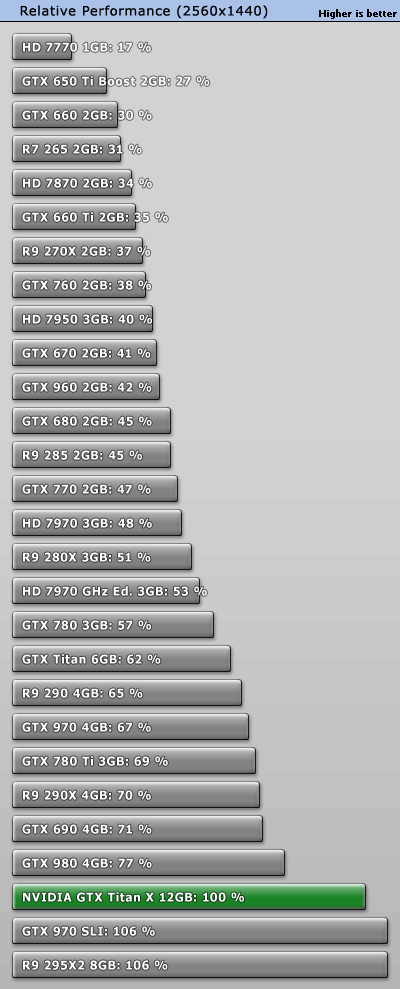
I am going to use 1440P resolution instead of 4K as that would penalize 670/680 cards too much due to lack of VRAM.
last gen mid-range $399 GTX670 = 39%
last gen upper mid-range $499 GTX680 = 43%
last gen flagship $699 GTX780Ti = 69%
new gen mid-range $329 GTX970 = 65%
new gen upper mid-range $549
GTX980 = 76%
GTX970 was 67% faster than a GTX670
GTX980 was
77% faster than a GTX680
Once again GTX980 had no trouble outperforming the 780Ti, last gen's flagship, while using way less power and having more features.
Now we are at Pascal =
14nm/16nm node + HBM2 (600GB/sec-1TB/sec+ memory bandwidth) + new architecture. This generation should be a lot closer to the jump we've seen from Fermi to Kepler rather than Kepler to Maxwell because NV is going to increase memory bandwidth 2.5-3X and jump to a new node! Essentially we should be looking at one of the major inflection points in GPU performance because memory bandwidth bottleneck will be lifted for many products.
GTX970's successor should be at least 60% faster, same for GTX980's successor. I am being conservative as I expect the gap to be 75-100% in 8-9 months post Pascal launch because NV will probably shift driver focus to Pascal.
😀
Where does that get us for GM204 successors?
GTX970 x 1.6 = 65% x 1.6 = 104% (already faster than the Titan X)
GTX980 x 1.6 =76% x 1.6 = 122% (easily faster than the Titan X)
Unless NV intentionally splits the generation into 3 parts and neuters the first wave of 14nm/16nm parts, I fully expect GTX970 successor to tie the Titan X or even beat it and 980's successor to easily beat the Titan X/Fiji XT.
Therefore, I do not understand why people are downplaying the 14nm/16nm HBM2 generation and discussing how the Big Pascal won't even show up until 2017. Next gen mid-range Pascal cards should follow the footsteps of GTX670/680 and 970/980 in matching or beating last gen flagship cards, while using less power and having more features, and I expect 8GB HBM2 for them too. These next gen mid-range cards should come in at $400-600. A lot of gamers now see that NV is doing its own Tick-Tock strategy where they release next gen mid-range as "flagships" and then follow up with the real large die flagship cards. I don't see NV releasing a 980 successor at $699 unless it soundly beats the Titan X by 30-40%.
That's why I maintain that this generation is a stop-gap one and anyone who intends to future-proof themselves with Fiji XT or GM200 6GB for 4K gaming is just going against the historical trends of GPU development over the last 15 years, if not more.