[WCCF] AMD Radeon R9 390X Pictured

Page 19 - Seeking answers? Join the AnandTech community: where nearly half-a-million members share solutions and discuss the latest tech.
Status
Not open for further replies.

Alatar

Member
Aug 3, 2013
167
1
81
oh my other predictions are R9 380 and R9 390 series sport HBM. R9 380 will match GTX 980 or be slightly faster(5%) at around 170-180W. R9 380X will be 15-20% faster than GTX 980 at 200-210W TDP. R9 390 at 250W TDP and perf on par with Titan-X and R9 390X at 270W TDP and perf roughly 10% faster than Titan-X. :cool:

Okay so now that we're having fun...

My prediction:

300 series will consist of: Bonaire, Pitcairn, Tonga, Hawaii and Fiji.

Fiji will see 3-2 versions, WCE 390X, 390X and possibly a 390, the 390Xs offering both 4GB and 8GB options. Power consumption will be on par with Hawaii/GK110/GM200. Performance slower than Titan X at 1080-1440 and slightly faster at 4K.

Hawaii will be slightly overclocked and offered in 8GB versions to better position it against the GM204 cards. No reference cards at all.

Tonga will remain pretty much the same as the R9 285 with 2GB and 4GB versions, and we might see a full tonga

Bonaire and pitcairn will remain the same.

Not sure about the naming of the product stack nor the pricing.

I'm looking forward to finding out which prediction is actually closer to reality.
:hmm:
 

raghu78

Diamond Member
Aug 23, 2012
4,093
1,476
136
Okay so now that we're having fun...

My prediction:

300 series will consist of: Bonaire, Pitcairn, Tonga, Hawaii and Fiji.

Not sure about the naming of the product stack nor the pricing.

I'm looking forward to finding out which prediction is actually closer to reality.
:hmm:

k. So you believe AMD will use a GPU (Pitcairn) which it first launched in March 2012 with no changes and deny the gamer a host of architectural improvements which have happened upto date with future GCN iterations after the first one. We will see who is right. :whiste:
 

Kenmitch

Diamond Member
Oct 10, 1999
8,505
2,250
136
My prediction:

The reviews will be jaw dropping once released. Many will be butt hurt.

Pretty vague but most likely true either way :)

GCN is the Christie Brinkley of the GPU world.

I'm bored with my 970 so looking forward to a reasonably priced alternative. Recently got a 1080p 144Hz monitor as a warranty replacement. Need more fps!
 

Enigmoid

Platinum Member
Sep 27, 2012
2,907
31
91
Just because you say there are no architectural improvements does not mean thats the truth. Frankly the amounts of obscene bandwidth combined with the improvements to memory bandwidth efficiency using color compression mean R9 390X would be a hugely imbalanced chip if there were no improvements to the core shader perf (per/sp). Think about it. Even assuming R9 390X has only 512 GB/s bandwidth combined with Tonga color compression which brings a 40% improved memory bandwidth efficiency it would have a >50% increase in bandwidth per sp or compute unit.

http://www.anandtech.com/show/8460/amd-radeon-r9-285-review/3

512 /320 x 1.4 = 2.24 times the effective bandwith of R9 290X. So R9 390X has more than twice the effective bandwidth of R9 290X for just 1.45x (4096/2816 = 1.45) the shaders. So effective bandwidth increase per sp is 2.24/1.45 = 1.54x more bandwidth per sp and per compute unit. Thats 50% more bandwidth per sp. What the heck is AMD gonna do with such an increase in bandwidth when we see that Hawaii is not bandwidth bottlenecked. :rolleyes:

Because that is the only way to get 4/8 GB on the system. If they went with half the bandwidth AMD would be limited to 2/4 GB at the most (two stacks). Furthermore, with that much bandwidth Fiji would be a beast in some compute applications on the professional side (which colour compression does nothing for).
 

flopper

Senior member
Dec 16, 2005
739
19
76
so HBM allows smaller pcb and more bandwidth with powersavings.
so how would amd then add changes to the GCN arc knowing thats going to happen?
 

JDG1980

Golden Member
Jul 18, 2013
1,663
570
136
Okay so now that we're having fun...

My prediction:

300 series will consist of: Bonaire, Pitcairn, Tonga, Hawaii and Fiji.

Fiji will see 3-2 versions, WCE 390X, 390X and possibly a 390, the 390Xs offering both 4GB and 8GB options. Power consumption will be on par with Hawaii/GK110/GM200. Performance slower than Titan X at 1080-1440 and slightly faster at 4K.

Hawaii will be slightly overclocked and offered in 8GB versions to better position it against the GM204 cards. No reference cards at all.

Tonga will remain pretty much the same as the R9 285 with 2GB and 4GB versions, and we might see a full tonga

Bonaire and pitcairn will remain the same.

Not sure about the naming of the product stack nor the pricing.

I'm looking forward to finding out which prediction is actually closer to reality.
:hmm:

That would be an absolutely terrible lineup. Why would AMD even bother releasing it? They'd be better off doing just the Fiji cards in the R9 300 series (plus the OEM junk that's already been announced) and leaving everything else branded as-is. Trying to sell Pitcairn as a "new" GPU in 2015 would open them up to ridicule by every review site.

As for Fiji, let's do some math. The R9 290X offers 69%-70% the performance of the Titan X. 100 / 70 ~= 1.43, so AMD needs about a 43% performance increase to match the Titan X. Graphics cards scale pretty well because of their massively parallel nature, so if Fiji really has 4096 shaders as the rumors indicate, then that alone would make up most of the discrepancy. 4096 / 2816 ~= 1.45 - there's the 45% increase right there. The TPU charts do not indicate if the 290X being compared to Titan X (presumably a reference card) used Quiet or Uber mode; if the former (which was the default setting), then there's about a 4%-6% boost just by getting the clocks to a consistent 1000 MHz. If switching to GloFo 28nm SHP and implementing watercooling could get clocks up to 1100-1150 MHz, then that's another boost - probably not perfect scaling, but should be at least 5%. Then we need to consider that Hawaii was GCN 1.1, while Fiji will be at least GCN 1.2 - and there may have been more improvements since Tonga. Despite its RAM deficit, the R9 285 is about 15% more powerful than the 7950, which has the same number of shaders. Some of those improvements were already incorporated in Hawaii's GCN 1.1, but others were not. So figure 7% or so improvement just from architectural changes over R9 290X.

Beating Titan X by 10% or more doesn't seem too unreasonable for Fiji.
 

RussianSensation

Elite Member
Sep 5, 2003
19,458
765
126
I see this across the stack as a behaviour. The R9 3xx perf/watt will be way up. oh my other predictions are R9 380 and R9 390 series sport HBM. R9 380 will match GTX 980 or be slightly faster(5%) at around 170-180W. R9 380X will be 15-20% faster than GTX 980 at 200-210W TDP. R9 390 at 250W TDP and perf on par with Titan-X and R9 390X at 270W TDP and perf roughly 10% faster than Titan-X. :cool:

There is a problem with your theory.

In what generation did AMD's next gen mid-range outperformed the previous flagship by 30%+? That's exactly what you are predicting with your 380X is 15-20% faster than a 980 theory.

High end vs. next gen mid-range
4870 vs. 5770
5870 vs. 6870
6970 vs 7870
HD7970Ghz vs. R9 280X

In none of those cases did AMD's next gen mid-range card outperformed the flagship by 30%. That means it's more reasonable imo to expect 380X to tie a 980 or at maybe beat it by 5%. I wouldn't even be surprised of 380X is slower than a 980 by 5% but is priced at $349 or maybe AMD will aim at $399 price level and beat 980 by 5%. I don't see 380X beating 980 by 15-20%. However, another possibility is the 380X has no HBM and is an enhanced Hawaii XT 290X. In that case, perhaps AMD might aim at a lower price of $299-339 but the card will be slower than a 980.

For R9 390 non-X, you expect it to be as fast as the Titan, but I don't either. I expect 390 non-X to beat the 980 by about 20% and cost $449-499. At that point the 390 nonX will deliver about 90-91% of the Titan X's performance which still makes is a great deal relative to the 980 or the Titan X.

For R9 390X, I think AMD might beat the Titan X by 5% (1440P) to 10% (4K), but not much more. However, I'd rather be conservative and say that 390X at $599-649 tying the Titan X would be a massive win in my books:

1) That would make it way faster than the 980 (basically 33-35% faster)
2) That would make the Titan X horribly overpriced, even more so than it is today.
3) It would require a GM200 6GB from NV and price drops on the 980.

That means all AMD needs to do really is tie the Titan X for $599-649 and it's mission accomplished. Then AMD can combat GM200 6GB with game bundles and I also think NV will go for the $699 price level as a replacement for the 780Ti. That could ensure that R9 390X undercuts the GM200 6GB even if it's slightly slower. If NV's GM200 is a cut-down version though, then I expect NV to respond with a fully unlocked and higher clocked GM200 6GB in the fall. Either way, I think NV will have the performance crown this generation at any cost. Given that Titan X overclocks 20% on a reference cooler, I think NV has the capability to launch a stock clocked 1250-1325mhz (Boost clock) GM200 6GB chip down the line. Just depends how 390X performs and how badly does NV want to retain the performance crown. If 390X is limited to 4GB only, then NV's job is basically done as they can market 6GB for the win anyway.

I personally think 380/380X will not use HBM1. I think they'll just be reworked Hawaii XT chips with better efficiency due to a better 28nm process, maybe some changes to the architecture from Tonga (colour compression, tessellation, new UVD, GCN 1.2), which might possibly reduce their memory controller from 512-bit to 384-bit without sacrificing their performance. I honestly don't see 380X being 15-20% faster than the 980 as it would make it way too fast against the 290X, which contradicts basically every single previous AMD generation as far as the comparison of "next gen mid-range vs. last gen flagship" goes.

The only restriction when cooling on air arises from the heat sink size requirement, and the only reason one would want that heat sink to be just as small as the new smaller PCB would be to use it in small cases. Otherwise, one can just as easily create a bigger heat sink (relative to PCB).

That would defeat the purpose of making a miniITX/smaller PCB card. I think his main point was in that context. If AMD/NV go the path of making smaller cards, then air cooling become not only an inferior solution but a very difficult one to even work. That's why were were hearing rumours back then that R9 390X will have the longer (290X/TitanX style) PCB for the air cooled versions while the smaller version will be WCE. It remains to be seen if that will be the case.

My prediction:

The reviews will be jaw dropping once released. Many will be butt hurt.

Pretty vague but most likely true either way :)

Epic prediction! Pretty much spot on! ;)
 
Last edited:

lyssword

Diamond Member
Dec 15, 2005
5,630
25
91
if this was amd's cpu division, I'd be pessimistic (phenom any1?). But I'm more optimistic about their gpu division.
 

jpiniero

Lifer
Oct 1, 2010
17,212
7,586
136
However, another possibility is the 380X has no HBM and is an enhanced Hawaii XT 290X.

If anything, the favorite has to be for the 380X to be a rebrand of the 285X considering the 380 is just a rebrand of the 285. Regardless of which one it ends up being, it's quite clear that the only thing that is new is the HBM 390/X.

I imagine AMD isn't selling any 295X2, so I don't think there will be a replacement, and it may simply just go away if they can manage to sell out the remaining stock.
 

Cloudfire777

Golden Member
Mar 24, 2013
1,787
95
91
It will all come down to:
1. What performance boost will HBM see over GDDR5 and is it detectable on all resolutions
2. What exactly is new with Fiji architectural wise over GCN1.0 and 1.2
 

krumme

Diamond Member
Oct 9, 2009
5,956
1,596
136
It will all come down to:
1. What performance boost will HBM see over GDDR5 and is it detectable on all resolutions
2. What exactly is new with Fiji architectural wise over GCN1.0 and 1.2

No it all comes down to gaming experience at 4k 60hz / 1440 144hz.
I dont care if they use ddr3 on 64 bit mem interface to get there but the perf needs to be at top if not best.
 

parvadomus

Senior member
Dec 11, 2012
685
14
81
IMO, Hawaii wont be in the 300s series. This is why:
1-This is the main reason AMD has not launched anything cause its trying to sell the remaining Hawaii chips.
2-They need a more efficient chip to replace M295X, I think a 2560-3072 core HBM based chip will replace Hawaii, maybe just a Hawaii with HBM + Tonga features.
 
Feb 19, 2009
10,457
10
76
IMO, Hawaii wont be in the 300s series. This is why:
1-This is the main reason AMD has not launched anything cause its trying to sell the remaining Hawaii chips.
2-They need a more efficient chip to replace M295X, I think a 2560-3072 core HBM based chip will replace Hawaii, maybe just a Hawaii with HBM + Tonga features.

Yup, its plain obvious due to the firesales and bundles to clear inventory. "Hey, we're selling these chips dirt cheap to clear stocks... just so we can relaunch them again with a new name!" Sounds idiotic tactic much?

If the chip is redesigned and made at GloFo, it isn't actually a rebadge.
 

RussianSensation

Elite Member
Sep 5, 2003
19,458
765
126
If anything, the favorite has to be for the 380X to be a rebrand of the 285X considering the 380 is just a rebrand of the 285. Regardless of which one it ends up being, it's quite clear that the only thing that is new is the HBM 390/X.

1. 380 is an OEM card, which tells me little about the retail 380 series. Many times retail and OEM cards don't even match on the NV/AMD side.

2. I've seen several people state that 380X is likely a 285X (i.e., 2048 SP, 32 ROP, 128 TMU Tonga) but I don't see how that card would be even remotely competitive with after-market R9 290/290X cards. I mean I am not a GPU engineer but I don't know how it can possibly overcome the shader and texture disadvantage (we know Tonga has superior pixel-fill rate and geometry performance but it's still limited by shaders and textures).

3. I agree with other posters that given the massive fire sales on Hawaii, it seems the exact chip is out of the new stack. It's possible 380/380X are enhanced Hawaii (lower power usage, GCN 1.2, new UVD, Tonga architectural advancements. We might even see same 2560/2816 shaders but the chip won't be Hawaii XT).


================

Many gamers here might not like to hear it, but I think no card in AMD's new lineup will offer the same price/performance of an after-market R9 290 such as MSI Gaming or Sapphire Tri-X at $240-250. Over time, sure, but at launch, I doubt it.

I've kept repeating for the last 12 months that an after-market R9 290 = reference 290X:

July 24, 2014 - Because reference 290X thermal throttled, all it took is an after-market cooled, 1.03Ghz 290 to match it. Piece of cake.
perfrel_2560.gif


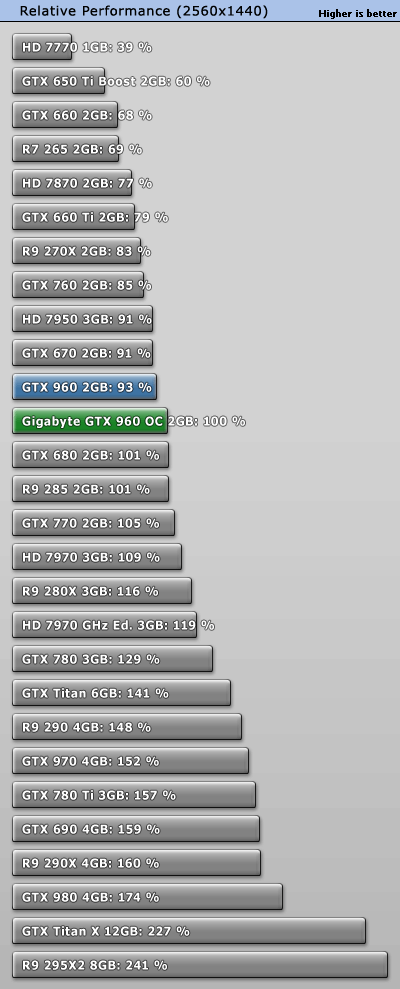
Newer drivers and latest games, reference R9 290X (or after-market 290 equivalent) offers 92% of the performance of a 980 at 1440P!

April 28, 2015
perfrel_2560.gif


Do you guys actually think AMD will launch a new card for $249 that offers 92% of the reference 980's performance and has 4GB of GDDR5? I don't. An after-market 290 $240 was a smoking deal for the $180-300 price segment. Only now the 970 looks so attractive after NV added 2 solid games.

When HD7950B, 7970Ghz came out, they offered worse price/performance than at that time remaining inventory of discounted HD7950/7970/7970 1Ghz (some 7970 cards weren't quiet 7970Ghz branded but had 1Ghz GPU clocks). Similarly when 6850/6870 came out, they offered worse price/performance to 5850 or 5870. The same with HD5770 vs. 4870/4890.

Since AMD's 280X/290/290X cards had such tarnished image from launch date, AMD couldn't wait to get rid of them and that's why we saw such insane discounts. Once AMD replaces 290/290X, I think their replacements will cost $299 (380) and $349-399 (380X). I could be wrong but I think anyone who bought an R9 290 for $240-250 in the last 6 months still got a great deal. Then again a very good 970 can often be found for $290-300, and that solid game bundle runs until July 31st. That means AMD will need something around the performance of a 290X for $299. Hmmm...very difficult to guess here just how fast 380/380X will be and what their price will be. If the rumours that 370X ~ 780 are true, 380/380X just might beat 970/980, respectively. Raghu78 thinks that's how it will play out.

Where this launch will be the most interesting is R9 390/390X. I am personally not that excited about 380/380X as I don't care much about power usage. If R9 390/390X are 40-60% faster than a 290X though, and are priced AMD style, I'll be impressed.
 
Last edited:

xLegenday

Member
Nov 2, 2014
75
0
11
Besides not going to be called 390 or 390x If, FIji is not as good as Titan as apparently still not - Im expecting AMD to do pricing around 799 mark for the XT and 599 for the smaller Fiji which should come on top of 980. :colbert:
 

RussianSensation

Elite Member
Sep 5, 2003
19,458
765
126
Besides not going to be called 390 or 390x If, FIji is not as good as Titan as apparently still not - Im expecting AMD to do pricing around 799 mark for the XT and 599 for the smaller Fiji which should come on top of 980. :colbert:

Fiji at $799 is way too high if it can't beat the Titan X because then NV could replace 780Ti with a GM200 6GB at $699 and AMD's Fiji XT is poor value. AMD already can't get sales when it offers superior price/performance so how do you think a Fiji XT will sell if it costs more than a GM200 6GB card?

Also, logically I can't understand how a 4096 shader/ 256 TMU / 1-1.05Ghz Fiji XT can't tie or even beat the Titan X. It could happen if those specs are 100% false. Otherwise, GCN scales more or less linearly.
 

3DVagabond

Lifer
Aug 10, 2009
11,951
204
106
No it all comes down to gaming experience at 4k 60hz / 1440 144hz.
I dont care if they use ddr3 on 64 bit mem interface to get there but the perf needs to be at top if not best.

How are they to accomplish this feat? That's what was being discussed.
 

swilli89

Golden Member
Mar 23, 2010
1,558
1,181
136
There is a problem with your theory.

In what generation did AMD's next gen mid-range outperformed the previous flagship by 30%+? That's exactly what you are predicting with your 380X is 15-20% faster than a 980 theory.

High end vs. next gen mid-range
4870 vs. 5770
5870 vs. 6870
6970 vs 7870
HD7970Ghz vs. R9 280X

In none of those cases did AMD's next gen mid-range card outperformed the flagship by 30%. That means it's more reasonable imo to expect 380X to tie a 980 or at maybe beat it by 5%. I wouldn't even be surprised of 380X is slower than a 980 by 5% but is priced at $349 or maybe AMD will aim at $399 price level and beat 980 by 5%. I don't see 380X beating 980 by 15-20%. However, another possibility is the 380X has no HBM and is an enhanced Hawaii XT 290X. In that case, perhaps AMD might aim at a lower price of $299-339 but the card will be slower than a 980.

For R9 390 non-X, you expect it to be as fast as the Titan, but I don't either. I expect 390 non-X to beat the 980 by about 20% and cost $449-499. At that point the 390 nonX will deliver about 90-91% of the Titan X's performance which still makes is a great deal relative to the 980 or the Titan X.

For R9 390X, I think AMD might beat the Titan X by 5% (1440P) to 10% (4K), but not much more. However, I'd rather be conservative and say that 390X at $599-649 tying the Titan X would be a massive win in my books:

1) That would make it way faster than the 980 (basically 33-35% faster)
2) That would make the Titan X horribly overpriced, even more so than it is today.
3) It would require a GM200 6GB from NV and price drops on the 980.

That means all AMD needs to do really is tie the Titan X for $599-649 and it's mission accomplished. Then AMD can combat GM200 6GB with game bundles and I also think NV will go for the $699 price level as a replacement for the 780Ti. That could ensure that R9 390X undercuts the GM200 6GB even if it's slightly slower. If NV's GM200 is a cut-down version though, then I expect NV to respond with a fully unlocked and higher clocked GM200 6GB in the fall. Either way, I think NV will have the performance crown this generation at any cost. Given that Titan X overclocks 20% on a reference cooler, I think NV has the capability to launch a stock clocked 1250-1325mhz (Boost clock) GM200 6GB chip down the line. Just depends how 390X performs and how badly does NV want to retain the performance crown. If 390X is limited to 4GB only, then NV's job is basically done as they can market 6GB for the win anyway.

I personally think 380/380X will not use HBM1. I think they'll just be reworked Hawaii XT chips with better efficiency due to a better 28nm process, maybe some changes to the architecture from Tonga (colour compression, tessellation, new UVD, GCN 1.2), which might possibly reduce their memory controller from 512-bit to 384-bit without sacrificing their performance. I honestly don't see 380X being 15-20% faster than the 980 as it would make it way too fast against the 290X, which contradicts basically every single previous AMD generation as far as the comparison of "next gen mid-range vs. last gen flagship" goes.


That would defeat the purpose of making a miniITX/smaller PCB card. I think his main point was in that context. If AMD/NV go the path of making smaller cards, then air cooling become not only an inferior solution but a very difficult one to even work. That's why were were hearing rumours back then that R9 390X will have the longer (290X/TitanX style) PCB for the air cooled versions while the smaller version will be WCE. It remains to be seen if that will be the case.


Epic prediction! Pretty much spot on! ;)

Actually yeah 7870 is about 30% faster than 6970...

http://www.anandtech.com/bench/product/1061?vs=1034

So this has happened before.
 
Feb 19, 2009
10,457
10
76
Fiji at $799 is way too high if it can't beat the Titan X because then NV could replace 780Ti with a GM200 6GB at $699 and AMD's Fiji XT is poor value. AMD already can't get sales when it offers superior price/performance so how do you think a Fiji XT will sell if it costs more than a GM200 6GB card?

Indeed, the competition is not Titan X, that 12gb VRAM allows it to sell at a premium to a small segment of enthusiasts who want it for that exact purpose. NV has clearly decided vram is going to matter in marketing.

AMD's lineup has to be competitive against a cut down 6GB GM200 at the top, with after market coolers, giving it 1.4ghz boost out of the box. Even cut down, that in theory would be Titan X performance out of box. For $699.

Rumor on the WCE is still solid on $799 8GB HBM. If its 15% faster than Titan X, it will sell just fine, clearly because its the fastest on that merit alone it justifies the price. But it has to be clearly faster, if its too close in performance, it has to be priced for much less. That's the way the cookie crumbles as they say.

If Hawaii is rebooted on GloFo 28nm, we could see either higher clocks or 30% reduction in power or a mix, say 1.1ghz clocks, 15% less power use. It would put it on par to a 980, at ~225W, so it will still lose in the metric most important for that segment, perf/w. Either way Hawaii & Tonga rebadges just cannot be competitive unless sold at bargain bin prices.
 

3DVagabond

Lifer
Aug 10, 2009
11,951
204
106
Fiji at $799 is way too high if it can't beat the Titan X because then NV could replace 780Ti with a GM200 6GB at $699 and AMD's Fiji XT is poor value. AMD already can't get sales when it offers superior price/performance so how do you think a Fiji XT will sell if it costs more than a GM200 6GB card?

Also, logically I can't understand how a 4096 shader/ 256 TMU / 1-1.05Ghz Fiji XT can't tie or even beat the Titan X. It could happen if those specs are 100% false. Otherwise, GCN scales more or less linearly.

For whatever reason, people don't want to buy old stuff. Look at when nVidia released the 770 and AMD the 7970GHz. The 770 was perceived as next gen because it replaced the 680 while the 7970GHz was just seen as an O/C'd 7970. Since most people were convinced that the 680 was a better card than the 7970, why would you buy an O/C'd 7970 when you can have the next gen 770. So, you are right that simply rebranding Hawaii would be terrible.

So, if they do anything to update Hawaii, so they can claim it new generation, they will be able to sell it for more than the 290/X. The one thing it must do though, is be more efficient. Improved process and add some of AMD's new power gating functionality they are working on for their APU's. Maybe shrink the bus size and incorporate the advanced color compression. If they can just get an additional 10% performance and possibly ~20% improvement in efficiency on top, I think they can sell that at $399 and $299.
 

RussianSensation

Elite Member
Sep 5, 2003
19,458
765
126
For whatever reason, people don't want to buy old stuff. Look at when nVidia released the 770 and AMD the 7970GHz.

Not just NV vs. AMD examples. Awesome after-market GTX480 were sitting on Newegg at $299 when the inferior 570 was $349 and the 580 was $499.

Smart money bought the 480s. Today 580 is just 8% faster than a 6970 (see link below) which means 580 was a waste of $ over the 480 all along, other than e-peen and sense of pride that you had the latest and greatest. From a logical perspective, $300 after-market 480 was da bomb. You just needed to know which "old and worthless/unwanted" GTX480 to buy. ;)

amp_temps.png


It's good though in a way because those who want the latest tech pay the early adopter tax/premiums which are used to fuel profits and thus R&D for tech firms, while those who want to save $ pick up the inventory of "old and unwanted" products that help the tech firm minimize its warehouse/storage and inventory turnover costs. Personally, I am a big fan of buying old gen cards at a big discount but recognize that at certain times buying new cards is better (like when $400 R9 290 launched or $330 970 launched). It just depends on where the market is. I think with AMD's finances, I just don't see how they will be able to beat an after-market R9 290 at $240 at launch. Perhaps in 6 months around Xmas when they might add game bundles and rebates.

But present day is more important? Performance changes over time in some generations

You are right. Older generations do get penalized in 3-4 years from launch though for 2 reasons:

1) Eventually next gen games fully expose the bottleneck in their architectures.
2) AMD/NV's drivers stop focusing on them.

For that reason R9 270X (HD7870) mops the floor with HD6970/580 but at launch it was barely faster. Today R9 270X is 41% faster than a 6970 and 30% faster than the GTX580. Pretty crazy.

http://www.computerbase.de/2015-05/...ergleich/2/#abschnitt_leistungsratings_spiele

R9 290/290X has a weak tessellation productivity and pixel-fill-rate efficiency. In theory if games become more tessellation heavy, it's quite possible that 380X could outperform them by 25-30% if tessellation/pixel fill-rate become the primary big bottlenecks for those Hawaii XT cards. However, I don't think a 285X with only 2048 shaders and 128 TMUs can do it. Maybe if 380X is a 2816 shader, 48-64 ROP Tonga, then I would believe it.

72520.png

67232.png

67234.png


At launch though, I just don't see how 380X would beat 290X by 20-30% because that would beat the 980 easily. Considering 380X is probably a $349-399 card, this sound WAY too good to be true. I mean think about it, if $349-399 R9 380X is 15-20% faster than the 980 per Raghu78, what the heck is 980 worth, $299-329 overnight?
 
Status
Not open for further replies.