right_to_know
Member
- Nov 19, 2015
- 81
- 15
- 71




Considering that photons take 8 minutes to reach Earth from the (surface of) the Sun, 21.6 hours one-way to reach Voyager 1 puts it in a "waayyyyy out there" perspective, heh.Just for funsies. It takes 43.24 hours for round trip communications.

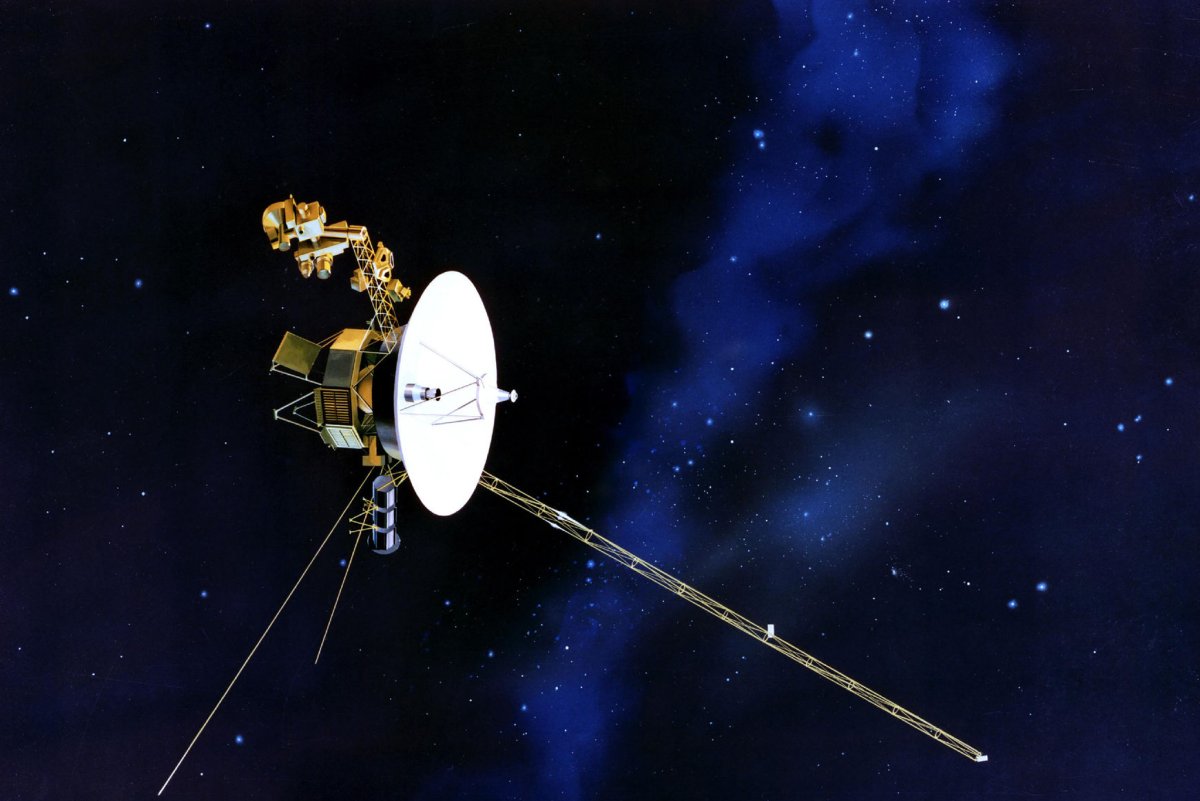
45yrs later, how is the Vger probe still operating?May 19 (UPI) -- NASA engineers are investigating a mystery with telemetry data from the aging Voyager 1 probe.
The Voyager 1 probe, currently 14.5 billion miles from Earth, is receiving and executing commands from NASA team on Earth and sending back science data, according to a NASA statement.
...................
Voyager 1's signal hasn't weakened, which suggests its antenna remains properly aligned, but the telemetry data it's returning appears random or impossible, engineers said.
...................
The engineering team plans to continue monitoring the signal to determine whether the invalid telemetry data is coming directly from AACS or another system involved in producing and sending such data.
NASA engineers investigate Voyager 1 spacecraft data mystery - UPI.com
NASA engineers are investigating a mystery with telemetry data from the 45-year-old Voyager 1 probe, which is 14.5 billion miles from Earth, though they say the spacecraft continues to receive and execute commands.www.upi.com
Cue Ilia?


RTGs. Radio isotope thermal electric generator. A large chunk of highly radioactive plutonium gives off a bunch of heat that gets converted to electricity.45yrs later, how is the Vger probe still operating?
i dont see solar panels.
View attachment 63355
WTF Energizer batteries?
i'm assuming solar panels are better? (ie: james webb telescope)RTGs. Radio isotope thermal electric generator. A large chunk of highly radioactive plutonium gives off a bunch of heat that gets converted to electricity.
Voyager 1 has reached the edge of our simulated universe.
i'm assuming solar panels are better? (ie: james webb telescope)
Short answer? It depends.i'm assuming solar panels are better? (ie: james webb telescope)



Simulated? If this is a simulation then what is the simulation running in? At some point you have to have a real universe for the base simulation to be running in. If it’s simulations all the way down might as well be turtles.Oh, its simulated all right, I pretty much proved that years ago on here. But Voyager is many, many billions of light years away from getting to the "edge" - and there is not really an edge anyways since in the simulation it all circles back on itself. Thing about walking along the surface of the Earth - you would never get to the "edge" (unless you believe crack-pot flat earthers...).
Simulated? If this is a simulation then what is the simulation running in? At some point you have to have a real universe for the base simulation to be running in. If it’s simulations all the way down might as well be turtles.

Thermionic devices do create a current w/o moving parts, but there's a bit more to it. First, you need a substance that doesn't have strongly bound valence electrons. Most elements have several electron layers or orbitals. The more you heat the media, it becomes progressively easier to spirit the outer orbital's electrons away. All you need to do then is give them someplace to go.Short answer? It depends.
Long Answer:
If the mission is between the sun and Mars generally solar panels can meet mission requirements. They tend to be fairly lightweight for the power they provide
First thing to understand is how solar power drops with the distance from the sun. Sp below is the power in Watts/meter squared available from the sun at the orbital distance from the sun at each of the planets
View attachment 63373
you can see that the power available drops from over 9000 W/m^2 at Mercury to only 580W/m^2 at Mars. Save is the average amount of power received at the surface of the planet in W/m^2. (It’s 1/4 of Sp due to geometry and doesn’t take into account an atmospheric effects. In general power at the poles is basically 0 while it’s almost equal to Sp on the equator at noon. Of course the night side is 0 too).
Once past Jupiter solar energy is so low there’s no way launch enough solar panels to power a mission.
For a solar array based power system there are some complexities. Almost all missions in orbit around or landed on a body will have night passes which means adding batteries which adds complexity and weight. If the spacecraft needs X watts to run then you need to size your batteries to provide more than X for the longest night pass it might see.
The arrays have to be sized to produce 2-3 X so they can run the systems and recharge the batteries while the sun is out. Sometimes that means adding gimbals to track the sun or keeping the vehicle pointed so the arrays are pointed at the sun. Both add complexity or constraints to operations.
RTGs on the other hand will provide power consistently anywhere for decades. They also provide a lot of waste heat which can be used to reduce the need for heaters.
They do decrease power output overtime by about .8%/year. But as Voyager has shown you can run a mission for over 40 years by turning non essential science equipment off.
Their major issues are the PU238 used to provide power is almost gone. It was a an unwanted byproduct of Cold War nuclear warhead production which no one is doing anymore. We’ve used our stockpile and we bought up the Russian stockpile back in the 90’s.
NASA is supposed to be working with the DOE to make a scientific reactor to produce a few KGs of it a year for deep space missions.
RTGs are not very efficient as their thermocouples only convert a few % of the heat to electricity. Which makes them kind of heavy for the power they produce. They are surprisingly safe. The radiation PU238 gives off is easily shielded alpha particles and they have no moving parts. It’s effectively a big hunk of metal that gives off electricity and heat.
I remember a story of the USAF launching one in a satellite in 60’s when the rocket blew up. They fished the RTG out of the ocean and put it on the next satellite as it was basically fine.
We’ve done solar array based missions out to Jupiter (JUNO) with the newest most efficient space rated arrays. At Earth they produced 14,000Watts. At Jupiter 485Watts.
We’ve also done RTG missions for the last two rovers (Curiosity and Perseverance) on Mars due to long Martian winter nights and the issues with dust on solar arrays.
So to sum up, it really depends on the mission which power source is right.
I have absolutely, positively no idea what the simulation is running in. But you could ask the same question as to someone who says "oh, the universe just IS". Well, its doing stuff, so what is it doing stuff IN? If its in something now what was here before universe was here? It gets you nowhere, no answers. In a simulated universe, it makes absolute sense that YOU WOULD NOT KNOW WHAT THE SIMULATION IS BEING RUN IN BECAUSE OF THE INHERENT NATURE OF THE SIMULATION. Think if you ran a simulation with sentient beings in your question, they would be asking the same question about where they came from, but no answers (unless you programmed in answers for them or left some flaw accidentally that allowed them to understand the world outside their simulation).
Nor does "it might as well just be turtles" have any relevance. No, based on pure logic I think the universe being a simulation is logically about a billion trillion billion trillion times more like than the answer being "turtles".
We should be searching for some kind of flaw in the simulation (mentioned above) that might allow us to gain insight into the real nature of the universe and more importantly what is outside it. We might never find it, it might not exist, but that should be our focus. Rather than science dorks writing books about the universe can just magically appear out of nothing and there are an infinite numbers of universes and that solves the issue and no need to ask these important questions. Such silliness.
If the question is “Why is there anything at all?” The answer “it’s a simulation” doesn’t actually answer the question anymore than “it’s turtles all the way down”.
There’s also some fundamental limits on how much data is required to store the description of every particle in the universe which makes unlikely but not impossible for our universe to be a simulation.

1. Sure it does. A simulation can explain it, as I've stated above. Turtles don't do shit but eat, shit and replicate, just saying "its turtles all the way down" is just silly nonsense. Don't be coy. Of course it being a simulation does not answer the question "well who and what are the simulators", but as I said already we need to try and find a flaw, opening in the simulation, whatever you want to call it, to get the bigger truth.
2. Are you using some limits to data transfer in the laws the simulators put into effect for our simulated universe to try and describe what lies outside our simulated universe and what its laws might be? LOL, come on man...
A simulation explains our corner of reality it does not explain why the simulators universe exists. In your hypothesis our simulation exist in that universe which means that the simulators universe is ours too.1. Sure it does. A simulation can explain it, as I've stated above. Turtles don't do shit but eat, shit and replicate, just saying "its turtles all the way down" is just silly nonsense. Don't be coy. Of course it being a simulation does not answer the question "well who and what are the simulators", but as I said already we need to try and find a flaw, opening in the simulation, whatever you want to call it, to get the bigger truth.
2. Are you using some limits to data transfer in the laws the simulators put into effect for our simulated universe to try and describe what lies outside our simulated universe and what its laws might be? LOL, come on man...

Our brains do things that regular computers can't. Quantum computing does thing regular computers and brains can't do, and vice versa. Theoretically a civilization that has mastered the creation and application of all three along with maybe other technologies we have not discovered yet can maybe solve the issues you raise. Especially quantum computing from what little I know of it. Maybe everything is lazy loaded only when observed and garbage collected when not.A simulation explains our corner of reality it does not explain why the simulators universe exists. In your hypothesis our simulation exist in that universe which means that the simulators universe is ours too.
Also math is math. Their simulation of our universe has to model the simulated universe we interact with. Their model has to account for the estimated 10^80 particles we see, all the data to describe those particles, and the data to describe the interactions between those particles. Just to store the information about a few 100 electrons would take computer memory with more particles than the universe has. Now we could hypothesize that this isn’t an issue for the Simulators but we very quickly leave “it’s turtles all the way down” to “God Did It” by attributing god like powers to the Simulators.
Universe as Simulation is a hypothesis and if you want to treat it that way it is science. If you are accepting it on faith then it’s not.
It's never aliens until it's aliens.They're out there. Calling. Waiting.
A mysterious object 1 billion light-years away is sending out a 'heartbeat' radio signal from deep space
Business Insider|17 minutes ago
Astronomers detected a pulse of radio waves, called a fast radio burst, in a faraway galaxy. The signal lasted 1,000 times longer than average bursts.

It's never aliens until it's aliens.





 Facebook
 Twitter