
Matt1970
Lifer
At least you acknowledge the economy recovered. :thumbsup:
It has not recovered to the level you seem to think it has and the recovery seems to favor those at the top.

At least you acknowledge the economy recovered. :thumbsup:

It has not recovered to the level you seem to think it has and the recovery seems to favor those at the top.
At least you acknowledge there is a recovery :thumbsup:
I can't think of anyone off the top of my head who think things are getting worse.

We all know who is in charge of the Federal Reserve, but we also all know you will surely give Obama credit just like you have for the "recovery". This shit is not over anyone's head, don't fool yourself. Your hack is also not fooling anyone either.
Herp derp.
Is that all you can come up with?
Edit* Never mind, forgot who I was dealing with.
I'm imitating your posts. They're awful.

Except for the $1.4million houses and the fact the boom won't hold out for 30 years for people to pay them down on their startups salaries/stocks. What could go wrong?In the Bay Area you bet it has recovered quite a bit. Traffic is back to the Dot Com era delays despite the new interchanges that have been built in the past 15 years. The only problem is the rebound is mostly in software and software startups, primarily in the Peninsula and San Francisco. I can still find you a bunch of empty buildings in Silicon Valley that once were all occupied during the Dot Com era.
There's large amounts of gentrification around the Bay Area too. My local mall which I used to frequent has dumped all the crappy food options there. McDonalds is gone, the crappy Chinese food is out, and so is the Mongolian BBQ. Instead we have high end lobster rolls there (they're good!) and much better gourmet burgers. Those in their 20s have no problem blowing money on good food and drinks now. During my 2 years away in grad school, I already felt the recovery, and it was tough keeping up with my friends without a real paycheck.

http://finance.yahoo.com/news/us-economy-grew-fast-5-133648403.html
Seems the US economy is doing much better than the rest of the world. Does this finally start to trickle down to the average person on the street or does it simply kick the FED into raising rates and doing nothing for the average Joe?
More money to spend? Are the US workers finally getting an uptick in wages or is this just another credit spike (which is up from last few years from what I read a few days ago)?
Tell ya what sweet cheeks, why don't you come back when you actually learn to debate any one of the topics at hand as it seems you are only able to come in and insult the people that are debating.

It has not recovered to the level you seem to think it has and the recovery seems to favor those at the top.

Actually that might well be true. Lobbyists must now begin buying Pubbies again - yet with the 2016 electoral map, they dare not stop buying Dems. Presto, liquidity!We all know this improvement is due to the Republicans winning majority in the House and Senate. No other explanation is acceptable.
🙄
You don't understand any of the nuanced debates here, that's a lost cause. But insulting you, now that is something you get. Direct. Simple. Black and white. That's your world, kiddo. Accept it.
How does not owing anybody anything violate basic economics? 😕lol. You're not so far from glenn. While you don't have quite his rage against cities and your perceived enemies, you also view this through a highly ideological lens. I mean you've been advocating for spending cuts and deficit reduction throughout most, perhaps all of the time since the financial crisis. That's seriously at odds with macroeconomics 101.
Why would you advocate for policies that violate basic economics if not for ideological reasons?
How does not owing anybody anything violate basic economics? 😕
i.e. Paying down debt.
It isn't the act of paying down debt itself, it is the act of trying to pay down debt in the middle of a liquidity trap with interest rates stuck at zero.
Analysis of the effects of deficit spending shows that the fiscal multiplier was substantially above 1 for, at a minimum, large amounts of time following the financial crisis. That means when governments cut spending and laid down debt they actually made their debt situation worse because it caused an even larger contraction in GDP.
They were making themselves bankrupt by killing their income faster than they were killing their debt.
The problem is some of those analysts also claimed the sequestration was going to cause us to go into a second recession, or double dip. Other analysts claimed the tax hike on those making over $400K would do the same thing. Analysts are great to quote when they get it right, but often times they don't. Either way, wouldn't it make things easier going into the next financial crisis with maybe an actual surplus or rainy day emergency fund? Or at the very least not having to pay 10% of our tax revenue towards interest payments on the debt?
The problem is some of those analysts also claimed the sequestration was going to cause us to go into a second recession, or double dip. Other analysts claimed the tax hike on those making over $400K would do the same thing. Analysts are great to quote when they get it right, but often times they don't. Either way, wouldn't it make things easier going into the next financial crisis with maybe an actual surplus or rainy day emergency fund? Or at the very least not having to pay 10% of our tax revenue towards interest payments on the debt?
Actually they claimed it would hurt the economy, which it definitely did. Some also said the damage would be enough to send us back into recession, but it turns out the economy was strong enough to weather the damage.
As for your other questions, the whole point of Keynesian economics is to reduce debt burdens when economic times are good, so yes after the economy recovers enough we should start Reducing our debt. (We will be able to eventually use monetary policy to offset the economic impact).
As for your question about tax payments for debt interest, you seem to misunderstand the point. When fiscal multipliers are above one it is saying that paying the debt interest will be EASIER if we went more into debt during the crisis. Regardless of whatever amount we end up paying in interest in the future it would have been worse if we went less into debt.
We had one before you know who took over. Killed it with tax cuts and the financial meltdown.
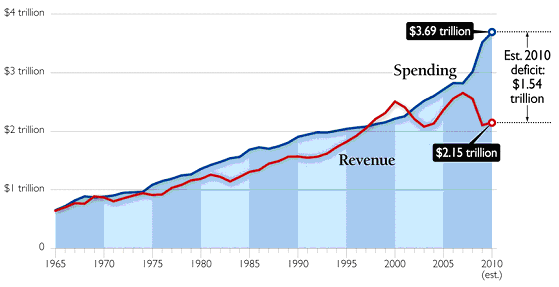
We had one before you know who took over. Killed it with tax cuts and the financial meltdown.
You don't seem to understand that insults are a sign of someone lacking in an ability to debate. Rather than debate the issue, you insult the debater.
Nah, you're not debating; you're shitting all over yourself with partisan diatribe and contradictory hokum.


