Ivy Bridge was never meant to improve performance. It's basically a die-shrink of Sandy Bridge, but because of TIM instead of solder we never saw the benefit you normally associate with a die shrink (lower temps, higher OC). If IB-E uses solder that might finally allow the 22nm process to shrine, allowing for higher overclocks than Sandy Bridge.
Unfortunately while I agree with your sentiments regarding "that which one would normally associate with a die shrink", I disagree with your sentiments of what solder will add to the equation in terms of temperatures and overclocks.
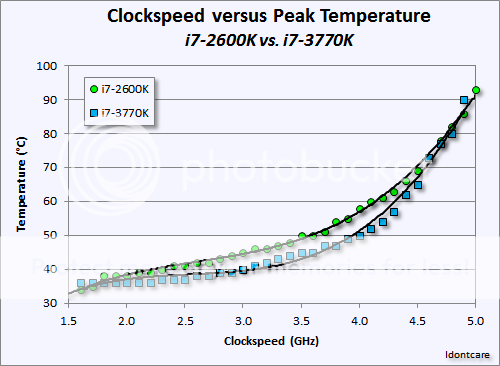
As we have seen countless times with delidded IB's, while the TIM-paste and resultant IHS gap does create poor thermal performance, eliminating that gap and replacing the TIM-paste with the equivalent of solder only merely results in bringing IB's thermal performance and OC potential in-line with that of 32nm SB.
^ Once delidded and TIM replaced with liquid metal, the IB has lower power consumption at any given clockspeed, but no better OC potential than that of a 32nm SB.
^ Once delidded and TIM replaced with liquid metal, the IB has only slightly lower temperatures under load at any given clockspeed relative to that of a 32nm SB.
In general all that delidding does for the IB is get it back to the point where an enthusiast can push it to the same place that they can push a SB, but not any further. (and in fact there appears to be a slight regression in technical capability of the 22nm versus 32nm as we see both IB and HW tend to not reach the same OC clockspeeds that 32nm was capable of achieving, 4.9GHz was the absolute limit for my delidded IB whereas 5GHz was easily in reach for my SB)
And we wouldn't expect a soldered IBE to be any different in that regard when compared to a soldered SBE.
In this case all that we (the end-consumer) really got out of the die shrink was a lower power-consumption profile. Intel got a smaller chip that was cheaper to produce and has better margins.
I personally suspect that Intel is grappling with a situation with their 14nm where the performance curve has actually regressed even further, where hitting 4GHz (at any power-consumption level and operating temperature) is currently unyieldable. But that is just my personal opinion and speculation.







 Facebook
 Twitter