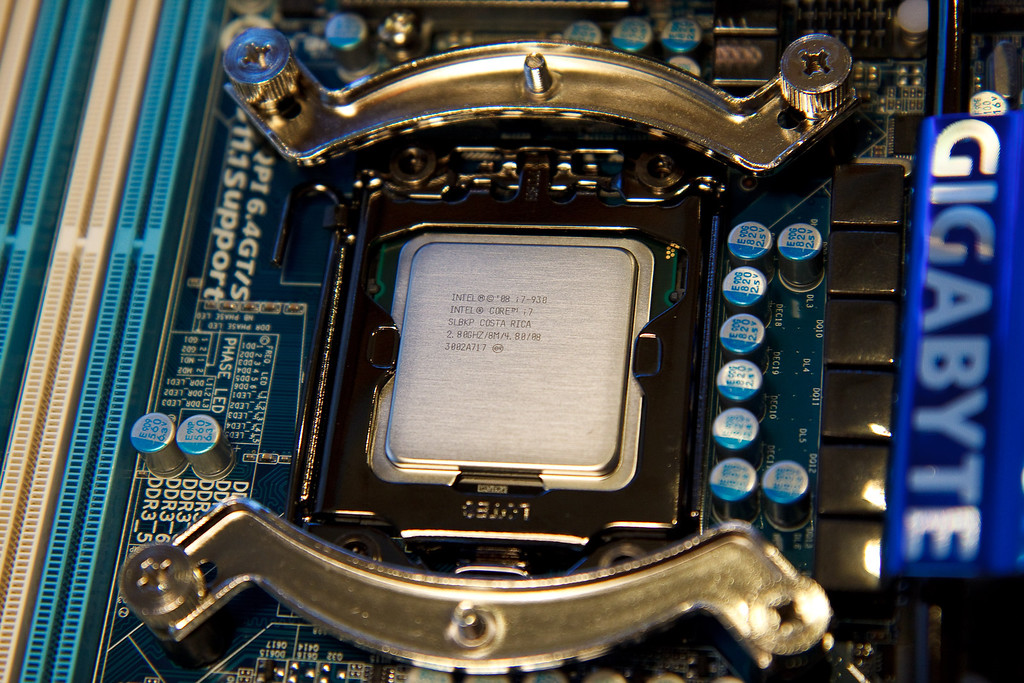
Thermal Compound On Core i7 2600k Heatsink

Page 2 - Seeking answers? Join the AnandTech community: where nearly half-a-million members share solutions and discuss the latest tech.

tweakboy

Diamond Member
Jan 3, 2010
9,517
2
81
www.hammiestudios.com
You thin line from left to right,. So you have a line of it in the middle of the processor

Put straight line in between cpu's Artic tells you this. Shows you example too.
 

BonzaiDuck

Lifer
Jun 30, 2004
16,821
2,143
126
I use IC Diamond almost exclusively for all my builds in the last ~2 years.
It performs very well, is available at a B&M store (Microcenter) and I have yet to notice any unwanted IHS etching on any of my CPUs (Phenom IIs, i7s and a C2D).

ANSWERING SEVERAL: No, Zap, they didn't scare me off. I've been PRIME'ing and IBT'ing my system to develop a table of how two voltage settings behave at different speeds, so I can eliminate the excess voltage with which motherboards always leave us in "Auto" settings.

MadScientist: I can completely understand the phenomenon of "pockets" given how that stuff spreads. Run the credit card or razor-blade across the processor without doing it slowly enough, or make another "pass" to more evenly distribute the paste, and it will tear a circular hole in the film already laid down: a perfect scenario for a "bubble." That's why I layer both surfaces, and assure there are no gaps.

Also, on lapping the direct-touch coolers. I think I got one of those -- maybe it was a Xigmatek. The exposed copper is not plated -- that is . . . it is "exposed copper." Ordinarily then, you wouldn't want to lap it anyway. But what I suggested there: If you were to use a two-part epoxy mixed with diamond to fill the cracks, you'd simply want to sand off any excess to expose the copper again. I doubt very much you'd come close to tearing one of those heatpipes open. Frankly, I think it would just be a better idea to use the ICD compound "as is" to fill the holes -- unless of course you're mixing your own.

Ben90 -- There's the thermal throttling spec, and then there's the "thermal threshold" or whatever lies between that spec and TJunction. Or that's the way I understand it. The Indigo requires an 80C temperature for "re-flow." If I could find a product that would "re-flow" at 60C and get the same effect, I think I'd go that route instead.

And -- there is such a product -- at least if you can believe their (promotional) informational material: Cool Laboratory's Liquid MetalPad. It's "Re-flow" temperature is about 60C. No less than the Indigo Xtreme firm, the makers of CL Liquid MetalPad benched their product against the Indigo and some others, actually showing an edge over the Indigo. Supposedly, removal of "MetalPad" is no different than it is for Indigo.

I'm looking into these "metal" products. I think the CL product uses Gallium. Not sure about the composition of the Indigo.

Also, back to MadScientist's point about the oils and solvents used for the ICD. You can read Citarella's article of January 2007 with the lab tests run against other compounds, or maybe it was something I found at IC's web-site. They expect the stuff to dry out. But from my experience, the non-diamond material never just "goes away." The micronized diamond is the essential factor to its use, and the diamond particles don't deteriorate. That's my best take on it. I have one machine here for which load temperatures under the same stress tests haven't changed since the material was applied four years ago. That's "good enough for me."

The differences reported for CL's product with Indigo are very small -- maybe a centigrade degree or so. The differences over ICD touted by Indigo are bigger, but you also know of my skepticism based on the AS5 versus ICD data. When it boils down to the choice of a thermal paste, I believe I get a bigger differential for lapping the sink and IHS (my answer to another poster who cares about the warranty and the model/spec printed in the nickel-plate).

So I'm at a point now where I'd like to get a gain of 3 to 4C degrees. I can't be sure that would happen with either Indigo or MetalPad. I DO know, however, that I can reap a benefit of at least 10C and maybe 15C with a decent water-cooling setup.

But I'll be ready to "go there" when I see how much I've reduced my Sandy Bridge voltages at the clocks I want to achieve. Frankly, I'm within 60 Mhz of the target 4.6 Ghz with a "prevailing" load VCORE of between 1.25 and 1.26V, with the core temperatures all under 69C at 84F room-ambient.

Of course, the "Package" temperature reported by HW MOnitor shows closer to 71C. I am trying to confirm with the CPUID folks whether "Package" draws its information from the legacy TCASE sensor. That's the sensor used in the Intel thermal throttling specification. And it's higher than the core temperatures for any of several reasons: the sensor reports temperatures higher than they are (and we know these sensors aren't all that accurate), something changed in Intel's design per the relationship between the core sensors, the IHS and TCASE, or -- well -- you can give your speculations, because I need to know more -- even if you're making educated guesses . . .
 
Last edited:

Ben90

Platinum Member
Jun 14, 2009
2,866
3
0
There is no Tcase sensor. HWMonitor is pretty inaccurate for most things, the only reason why people give it credibility is its from the same makers as CPUZ. I wish they would just not report information that it has no idea about instead of just making up numbers.

My i7-920 ran at 95*C overvolted and overclocked for roughly 2 months strait. 80*C won't do anything to a processor.
 

MadScientist

Platinum Member
Jul 15, 2001
2,186
63
91
Hello GCC, and welcome to AnandTech Forums.

The stock compound is not comparable to AS5, but is completely suitable for your purposes. How do you think the rest of the world (you know, the NON-overclockers) do things? Don't bother using AS5 until you get the aftermarket cooler and start overclocking.

Agree.

This thread is getting derailed.
 

ICD7

Member
Feb 29, 2008
147
1
71
Ok, even if there are particulates in IC Diamond, my experiences with the scratches or what I believe to be etching is really requires movement.

http://forums.anandtech.com/showpost.php?p=29822157&postcount=37

Is what I ran into after maybe 2 applications. This was within the FIRST WEEK of my i7. I returned it and RMAed it at Microcenter

Now I didn't think much of it later and ignored it, but after 1 year of use I disassembled my Noctua D14 to find this:

IMG0722-XL.jpg


The serial is completely gone.

Here's the before:

IMG0023-XL.jpg


Also while lighting can make the serial hard to read, I know for a fact the i7's serial is severely etched off. Also, I was building an i5 AND i3 system simultaneously this May when I disassembled my year old i7 to examine the etching.

207368_10100398709624523_1206394_57944661_5113041_n.jpg


That was my i3 or something and compared to it my i7 serial was impossible to read.

Now I understand that these compounds CAN have abrasives, but as someone who is working in the metallography lab to polish and grind to get nanometer smoothness for graphene growth, I tend to think it's not that easy for a HS to cause that kind of damage. You really have to put a lot of lateral forces on your CPU with your HSF and CONTINUE to rub back and forth to get any type of grinding effect. I was grinding copper plates on 200, 400, 600, 800, 1200 grit paper and that was more than a workout. Then going down to micron level stuff, you go to to the spinning polishing pads with alumina powder. Working with nanometer level, I'm using a vibratory polisher where the sample is in a slurry and the vibratory polisher kinda swirls it around on its own with a heavy metal holder giving it pressure. Unless you're suggesting my HSF unit is giving my CPU enough vibration to polish it, I highly doubt this is what's going on.

I'm not one to mount and remount my CPU. I've probably done 5 mounts TOTAL with IC Diamond 7. And that's split between the original CPU I got which I RMAed in a week. Sure in between I used MX-3 and AS5 for a day or two, but having used AS5 since 2002, I've never seen any abrasion or corrosion. IC Diamond 7 on the other hand was visible in days!

I mean you could think about it this way.... Put your hand on sandpaper. Lift and put your hand down again. Repeat 10 times. Now compare this to putting your hand down on sandpaper, rubbing it back and forth 10 times. Yeah, you can tell which one is far more damaging.


Overall I don't think IC Diamond 7 is bad. I just think there are side effects people need to be aware of. I could go all out and do SEM testing to see wtf is going on, but really? I'm not that interested in my CPU's IHS. It's still my TIM of choice for my main rig, but for anything else I'll stick to good old MX-3 which is DIRT cheap.


Must be the heat.

The diamond we buy for our compound is purchased from one of the largest diamond suppliers in the country, the same sources and sizes that are used for optical lapping.

The diamond we buy is commonly referred to in the biz as a flour. Now if I magnify your pictures 250% it is no big deal to analyze "scratches" which can only be made a certain width/depth by an established particle size, the fact that they represent a particle size 10X+ times the diamond component in our compound should be noted. Any suggested idea particles are larger than this shows a lack of understanding of the screening process as you will not find 1200 grit sandpaper peppered/contaminated with 150 grit sized particles and especially in mission critical optical components like lasers you will not see errantly large particles. We purchase only the highest quality and pay through the nose for it.

To draw a contrast for you I am privy to a competitors processing technique in which the paste is mixed in paint mixers, in a block building, with unfiltered air.

We are not Yahoos or hillbilly's, we contract our mixing and the people that do it do it in a sterile air filtered environment on million dollar machines that heat the compound and mix it in a vacuum to prevent any air being folded into the compound. Our processing and quality control are state of the art.

We do pay attention and we do collect reports of supposed scratching and they are analyzed and found with out merit, we even go to the trouble of identifying the physical location where they where generated....

When researching a problem you look for a commonality between samples.

Below sample was recently circulated and claimed the belt sanded look was due to the sink sitting stationary on the IHS and that he was excruciating careful cleaning off the compound. Happens to be a different grit size/finish, varying grit sizes? Note the white lettering overlaying scratches. I honestly do not know the question to this - does Intel do white ink print ID on nickel plated IHS's?


DSC1412.jpeg


So here is a third one with a North South orientation, this "clear" picture has the addition of a circular scratch finish - This was noted as a lapped IHS. The circular marks are the same as the N/S in size which indicates it was done with the same abrasive medium, both 10X + any particle size in IC Diamond.

So a third with a another different finish - So where is the connection? it's not there.

1025315.jpg


The images below were final lap with IC Diamond, an intentional abrasion with ICD with no visible scratching, that's it, nada, none, nowhere to be seen, nonexistent, mort, deceased, no longer with us, the parrot is dead. The suggestion is ridiculous and as a point of fact if you applied Colgate toothpaste to that finish it would fog the mirror finish not because it is harder but the toothpaste particle size is larger and but still harder than copper to provide a scale of reference for the posted pictures.

f9edgelapafterpolish.jpg


ICD7finalpolish.jpg


The fact here is the particle size is on a scale as to be physically impossible to create the marks and claims presented here.
 

BonzaiDuck

Lifer
Jun 30, 2004
16,821
2,143
126
There is no Tcase sensor. HWMonitor is pretty inaccurate for most things, the only reason why people give it credibility is its from the same makers as CPUZ. I wish they would just not report information that it has no idea about instead of just making up numbers.

My i7-920 ran at 95*C overvolted and overclocked for roughly 2 months strait. 80*C won't do anything to a processor.

I'll eventually check for myself, or you can pass me some links or info. I thought the thermal throttling spec was posted by INtel for the Sandy Bridgers, and I THOUGHT I read the footnotes at their web-site. So I have this recollection that it referred to the "TCASE" sensor.

Or let me put it another way: A lot of these utilities now refer to the "Package" temperature. Sure -- the core sensors (or the old legacy TCASE sensor) have inaccuracies and are only reliable for some limited use. So . . . is "package" determined by an average or a maximum? Is there an algorithm? It has to have "meaning."

I could be wrong, and it would be nice to put this one behind us with some absolute certainty about "How INtel did what, and with which, and to whom" -- to quote an old Shel Silverstein limerick in a mid-60's issue of Playboy .. . .

[And I still admit . . . . my memory is deteriorating as I myself traverse "my own sixties . . . "]
 

BonzaiDuck

Lifer
Jun 30, 2004
16,821
2,143
126
Agree.

This thread is getting derailed.

Yes, the OP started something without intending to. Even more amazing -- how some of us begin to split hairs and write dissertations over choices that may amount to 2 degrees Celsius in performance . . .

Up in the sky! More compulsive-obsessive than people in "Hoarders!" More anal-retentive than accountants and programmers! It's . . . . It's . . . SUPER-Over-clocker!!
 

VirtualLarry

No Lifer
Aug 25, 2001
56,587
10,225
126
I stick to AS5. It's the old standby, and with good reason. It's cheap, it's easy to apply, it's effective at what it does, and it works.

I still don't know to what effect the supposed "burn-in period" does. I've never done any burn-in, nor noticed any increase in effectiveness after a certain period.

One thing that I have noticed, though, is that it is easy to remove a heatsink from a CPU with AS5 applied. Not so with white paste (hardens like a rock), or the pre-applied AMD OEM heatsink paste (acts like glue, it seems like). That factor alone is enough to make me want to continue using it.
 

ICD7

Member
Feb 29, 2008
147
1
71
I stick to AS5. It's the old standby, and with good reason. It's cheap, it's easy to apply, it's effective at what it does, and it works.

I still don't know to what effect the supposed "burn-in period" does. I've never done any burn-in, nor noticed any increase in effectiveness after a certain period.

One thing that I have noticed, though, is that it is easy to remove a heatsink from a CPU with AS5 applied. Not so with white paste (hardens like a rock), or the pre-applied AMD OEM heatsink paste (acts like glue, it seems like). That factor alone is enough to make me want to continue using it.

The better the mechanical contact the better the heat transfer. If you are looking for lower temps that would a positive criteria. If you are looking for easy removal as a priority and willing to sacrifice some performance then another choice might be appropriate. One shoe does not fit everybody kind of thing.
 

ICD7

Member
Feb 29, 2008
147
1
71
Just to go on record here and respond to post # 23 by DLeRium

http://innovationcooling.com/image/icreport3.pdf

PROCEDURE:
FMS respects the Forensic Best Practice Guidelines as set out by the Scientific Working Group on Imaging Technology (“SWGIT”) and the Scientific Working Group on Digital Evidence (“SWGDE”). SWGIT defines image authenticity as “the application of image science and domain expertise to discern if a questioned image or video is an accurate representation of the original data by some defined criteria” [1]. By this definition, it is possible for an image to be considered not authentic yet still accurately represent the image content. This being said, the following two digital images were analyzed using image analysis techniques that are widely accepted in the relevant scientific community, structured in the proposed Image Authentication Framework in the Analytical Framework for Authenticating Digital Images by Scott D. Anderson, MSc. [2][3]. This frame work divides each image analysis into four main categories; File Structure, Global Structure, Local Structure Analysis, and Source Image Identification.

Interestingly, the forensic investigator also added side note that the serial numbers do not match:

http://innovationcooling.com/image/serialcomparison.png


Here you can do your own forensic analysis of the picture -Tutorial on the site http://fotoforensics.com/tutorial-ela.php
http://fotoforensics.com/analysis.php?id=c6f6a8a3a4ca2ae94332f71c3f87476f88dbc613.299158
 
Last edited: