
-
We’re currently investigating an issue related to the forum theme and styling that is impacting page layout and visual formatting. The problem has been identified, and we are actively working on a resolution. There is no impact to user data or functionality, this is strictly a front-end display issue. We’ll post an update once the fix has been deployed. Thanks for your patience while we get this sorted.
You are using an out of date browser. It may not display this or other websites correctly.
You should upgrade or use an alternative browser.
You should upgrade or use an alternative browser.
The Ryzen "ThreadRipper"... 16 cores of awesome
Page 53 - Seeking answers? Join the AnandTech community: where nearly half-a-million members share solutions and discuss the latest tech.
mattiasnyc
Senior member
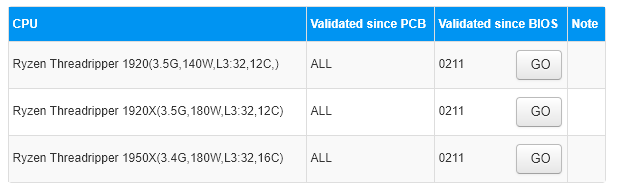
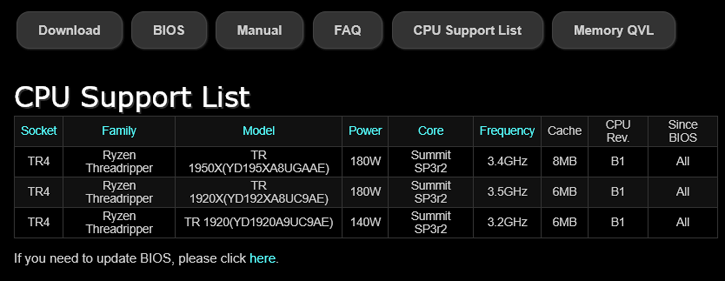
Ryzen Threadripper 1920,12C24T,TDP 140W
It'll be interesting to see where it lands in terms of price. There's a $30 difference between the 1700 and the 1700x, and I would expect the gap to be bigger here. $700? $650?

AdamK47
Lifer
Going to pair two hot off the press links :
and my own analysis
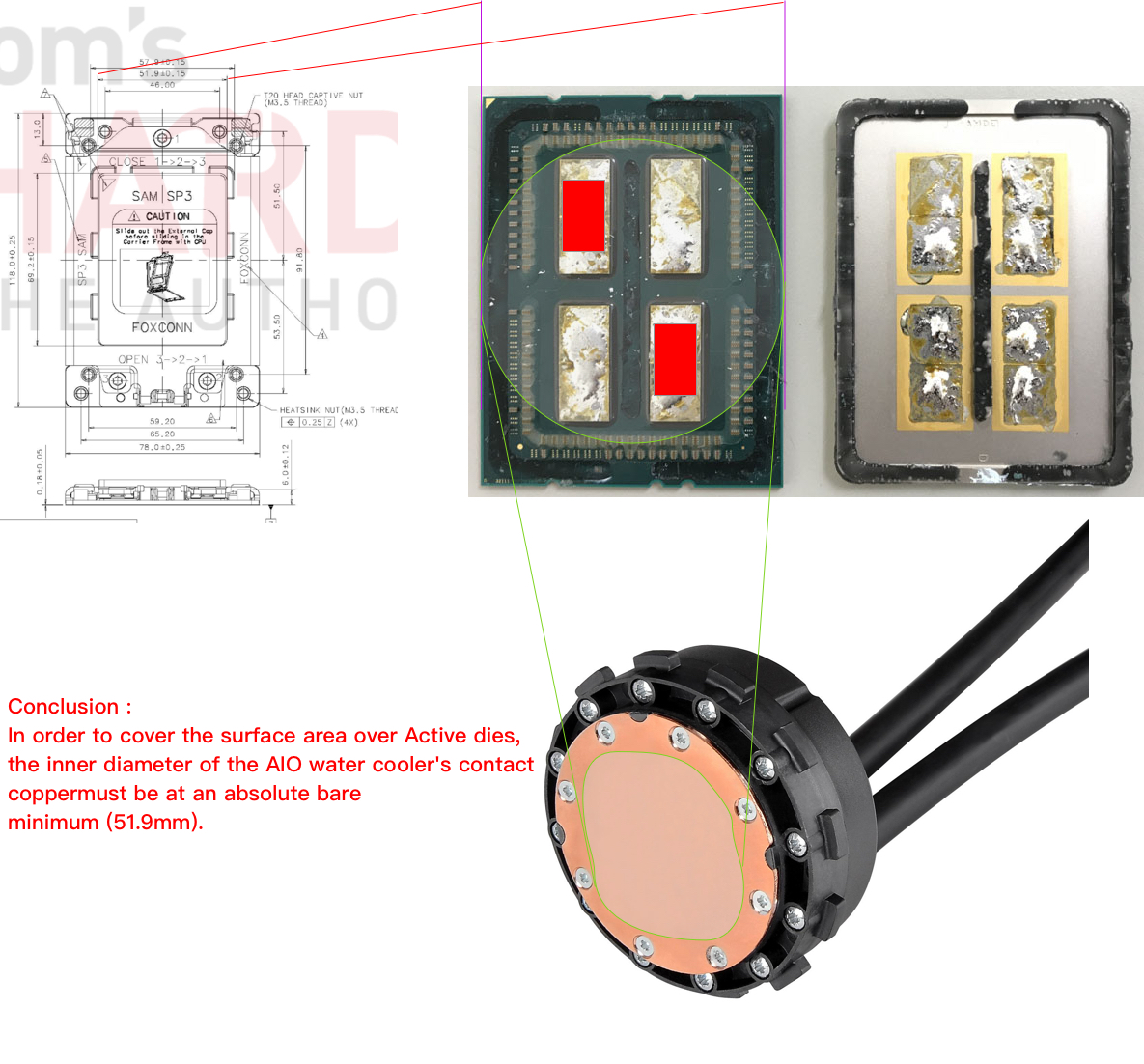
Conclusion..
None of the AIO water cooling solutions being pushed with the product launch cover the dies sufficiently.
The center of mass of the cold plate is over dead air and up to 50-70% of the active die is left out of contact w/ the copper surface. This is absolutely bogus and unacceptable.
This is the very reason why Noctau designed custom contact interfaces to thread ripper (Because nothing on the markt covers the dies sufficiently) ... Right is ryzen .. left is threadripper. Per the spec, the the Noctau covers the full Heatspreader :

If an AIO water cooling solution with a circular base actually covers the active dies in a diagonal configuration, they have to be 51.9mm in the inner diameter. Nothing on the market is that diameter... I hear EK is making a custom interface for threadripper. This is what's needed for all the AIO watercoolers... It seems this is the only solution that was ready at launch which is why I was hoping AMD actually included a cooler themselves. They're trusting their flagship product in the hands of a bunch of cost cutting third party cooling companies. I shunned Noctau's poo colored fans but at least they engineer a spec'd product.
That answers my earlier question and confirms my suspicions about it.
I'm actually surprised that no one else thought about or was concerned about this.
I don't think it will be a huge deal. The dies are soldered to a metal cover, so there is good thermal transfer all around. Optimal? No, but not bad either. For those that want to push it, a little lapping should do the trick.That answers my earlier question and confirms my suspicions about it.
I'm actually surprised that no one else thought about or was concerned about this.

Thanks.They are B1's only for now.
Pandora's Box
Senior member
I spoke to James Prior (works for AMD) this afternoon. I specifically asked him if the EVGA CLC 280mm definitely works with Threadripper. He said AMD has internally tested a handful of AIO coolers, they all work with threadripper. I think these issues gamers nexus is bringing up are a non-issue.

Malogeek
Golden Member
Of course they work. No one would tell you otherwise. Also GN hasn't done any testing, all they were doing is looking at how well the existing AIO cooler plates cover the hotspots. Nothing more. There is no issue yet because no testing is done.I spoke to James Prior (works for AMD) this afternoon. I specifically asked him if the EVGA CLC 280mm definitely works with Threadripper. He said AMD has internally tested a handful of AIO coolers, they all work with threadripper. I think these issues gamers nexus is bringing up are a non-issue.

ub4ty
Senior member
And guess what it will traverse over? An already thermally exhausted area over the dies... Thus, you'll have heightened heat in the areas not in contact with the heatsink but over the die and you'll get hot areas on the portions of the die in contact with the heatsink. Bad thermal efficiency plus you're drawing extra heat across and up areas that are already thermally exhausted.. We haven't even gotten into the internal fins occupying an even smaller area on the copper plate that are supposed to be over the die and even worse the orientation.I can imagine it creating hot spots on the outer edges of the dies that aren't covered. The ideal path for the heat is up through the IHS and into the block. In this case it would have to traverse the IHS and then move into the block. Heat will build up.
This is an absolute clown show IMO. Those that don't call it what it is are either being apologist or lack a basic education in physics and heat transfer... Though you don't even need this, a little common sense goes far here.
ub4ty
Senior member
There's a difference between doing the job and doing the job right or efficiently.I suppose that if AMD has validated these coolers, its due to they do the job, but for sure it will be better with specific TR coolers....
I channel the intel mayo paste instead of TIM solution fiasco as a referenceable example of (does the job) vs (does it right). This is near the degree of the intel mayo paste fiasco. Though at least this one can be solved by buying a properly engineered cooling solution and not somebody slapping on a contact plate meant for one single die to two in a diagonal gapped configuration equivalent to the spacing of 4 dies.
Common sense would tell you that something meant for one die sure as hell isn't going to work efficiently on 4 spaced out dies....
Put one of these AIO Water coolers on out the box and leave prime95 running for 24 hours and tell me if your house burns down.
ub4ty
Senior member
LOL, you also could use your own brain and look at the contact area and figure out it isn't working in any scale of efficiency like a properly sized surface would.I spoke to James Prior (works for AMD) this afternoon. I specifically asked him if the EVGA CLC 280mm definitely works with Threadripper. He said AMD has internally tested a handful of AIO coolers, they all work with threadripper. I think these issues gamers nexus is bringing up are a non-issue.
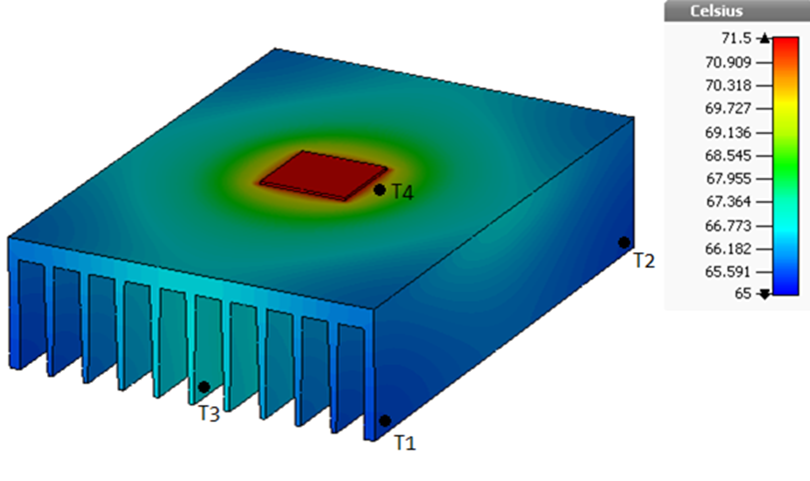
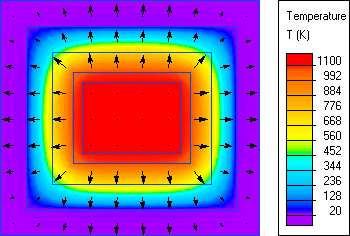
See the hot spot and see the thermal trail off? You're getting highly inefficient thermal transfer if you don't have anything contacting the surface immediately above the heat source (dies). This is why the center of mass and the internal fins are directly in the center of all of the AIO water cooling contact plates. They are designed for one die dead center not 2 dies spaced out and at a diagonal. This is inefficiency on inefficiency. Also, think about covering half of the above heat source with a heatsink... Now tell me, where does the heat flow across to get up into the heatsink? Back across a max'd our thermal region .. multiplying the heat that's in it.
Sure it works and that is likely not under persistent heat stress. God knows what this manifests in the long run.. At the temperature processors run at when max'd out, I'm sure you're going to get warping and all sorts of issues down the road. A freshman in college out of physics could tell you this. I can't believe actual people who do this for a living are lying to people and saying otherwise.... I'm not sure what type of fools they think people are.
Pandora's Box
Senior member
End of the day I doubt the Noctua TR4 cooler is going to be available for launch of Threadripper. I'll use my EVGA CLC 280mm cooler for now, will keep an eye on the Noctua cooler and may switch out down the line.

Markfw
Moderator Emeritus, Elite Member
Exactly ! And I will report loaded temps on both coolers.End of the day I doubt the Noctua TR4 cooler is going to be available for launch of Threadripper. I'll use my EVGA CLC 280mm cooler for now, will keep an eye on the Noctua cooler and may switch out down the line.
ub4ty
Senior member
Deeper down the rabbit hole we go...
Dell is using a much larger custom AIO surface mount and bracket than what is being offered by the compatibility list and AMD. They switched to it towards launch after using skimpy brackets in testing. Clearly the Compatibility list solutions and AMD's bracket wont cut it for a production system ... The fact that an OEM has already moved on from it some time ago shows they knew of this issue and know that these compatible list coolers aren't going to cut it.. This gets uglier the more I look into it.
Detailed here :
http://imgur.com/a/EonHL
Dell is using a much larger custom AIO surface mount and bracket than what is being offered by the compatibility list and AMD. They switched to it towards launch after using skimpy brackets in testing. Clearly the Compatibility list solutions and AMD's bracket wont cut it for a production system ... The fact that an OEM has already moved on from it some time ago shows they knew of this issue and know that these compatible list coolers aren't going to cut it.. This gets uglier the more I look into it.
Detailed here :
http://imgur.com/a/EonHL
mattiasnyc
Senior member
This gets uglier the more I look into it.
Maybe you should take a break then. I don't think I've ever seen someone this "intensely" looking at a presumed issue before the testing has been done getting this "agitated". We're what, only 7 days away from the gag lifts on reviews, right? So, 7 days of waiting and then we'll know.....
So a less than 5 Celsius difference? Based on top graphic.LOL, you also could use your own brain and look at the contact area and figure out it isn't working in any scale of efficiency like a properly sized surface would.
See the hot spot and see the thermal trail off? You're getting highly inefficient thermal transfer if you don't have anything contacting the surface immediately above the heat source (dies). This is why the center of mass and the internal fins are directly in the center of all of the AIO water cooling contact plates. They are designed for one die dead center not 2 dies spaced out and at a diagonal. This is inefficiency on inefficiency. Also, think about covering half of the above heat source with a heatsink... Now tell me, where does the heat flow across to get up into the heatsink? Back across a max'd our thermal region .. multiplying the heat that's in it.
Sure it works and that is likely not under persistent heat stress. God knows what this manifests in the long run.. At the temperature processors run at when max'd out, I'm sure you're going to get warping and all sorts of issues down the road. A freshman in college out of physics could tell you this. I can't believe actual people who do this for a living are lying to people and saying otherwise.... I'm not sure what type of fools they think people are.
ub4ty
Senior member
I've provided the detail that are necessary ... I no longer have any comments.Maybe you should take a break then. I don't think I've ever seen someone this "intensely" looking at a presumed issue before the testing has been done getting this "agitated". We're what, only 7 days away from the gag lifts on reviews, right? So, 7 days of waiting and then we'll know.....
It's the individual's choice from here on out


DrMrLordX
Lifer
Put one of these AIO Water coolers on out the box and leave prime95 running for 24 hours and tell me if your house burns down.
Yay for hyperbole.
How about letting people run some tests with these coolers instead of trying to manufacture controversy? You sound like someone trying to distract from problems with some competitor's recent platform launch . . .
TRENDING THREADS
-
 Discussion Zen 5 Speculation (EPYC Turin and Strix Point/Granite Ridge - Ryzen 9000)
- Started by DisEnchantment
- Replies: 25K
-
Discussion Intel Meteor, Arrow, Lunar & Panther Lakes + WCL Discussion Threads
- Started by Tigerick
- Replies: 25K
-
 Discussion Intel current and future Lakes & Rapids thread
- Started by TheF34RChannel
- Replies: 24K
-

-
