This thread reminds me of hardcore car enthusiasts who made fun of Hybrid vehicles and made fun of those who thought outside the box about hybrids. Now, LaFerrari, McLaren P1 and Porsche 918 all use internal combustion engines, augmented by hybrid powertrains to provide instantaneous torque. It takes risk and going against the status quo to innovate. If everyone just catered to what's popular
today, we'd never have newer and better products. We'd still be stuck using 3.5-4 inch smartphones.
Who said that 250W TDP is the absolute maximum that flagship GPUs should abide by? If the market accepts a 300W TDP Hybrid WC style card, that means AMD is single-handidly creating a new market segment for flagship GPUs -- 300W+ with water.
Why is this amazing? Because it means we can have High end (780 style card), Ultra High End (780Ti) and 300W WC monsters Uber High end cards. Just imagine the possibilities of taking the efficiency of Pascal/Volta on 14nm and scaling them to 300-350W!
Just like there is a market for $1000+ IEMs and custom in-ear monitors, why shouldn't GPU makers drop the status quo and create 300W single-chip flagship cards? With Hybrid WC they would solve the noise and temperature issues, finally allowing them to move well past the 250W historical 'limits'. For that reason I hope and I really want for NV to adopt Hybrid WC too and give us 300-350W Pascal/Volta.
Everyone wins -- those who want 180-200W cards will get them, those who want 250W cards max will get them and those who want performance above all will buy 300-350W cards. With R9 290X and 780Ti approaching 300W, and after-market solutions easily coping with such power consumption loads, it was only a matter of time before either AMD or NV made an official 300W card.
Think about this: If Intel only made 77-88W i7s for 10 years, and suddenly they made the world's first ever 140W 6-core CPU, would you guys also complain? If Intel sold me a 250W CPU that performed amazing, and I could actually afford it, I would take it and pair it with a Swiftech H240-X.
Also, it's interesting to read about how some people don't want to sell their case or their air cooler but how hard is it? I know I can probably sell my Thermalright Silver Arrow for $40 in less than a week if necessary. That cooler has more than paid for itself after 4 years of usage, which means since I bought it for $70, my cost of ownership was only $30 over 4 years. I don't know why it's SUCH a big deal for PC gamers to resell parts just because a change is coming for the GPU industry.
Silverstone even sells 600W Gold-rated 50A on 12V rail SFX (miniITX) PSU:
http://www.newegg.com/Product/Produc...-109-_-Product
With Hybrid WC, you can now fit a 300-350W GPU inside a small case, and it will be quiet.
Seriously, all I hear are excuses -- can't fit my HDDs, can't fit radiators, can't use 2x120 mm rads as intakes, etc.
$70 NZXT case - easily accommodates 3x 120mm rads.
1x 120mm at the top for the CPU
1x 120mm x 2 for dual-300W Hybrid WC cards
There are 2 slots for 2x1TB SSDs in RAID
But where to fit the mechanical HDDs? The PSU bay:
Who here needs more than 2x
8TB hard drives?
See, the engineers who make cases and PSUs have already thought about everything for you! They even made a
$70 (!) case that gives you the option of dropping in 3x120mm rads (in fact that S340 can fit 1x280mm rad at the front and 1x140mm at the top); and should you desire a miniITX system, well you can just buy a 600W SFX style PSU.
If you are the type who has 8-10 1TB old school slow HDDs taking up 2 of your HDD drive cages, it's YOU who is behind the times, not the PC industry. Sooner or later a single 60TB drive will be available but don't tell me you'll still be rocking 10x 6TB drives instead?
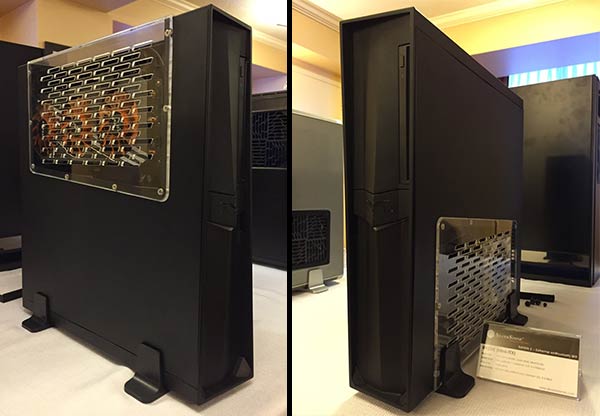
Sure, there are small cases that aren't readily suitable for a Hybrid WC card such as the Silverstone Raven RVZ01/02, but now we are talking < 1% of the entire PC market. Remarkably, even that case can fit an after-market open air cooled flagship card. And since GPU makers will want to cater to nearly every consumer, at least 1 AIB will make an after-market open air 300W TDP card based on AMD's R9 300 series.
To me being a PC enthusiast isn't about who spends the most $ on hardware, or who upgrades most often, or about saying NO to something new & radical because it's completely different to the last 20 years of PC hardware. It's about finding solutions to 'problems' and always learning about new PC hardware because it's interesting. If I have to adopt to newer market trends in terms of hardware options, so be it. If it wasn't for change, the PC industry would have been dead by now. Worst case that happens is the AIO solution fails to gain market traction, but at least someone tried.




 but rather a dual card by manufacturer. He also suggests that AIO is a good thing only.



 Facebook
 Twitter