
-
We’re currently investigating an issue related to the forum theme and styling that is impacting page layout and visual formatting. The problem has been identified, and we are actively working on a resolution. There is no impact to user data or functionality, this is strictly a front-end display issue. We’ll post an update once the fix has been deployed. Thanks for your patience while we get this sorted.
You are using an out of date browser. It may not display this or other websites correctly.
You should upgrade or use an alternative browser.
You should upgrade or use an alternative browser.
Superconductivity can be turned on and off with a powerful terahertz pulse
Page 2 - Seeking answers? Join the AnandTech community: where nearly half-a-million members share solutions and discuss the latest tech.

William Gaatjes
Lifer
William Gaatjes
Lifer
That's because an Ion lacking 3 charges is less stable than one lacking 1 or 2. I can imagine the attractive forces of aluminium is slightly higher than copper on the electrons.
Could that be translated into more disturbances ?
It is interesting. Especially when energy is transferred not by electron flow, but by electrons transferring EM from one electron to the other as charge carriers. A simple electrically conducting wire can hold so much "secrets".
As a side note, in vacuum electrons can move extremely fast. Pure vacuum such as in interstellar space can mean no disturbances. Now the post above is about ions forming lattices in plasma under the influence of external fields.
In a solid, the electrons experience acceleration and deceleration all the time and that is why EM waves are generated and absorbed. Giving rise to more disturbances than where already present : Scattering. But at some situations, there is an equilibrium.
In a plasma it is essentially the same. Controlling the "lattice" is controlling the plasma. The more outside disturbances, the more difficult it becomes.
Shielding the plasma from out side interference is necessary.
I wonder if they do that. Or do they assume that the strong magnetic fields will keep out particles ? To control that plasma in a fusion reactor, a lot more is needed. More and more i have my doubts about the tokamak fusion reactor design.
Forget the toroidal magnetic fields, use pulsed lasers instead...
Last edited:
William Gaatjes
Lifer
Almost forgot :
And there is your answer Lemon law.
A highly conducting material (metallic hydrogen or deuterium or trtium) carrying a lot of current.
And then the super conductive state is shut off by means of a tera hertz laser pulse...
This way magnetic fields are only needed as confinement.
And less current is needed to be provided by the poloidal magnetic field to inject the current for the required reaction. The disruption of the super conductive state will create locally enough disturbances to create a reaction.
Instead of using super hot plasma to begin with, use something that is superconducting and then disrupt the superconductor while running maximum current through it.
At least that is what i think how it could work...
The problem is, how to simulate high pressures locally in a vacuum.
How to emulate a diamond anvil in a vacuum without using the diamond anvil ?
^_^.
Is it just me, but there is something a little defective in saying an strong EM pulse can disrupt superconductivity.
When the holy grail is achieving and keeping superconductivity, why is it an advance to temporarily disrupt the super conductive state?
And there is your answer Lemon law.
A highly conducting material (metallic hydrogen or deuterium or trtium) carrying a lot of current.
And then the super conductive state is shut off by means of a tera hertz laser pulse...
This way magnetic fields are only needed as confinement.
And less current is needed to be provided by the poloidal magnetic field to inject the current for the required reaction. The disruption of the super conductive state will create locally enough disturbances to create a reaction.
Instead of using super hot plasma to begin with, use something that is superconducting and then disrupt the superconductor while running maximum current through it.
At least that is what i think how it could work...
The problem is, how to simulate high pressures locally in a vacuum.
How to emulate a diamond anvil in a vacuum without using the diamond anvil ?
^_^.
Last edited:
Why ? 😕
Im just not smart enough to understand all of it. I mean i can follow ok, but how people come up with this stuff is way past my level of intelligence
William Gaatjes
Lifer
Im just not smart enough to understand all of it. I mean i can follow ok, but how people come up with this stuff is way past my level of intelligence
I am also not smart. But i have learned how to search for information. I am partially a hunter gatherer, and i have chosen information as my prey... 😎
Without the Internet, i would be searching for very expensive books forever.
See it like this, while the road you are running on is shaking, a strong pulsating wind from all sides is affecting your direction of movement. At the same time you have to catch balls and throw them back. That is life for an electron.
Imagine that the ground shakes in such a way that every time you take a step forward, the ground also advances upwards, giving you extra lift while you run. Making your leaps bigger. And that the wind is in a pulsating manner pushing you in the back giving you as forward force, also increasing your leaps. That would it be like when the material is superconducting.
William Gaatjes
Lifer
The Z machine from Sandia National Laboratories. It has some extraordinary properties.
It works by discharging large currents through tungsten(or other metals) wires.
These wires vaporise and through complex physics create enormous pressure waves and high temperature. The Z machine is capable of creating extremely high pressures though at the moment not high enough to create metallic hydrogen for that short moment. The Z machine is capable of generating temperatures in excess of 2 billion Kelvin.
The wiki explains some nice prospects for the future.

http://en.wikipedia.org/wiki/Z_machine
http://www.sandia.gov/z-machine/
Another interesting piece of the puzzle :
http://arstechnica.com/science/news...th-a-laser-may-make-fusion-more-efficient.ars

I wonder how high the pressure is that can be created with a pulsed magnetic field.
I wonder if crushing hydrogen together to make it super conductive (turning it into metallic hydrogen) requires lower pressures than crushing hydrogen together to force the nuclei to fuse ?
The William Gaatjes sequenced pressure to super conduction fusion generator :awe: :
1 Generate a large magnetic field "pulse " to force hydrogen atoms together.
2 The hydrogen is superconducting for a moment.
3 Then a large current can be run through the hydrogen.
4 After that the magnetic field from step 1 loses its strength.
5 No more super conduction because pressure drops immediately.
6 Hydrogen heats up tremendously because of high current running through it still experiences high pressure and fuses together .
7 generates a surplus of heat.
8 absorb heat to generate electricity in the usual way.
9 reload chamber.
10 start at step 1.
My idea is that step 1 to 7 must be precisely timed in the nano second scale.
It works by discharging large currents through tungsten(or other metals) wires.
These wires vaporise and through complex physics create enormous pressure waves and high temperature. The Z machine is capable of creating extremely high pressures though at the moment not high enough to create metallic hydrogen for that short moment. The Z machine is capable of generating temperatures in excess of 2 billion Kelvin.
The wiki explains some nice prospects for the future.
The ultra-high temperatures reached in 2006 (2.66 to 3.7 billion kelvins) are much higher than those required for the classical hydrogen, deuterium and tritium fusion previously considered. They could allow, in theory if not in practice, the fusion of light hydrogen atoms with heavier atoms such as lithium or boron. These two possible fusion reactions do not produce neutrons, and thus no radioactivity or nuclear waste, so they open for the first time the possibility of human-made clean aneutronic fusion.
http://en.wikipedia.org/wiki/Z_machine
http://www.sandia.gov/z-machine/
Another interesting piece of the puzzle :
http://arstechnica.com/science/news...th-a-laser-may-make-fusion-more-efficient.ars
Lasers plus a crushing magnetic field may make fusion more efficient
Ever since I first heard about the idea, I have loved inertial confinement fusion. The basic concept involves blowing stuff up with lasers to get some energy, then doing it again and again as fast as possible. What more could a 38-going-on-5-year-old want? Well, what I might also want is a fusion reaction that generates more energy than you put in to it.
One thing that lets me down about inertial confinement fusion is that the implosion that gets the fusion reaction going also acts to stop the fusion. One idea for improving the fusion reaction that has been floating around for a while is to use magnetic fields in place of lasers to increase the efficiency of the fusion burn. But until recently, no one could figure out how to make it work properly.
A crash course in inertial confinement fusion
Fusion is the process whereby the atomic nuclei of lighter elements are combined to make heavier elements. So sticking two deuterium atoms together (deuterium is a form of hydrogen with a neutron and a proton) will give you helium and 3MeV (480×10-15J) of energy. To put that in perspective, one gram of deuterium will provide 144 billion Joules of energy when it is completely burned into helium. One gram of benzene, a common hydrocarbon, releases just 48kJ when oxidized (burned in the normal sense).
But fusion is not so easy to achieve. Although atoms are electrically neutral, the parts that need to be stuck together—the atomic nuclei—are positively charged and repel each other. The external pressure needs to be high enough that it overcomes the Coulomb forces holding the nuclei apart.
In traditional inertial confinement fusion, the compression is driven by lasers (all the really cool stuff involves a laser somewhere). A perfectly spherical droplet of deuterium and tritium (tritium is hydrogen with two neutrons) ice is dropped through a target zone, where it is illuminated from many different directions by a very intense pulse of laser light. The photons are all either reflected or absorbed—either way, they give the deuterium and tritium atoms a kick toward the center of the target area. How hard a kick? The nuclei end up moving at about 30 million meters per second.
Right at the center of the target, the pressure is large enough to initiate fusion. Once that begins, the center of the pellet begins expanding, creating a compressed shell that also begins to fuse. Ideally, the chain reaction proceeds outward to completely burn away the deuterium-tritium pellet.
But a complete burn is usually prevented by the lasers that initiate the fusion process. There are two critical issues. First, the electrons are stripped away from the nuclei and leave the area. In doing so, they carry away vital energy, reducing the temperature and the initial pressure. This slows down the fusion process, allowing the pressure to drop and preventing the expanding shell of fusion from achieving a complete burn.
The second issue is more technical. The pressure that drives the initial compression needs to be evenly applied—the laser pulses all need to have exactly the same energy, same spatial beam profile, and arrive at the target at the same time. If they're not, much of the deuterium and tritium sprays out of the pellet and never undergoes fusion.
A magnetic field makes everything better
For many years, fusion scientists had thought that if a magnetic field were used to compress the target, then a more complete fusion burn might be possible. The basic idea is that the role of the lasers changes. Instead of being responsible for compressing the pellet, it is only required to pre-heat the deuterium and tritium. Then, before the pellet explodes, the magnetic field is turned on, compressing it and initiating fusion.
The magnetic field acts on all charged particles, so it confines both electrons and nuclei, keeping the energy within the pellet. Furthermore, because everything is confined, the speed at which the nuclei need to be moving is reduced to just 1 million meters per second. If you think that isn't significant, consider that energy is proportional to the square of speed, so we are talking about requiring a thousand times less energy to initiate fusion.
But the magnetic field itself uses energy, and early calculations showed that it might slow down the expansion of the burn shell, which would also result in an incomplete burn. It would help—the total gain in energy production from magnetically confined inertial fusion was predicted to be a factor of ten. But we need gains on the order of a factor of 50 to make fusion break even. So the entire idea seemed destined for the scrap heap.
This is where this latest bit of research comes in. Slutz and Vesey from Sandia National Laboratories have shown that, if you modify the structure of the pellet, then energy gains between 200 and 1,000 are possible. The major finding is that the pellet and initial heating stage need to be modified. Slutz and Vesy start with a fairly standard pellet: a cylindrical piece of cryogenically cooled deuterium/tritium, surrounded by either aluminum or beryllium (this is the conductor that the magnetic field acts on).
The pellet is fabricated so that the density of the ice is very high just inside the metal shell. And, it seems (though the authors never explicitly say) that the whole cylinder is large enough in diameter so that the only the center of the pellet is heated by the incoming laser beams. The laser beams themselves don't hit it from every direction, but only along the axis of the cylinder.
Where the laser meets the hydrogen
The laser pulse heats the material at the very center of the pellet, creating a gas in that location. Before the outside of the pellet can heat up, the magnetic field is turned on, crushing the metal liner and compressing the gas. Fusion initiates, and the expanding shell of fusing material runs right into the layer of dense ice, slamming it into the shell before it can escape outwards. The result is a nearly complete burn.
The researchers calculated the amount of current and the duration of the current pulse required to produce the magnetic fields, and the numbers they came up with are not unreasonable (50-70MA for ~100ns). They also looked into the fabrication of the pellet. One critical issue is the smoothness of the inner shell of the surrounding metal layer. They show that they require the surface to be perfect to within about 20nm, while current technology routinely manages 30nm. The additional precision should be feasible with current technology.
Where I think the authors may have missed the mark is earlier in their calculations. It seems that they require the laser beam to create a gas with a relatively sharp boundary so that the shell of dense ice is left untouched, even as the interior is vaporized. It is unclear from the paper if they calculate the heating stage explicitly or not. I believe they do, but that leaves unanswered questions about how it's done.
On a computer, it is very easy to create marvelous laser beams with very narrow effects. But in the laboratory, laser beams have strict limitations. Intensities change relatively smoothly, meaning that there is no sharp boundary between where the laser is heating material and where it is not. In addition, laser beams change diameter as they propagate, so the diameter of the heated zone compared to the unheated zone will change depending on where the pellet is hit by the laser.
From what is in the paper, it is hard to say if the initial conditions required for a good burn can be met with a laser. What this really calls for, of course, is a huge experiment where people like me get to blow stuff up.
Physical Review Letters, 2012, DOI: 10.1103/PhysRevLett.108.025003
I wonder how high the pressure is that can be created with a pulsed magnetic field.
I wonder if crushing hydrogen together to make it super conductive (turning it into metallic hydrogen) requires lower pressures than crushing hydrogen together to force the nuclei to fuse ?
The William Gaatjes sequenced pressure to super conduction fusion generator :awe: :
1 Generate a large magnetic field "pulse " to force hydrogen atoms together.
2 The hydrogen is superconducting for a moment.
3 Then a large current can be run through the hydrogen.
4 After that the magnetic field from step 1 loses its strength.
5 No more super conduction because pressure drops immediately.
6 Hydrogen heats up tremendously because of high current running through it still experiences high pressure and fuses together .
7 generates a surplus of heat.
8 absorb heat to generate electricity in the usual way.
9 reload chamber.
10 start at step 1.
My idea is that step 1 to 7 must be precisely timed in the nano second scale.
Last edited:

Lemon law
Lifer
Well thank you William Gaatjes, now that I know you are chasing that other holy grail goal of hydrogen fusion that could offer almost limitless energy with no radioactive by products,
this whole thread makes better sense to me. Which is not to say I am scientifically competent to understand much of the highly advanced physics of it. As it is fusion is somewhat old hat. Stars do it naturally but it does us little good unless we can duplicate the process on earth. And we humans have had that ability for at least forty years, the problem is that we waste such more energy creating the magnetic fields needed, the fusion energy created is far less than the input energy.
Its why I like your threads William Gaatjes, it makes us all think of the possible technologies of the future.
this whole thread makes better sense to me. Which is not to say I am scientifically competent to understand much of the highly advanced physics of it. As it is fusion is somewhat old hat. Stars do it naturally but it does us little good unless we can duplicate the process on earth. And we humans have had that ability for at least forty years, the problem is that we waste such more energy creating the magnetic fields needed, the fusion energy created is far less than the input energy.
Its why I like your threads William Gaatjes, it makes us all think of the possible technologies of the future.
William Gaatjes
Lifer
Well thank you William Gaatjes, now that I know you are chasing that other holy grail goal of hydrogen fusion that could offer almost limitless energy with no radioactive by products,
this whole thread makes better sense to me. Which is not to say I am scientifically competent to understand much of the highly advanced physics of it. As it is fusion is somewhat old hat. Stars do it naturally but it does us little good unless we can duplicate the process on earth. And we humans have had that ability for at least forty years, the problem is that we waste such more energy creating the magnetic fields needed, the fusion energy created is far less than the input energy.
Its why I like your threads William Gaatjes, it makes us all think of the possible technologies of the future.
Thank you.
That is what i am here for. Sharing my interest with people much smarter than me.
My function is to increase probabilities in possibilities.
If hope increases, humans get interested, especially the young ones.
Creating even more hope and a positive mentality.
Some individuals might have a certain "gift" or ability to solve certain problems in a specific scientific field. Bring them together and they will perform the "wonders" that are needed for advancement.
Creativity is far more than an algorithm to store experiences. It is the ability to use stored experiences to create scenario's not experienced before.
A powerful but dangerous mechanism that must not be wielded lightly.
For it is not good or evil and can be used for either side...
Last edited:
William Gaatjes
Lifer
The big question is of course how to compress hydrogen by use of a magnetic field. I have not done any calculations, it is just an idea.
In the article from arstechnica :
I do not think it is possible to re-use the same magnetic field pulse that was used to compress the hydrogen/tritium/deuterium fuel for a moment. Thus a second pulse is needed to let a large current flow. Then the first magnetic pulse would decay, lowering the pressure and the super conducting state disappears while the large current is still flowing and the pressure is still very high. Hopefully a condition to have enough fusion to be efficient enough to offset the energy used for the magnetic pulses.
To start the magnetic pulse , energy could be used generated by solar towers such as the Torresol Energy Gemasolar plant in Fuentes de Andalucia near Seville, Spain or the ones that will be build in Arizona, USA.
This research may also very much help advance fusion technology
By shielding the superconductor from the pressure pulse ?
Allowing for better control of the induced current by the second magnetic pulse ?
http://phys.org/news/2012-03-magnetic-cloak-physicists-device-invisible.html

More information about 24 hour solar energy in this Anandtech forum thread :
http://forums.anandtech.com/showthread.php?t=2234745
In the article from arstechnica :
This is to be able to generate the high pressure i understand of it.Slutz and Vesy start with a fairly standard pellet: a cylindrical piece of cryogenically cooled deuterium/tritium, surrounded by either aluminum or beryllium (this is the conductor that the magnetic field acts on).
I do not think it is possible to re-use the same magnetic field pulse that was used to compress the hydrogen/tritium/deuterium fuel for a moment. Thus a second pulse is needed to let a large current flow. Then the first magnetic pulse would decay, lowering the pressure and the super conducting state disappears while the large current is still flowing and the pressure is still very high. Hopefully a condition to have enough fusion to be efficient enough to offset the energy used for the magnetic pulses.
To start the magnetic pulse , energy could be used generated by solar towers such as the Torresol Energy Gemasolar plant in Fuentes de Andalucia near Seville, Spain or the ones that will be build in Arizona, USA.
This research may also very much help advance fusion technology
By shielding the superconductor from the pressure pulse ?
Allowing for better control of the induced current by the second magnetic pulse ?
http://phys.org/news/2012-03-magnetic-cloak-physicists-device-invisible.html
Autonomous University of Barcelona researchers, in collaboration with an experimental group from the Academy of Sciences of Slovakia, have created a cylinder which hides contents and makes them invisible to magnetic fields. The device was built using superconductor and ferromagnetic materials available on the market. The invention is published this week in the journal Science.
The cylinder is built using high temperature superconductor material, easily refrigerated with liquid nitrogen and covered in a layer of iron, nickel and chrome. This simple and accessible formula has been used to create a true invisibility cloak.
The cylinder is invisible to magnetic fields and represents a step towards the invisibility of light - an electromagnetic wave. Never before had a device been created with such simplicity or exactness in theoretical calculations, or even with such important results in the laboratory.
Researchers at UAB, led by Àlvar Sánchez, lecturer of the Department of Physics, came up with the mathematical formula to design the device. Using an extraordinarily simple equation scientists described a cylinder which in theory is absolutely undetectable to magnetic
fields from the outside, and maintains everything in its interior completely isolated from these fields as well.
The ferromagnet attracts magnetic field lines, the superconductor repels magnetic field lines and the superconductor-ferromagnetic bilayer cloaks a magnetic field. An object inside the cloak would be magnetically undetectable. Video courtesy of J. Prat-Camps, C. Navau, A. Sanchez
Equation in hand and with the aim of building the device, UAB researchers contacted the laboratory specialising in the precise measurement of magnetic fields at the Institute of Electrical Engineering of the Slovak Academy of Sciences in Bratislava. Only a few months later the experimental results were clear. The cylinder was completely invisible to magnetic fields, made invisible whatever content was found in its interior and fully isolated it from external fields.
The superconductor layer of the cylinder prevents the magnetic field from reaching the interior, but distorts the external field and thus makes it detectable. To avoid detection, the ferromagnetic outer layer made of iron, nickel and chrome, produce the opposite effect. It attracts the magnetic field lines and compensates the distortion created by the superconductor, but without allowing the field to reach the interior. The global effect is a completely non-existent magnetic field inside the cylinder and absolutely no distortions in the magnetic field outside.
The ferromagnet attracts magnetic field lines (left), the superconductor repels magnetic field lines (middle), and the superconductor-ferromagnetic bilayer cloaks a magnetic field (right). An object inside the cloak would be magnetically undetectable. Image courtesy of J. Prat-Camps, C. Navau, A. Sanchez
Magnetic fields are fundamental for the production of electric energy - 99% of energy consumed is generated thanks to the magnetic camps within the turbines found in power stations - and for the design of engines for all types of mechanic devices, for new advances made in computer and mobile phone memory devices, etc. For this reason controlling this field represents an important achievement in technological development. Scientists are perfectly familiar with the process of creating magnetism. However, the process of cancelling at will is a scientific and technological challenge, and the device created by UAB scientists opens the way for this possibility.
The results of this research project also pave the way for possible medical applications. In the future, similar devices designed by UAB researchers could serve to block a pacemaker or a cochlear implant in a patient needing to undergo a magnetic resonance.
More information: Experimental Realization of a Magnetic Cloak, Science 23 March 2012: Vol. 335 no. 6075 pp. 1466-1468. DOI: 10.1126/science.1218316
ABSTRACT
Invisibility to electromagnetic fields has become an exciting theoretical possibility. However, the experimental realization of electromagnetic cloaks has only been achieved starting from simplified approaches (for instance, based on ray approximation, canceling only some terms of the scattering fields, or hiding a bulge in a plane instead of an object in free space). Here, we demonstrate, directly from Maxwell equations, that a specially designed cylindrical superconductor-ferromagnetic bilayer can exactly cloak uniform static magnetic fields, and we experimentally confirmed this effect in an actual setup.
More information about 24 hour solar energy in this Anandtech forum thread :
http://forums.anandtech.com/showthread.php?t=2234745
William Gaatjes
Lifer
New research that might be used for fusion.

Artist's impression of an electron splitting up into two new particles: a spinon carrying the electron's spin and an orbiton carrying its orbital moment. (Graphics: David Hilf, Hamburg)
http://phys.org/news/2012-04-ornl-microscopy-yields-proof-ferroelectricity.html
Artist's impression of an electron splitting up into two new particles: a spinon carrying the electron's spin and an orbiton carrying its orbital moment. (Graphics: David Hilf, Hamburg)
http://phys.org/news/2012-04-ornl-microscopy-yields-proof-ferroelectricity.html
Electrons doing the splits
April 18, 2012
Observations of a 'single' electron apparently splitting into two independent entities -- so-called quasi-particles -- are reported in this weeks Nature.
An electron has been observed to decay into two separate parts, each carrying a particular property of the electron: a spinon carrying its spin - the property making the electron behave as a tiny compass needle - and an orbiton carrying its orbital moment - which arises from the electron's motion around the nucleus. These newly created particles, however, cannot leave the material in which they have been produced. This result is reported in a paper published in Nature by an international team of researchers led by experimental physicists from the Paul Scherrer Institute (Switzerland) and theoretical physicists from the IFW Dresden (Germany).
All electrons have a property called "spin", which can be viewed as the presence of tiny magnets at the atomic scale and which thereby gives rise to the magnetism of materials. In addition to this, electrons orbit around the atomic nuclei along certain paths, the so-called electronic "orbitals". Usually, both of these quantum physical properties (spin and orbital) are attached to each particular electron. In an experiment performed at the Paul Scherrer Institute, these properties have now been separated.
The electron's break-up into two new particles has been gleaned from measurements on the copper-oxide compound Sr2CuO3. This material has the distinguishing feature that the particles in it are constrained to move only in one direction, either forwards or backwards. Using X-rays, scientists have lifted some of the electrons belonging to the copper atoms in Sr2CuO3 to orbitals of higher energy, corresponding to motion of the electron around the nucleus with higher velocity. After this stimulation with X-rays, the electrons split into two parts. One of the new particles created, the spinon, carries the electron's spin and the other, the orbiton, the increased orbital energy. In this study, the fundamental spin and orbital moments have been observed, for the first time, to separate from each other.
In the experiment, X-rays from the Swiss Light Source (SLS) are fired at Sr2CuO3. By comparing the properties (energy and momentum) of the X-rays before and after the collision with the material, the properties of the newly produced particles can be traced. "These experiments not only require very intense X-rays, with an extremely well-defined energy, to have an effect on the electrons of the copper atoms", says Thorsten Schmitt, head of the experimental team, "but also extremely high-precision X-ray detectors. In this respect, the SLS at the Paul Scherrer Institute is leading the world at the moment."
"It had been known for some time that, in particular materials, an electron can in principle be split", says Jeroen van den Brink, who leads the theory team at the IFW Dresden, "but until now the empirical evidence for this separation into independent spinons and orbitons was lacking. Now that we know where exactly to look for them, we are bound to find these new particles in many more materials."
Observation of the electron splitting apart may also have important implications for another current research field - that of high-temperature superconductivity. Due to the similarities in the behaviour of electrons in Sr2CuO3 and in copper-based superconductors, understanding the way electrons decay into other types of particles in these systems might offer new pathways towards improving our theoretical understanding of high-temperature superconductivity.
More information: Spin-Orbital Separation in the quasi 1D Mott-insulator Sr2CuO3, J. Schlappa, K. Wohlfeld, K. J. Zhou, M. Mourigal, M. W. Haverkort, V. N. Strocov, L. Hozoi, C. Monney, S. Nishimoto, S. Singh, A. Revcolevschi, J.-S. Caux, L. Patthey, H. M. Rønnow, J. van den Brink, and T. Schmitt; Nature, Advance Online Publication, 18.04.2012, DOI: 10.1038/nature10974
Provided by Paul Scherrer Institute
William Gaatjes
Lifer
More news from the field of super conductivity research that is very interesting to read about. The "pseudo gap".
http://phys.org/news/2012-07-stages-superconductivity-insight-pseudogap-important.html

A link to my other super conductivity thread :
http://forums.anandtech.com/showthread.php?t=2082665&highlight=super+conductivity
http://phys.org/news/2012-07-stages-superconductivity-insight-pseudogap-important.html
More than two decades after scientists discovered a new type of copper-based high-temperature superconductor energy-efficient material that can carry electricity without waste Harvard physicists say they have unlocked the chemical secret that controls its fools gold phase, which mimics, but doesnt have all the advantageous properties of, superconductivity.
In an effort to better understand the phase, called the pseudogap, Associate Professor of Physics Jenny Hoffman and Ilija Zeljkovic, a graduate student working in Hoffmans lab, began studying where oxygen atoms a critical element added (doped) to a copper-based ceramic to create the superconducting material are located in the materials crystal structure.
As reported July 20 in Science, their surprising finding is that it isnt oxygen, but a lack of it, that appears to be most strongly related to the pseudogap. The finding, Hoffman said, should give researchers the understanding to begin designing materials to act as superconductors at even higher temperatures.
The important finding here is that we believe we have the chemical handle on what is controlling the local pseudogap, Hoffman said. The goal is to get to a place where we can say we understand these copper-based superconductors, and then take the next step to achieving higher temperatures. Im extremely optimistic that we are going to get to room-temperature superconductors someday, but I think were probably still a couple decades away.
Discovered in 1988, the copper-based material Bi2Sr2CaCu2O8+x (called bisco by researchers) may be one of the keys to creating higher-temperature superconductors.
A flaky, black material, bisco is capable of acting as a superconductor, but that useful property is accompanied by several frustrating problems, Hoffman said. For example, bisco is not ductile, it works poorly in magnetic fields, and current flows well through the material only in certain directions.
The bottom line is: Despite technical challenges, copper-based superconductors are great, they were a breath of fresh air in superconductivity research when they were discovered, Hoffman said. Its really tantalizing we feel as if these materials suggest that there may be something better out there, but we dont understand them well enough to get from here to whatever it is out there thats better.
For a decade and a half, Hoffman said, much of that work has been focused on the pseudogap, an unusual rearrangement of the electron energy levels in the material that can mimic superconductivity, which has divided researchers.
There has been a tremendous amount of work focused on trying to understand the pseudogap, for two reasons, Hoffman said. There is one school of thought that argues that this pseudogap might actually be superconductivity thats simply being foiled in some way. The alternate theory is that the pseudogap is actually a competing phase, one that must be defeated to achieve superconductivity.
Earlier studies hinted at a link between the oxygen dopants and the pseudogap, but the results were far from definitive, Hoffman said, because researchers had only been able to image about one-third of the oxygen dopants in the material. To get a fuller picture, she and Zeljkovic were able to turn up the energy range on a piece of equipment designed to capture atomic-scale images of the material: a scanning tunneling microscope.
The microscope, built by Zeljkovic and two other graduate students, Liz Main and Adam Pivonka, works by positioning its needlelike tip several angstroms from a sample. By measuring the electrical current that flows between the tip and the sample, researchers are able to image individual atoms in the material. Using the device, however, comes with significant technical challenges.
The idea is to keep the tip at a constant distance from the sample as you sweep it across the surface, similar to the way the read-head on a computer hard drive works, but 100 times closer, Zeljkovic said. The challenge is that angstroms are really, really small about one ten-billionth of a meter so you need a tremendous amount of vibration isolation. Basically, everything in the room even the room itself is built to limit vibrations that can ruin a scan.
By slowly sweeping the microscope tip over a 35-nanometer-square area over six hours, Hoffman and Zeljkovic were able to create a map of every oxygen dopant in the top three atomic layers of the material. When that map was compared with data that showed the local strength of the pseudogap, they found a surprise.
Rather than being correlated with any of the interstitial oxygen atoms those dopants intentionally added to the metal to give it superconducting properties the pseudogap seemed to be connected with defects in the material caused by removing oxygen atoms from positions immediately adjacent to copper atoms.
This is the first time weve been able to look at all the oxygen interstitials and vacancies at the same time, Hoffman said. What Ilija has done is to correlate the oxygen locations with the strength of the pseudogap. Now, for the first time, we can make a statement about the exact chemistry thats affecting the pseudogap, and we have a chemical handle on how to control something that everyone in this field has been focusing on for the last 15 years.
Hoffman and Zeljkovic are also working to understand what causes the pseudogap in the first place. They recently invented an algorithm to increase the effective spatial resolution of the same microscope to the picometer level one-trillionth of a meter. Their new resolution allows them to rule out one possible cause of the pseudogap: a minute structural distortion that breaks the inversion symmetry of the crystal. This work was also reported this month, in Nature Materials.
The reason were so interested in the pseudogap is because we believe its competing with superconductivity, Hoffman continued. But even if you dont agree that its competing, you still want to know what it is, and how to control it. Until now, we didnt have any practical knobs to turn to modify the pseudogap. How could we begin to understand superconductivity in these materials if we didnt have a way to tune this alternate phase that superconductivity seems to arise out of?
Journal reference: Science Nature Materials
Provided by Harvard University
This story is published courtesy of the Harvard Gazette, Harvard University's official newspaper. For additional university news, visit Harvard.edu.
A link to my other super conductivity thread :
http://forums.anandtech.com/showthread.php?t=2082665&highlight=super+conductivity
William Gaatjes
Lifer
IMHO:
I personally think it is the same as this picture when super conduction takes place.
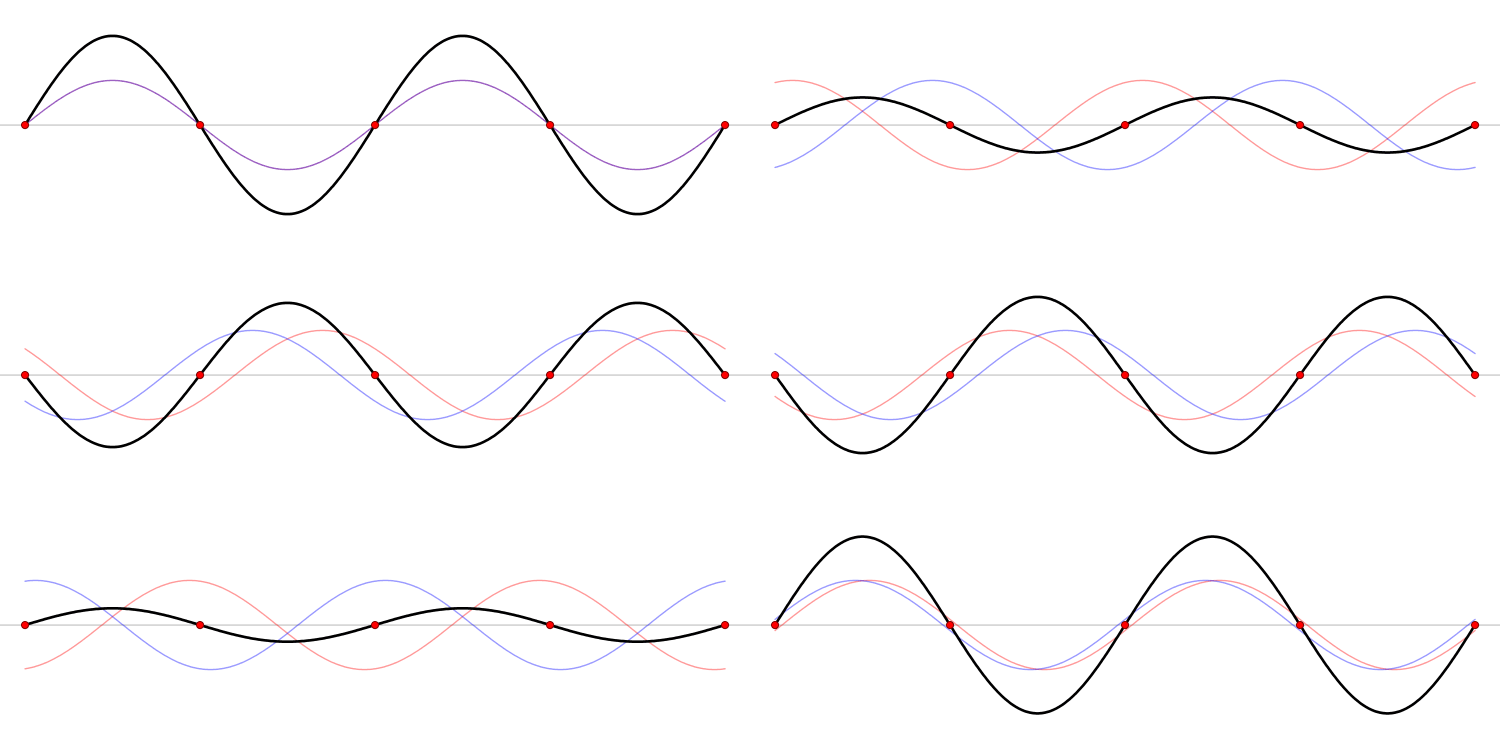
I think it is that the electrons can not slide along because the waves of the individual atoms and their components do not add up harmonically in the normal resistive state. I do not know the right words to explain it properly, but when electrons can hop along where the different electric fields cause a smooth flow without jitter (the process called electron scattering that is causing resistance) it would be the super conducting state. It is similar as a surfer riding the wave. Where the wave is comprised of all the separate waves of the individual atoms. I always see the normal "resistive state" as a state where the electrons experience slow downs and speed ups releasing and absorbing em radiation in the process which get finally transmitted as thermal radiation. The surfer in the analogy experiences a very bumpy wave. It would be similar as a car with wooden wheels on a brick road.
While reading my own post, i started to wonder that a speed up of electron flow could be measured.
If an electric flow of direct current is started in a normal resistive conductor, it will flow slow. When a high speed AC signal is applied, it will pass through the wire with a certain percentage of the speed of light.
When in super conductive speed, that direct current flow should flow faster.
A high speed AC signal should however not necessary pass through the wire with a higher speed when compared to the resistive state. I wonder if such tests have ever been done with a time domain reflection measurement device.
I have this strong feeling that it may be counter intuitive when it comes to passing ac signals. Because the AC signal is passed as EM energy from electron to electron.


I wonder if there would be a difference in time or at least in impedance characteristics ? My intuition says yes. But it blurs out when i try to imagine what kind. Could be something interesting.
http://en.wikipedia.org/wiki/Time-domain_reflectometer

Sunny129
Diamond Member
as opposed to an actual flow of free electrons through the substrate? i want to be sure i understand you.I have this strong feeling that it may be counter intuitive when it comes to passing ac signals. Because the AC signal is passed as EM energy from electron to electron.
William Gaatjes
Lifer
as opposed to an actual flow of free electrons through the substrate? i want to be sure i understand you.
I have to read it again.
The likely answers are in the other thread it seems, forgot about what is discussed in that thread. :http://forums.anandtech.com/showthread.php?t=2082665&highlight=super+conductivity
I wonder if the professor Prins got finally some students and resources to prove his theories and models.
http://www.cathodixx.com/about.asp
TRENDING THREADS
-
 Discussion Zen 5 Speculation (EPYC Turin and Strix Point/Granite Ridge - Ryzen 9000)
- Started by DisEnchantment
- Replies: 25K
-
Discussion Intel Meteor, Arrow, Lunar & Panther Lakes + WCL Discussion Threads
- Started by Tigerick
- Replies: 25K
-
 Discussion Intel current and future Lakes & Rapids thread
- Started by TheF34RChannel
- Replies: 24K
-

-
