• We’re currently investigating an issue related to the forum theme and styling that is impacting page layout and visual formatting. The problem has been identified, and we are actively working on a resolution. There is no impact to user data or functionality, this is strictly a front-end display issue. We’ll post an update once the fix has been deployed. Thanks for your patience while we get this sorted.

Stock Volt Overclock Question...

superccs

Senior member
I have been overclocking for a long time but couldn't answer this question with any confidence...

If you are overclocking at stock voltages will that increase CPU temps and power consumption?

I am thinking no, but wasn't sure since in P=IV we are only keeping V constant.

Thanks,
-c
 
Yes it will, but not as much as increasing the voltage does.

This.

It will also accelerate CPU degradation, but if you only have a moderate overvolt, it should last for more than five years before needing another voltage bump to maintain stability.

You can also undervolt AND overclock, negating any differences in temperature and degradation while achieving higher performance.
 
I have been overclocking for a long time but couldn't answer this question with any confidence...

If you are overclocking at stock voltages will that increase CPU temps and power consumption?

I am thinking no, but wasn't sure since in P=IV we are only keeping V constant.

Thanks,
-c

Hey "c", checkout this thread, I bet it'll be right up your alley :thumbsup:

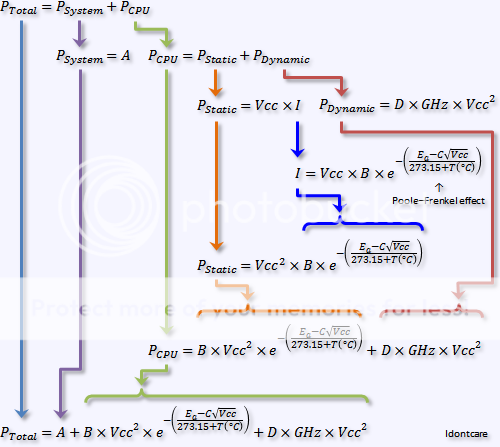
One thing to understand is that even if you don't change the voltage or the clockspeed but you do let your operating temps increase (fins on HSF clog up, or room-temp increases, etc) then the power-consumption of the CPU will increase for static leakage reasons alone.

TempvsPowerfor3GHzat1491V.png


Power consumption is proportional to frequency and also voltage cubed. That's why it's recommended not to overvolt.

Not cubed, it really is just to the square power.

PtotalVccTGHz.png


Confirmed experimentally as well:

PtotalVccTGHzFitOverlayGraph.png
 
mmmm im wondering how long its going to take u guys to realize looking at load values on a idle machine with core sleep states is pointless..

:X
 
mmmm im wondering how long its going to take u guys to realize looking at load values on a idle machine with core sleep states is pointless..

:X

I agree. It's also why nobody really needs to worry about frying their CPU if they're staying withing thermal and voltage thresholds-- 95% of the time you're running at <1.1v and 2.5ghz...
 
One thing to understand is that even if you don't change the voltage or the clockspeed but you do let your operating temps increase (fins on HSF clog up, or room-temp increases, etc) then the power-consumption of the CPU will increase for static leakage reasons alone.

TempvsPowerfor3GHzat1491V.png

This chart showns exactly why you have to keep your case clean. I shudder to think of what the same graph for the FX-8150 @ 4.5GHz will look like.
 
Hey "c", checkout this thread, I bet it'll be right up your alley :thumbsup:

One thing to understand is that even if you don't change the voltage or the clockspeed but you do let your operating temps increase (fins on HSF clog up, or room-temp increases, etc) then the power-consumption of the CPU will increase for static leakage reasons alone.

Not cubed, it really is just to the square power.

Confirmed experimentally as well:


Thats some good data, Thanks Mr. Question answered.

So the temp to power usage is kind of a little beyond linear?
 
So the temp to power usage is kind of a little beyond linear?

Pretty much. It is exponential, but we mere humans operate our CPU's in such a narrow temperature range (40-90°C) that it can be viewed as linear with minimal error introduced by the approximation.

But it is a significant contributor of the CPU's overall power consumption.

Your CPU might consume 65W at 40C but it will consume 85W at 90C. That's a big difference just for sake of a temperature change.
 
Back
Top