Question SSD p(SLC)mode?

Rasman

Junior Member
Dec 12, 2025
3
0
6
Hello, everyone!

I am interested in a simple question: Why are there no p(SLC) technology SSDs available for sale at a reasonable price for consumer SSDs?
There are some examples 1 2 3 4 from China, but they are not sold anywhere.

SSDs manufactured 10-15 years ago had NOR flash for storing firmware and capacitors to protect against rapid power loss.
These components are very inexpensive for mass production, but now they are not installed, which greatly reduces the reliability of SSDs. WHY?
StorageReview-Intel-DC-S3500-SSD-Circuit-Board-Top.jpg


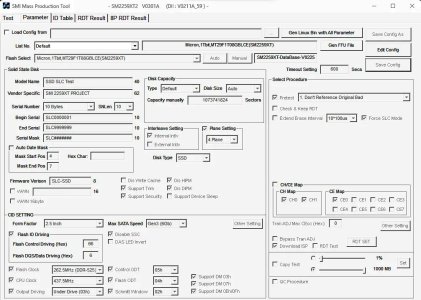
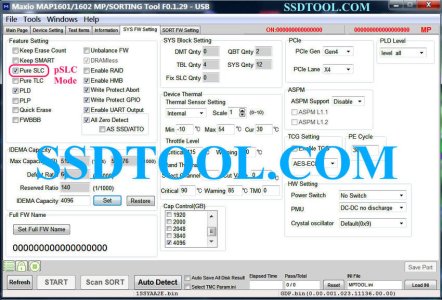
Some enthusiasts working with SSDs have found a way to change the firmware to p(SLC) Mode, which is very easy to do during production, but why isn't it being done?
MAP1602.jpg
image-37.jpg
Industrial or corporate SSDs are currently sold at 2-4 times the price higher!
5 6
 

mikeymikec

Lifer
May 19, 2011
21,389
16,601
136
"p(SLC)" is a confusing term since SLC already says what needs to be said and PLC for all intents and purposes is the opposite of SLC.

The question becomes "why are there no (or a lack of, I've never actively sought SLC SSDs) SLC SSDs?" I think the answer is very simple. MLC/TLC/QLC/PLC brought prices down for high capacity SSDs. Who needs say a 250GB cutting edge performance SSD? What does M.2 peak out at these days, something like 15GB/sec? Wow, I filled a 250GB SSD in 16 seconds! If you're going to have that kind of throughput in a product, it's got to end up getting stored somewhere, and that item has got to be affordable. Most high-end mainstream SSDs I'm aware of are TLC tech, so let's do a simple calculation. If a 1TB TLC M.2 drive costs £100 then logically (ignoring physical and supply constraints) a SLC equivalent drive is going to cost three times more. When a single 'current' computer game weighs in at over 250GB in terms of storage needs, if one wants more than a few games installed then one needs at least 1TB SSD storage. How does that affect the cost of ownership for the average PC gamer? I (for personal reasons) have never spent £300 on a storage drive. £150? Sure (my first SSD: Samsung 840 PRO 256GB).

I personally haven't noticed any real-world difference from changing from a decent SATA SSD to a decent NVMe drive. Why do I need to be able to do multi-gigs per second transfer speeds until the cows come home? At my business's end of the market, I go for decent quality SSDs for two reasons: 1) I've seen what happens in terms of real-world performance with DRAM-less SSDs, 2) I'm hoping that buying from higher in the range than the trash results in better quality and reliability.

I'm going to ignore your capacitor question as I know next to nothing about SSD manufacturing techniques.
 

Hail The Brain Slug

Diamond Member
Oct 10, 2005
3,889
3,329
146
SLC drives: this is a question I ask myself constantly. Its clear a modern SSD would benefit from being run as MLC or SLC, we see the performance gain from the pSLC cache. Why is there no vendor that offers a drive with an end user configurable cell mode? It's would obviously require a complete erase upon changing modes but you could buy an 8TB TLC drive and choose to use it as a 5.33GB MLC or 2.66GB SLC drive.

Power loss capacitors: There simply isn't room on a single sided 2280 drive, and the vast majority of consumers dont care about the feature. 2280 single sided is aspired by most mfg because it has the best compatibility to reach a greater market. You can see power loss capacitors on drives like the PM9A3, they take up a lot of space and the drive ends up being 22110 and dual sided.
 

Rasman

Junior Member
Dec 12, 2025
3
0
6
p(SLC) is pseudo SLC, the ability to operate (TLC), (QLC) NAND in 1-bit mode, also used when caching writes to (TLC), (QLC) SSDs.

The firmware of modern SSDs is stored in NAND memory, a shared array, which can only be restored using Mass Production Tool, the factory SSD firmware program, if damaged.
NOR memory offers high reliability for firmware storage, unlike NAND, and the ROM chip is very small and fits easily on M2.
It costs a few cents in mass production. Would you agree to pay an extra $10 for a more reliable SSD with NOR memory?

Very high data transfer speeds with low reliability are like a very powerful car with poor brakes and steering.

Why isn't there simply a choice between 4TB (TLC) for $350 and 1280GB p(SLC) for $350? The only difference between them is a change in firmware.
 

00Logic

Member
Oct 29, 2016
25
10
81
Assuming you don't want to download swiped software from a questionable Russian site to perhaps mod your SSD to pSLC without error or possible rootkit infection:

SSDs with Dynamic pSLC might... be modded: (Testing Required)

Dynamic pSLC generally means that:
For TLC: 1/3rd of the drive is accessed in pSLC mode until the drive is more than 1/3rd full.

So Secure Erasing a SDD and then creating a partition of 1/3rd the size (TLC) or 1/4th the size (QLC) should give you a drive with the low latency and 2X read speed and ~6X write speed of SLC.
(At least for writes. ReAds..?)
Not to mention a HUGELY increased lifespan!

Secure Erase before partitioning:
Becuse you dont want any 'forgotten' data that's not mounted etc and thus not being trimmed etc.

I did this, to good effect, to my 500GB Corsair MP600 from day 1.
I also ran a read cache and 2nd PageFile on a 58GB Optane 800p.
So have no 'Before' data to compare to...
Has anyone done anything similar?
 

Rasman

Junior Member
Dec 12, 2025
3
0
6
All software Mass Production Tool SSD (MPTool) wherever you download it is only Chinese software. There are many sites where you can find this software in different functional versions, but it is all from China.

It is very difficult to determine whether there are bookmarks or not, you need complete documentation on the processor and memory. There is nowhere to find full documentation.

No disk layout will affect the operation of memory cells. If you use only 10% of the disk volume, then the p (SLC) cache will be overwritten in TLC or QLC, the life expectancy will not increase in any way, it will remain by default. Only flashing with changing the operation of memory cells can change the operation of these memory cells.