• We’re currently investigating an issue related to the forum theme and styling that is impacting page layout and visual formatting. The problem has been identified, and we are actively working on a resolution. There is no impact to user data or functionality, this is strictly a front-end display issue. We’ll post an update once the fix has been deployed. Thanks for your patience while we get this sorted.

Sprint LTE now Live, Promises 6-8Mps down/2-3Mbps up

Bateluer

Lifer
http://www.androidpolice.com/2012/0...s-speeds-of-just-6-8mbps-down-and-2-3mbps-up/

To that end, things aren't looking great for Sprint's new 4G network – at launch, it is promising just 6-8 Megabits per second download speed (burstable to 25Mbps) and 2-3 Megabits per second upload. While these speeds are certainly faster than the Now Network's 3G alternative, they aren't exactly what consumers may have expected from a new LTE network.

Thats some what poor? But, looks like they'll be moving quickly to LTE Advanced.

All of that being said, Sprint's LTE network is an improvement over both its 3G and WiMax offerings (the latter of which will be phased out by 2015), and the Now Network is already planning to up the ante at some point in 2013 with LTE Advanced.
 
That's well into "fast enough not to matter" for most.

I would tend to agree, if its consistently in those ranges. Thats plenty fast for streaming music, NetFlix, YouTube, Hulu, etc.

But, from a marketing perspective, its something that will hurt Sprint when their competitors can advertise double their speeds and gain paying customers from it.
 
I would tend to agree, if its consistently in those ranges. Thats plenty fast for streaming music, NetFlix, YouTube, Hulu, etc.

But, from a marketing perspective, its something that will hurt Sprint when their competitors can advertise double their speeds and gain paying customers from it.
Sprint can advertise unlimited to counter that.
http://www.youtube.com/watch?v=iaZjiUA1Uco

I'd take unlimited 6Mbps over 30Mbps with 2GB data caps any day of the week.

As long as Sprint keeps their unlimited data plans, it's good value.
If Sprint gets rid of their unlimited data plans however...
 
Is this new network coming to a real city like New York or staying in the boondocks for a couple of years before making it here?
 
Is this new network coming to a real city like New York or staying in the boondocks for a couple of years before making it here?

Yes, but I feel your pain, San Francisco is a first tier city for the roll out but wont be on till Oct.
 
We're supposed to get it in Charlotte by the end of September. Thinking of switching from AT&T. I get 4-6Mbps down now on HSDPA, but k ow the towers south of Charlotte won't be converted to LTE until at least 2015, possibly later.

The promise of future higher speed and unlimited data (though I'm on "unlimited data" on AT&T) are awfully enticing.

Looks like its totally available in Atlanta, DFW, Houston, San Antonio and Austin. I wouldn't consider that the "boondocks".
 
Last edited:
I am pretty sure they deployed in 5 Mhz in these markets. That's half the available bandwidth of their competitors. Everyone will have LTE-A at the same time, so no real bonus there.
 
a6f851ce-557b-b812.jpg
Verizon unlimited.

Looks like sprints got some work to do.


Edit:
a6f851ce-5635-01a1.jpg
what the...
 
Last edited:
Pretty disappointing, but should be good enough for mobile. Don't think it will be available in Socal until at least 2013 though.

I'm still on Verizon LTE unlimited tho 🙂.

212865467.png
 
Maybe I'm in the minority, but I don't think 3g is really too slow most of the time. I bought my droid bionic thinking about how amazing 4GLTE would be, and then I hardly noticed it. And now i'm back on "regular 3g" with my galaxy nexus and I don't even notice the difference.
 
Maybe I'm in the minority, but I don't think 3g is really too slow most of the time. I bought my droid bionic thinking about how amazing 4GLTE would be, and then I hardly noticed it. And now i'm back on "regular 3g" with my galaxy nexus and I don't even notice the difference.

Depends on how you use it. yeah most of the time you won't notice it, but try to download any file of a decent size and you probably will.

When downloading podcasts, uploading stuff to dropbox/downloading, etc, I definitely appreciate the 4G.
 
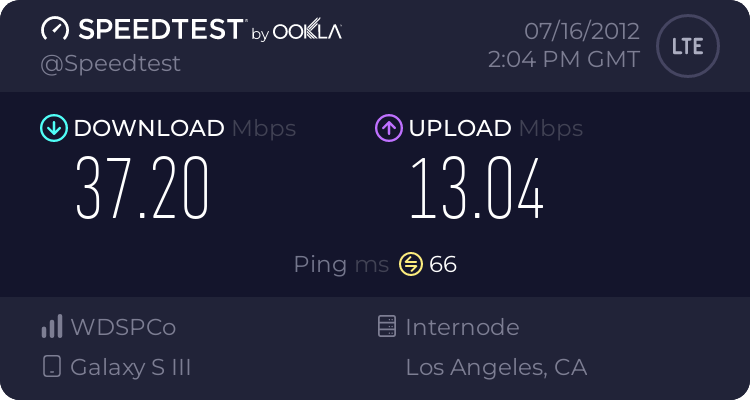
people are making way too much out of that video. people are pulling down in the 20s right now.

sprint is supposedly building its network in such a way that converting to LTE/R10 is fairly simple, whereas vzw and att will need to rebuild much of their network infrastructure.
 
I would really just like to have good ping. I think I've mentioned this before, but I like using Splashtop, and it's a bit painful over 3G or even AT&T's faux-4G. You pretty much need 4-5 bars of the latter to even get a decent experience (video would still be choppy though).

LTE should be far better since ping rates are usually half to a quarter of what they are on HSPA+.
 
people are making way too much out of that video. people are pulling down in the 20s right now.

Sprint is supposedly building its network in such a way that converting to LTE/R10 is fairly simple, whereas vzw and att will need to rebuild much of their network infrastructure.
This.
 
Maybe I'm in the minority, but I don't think 3g is really too slow most of the time. I bought my droid bionic thinking about how amazing 4GLTE would be, and then I hardly noticed it. And now i'm back on "regular 3g" with my galaxy nexus and I don't even notice the difference.
Verizon 3G is slow.
Sprint 3G is slower.
AT&T 3G is not.
 
people are making way too much out of that video. people are pulling down in the 20s right now.

sprint is supposedly building its network in such a way that converting to LTE/R10 is fairly simple, whereas vzw and att will need to rebuild much of their network infrastructure.

uhhhh..... and do you think their infrastructure vendors are any different? It's slim pickings out there if you want to purchase eNodeB/MME/SGW/PGW. No one vendor is even close to correctly implementing R8, let alone a future release.

Also in 5 mHz you have 300 subcarriers per millisecond. given a normal cyclic prefix, we fit 14 OFDM symbols per carrier.

300 X 14 = 4200

Now assuming 64 QAM, we get 6 bits per symbol:

6 X 4200 = 25200, or 25.2 Mbps
So you have just hit channel saturation on those "20" speed tests.

Now the argument is "cell density" which is hogwash. All other carriers will be doing a 1 for 1 overlay, as eNodeB's a far cheaper than the alternatives. Not only that, no vendor is supporting Inter Carrier Interference Cancellation, so they will still have to deal with the fact that every cell (sector) interferes with it's neighbors. IC-IC chops up the already sparse spectrum anyways.
 
uhhhh..... and do you think their infrastructure vendors are any different? It's slim pickings out there if you want to purchase eNodeB/MME/SGW/PGW. No one vendor is even close to correctly implementing R8, let alone a future release.

Also in 5 mHz you have 300 subcarriers per millisecond. given a normal cyclic prefix, we fit 14 OFDM symbols per carrier.

300 X 14 = 4200

Now assuming 64 QAM, we get 6 bits per symbol:

6 X 4200 = 25200, or 25.2 Mbps
So you have just hit channel saturation on those "20" speed tests.

Now the argument is "cell density" which is hogwash. All other carriers will be doing a 1 for 1 overlay, as eNodeB's a far cheaper than the alternatives. Not only that, no vendor is supporting Inter Carrier Interference Cancellation, so they will still have to deal with the fact that every cell (sector) interferes with it's neighbors. IC-IC chops up the already sparse spectrum anyways.

Haha, I don't think many here will be able to argue on that level with you. 😛 But it definitely sounds like you know your stuff.
 
Back
Top