

William Gaatjes
Lifer
I want to provide some insight for those interested.
I finally have a proper theory about why my back went bad.
It is all quite common for those people that have experienced it or have some form of medical profession in the direction of physiology. But not for people who do not know about it.
After doing a lot of reading, i can give some insight and perhaps help other people to prevent living with constant (but luckily mild) pain. I do have to write, that occasionally it is not mild at all and unfortunately most of the time i have serious concentration problems from it and when i have stress(which increases muscle tension) i wake up at night in pain. And most of the time i won't be able to sleep again, especially if stress related factors keep me from relaxing my body. This is a very vicious negative spiral indeed. Because stress and my constant back pain i can hardly sleep anymore. After going crazy almost for a while because of sleep deprivation, i finally received and found the strength to regain my sanity again. But here is the background story.
Years ago when i was doing jogging, i stepped with my right leg in a hole in the street (Loose tile) and i heard something snap in my lower back. It did not hurt at the time and i did not seem to have any pain or problems with it. After some stretching i just went on jogging.
But i never realized that i was becoming less flexible in my legs since then.
I had no problem bending forward as low as possible with my hands flat on the ground next to my feet. Now i can hardly get my hands at ankle height after a serious warm up and work out.
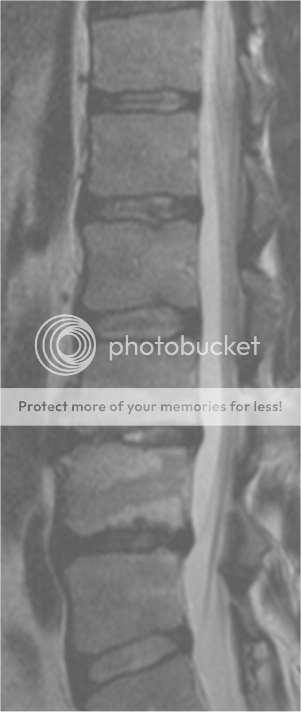
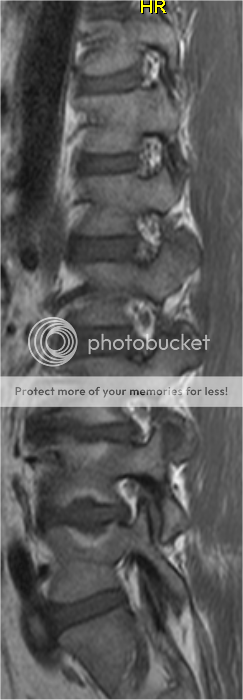
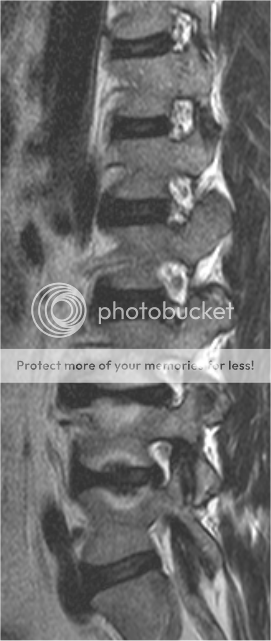
It is very likely that about 11 to 15 years ago i hurt my SI joint while stepping into that hole. Since then my spine has become more problematic, but i only noticed it about 6 years ago when i was moving furniture at my work at the time. Since then i have been having serious problems with my spine. Everyday events of life increase muscle tension because of stress. This also causes pressure on my intervertebral discs. Especially in the lumbar section of the spine. This caused that i had a mild form of what the doctors call "anterieure fytvorming". From what i can understand of it, roughly translated, this means bone growth in the form of crystals and sharp edges on bones or joints. I assume this causes damage in the surrounding tissues when a lot of pressure is applied and then a local inflammation will occur causing reduced movement and even more pain. Constant inflammation causes even faster degradation of the vertebra and the cartilage covering the intervertebral discs.
As can be seen in these pictures :

http://en.wikipedia.org/wiki/Sacroiliac_joint
After MRI and Xray scans it was revealed that i had a mild form of scoliosis in my spine about 4 years ago. But no SI problems according to the doctor.
I should note that when i stepped into the room, the doctor mentioned that he expected a man about 20 years older than me based on the degradation of my spine.
However, about a year ago, the best physiotherapist i ever had, had determined that my SI joint was severely locked in place and that i had no more movement in it. Since then i have been reading about the SI joint and it seems that a lot of spinal problems start with an unrecognized but serious issue in the SI joint. I have been doing my back exercises to increase core stability. And now i also do exercises to regain movement and flexibility in my SI joint. I also do exercises to increase the strength of all the muscles on my back. At the moment i do mainly exercises to do a work out for the muscles on my back and for the lower abdominal muscles. It seems to be paying of, but sometimes when i do my spine exercises, i sound like a xylophone.
But it does not hurt anymore and when my spine is flexible enough, i have no pain as long as i am walking around. But when i stay too long in a stationary position, it starts to hurt after a while and i need to stretch my spine again by stretching out.
More information here.
http://forums.anandtech.com/showthread.php?t=2250979
If you have any of these complaints, go to your physiotherapist immediately before you end up like me. This is not an attention post. I just like to help out.
I finally have a proper theory about why my back went bad.
It is all quite common for those people that have experienced it or have some form of medical profession in the direction of physiology. But not for people who do not know about it.
After doing a lot of reading, i can give some insight and perhaps help other people to prevent living with constant (but luckily mild) pain. I do have to write, that occasionally it is not mild at all and unfortunately most of the time i have serious concentration problems from it and when i have stress(which increases muscle tension) i wake up at night in pain. And most of the time i won't be able to sleep again, especially if stress related factors keep me from relaxing my body. This is a very vicious negative spiral indeed. Because stress and my constant back pain i can hardly sleep anymore. After going crazy almost for a while because of sleep deprivation, i finally received and found the strength to regain my sanity again. But here is the background story.
Years ago when i was doing jogging, i stepped with my right leg in a hole in the street (Loose tile) and i heard something snap in my lower back. It did not hurt at the time and i did not seem to have any pain or problems with it. After some stretching i just went on jogging.
But i never realized that i was becoming less flexible in my legs since then.
I had no problem bending forward as low as possible with my hands flat on the ground next to my feet. Now i can hardly get my hands at ankle height after a serious warm up and work out.
It is very likely that about 11 to 15 years ago i hurt my SI joint while stepping into that hole. Since then my spine has become more problematic, but i only noticed it about 6 years ago when i was moving furniture at my work at the time. Since then i have been having serious problems with my spine. Everyday events of life increase muscle tension because of stress. This also causes pressure on my intervertebral discs. Especially in the lumbar section of the spine. This caused that i had a mild form of what the doctors call "anterieure fytvorming". From what i can understand of it, roughly translated, this means bone growth in the form of crystals and sharp edges on bones or joints. I assume this causes damage in the surrounding tissues when a lot of pressure is applied and then a local inflammation will occur causing reduced movement and even more pain. Constant inflammation causes even faster degradation of the vertebra and the cartilage covering the intervertebral discs.
As can be seen in these pictures :
http://en.wikipedia.org/wiki/Sacroiliac_joint
After MRI and Xray scans it was revealed that i had a mild form of scoliosis in my spine about 4 years ago. But no SI problems according to the doctor.
I should note that when i stepped into the room, the doctor mentioned that he expected a man about 20 years older than me based on the degradation of my spine.
However, about a year ago, the best physiotherapist i ever had, had determined that my SI joint was severely locked in place and that i had no more movement in it. Since then i have been reading about the SI joint and it seems that a lot of spinal problems start with an unrecognized but serious issue in the SI joint. I have been doing my back exercises to increase core stability. And now i also do exercises to regain movement and flexibility in my SI joint. I also do exercises to increase the strength of all the muscles on my back. At the moment i do mainly exercises to do a work out for the muscles on my back and for the lower abdominal muscles. It seems to be paying of, but sometimes when i do my spine exercises, i sound like a xylophone.
But it does not hurt anymore and when my spine is flexible enough, i have no pain as long as i am walking around. But when i stay too long in a stationary position, it starts to hurt after a while and i need to stretch my spine again by stretching out.
More information here.
http://forums.anandtech.com/showthread.php?t=2250979
If you have any of these complaints, go to your physiotherapist immediately before you end up like me. This is not an attention post. I just like to help out.
Last edited:


