• We’re currently investigating an issue related to the forum theme and styling that is impacting page layout and visual formatting. The problem has been identified, and we are actively working on a resolution. There is no impact to user data or functionality, this is strictly a front-end display issue. We’ll post an update once the fix has been deployed. Thanks for your patience while we get this sorted.

Question Speculation: RDNA3 + CDNA2 Architectures Thread

Page 233 - Seeking answers? Join the AnandTech community: where nearly half-a-million members share solutions and discuss the latest tech.
After their lies in the 7900XTX/XT reveal I will be mentally taking 10% off at least and waiting for reviews. Prior to that reveal they had a solid track record of their presentation numbers being pretty on the money, no idea why they flushed that down the loo.
If MLID is to be believed, AMD had to sacrifice some of the RDNA3 performance for stability and bug workarounds in the drivers.
 
It's hit or miss. Zen team keeps announcing killer product after killer product. Meanwhile the RDNA team is disappointing even itself.

I can agree with that, sadly. N21 products (6900XT/6950XT/6800XT/6800) were pretty well a smash hit. Everything else below that, and everything else newer since has been a bit.. disappoint.
 
One week for the next disappointment, I'm so excited... 😕
Surprise me AMD.
Well, we have the baseline, by calculating what percentage Navi32 is vs. Navi31.

So the likelihood is that Navi32 will not fall below this baseline. So then, there is baseline with some room on the upside. That's what we should be watching for. Some upside over the base line or none.
 
I can agree with that, sadly. N21 products (6900XT/6950XT/6800XT/6800) were pretty well a smash hit. Everything else below that, and everything else newer since has been a bit.. disappoint.
IDK, the 7900XTX had some decent cards at the high end, but it was best to get the chonker cards from Sapphire/Powercolor etc. And the other RDNA2 cards were pretty good in general, particularly the 6700XT and 6750XT. The 6600XT and 6600 were also decent. The main issue was the RX 6500, and the sometimes overpriced 7900 series.
 
IDK, the 7900XTX had some decent cards at the high end, but it was best to get the chonker cards from Sapphire/Powercolor etc. And the other RDNA2 cards were pretty good in general, particularly the 6700XT and 6750XT. The 6600XT and 6600 were also decent. The main issue was the RX 6500, and the sometimes overpriced 7900 series.
N22 had a bad balance of specs in my opinion. Too much BW and IC for only 40CU.
Should have been 48CU, 192-bit and 64MB IC for the same die size or a bit less.

N24 was bad as you said. Their design choices crippled It a bit too much.
There were 3 big misses.
1. missing media encoding/decoding support
2. 4GB Vram combination with PCIe4 4x
3. very high clocks for 6500XT causing very high TDP

Paired with 8GB Vram It performed decently.
Should have limited TBP to 75W and lowered boost to 2250-2300MHz, higher clocks were already pointless when It just didn't have the required BW.
It was evident If you compared It to RX 6400. Only 28% difference at 1080p despite having 61% more TFLOPs(+33% CU and 21% higher boost).
 
N24 was bad as you said. Their design choices crippled It a bit too much.
There were 3 big misses.
1. missing media encoding/decoding support
2. 4GB Vram combination with PCIe4 4x
3. very high clocks for 6500XT causing very high TDP

I think that you need to remember that this chip was probably never intended for desktop and was only released there due to the shortages.

In a laptop, two of your three misses aren't as much of an issue:
1. All mobile Zen 3 chips have a basic GPU and can thus be used for media encoding. In general, laptops with a discrete GPU pretty much always have an APU where the discrete GPU is only used for heavy tasks.
3. In a laptop, the clock speeds are kept much lower, so the chip is very efficient

The mobile Zen 3 APU's are limited to PCIe 3, so that is still an issue, although with the lower clocks it might not matter as much.
 
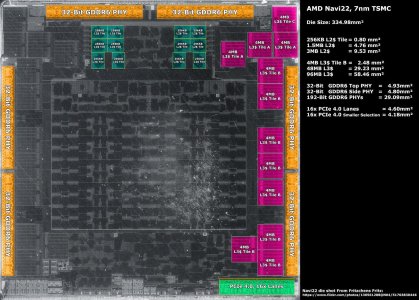
N22 had a bad balance of specs in my opinion. Too much BW and IC for only 40CU.
Should have been 48CU, 192-bit and 64MB IC for the same die size or a bit less.

That was not a viable configuration with the elements they had. IC is tied to memory controllers, with 192-bit it's either 48 or 96MB. They decided 48 was too little.
 
That was not a viable configuration with the elements they had. IC is tied to memory controllers, with 192-bit it's either 48 or 96MB. They decided 48 was too little.
Not 100% sure If It's really tied to It, but let's say It is.
N22 wit 192-bit bus has 24*4MB=96MB or 4*4MB per 32-bit GDDR6.
Fgrpi3VWYAAOcvW.jpg
So It can be either 24MB, 48MB, 72MB or 96MB. 72MB could have been a good compromise although a bit unusual number.
 
Last edited:
Not 100% sure If It's really tied to It, but let's say It is.
It's a memory-side cache, where the IC is directly bound to and part of the same logical structure as a single memory controller channel.

N22 wit 192-bit bus has 24*4MB=96MB or 4*4MB per 32-bit GDDR6.
View attachment 84579
So It can be either 24MB, 48MB, 72MB or 96MB. 72MB could have been a good compromise although a bit unusual number.

While GDDR6 chips are 32-bit, it actually has two 16-bit channels per chip⁰, and each of those has it's own IC. With 4MB slices, you can have one or two per channel, meaning 12*4= 48MB or 12*4*2 = 96MB.

0: See page 2 of the standard. (free, but requires registration&login)
 
While GDDR6 chips are 32-bit, it actually has two 16-bit channels per chip⁰, and each of those has it's own IC. With 4MB slices, you can have one or two per channel, meaning 12*4= 48MB or 12*4*2 = 96MB.

0: See page 2 of the standard. (free, but requires registration&login)
That 4MB slice doesn't need to be that size, right?
Then It can be 1MB, 2MB, 3MB, 4MB or even more.
In total 24MB, 48MB, 72MB or 96MB with 2 slices per channel.
 
Last edited:
That 4MB slice doesn't need to be that size, right?
Then It can be 1MB, 2MB, 3MB, 4MB or even more.
In total 24MB, 48MB, 72MB or 96MB with 2 slices per channel.
In principle, absolutely yes, but that's more development work. AMD designed a single 4MB slice, and used it in all the RDNA2 products, with N23 and N24 using one slice per channel, and N21 and N22 using two per channel.
 
Finally! Maybe...

Fixed Issues​

* Improvements to high idle power when using select multi-display setups with mixed high-resolution and high refresh rate displays on Radeon™ RX 7000 series GPUs with variable refresh rate enabled. Further optimizations are being investigated to improve idle power on additional display configurations.
https://videocardz.com/driver/amd-radeon-software-adrenalin-23-8-1
 
Back
Top