• We’re currently investigating an issue related to the forum theme and styling that is impacting page layout and visual formatting. The problem has been identified, and we are actively working on a resolution. There is no impact to user data or functionality, this is strictly a front-end display issue. We’ll post an update once the fix has been deployed. Thanks for your patience while we get this sorted.

Question Speculation: RDNA2 + CDNA Architectures thread

Page 106 - Seeking answers? Join the AnandTech community: where nearly half-a-million members share solutions and discuss the latest tech.
If you checked his follow up Tweet he also stated that the XT was over 3070 perf. Not matching a 3070 or targeting a 3070 in terms of where performance should actually lie, just the 3070 is likely what would be have used as a comparison point.

Now you have an XTX version on top with more CUs and probably higher clocks (usually how AMD segments these dies). You can probably guess where performance will be closer to landing at this point.
 
Last edited:
Now you have an XTX version on top with more CUs and probably higher clocks (usually how AMD segments these dies). You can probably guess where performance will be closer to landing at this point.
Barely matching a 3080 at best? Assuming "faster than a 3070" is like 15% faster, considering VCZ's words, and that XTX is another 15% faster like the 5700XT compared to the 5700.

In the first place, XTX having more CUs would be surprising, honestly.
 
Barely matching a 3080 at best? Assuming "faster than a 3070" is like 15% faster, considering VCZ's words, and that XTX is another 15% faster like the 5700XT compared to the 5700.

In the first place, XTX having more CUs would be surprising, honestly.

If AMD have a 500mm^2 die (not something I am convinced of but anyway) with cache and a 256 bit bus it may be entirely possible they have decided to have 3 CU bins for it to make up for the naturally lower yield a larger die has. I could imagine 80CU, 72CU and 64CU parts all being built off of a single die.

This would also work with N23 at 40CUs, N22 at 56CUs (+40%) and N21 at 80CUs (+43%). That would seem like a stack AMD could use to fill the bulk of the market.
 
Very interesting patent. Essentially it boils down to (to use the example used in the patent itself): Compressing data in cache is a good idea since cache space is limited. Since L2$ has low latency of few cycles, the additional latency of compressing the data makes it unfeasible to use there. But since L3$'s latency is significantly higher and L2$ needs to talk to it anyway, the latency from compressing the data is masked there. Thus compression of data in L2$ is achieved by letting L3$ compress the data while L2$ waits for the data to arrive during the usual latency after it requested it. (It also discusses having several levels of compression that are picked as best fit at that point.)
 

Or i missed something, or It's used already
images
 
Very interesting patent. Essentially it boils down to (to use the example used in the patent itself): Compressing data in cache is a good idea since cache space is limited. Since L2$ has low latency of few cycles, the additional latency of compressing the data makes it unfeasible to use there. But since L3$'s latency is significantly higher and L2$ needs to talk to it anyway, the latency from compressing the data is masked there. Thus compression of data in L2$ is achieved by letting L3$ compress the data while L2$ waits for the data to arrive during the usual latency after it requested it. (It also discusses having several levels of compression that are picked as best fit at that point.)
I still think this will enable some sort of multi-GPU down the line. Having the L3 shared, or through some sort of crossbar will fix many issues.
 
The backtrack from VideoCardz was rather curious to me since it most definitely appears to be false. The numbers don't add up, and then there was that OpenVR leak...

For the record:

Navi 21: 2050-2200 MHz clocks
Navi 22: 2300-2500 MHz clocks

Navi 21: 80CU
Navi 22: 40 CU

If Navi had scaling issues, they would not be releasing Navi 21. Navi 22 is more than capable of competing with the 3070 and 3070ti. I suspect that one of the leakers got caught and is now attempting to backpedal...

EDIT: The numbers I posted came directly from BIOS and source code dumps provided by AMD.
 
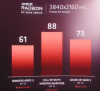
3fps slower in gears 5 according to guru3d
10fps according to

 
3fps slower in gears 5 according to guru3d

Depends on the benchmark.

Also note that AMD is using a new, unreleased CPU for the comparison.

That being said, those who claimed Big Navi was only competing with the 3070...RIP.
 
Yeah, you shouldn't try and directly compare to reviewer scores from this. There's all kinds of variables at play. This does show though that Big Navi is at least close to 3080 at worst in 3 these games.
 
Back
Top