Should the US develop a new bomber?

Page 2 - Seeking answers? Join the AnandTech community: where nearly half-a-million members share solutions and discuss the latest tech.

Freshgeardude

Diamond Member
Jul 31, 2006
4,506
0
76
When was the last major disease cured? When was the last world changing invention? The last massive infrastructure overhaul/improvement phase? The only thing we've seen in the last few decades is small improvements and proliferation of consumerism, alongside serious decay and weakening. You cannot compare an extra 10 points in sysmark to launching a rocket into space. You cannot compare coke zero to the polio vaccine. What we have today is nothing compared to what went on during prior periods.

This is actually normal, as invention and innovation are largely cyclical. The point, however, was that high taxation is NO barrier to innovation and can in fact encourage it (since it's done by individuals, NOT companies or monied research).


recently there have been many methods appearing to cure cancer that are still in testing stages

I saw a video of a man who explained how he cured his own paralysis (neck down) with a technology he wants to put out which is in early fda approval stages.

Stem cells have a GREAT possibility which has been picking up in recent years.

Bill gates recently went on saying they created a jell that's supposedly blocking 50% of aids infections.

These are the majority of health problems today, which are being solved.

But none of these can be done without money.


Have you seen computer technology?

20 years ago, 20mb was considered a lot and VERY expensive in an HD. now 2tb is considered a lot (for the average person) and what 175 at most it costs?

computers used to take up entire floors, now they fit snuggle in your pocket.

CELL PHONES? lol

Cell phone technology has recently seen a big boom, starting with the iphone (i am no apple fanboy, just stating facts) which brought others into the picture (android?) and now we have phones more powerful than computers were 5-10 years ago.

ALL requires MONEY to happen.

Sure, there is that one poor person who invents a technology and becomes rich, but lately, more innovation is coming from the top than the bottom
 
Last edited:
May 16, 2000
13,522
0
0
You make it sound as if military spending is the biggest problem of the US. Both the military R&D AND military procurement are about $250b combined, which is not a small amount, but nothing approaching most of the controversial civil issues.
The MIC has many positive effects - it helps train loads of engineers, it provides countless jobs, and perhaps most interestingly, it's one of the last strong export industries that are left in the US. If you want to reduce spending, cut personnel. Cutting R&D programs is foolish.

Some of the biggest strides in electronic development, materials and aviation (including space exploration, early NASA days) were the direct result of military programs.

Apart from that, don't forget that the reason US sustains its debts and massive resource consumption is the most powerful military in the world. Perhaps it's unjust, but it's extremely convenient.
Unless you want to compete with China and India for resources and global control, I suggest it's kept this way.

As for the bomber itself, unless there is a way to develop stealthy aircraft for a fraction of the procurement budget of the B-2, I think it's not necessary. Longer range UAVs, cruise missiles and expansion of the navy strike force are better options. A B-52 operating in a hostile environment is a sitting target, unless air defenses are taken out, which requires a large scale war effort and not always desirable politically.
The one thing it's good for is hammering a target for days on end, but with today's warfare, making long round trips to home bases is pretty wasteful.

I think the future is in the sea, as a launch platform for improved UAVs, JSF-type strike aircraft and cruise missiles.

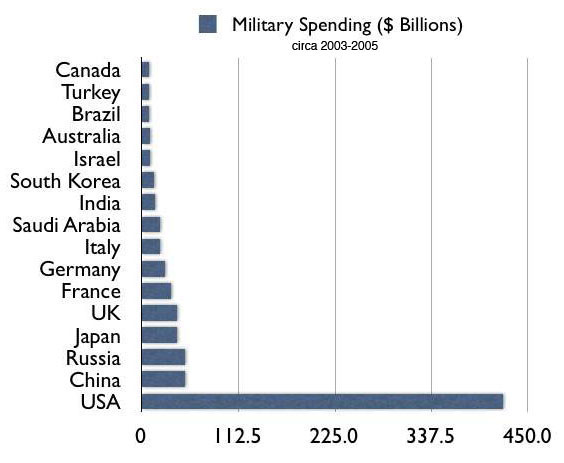
Silly me, why am I complaining...it's not like we overspend on it or anything, despite its near total uselessness.

WorldMilitarySpending.jpg


450px-Fy2008spendingbycategory.png


The difference between military spending (the second highest portion of our budget) and the rest is that military spending has VERY few returns. Yes, there is some innovation, but we KNOW from thousands of years of history that it's not the primary, or even a terribly significant source of innovation. Moreover we can assume that the accidental innovations stemming from military research could be attained from direct science/innovation research WITHOUT forced military application, and therefore less waste. Yes, there is also an employment issue, and that's really the biggest hit in my opinion. However, if those employees were added to the payrolls of police, fire, environmental cleanup, urban rejuvenation, or other efforts how much more direct improvement and training would be seen?

To even CONSIDER sustaining debt through threat of coercion pretty much labels you insane, or evil. There can be NO good come from our financial situation, and NO good from the 'might makes right' mindset. The consumption issue is even worse...it's nothing short of running towards obliteration head first. It's like running through plate glass on pcp...you may be able to do it because you don't feel it, but you're still going to bleed to death in short order.

Look, I'm not anti-military, hell I'm ex-military and loved doing my bit. What I am is anti-stupid, and our current financial and military situation is just that. I'm also anti-fascist and anti-authoritarian, and those are all that can be derived from our course since wwii (as Eisenhower warned of so eloquently). We are on the verge of being FAR worse than ever we feared of mother Russia. When a company becomes super-powered by comparison we wisely break it up. How much more dangerous when a NATION becomes super-powered by comparison?
 

Moonbeam

Elite Member
Nov 24, 1999
74,873
6,784
126
A man who lives in a mansion has an iron gate and a man who lives in a hut can't give away the moon.
 
May 16, 2000
13,522
0
0
recently there have been many methods appearing to cure cancer that are still in testing stages

I saw a video of a man who explained how he cured his own paralysis (neck down) with a technology he wants to put out which is in early fda approval stages.

Stem cells have a GREAT possibility which has been picking up in recent years.

Bill gates recently went on saying they created a jell that's supposedly blocking 50% of aids infections.

These are the majority of health problems today, which are being solved.

But none of these can be done without money.


Have you seen computer technology?

20 years ago, 20mb was considered a lot and VERY expensive in an HD. now 2tb is considered a lot (for the average person) and what 175 at most it costs?

computers used to take up entire floors, now they fit snuggle in your pocket.

CELL PHONES? lol

Cell phone technology has recently seen a big boom, starting with the iphone (i am no apple fanboy, just stating facts) which brought others into the picture (android?) and now we have phones more powerful than computers were 5-10 years ago.

ALL requires MONEY to happen.

Sure, there is that one poor person who invents a technology and becomes rich, but lately, more innovation is coming from the top than the bottom

There are numerous medical breakthroughs in the pre stages, and that's awesome (and overdue). Isn't it interesting how for four thousand years we've somehow managed to perform at least equally well against medical issues WITHOUT spending all that money you say is required? Isn't it somewhat telling that the medical 'innovation' we see today is usually treating symptoms with drugs that require drugs to counter their side effects...all the while profit margins on pharmaceutical companies go through the roof, and the upper crust absorbs a higher percentage of wealth than ever before? In other words, you want taxes from the middle class to pay companies to develop methods of getting more money from the poor to make themselves more wealthy. Somehow I'm not a big fan of that plan.

As for the computer evolutions, yes it's convenient but it's mostly improvement of existing technology driving further consumerism...not breakthroughs to make meaningful changes in the world.

It's not 'that one person', it's the majority of all invention and innovation throughout all of time. It's also not them becoming rich, since most innovators see next to nothing from their invention. After taking a class on invention and innovation I was FLOORED to find out how little profit was had from all of human progress, and how little progress is stemming from all the current profits.
 

Pocatello

Diamond Member
Oct 11, 1999
9,754
2
76
Strategic bombers are still important, they can fly long distance and carry a large load, in case we don't have a friendly air base in the region. I see something like the Northrop Grumman X-47B UCAV to fulfill the need of a bomber. It's still in development and doesn't carry a huge load of a strategic bomber. Any future bomber needs to be a lot cheaper to build and maintain than the B-2 and the B-1B. But I don't trust the U.S Air Force with its current mindset, which is obsessed with building a magic bullet. The F-22 and the B-2 are magic bullets but too few in numbers to be useful because they are too expensive.
 

irishScott

Lifer
Oct 10, 2006
21,562
3
0
And surrendering to the military industrial complex is far, FAR worse. There were VERY good reasons the nation was formed without a standing military, and even after starting one it was kept minimalist as much as possible. The expansion of the military, and the executive use thereof, is probably the greatest failing of American evolution.

The expanding of our military is arguably what won WWII, and was definitely a factor in winning the Cold War. It also allowed us to kick out Saddam in the 90s, and during many natural disasters it was our military that was delivering humanitarian aid on a massive scale other nations are simply not capable of.

I agree we shouldn't just surrender to the military industrial complex, but that's no argument to get rid of it either.
 

piasabird

Lifer
Feb 6, 2002
17,168
60
91
A prolific inventor that died a relatively wealthy man:

John Browning was the greatest gun designer in history and the founder of Browning Arms. A few of his more notable designs include the Winchester 1885 High Wall single shot rifle, the Winchester Model 94 lever action rifle (the best selling civilian rifle of all time), the military BAR light machine gun (veteran of WW I, WW II, and Korea), the Colt Model 1911 autoloading pistol, the Browning Hi-Power (P-35) autoloading pistol (the first "wonder 9"), the Auto-5 shotgun (the first successful autoloading shotgun), and the Superposed double-barrel shotgun (which popularized the type all over the world). All of the guns mentioned above, except the military BAR, are still in production today, an amazing tribute to the brilliance of their design.

The Brownings hold or were responsible for over 100 patents in firearms manufacture. His design for the 1911 45 is still considered to be a brilliant and dependable design. His favorite activity was hunting, and that was one of his great loves in life. As soon as he developed a patent he moved on to designing other weapons that were not even needed yet. He invented the water cooled machine gun 15 years before it was needed in WWII.
 
Last edited:

CaptnKirk

Lifer
Jul 25, 2002
10,053
0
71
Bombers are useful in that they can loiter over a battle field area. A cruise missile can't really do that.

If we're going to build a new bomber, we should do it right:

-Build a prototype or two to work out the major bugs
-Then start assembly production - you don't have to get it perfect the first time, but each subsequent bomber should be better than the previous as problems are encountered and fixed. Incorporate fixes into the previously built bombers.
-Build different blocks if new technologies come up you want implemented as well. Stop moving the goal posts.
-If you say you're going to order X, order X. Don't constantly reduce the number ordered, as that also drives up price per unit. A big reason why the B-2 was the $2 billion bomber.

The F-117 program was a good example of a project run right. (Read Skunk Works for more details) Too bad it wasn't enough to kill the retarded B-1 project (a big waste of money).[/b}


The F-117 was a very small compact vehicle which utilized peculiar angularity to deflect radar signal return.
It had very little range or payload capacity.

The 'Original' B-1, before it was spayed and neutered by Congressional budget cutting,
was a concert of technology up to that time in history.
The capability to fly supersonic was removed because it would cost a million dollers p[er engine nacelle less,
which eliminated nearly half of it's performance capacity.

When Carter cut the program in 1976, it's advantage over Soviet Observance had dissapeared,
they had developed the synthetic side looking radar that enabled them to fly above and look down and locate the B-1's for interception,
eliminatinng the terrain following low altitude approach that had previously been able to defeat their detection methods.

Retreival of the program under Reagan, and building out the fleet from where it had been placed in suspended animation
was little more than a jobs program, as the B-1 as stripped to meet cost mandates was mostly a dysfunctional compromise.

Had it been allowed to continue in it's 1973 design concept, before budget constraints,
it would have been an advanced system only until until 1980 . . .
IF it had been left with supersonic capabilities.
It had been planned to evolve generationaly with block improvements as they were developed.
The major change from the B-1A to B-1B was nothing more than changing the escape system
from a capsule environment to individual cannisters, since the 'Dumbo-Ears' stabilizers would not deploy
at velocities above 0.9 Mach - dynamic overpressure pinned them to the sides of the caspule
and the rocket extraction system spun them up like a centrifuge making them unsurvivable.
 

Freshgeardude

Diamond Member
Jul 31, 2006
4,506
0
76
There are numerous medical breakthroughs in the pre stages, and that's awesome (and overdue). Isn't it interesting how for four thousand years we've somehow managed to perform at least equally well against medical issues WITHOUT spending all that money you say is required? Isn't it somewhat telling that the medical 'innovation' we see today is usually treating symptoms with drugs that require drugs to counter their side effects...all the while profit margins on pharmaceutical companies go through the roof, and the upper crust absorbs a higher percentage of wealth than ever before? In other words, you want taxes from the middle class to pay companies to develop methods of getting more money from the poor to make themselves more wealthy. Somehow I'm not a big fan of that plan.

As for the computer evolutions, yes it's convenient but it's mostly improvement of existing technology driving further consumerism...not breakthroughs to make meaningful changes in the world.

It's not 'that one person', it's the majority of all invention and innovation throughout all of time. It's also not them becoming rich, since most innovators see next to nothing from their invention. After taking a class on invention and innovation I was FLOORED to find out how little profit was had from all of human progress, and how little progress is stemming from all the current profits.


to your answer about medical breakthroughs: it is because all of the simple medical mysteries are not as complicated as say aids/ cancer/ spinal injury where you can shoot some antibiotic to fix it.

and on that note, penecillin, in YOUR terms, is considered a continuation of existing technology. Other antibiotics existed before.

and on that note, computers.

Innovation brought better technology for computers. not so so much consumerism, although that was important.

without innovation, the internet wouldnt have been made and we wouldnt be having this conversation.

hard drives would probably be breaking 1gb, and cell phones that can go on the internet wouldnt exist.


all of the computer oriented inventions came with money.
 

CycloWizard

Lifer
Sep 10, 2001
12,348
1
81
When was the last major disease cured? When was the last world changing invention? The last massive infrastructure overhaul/improvement phase? The only thing we've seen in the last few decades is small improvements and proliferation of consumerism, alongside serious decay and weakening. You cannot compare an extra 10 points in sysmark to launching a rocket into space. You cannot compare coke zero to the polio vaccine. What we have today is nothing compared to what went on during prior periods.

This is actually normal, as invention and innovation are largely cyclical. The point, however, was that high taxation is NO barrier to innovation and can in fact encourage it (since it's done by individuals, NOT companies or monied research).
I'm fairly certain Freshgeardude did a pretty good job of covering examples. The difference is that innovation happens so quickly and over disparate areas such that our brains can't even register the advent of dramatic change anymore: change is now perceived as the status quo. There have been plenty of studies which show an exponential increase in the rate of innovation. You can't say that a lack of cures is evidence of innovation, as a lack of cures is more due to the complexity of the diseases which have not yet been cured. Diseases which are one-size-fits-all and affect everyone the same have already been cured, whereas diseases like cancer and Alzheimers which affect each patient differently require personalized medicine. Since individuals can now be genotyped in a matter of days rather than decades, it's only a matter of time until this sort of treatment becomes standard. I'd recommend reading this:
http://www.newscientist.com/article/dn7616-entering-a-dark-age-of-innovation.html
It's an article based on predictions which share your viewpoint (i.e. that innovation per capita is declining), but with contrasting viewpoints to the contrary.

You can claim that high taxation is no barrier to innovation, but it's just a claim with nothing to back it up at this point. Innovation is useless if it never achieves commercialization, and how does one go about doing that without money? I'd love to know because I have plenty of ideas that are worth plenty of money, but I lack the capital to commercialize them. The only way government helps me here is through SBIR/STTR grants, which take money from the wealthy and award it based on quasi-peer review to help commercialize such ideas. However, this vehicle is very limited in scope and is generally less efficient than securing funding through venture capitalists, who also aid in project/product management. Further, SBIR/STTR explicitly favor women/"financially disadvantaged" companies, so people like me who are white males paying plenty of taxes get bent over as usual.
 

Steeplerot

Lifer
Mar 29, 2004
13,051
6
81
Makes you wonder, if it were not for our friends at the Military Industrial Complex what would Americans have left to do besides jobs in transporting shit from china to wal marts and overpaid pundits on cable news and radio apologizing for the corporations rape of our manufacturing base?
 
Last edited by a moderator:
May 16, 2000
13,522
0
0
You can claim that high taxation is no barrier to innovation, but it's just a claim with nothing to back it up at this point. Innovation is useless if it never achieves commercialization, and how does one go about doing that without money? I'd love to know because I have plenty of ideas that are worth plenty of money, but I lack the capital to commercialize them. The only way government helps me here is through SBIR/STTR grants, which take money from the wealthy and award it based on quasi-peer review to help commercialize such ideas. However, this vehicle is very limited in scope and is generally less efficient than securing funding through venture capitalists, who also aid in project/product management. Further, SBIR/STTR explicitly favor women/"financially disadvantaged" companies, so people like me who are white males paying plenty of taxes get bent over as usual.

Except for all of recorded history, you're right, I have no support. Already brought up the high tax rates throughout most of US history, while we took the lead from Europe on innovation. You can also look at earlier periods across the globe where taxation was so extreme it led to an option between starvation or revolution, yet still mankind somehow managed to invent, well, pretty much everything you've ever seen or learned.

Your innovation is useless without commercialization comment is the most disgusting load of horseshit I've read yet in this thread. So, relativity, useless. Trig, useless. Scientific method, useless. Art, useless. Tools, useless. Oh wait, that's right...ALL of those things led to other discoveries, or were utilized with NO commercialization for thousands of years bringing us to where we are now.

Thought is purity, and it exists COMPLETELY separate from economy. Innovation is nothing more than these thoughts which expand our universe. The commercialization of those thoughts is nothing but greed, laziness, or exploitation of human failings.
 

Bateluer

Lifer
Jun 23, 2001
27,730
8
0
And surrendering to the military industrial complex is far, FAR worse. There were VERY good reasons the nation was formed without a standing military, and even after starting one it was kept minimalist as much as possible. The expansion of the military, and the executive use thereof, is probably the greatest failing of American evolution.

Most of your comments are inane and idiotic, but this one makes a little sense. The USA's early military was allowed to pretty much decay between 1783 and 1812. Training and equipment, as well as numbers were extremely lacking. A standing, professional military force is essential for any nation.

Does the US defense budget need to be 50% our total GDP? No. We could easily scale that way back, trim a lot of the fat out and still be able to tangle with any nation on Earth as well as be able to ramp up quickly in the event of a global conflict.
 

Darwin333

Lifer
Dec 11, 2006
19,946
2,330
126
Bullshit. Nuclear power was something, but didn't completely reshape the landscape (especially in America where it saw little use). In the US it provides less than 20% of total usage, and only 18% worldwide. It's ridiculously expensive, has VAST environmental impact, has no permanent disposal solutions currently available, can only be deployed in limited areas, is a target for espionage and vulnerable to attack, etc. Basically nothing changed in most of the world as a result of nuclear power...at least so far.

And it is still vastly better than any other conventional power source we currently have. It has VASTLY less environmental impact than other conventional sources, the waste that it does generate is extremely condensed and actually stored (regardless of the fact that no permanent storage solution exists) whereas conventional sources DO have a permanent storage solution.... the atmosphere, every energy source is a target for attack and our nuclear reactors are the best protected, and lastly we could be able to deploy them in many more places if we hadn't lost a few decades of advancement due to politics.

I am in the solar industry and am a "true believer" in solar power but the bottom line is we will still need large generators for many decades to come. Coal, nat. gas, or nuke... take your pick. I personally think that nuclear power is the best option by far. I am especially interested in new ideas using thorium as fuel.

Innovation isn't now, nor has it ever been, about money. Most of the greatest advancements in human history were by individual people who saw little for their efforts and died paupers. Not from companies, not from governments...from poor individuals. Yes, there are other sources, but MOSTLY that's where all innovation, advancement, and discovery come from throughout all of history. This will in NO way be diminished by taxation. In fact, increased taxation, if spent correctly, would INCREASE individual advancement by providing proper social services and education opportunities to more people who may be the ones to make these discoveries (by the way, trickle down is 100% lying ignorant bullshit, if that's what you were alluding to).

The top tax rate from 1935 to 1965 was over 80%, yet we saw a period of technological advancement unmatched...at least since the initiation of the industrial revolution.

How does this fit in with your original point?

You are stating that "we" will invent all of the good stuff with or without increased .mil spending, basically it isn't one or the other.

As far as a new bomber, I have thought for a while now that we needed a new "heavy lifter" to replace the B-52 but today I am not sure if developing something like that would be worthwhile. I agree with an earlier poster, UAVs are the future. We should be building unmanned UAVs that can perform on par with our current manned fleet.
 

bruceb

Diamond Member
Aug 20, 2004
8,874
111
106
Space based offense / defense is far off and against current treaties.
We do need a newer bomber, but an alternate would be a powerplant and avionics update on the B-52.
Yes, the Air Force could use new tankers, but the KC-135 while old, is still serviceable for some time. I foresee the contract going to Boeing for new tankers. They can easily be done on the 767/777/787 series of planes.
 
May 16, 2000
13,522
0
0
And it is still vastly better than any other conventional power source we currently have.

The nuclear discussion was specifically revolving around how it came into being from military research. I was pointing out that even though that was true, it hadn't had the broad impact many tend to place on it. It supplies very little of our, or the world's, energy.


How does this fit in with your original point?

You are stating that "we" will invent all of the good stuff with or without increased .mil spending, basically it isn't one or the other.

My original point was that the money that's being essentially wasted on military focused pursuits (since we have no viable enemy requiring either conventional or nuclear force at even a fraction of the level we have available) could instead be focused directly into more pressing needs - either for immediate use or research for the future. This should provide greater gains per dollar invested since it's the primary goal of the research, and not an adaptation of military developments for civilian use.

It would be like coming out with a new drug or medical procedure which VASTLY improves the function of the appendix. That's nice and all, but since we don't need it anyway how about you figure out a way to grow my hair back instead.
 

Zorba

Lifer
Oct 22, 1999
15,613
11,256
136
The difference between military spending (the second highest portion of our budget) and the rest is that military spending has VERY few returns. Yes, there is some innovation, but we KNOW from thousands of years of history that it's not the primary, or even a terribly significant source of innovation. Moreover we can assume that the accidental innovations stemming from military research could be attained from direct science/innovation research WITHOUT forced military application, and therefore less waste. Yes, there is also an employment issue, and that's really the biggest hit in my opinion. However, if those employees were added to the payrolls of police, fire, environmental cleanup, urban rejuvenation, or other efforts how much more direct improvement and training would be seen?

Here is one example I am familiar with. Jet engine technology was developed for military use and just about every major innovation in Jet engines has come from military/NASA spending. Jet engine manufactures do not push new technology in commercial engines because it is WAY too risky. They let the government cover the risk and then apply it to commercial engines.
 

nonlnear

Platinum Member
Jan 31, 2008
2,497
0
76
Here is one example I am familiar with. Jet engine technology was developed for military use and just about every major innovation in Jet engines has come from military/NASA spending. Jet engine manufactures do not push new technology in commercial engines because it is WAY too risky. They let the government cover the risk and then apply it to commercial engines.
Are you making an argument or just an observation of the current business reality? I hope it's the latter. The only risk involved in pushing new jet technology without military gravy is a business risk induced by the fact that all the entrenched players in the market defray most of their development and regulatory risk by putting their prototypes through the military wringer first. That being the case somebody would have to be either very stupid, or waaaaay ahead of the curve to take an engine from concept to sales without any military grants. If the military machine were turned off and the jet industry had to fend for itself, it would keep on innovating. It has happened before* (albeit occasionally). It could easily become the norm if global reality dictated it.

* Consider for example the ill-fated Williams EJ22, which put a three spool, five stage compressor into a 96 lb engine. The amount of innovation needed to get this engine onto a testbed was industry-shattering. It was all for a civilian design with specs that meant no military product could be pulled off the shelf to tweak. Granted it never finished development, but it probably could have if its timelines weren't rushed due to outside business factors. If Gulfstream had been the manufacturer requesting that engine you would have a pretty amazing turbofan purpose-built for civilian aerospace using groundbreaking technology that didn't appear in any military engine.
 

SamurAchzar

Platinum Member
Feb 15, 2006
2,422
3
76
We are on the verge of being FAR worse than ever we feared of mother Russia. When a company becomes super-powered by comparison we wisely break it up. How much more dangerous when a NATION becomes super-powered by comparison?

So essentially you are suggesting that US cuts back on military to level the field with China, India and Russia?
Quite the cat to let out of the bag.
 

SamurAchzar

Platinum Member
Feb 15, 2006
2,422
3
76
Look, military procurement is sick. I recall Ben Rich's account (the guy who ran Skunk Works and responsible for the F117) of more than 1k pages generated DAILY for administration of the various projects. That's not to say the programs should be cut, instead it's the "formization" and excess bureaucracy.

As for the B52 or any typical bomber loitering outside SAM coverage - that's not really true, you can't launch the same density of attack using missiles as you can with bombs, and SAM radars have coverage of hundreds of miles. The SAM missiles themselves slightly lag behind, but when dealing with a country like China, you have to account for a air-air interception capabilities.

So I stand by my original plan - sea based strike groups, UAVs and cruise missiles.