Stoneburner
Diamond Member
the Constructicons are going to be a very sad bunch.

Haha. Yeaa its the same. I think its a pain to watch all that good competence at AMD going away. Lets hope it find its place.
Looking back, it took a team of 70 in India to design bobcat.
Seen from the inside i know it sometimes looks like you need ressources, but this history just proves there is other ways.


I'm not sure this is big or unexpected. If you look at the last official roadmaps from AMD, Vishera was the last desktop CPU. After that it was nothing but APUs. So this may mean that AMD is going to use its desktop Trinity replacement as its ONLY desktop APU and not even try to make a 'Performance' or 'Enthusiast" part. Didn't Rory previously say they were no longer going to compete in the enthusiast market? If Zambezi and Vishera are doing as badly as others say it is, why bother making its replacement? The Steamroller and Excavator architectures will continue, they just won't be released in 'Performance" parts.
The cynical among us would point out AMD hasn't built a real enthusiast CPU since Athlon II, so whats different about this news?
I can't tell if you are being sarcastic or if you do believe this to be true. FWIW, the team was neither based in India nor was it a mere 70 headcount. (there is a Bobcat designer here on these forums 😉)
For sure. There are always opportunities to do things exponentially better than the status quo, overcoming objections and hurdles seems the biggest challenge and its only when....there is no other choice and their back is against the wall that the light is seen - most people cannot see the forest from the trees, including the experts, who often become set in their own ways.
I know it take more than 100 man to put together a bobcat 🙂, and that there was multiple teams working on the project. But i remember the Hyderabad team putting all the technologies and designs together (gpu, cpu and northbridge) with assist from Austin
http://www.thehindu.com/business/companies/article944158.ece
http://www.indiatechonline.com/amds-made-in-india-chips-ontario-and-zacate-369.php
http://finance.yahoo.com/mbview/thr...d=1918832&mid=1918959&tof=23&rt=2&frt=2&off=1
Just shows it doesnt take gigantic investments.
(edit: Like teams of several thousands for the huge non synthesized cores - i know what technology cost - and thats why bobcat is important)
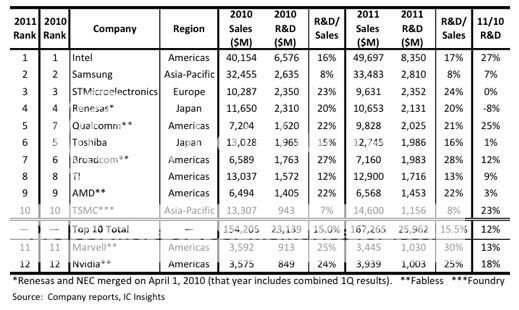

Don't remind me. I'm near the end of the IC-to-market chain (design -> EDA -> fab) and we get ridden like cheap crackwhores by the designers. 🙁Remember that bringing an IC to market doesn't end with the design team, you have layout, validation and certification teams that are involved as well. And in many cases a packaging team is involved.
Don't remind me. I'm near the end of the IC-to-market chain (design -> EDA -> fab) and we get ridden like cheap crackwhores by the designers. 🙁
I believe you, at the same time you can see the R&D budgets of fabless companies and the design costs for their products are definitely in the "staggeringly high" range.
Remember that bringing an IC to market doesn't end with the design team, you have layout, validation and certification teams that are involved as well. And in many cases a packaging team is involved.
And that is just to get an IC into the hands of the marketing folks, now they have to have a distribution network already setup with which to feed the chip into.
What made bobcat a success for AMD isn't that it was designed on a shoestring budget with a skeleton crew, but that once designed the thing sold in ridiculously high volumes which made the margins look great and actually gave AMD cashflow to sustain operations while supporting a lackluster bulldozer launch.
But Bobcat still is only what it is, which is a Via Nano beater and and Intel Atom beater, it does not really meet the market needs of the low-end (smartphones) nor the mainstream where Athlon X2 and the i3 address. To go to those markets you need a deeper team, a more expensive team.
But I do think AMD already has the ability to do it, too bad Wichita and Krishna were cancelled 🙁 Jaguar could make some gains. But what AMD is lacking is leadership that has a vision to go where it could go with those products.
I remember when JFAMD was active here and I asked him, before bulldozer released, if he saw a future for bobcat's successor to have a performance/watt advantage in the server space. He waved off the notion as silly and never happening. That was short-sighted of him IMO but it just goes to show the challenges within AMD if upper management has to convince middle-tier folks that their future required thinking outside the box, that is pure uphill battle for them.
I think its very human. Its only when confronted to the worst scenario you somehow escape your prior understanding, because your prior understanding controlling you, is put to rest by the extreme stress.
But it also happens when you are very bored. There is nothing as good for trickering innovation as a lot of boredom 🙂
Non of the experts ever bring themselves there, so you can expect no new insight from them.
I think back at Dirk vs RR, one is expert the other is not, who is more apt to make good decision? it should be Dirk but then he persisted on BD even if it had to be a dud from day one. So human nature >>> expertise.
Definition of 'Peter Principle'
An observation that in an organizational hierarchy, every employee will rise or get promoted to his or her level of incompetence. The Peter Principle is based on the notion that employees will get promoted as long as they are competent, but at some point will fail to get promoted beyond a certain job because it has become too challenging for them. Employees rise to their level of incompetence and stay there. Over time, every position in the hierarchy will be filled by someone who is not competent enough to carry out his or her new duties.
Investopedia explains 'Peter Principle'
The Peter Principle was first observed by Dr. Laurence J. Peter and published in his book "The Peter Principle" in 1968. Dr. Peter also states that a promotion to the higher-ranking job position may not necessarily reveal the employee's incompetence, but rather the new position may require different skills the employee does not possess. Dr. Peter sums up the Peter Principle with the saying: "the cream rises until it sours." The Peter Principal can be a problem for businesses which can be solved through continued education. Even with proper employee training, the Peter Principal predicts the employee will eventually get to a position where they are incompetent because of further promotion.
I think what we are all coming to acknowledge is that The Peter Principle is yet again observed as the law of the land, and Dirk proved to be no exception. 🙁
Dirk was billed as a genius at DEC, I personally wouldn't know if that was true (didn't work with anyone who worked with Dirk when he was at DEC) but he was also billed as a genius at AMD in creating the original Athlon K7 (something I can attest too based on first-person accounts of coworkers at TI who came from AMD).
Sadly it looks like AMD promoted him to the point where he not only was no longer able to utilize his genius, but it was also a liability at that point in the decision chain.
I remember reading somewhere that the fear at Intel was that the same would be true of Pat Gelsinger, chief architect of the 486, that he was pure genius at microarchitecture design but he had already been promoted beyond his peak potential and that putting him in the CEO role would be a disaster in the making.

As you can see by SA retraction,the story was pure BS. Shame on you for believing such nonsense, I thought you were smarter than that 🙄
What are you talking about? 🙄
There was no retraction.
They are still sticking with their original story, they have just added AMD's response.
All the more reasons not to take s/a seriously (as if we needed any more reasons).

Huh, what kind of logic is that?
S/A are massive AMD fanboys, they are not going to lightly publish something so damaging to AMD.

Demerjian, I would imagine, would rather eat broken glass than to publish something like this about AMD. Hey, maybe he only lightly gargled the glass but didn't swallow?

The only hope I have for AMD right now is that they might pull a Pentium M with Jaguar. Push their low power netbook/laptop core design into something powerful enough for a desktop.
Still "on track" for what?
They could be internally roadmapped to be cancelled, and if they are cancelled then AMD can claim they "are on track...for cancellation" 😕
AMD's denial doesn't really say much.
Here's some code comments from within the patch that explain a little about how the Bulldozer v3 scheduling is done:
The bdver3 contains three pipelined FP units and two integer units. Fetching and decoding logic is different from previous fam15 processors. Fetching is done every two cycles rather than every cycle and two decode units are available. The decode units therefore decode four instructions in two cycles.The only other potentially interesting comments out of this early Steamroller compiler patch is "New [COLOR=#234865 !important][FONT=inherit !important][COLOR=#234865 !important][FONT=inherit !important]AMD [/FONT][COLOR=#234865 !important][FONT=inherit !important]processors[/FONT][/COLOR][/FONT][/COLOR][/COLOR] never drop prefetches; if they cannot be performed immediately, they are queued. We set number of simultaneous prefetches to a large constant to reflect this (it probably is not a good idea not to limit number of prefetches at all, as their execution also takes some time)." Additionally, "BDVER3 has optimized REP instruction for medium sized blocks, but for very small blocks it is better to use loop."
Three DirectPath instructions decoders and only one VectorPath decoder is available. They can decode three DirectPath instructions or one VectorPath instruction per cycle.
The load/store queue unit is not attached to the schedulers but communicates with all the execution units separately instead.
bdver3 belong to fam15 processors. We use the same insn attribute that was used for bdver3 decoding scheme.
The way that the new compiler code is determining a "bdver3" processor rather than a previous-generation Bulldozer is based upon the AMD APU/CPU having xsaveopt. The xsaveopt instruction is part of AVX (Advanced Vector Extensions) and is an optimized extended state save instruction similar to xsave. With bdver3 is apparently the first time this xsaveopt instruction is being supported by AMD processors.
If that is the case, and we must admit to ourselves that surely AMD loses something in going from SOI back to bulk otherwise why have SOI in the first place, then bringing Kaveri to market isn't going to do anything about the ASP erosion and cost issues that AMD is already facing with its current 32nm products.
Mark my words, quote me if you want. AMD is done before Dec 31st 2013. The financials just aren't there. Without positive cash flow, they can't survive indefinitely. Without R&D and a strong engineering team, they can't maintain any form of relevance. Laying off huge numbers of critical engineers is a loss that they can't sustain when you're in the technology business. With things already dire, they are unlikely to convince anyone for the huge sums of money to keep them operating even on a minimalist level.
I know it take more than 100 man to put together a bobcat 🙂, and that there was multiple teams working on the project. But i remember the Hyderabad team putting all the technologies and designs together (gpu, cpu and northbridge) with assist from Austin
http://www.thehindu.com/business/companies/article944158.ece
http://www.indiatechonline.com/amds-made-in-india-chips-ontario-and-zacate-369.php
http://finance.yahoo.com/mbview/thr...d=1918832&mid=1918959&tof=23&rt=2&frt=2&off=1
Just shows it doesnt take gigantic investments.
(edit: Like teams of several thousands for the huge non synthesized cores - i know what technology cost - and thats why bobcat is important)

This article in the Austin American-Statesman has a less-misleading version than what went around in a lot of Indian media:
The new chips have strong roots in AMD's Austin engineering center, with a lot of help from other engineering centers around the globe. Ontario and Zacate feature an Austin-designed processor core known as "Bobcat" along with graphics and video processors that were created at AMD design centers near Toronto and in Sunnyvale.
"Northbridge" kind of the internal traffic cop for the chip was created in suburban Boston. And the integration of all those elements was done primarily in Hyderabad, India, with an assist from Austin.
The Statesman tends to have good coverage of big AMD-related stories (though surprisingly they didn't write anything about AMD's last layoff).

Steamroller has been in development for some time. They would have been developing compiler patches well before its release, and some of that work would be done before Steamroller was canceled.Why would AMD provide compiler patches for allegedly
cancelled products.??..
Steamroller has been in development for some time. They would have been developing compiler patches well before its release, and some of that work would be done before Steamroller was canceled.


