Arkaign
Lifer
Got a link for that? I’m particularly interested in potato memory vs high end memory.
It's their Zen2 review on YouTube. I should specify, the 'potato' memory is 3000 speed, but to be fair, that's ultra low end for 2019.

Got a link for that? I’m particularly interested in potato memory vs high end memory.

Indeed. Hardware Unboxed also confirmed this. Between potato memory and 3600 low latency even, there was like 1% to see between it (in real world benches of productivity and gaming).
Can you provide a timestamp for the DDR4 3000 figures?It's their Zen2 review on YouTube. I should specify, the 'potato' memory is 3000 speed, but to be fair, that's ultra low end for 2019.

I don't think Zen4 on 5nm is confirmed.
Ryzen 3600 as per cinebench at stock has twice the IPC of my FX6300 at 4.0, pretty cool. I do need a new CPU but i doubt it will make much difference with a 1050ti still being the bottleneck.
Reported for reading my mind!

12 core @ Amazon right now: https://www.amazon.com/gp/product/B07SXMZLP9no idea when the 12 core will be in stock so I said fuggit bought the 3600 for now. I plan to use that cpu for a plex encoder later.

Sold out. That was quick. Glad I snagged one before they ran out,12 core @ Amazon right now: https://www.amazon.com/gp/product/B07SXMZLP9
Zen 3.14159265The next iteration of the Zen core after Zen3 doesn't really have a name due to the number 4 being taboo in Chinese culture.

What does the higher TDP 3800X have over the 3700X, besides the obvious; I mean I don't understand the slight clock boost, higher tdp while having the same cores and threads. Is the 3800X a two chiplet cpu? Is it for the higher base clock?


What does the higher TDP 3800X have over the 3700X, besides the obvious; I mean I don't understand the slight clock boost, higher tdp while having the same cores and threads. Is the 3800X a two chiplet cpu? Is it for the higher base clock?
It's just a better binned version plus higher TDP so if you don't mess with bios settings it will be a fair bit faster when using a bunch of cores.

It's looking like 4.4GHz is about the max on all core overclocking with this generation. I typically game with all cores at the max, and this will be a gaming rig and nothing else, for now. Is anyone seeing higher all core overclocks than 4.4GHz?


Yeah, I snagged a whole bunch of R5 1600 CPUs, and open-box/refurb ATX mobos, for "budget" (LOL) builds. (*)I'll be spec'ing a computer for a friend in a few months and with the discounts that I am now seeing on the Ryzen 2600 series, I am sorely tempted to get him that, with him having the option to do a CPU upgrade only, in a year or two.
where is the 3800X is that a future release?

Higher Power and current limits for PB2 and XFR2 to operate at within your warranty. This translates to higher and more sustained boost clocks.What does the higher TDP 3800X have over the 3700X, besides the obvious; I mean I don't understand the slight clock boost, higher tdp while having the same cores and threads. Is the 3800X a two chiplet cpu? Is it for the higher base clock?
Reviewers were only sent 3900X and 3700X, hence the lack of information.where is the 3800X is that a future release?
Interestingly, the R5 1600 actually went up in price by $4-5 over the last few days, I thought Zen2 fever would send prices further downward.Yeah, I snagged a whole bunch of R5 1600 CPUs, and open-box/refurb ATX mobos, for "budget" (LOL) builds. (*)
(*) If you can consider an originally $230 6C/12T CPU to now be a "budget" CPU. 🙂
They're still pretty viable CPUs, though they still have the 1st-Gen Ryzen CPU deficit in gaming vis-a-via Intel. They do OC fairly easily, even on the stock 95W cooler (65W TDP CPU, AMD is generous with the cooler), to 3.7-3.8Ghz on air. Even with the "1080P gaming deficit", they are still solid CPUs, and if all you're looking for is 60-75FPS, they're perfectly adequate, and still great for productivity. (Though, they're no ThreadRipper-equivalent, not for a little over $100. But compared to a 4C/4T Intel 6600K / 7600K? They blow it away in everything but gaming.)Interestingly, the R5 1600 actually went up in price by $4-5 over the last few days, I thought Zen2 fever would send prices further downward.

Late to the party here. For all intents and purposes, Intel have reached 5.0 GHz with 32nm. Ever since then they have been trying to recreate that moment.This has little to do with process, but that the CPUs are way past the optimal frequency.
The side-effect(or advantage) of Intel being on 14nm and Skylake for so long is that Intel engineers were allowed to characterize the product for far longer than they have, or anyone else has been able to do in the past.
Before, at least the uarch or the process had to change every year. A year is a very short time in the development process. After taking out a few months to allow for inventory to build up, and coordinate with OEMs, you might have 6-7 months to launch the product. And all this time is spent on validation and finalizing the chip.
For 3 years, they kept squeezing out everything from the silicon every year. They said since 4790K that it can overclock to 5GHz, and it took 3 more chips to actually reach that(4790K, 6700K, 7700K, Coffeelake). Each time raising the ceiling by 100-200MHz.
5GHz is the frequency where you start making real sacrifices to get there because its a barrier. There was a speculation by Hiroshige Goto at PCWatch that Skylake may have been redesigned for higher frequencies. The intercore latency, the L2 and L3 latencies and bandwidth could all have been better if they aimed for lower frequencies, or had a replacement for Skylake arrived in 2016.
Article Testing Methodology Update (July 8th):
We ran our original review numbers with the latest available firmware for the MSI MEG X570 ACE motherboard last week (Version 7C35v11). On Saturday the 6th MSI had shared with us a notice about a new version coming out, which became available to download to us on Sunday the 7th, the launch day and date of publication of the review.
We’ve had more time to investigate the new firmware, and have discovered extremely large changes in the behaviour of the frequency boosting algorithm. The new firmware (Version 7C35v12) for the motherboard contains AMD’s new ComboPI1.0.0.3.a (AGESA) firmware.
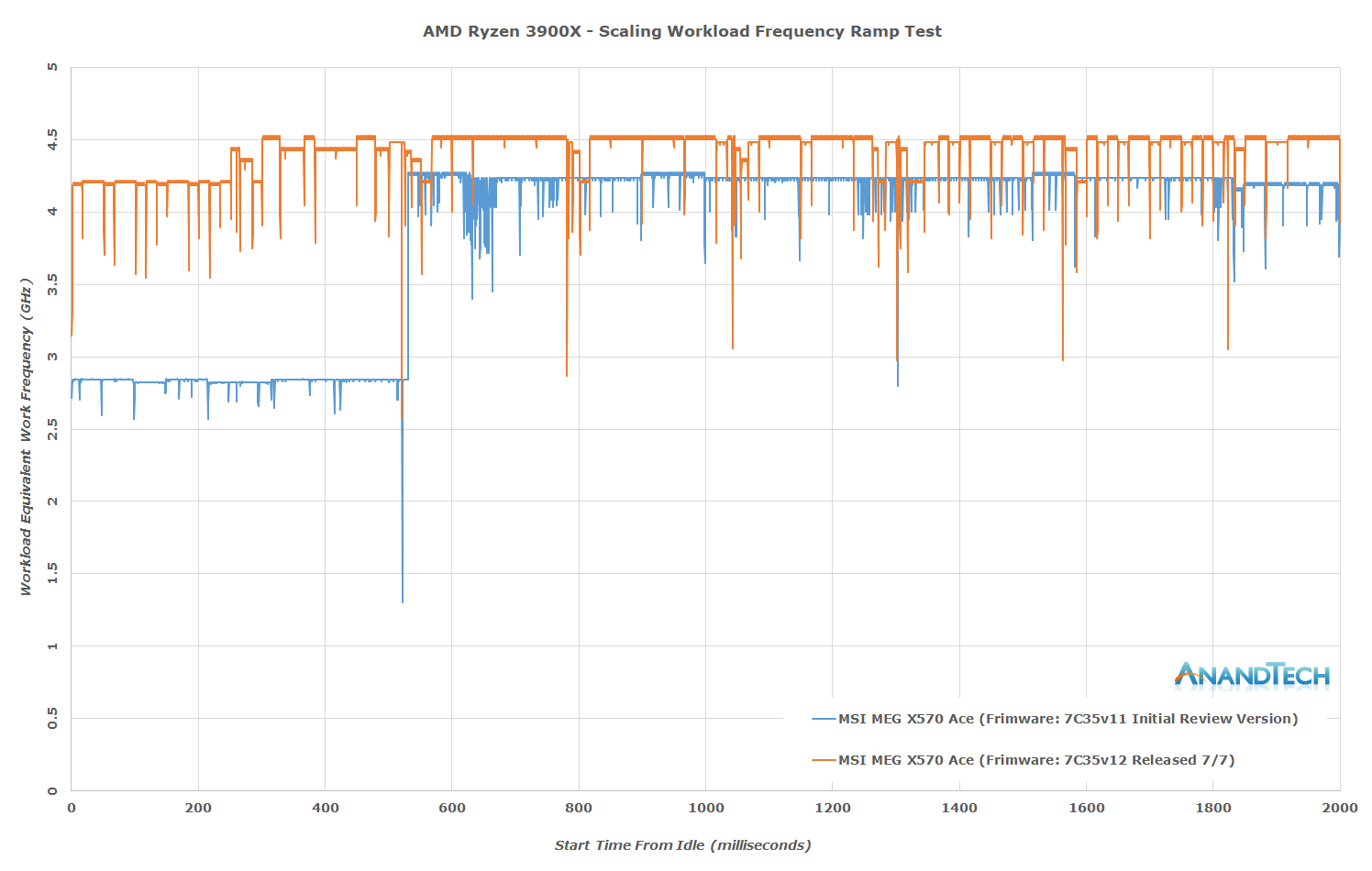
We discovered the following direct measureable effects between the two firmware versions:
(Note: This is a custom test that uses a fine-grained looping timed fixed instruction chain to derive frequency; it showcases single-core frequency)
We notice a significant change in the CPU’s boosting behaviour, now boosting to higher frequencies, and particularly at a faster rate from idle, more correctly matching AMD’s described intended boost behaviour and latency.
We’re currently in the process of re-running all our suite numbers and updating the article where necessary to reflect the new frequency behaviour.

On Amazon AMD is #1, 2 and 3 in best sellers and has 7 of the top 10. I don't think I've ever seen that before.Sold out. That was quick. Glad I snagged one before they ran out,