rofl at car prices or everything prices.

Page 2 - Seeking answers? Join the AnandTech community: where nearly half-a-million members share solutions and discuss the latest tech.

Kaido

Elite Member & Kitchen Overlord
Feb 14, 2004
52,402
7,652
136
And what's in the base model now vs what you got ~10+ years ago? Inflation alone would account for a ~$4-5k increase.

The base model was great! I had a really small budget at the time but needed a reliable car & it was the cheapest car next to the Nissan Versa at the time. Or maybe the Versa was $12k & the Kia Soul was $14k at the time, it's a bit hazy at this point lol. But it came with A/C, Bluetooth, power windows, power locks, etc. which was a GREAT deal for the features vs. the price at the time because all of the other base-model cars were pretty stripped down with stuff like manual roll-down windows & AM radios haha!
 
  • Like
Reactions: Pohemi
Dec 10, 2005
29,693
15,288
136
The base model was great! I had a really small budget at the time but needed a reliable car & it was the cheapest car next to the Nissan Versa at the time. Or maybe the Versa was $12k & the Kia Soul was $14k at the time, it's a bit hazy at this point lol. But it came with A/C, Bluetooth, power windows, power locks, etc. which was a GREAT deal for the features vs. the price at the time because all of the other base-model cars were pretty stripped down with stuff like manual roll-down windows & AM radios haha!
Sure, base model to contemporary base model of another line up, it may have been better, but what has been added to the base model since? Many are now including basic collision avoidance, or Android Auto/Apple Carplay, better safety equipment - all things that push up that base model price.
 

brianmanahan

Lifer
Sep 2, 2006
24,696
6,054
136
Auto prices have also risen because feature creep is off the charts. Entry level cars have features that used to only be found on luxury cars. All those sensors, motors, speakers, and fanny warmers don’t come cheap.

Plus engines and transmissions on even the econobox cars are superior to anything we’ve seen in decades past.

that is true.

honestly, my car isn't that safe compared to newer and slightly bigger ones, so i am debating upgrading just for that reason.
 

Pohemi

Lifer
Oct 2, 2004
10,959
17,134
146
Having to find a new job shouldn't be the answer either. Not everyone can be an engineer or manager or CEO or other high end job. Moving jobs (if going to another company) also means starting over from scratch. Seniority, vacation time, pension etc.
It kills me that people in general (other than the top 1-10%) are still buying into and parroting that notion.

It isn't people demanding better wages that are driving higher-than-natural inflation. That's a bunch of BS. It is the record corporate profits, CEO pay, AKA greed. They just don't want to share the "good times" in the capitalist market.

If everyone should just get a better/higher-paying job, who is going to work the jobs that corps still won't want to pay livable wages for? High school students? People need to get realistic and stop blaming the working masses for the massive inflation.

Yeah, fuck those greedy people for getting what they deserve from highly profitable corporations after being squeezed since the Great Recession. /s

This ^
 

repoman0

Diamond Member
Jun 17, 2010
5,191
4,574
136
Inflation will grow worse, just wait for the Unions to get their raises. UPS set the tone and now we have the UAW asking for 40% pay increase and 32hr work-weeks.

The Fed & Govt unions also have their hands out and will be rewarded nicely.
Why are you complaining about regular people getting a 40% raise (over five years) but not complaining about the CEOs of those companies who get 40%+? After all everyone knows that putting money in the hands of lower and middle classes rather than the ultra rich is the best and easiest way to grow the US economy, right?
 
Last edited:

pmv

Lifer
May 30, 2008
15,142
10,043
136
Inflation will grow worse, just wait for the Unions to get their raises. UPS set the tone and now we have the UAW asking for 40% pay increase and 32hr work-weeks.

The Fed & Govt unions also have their hands out and will be rewarded nicely.

But the inflation has preceded any pay rises, so how can the latter be a cause of the former?

Pay "rises" now would just amount to attempting to avoid further pay _cuts_ given inflation. I don't know about the US but here the only increases in pay have been for the highest 10% of earners - everyone else has seen a real-terms decline in income (I believe it's the greatest such fall since records began)
 
  • Like
Reactions: Pohemi

jmagg

Platinum Member
Nov 21, 2001
2,309
499
136
Seems like the best way is to give the auto workers a decent raise based on past profits, and a sliding scale on future raises based on future profits.
 

SteveGrabowski

Diamond Member
Oct 20, 2014
9,376
8,068
136
Having to find a new job shouldn't be the answer either. Not everyone can be an engineer or manager or CEO or other high end job. Moving jobs (if going to another company) also means starting over from scratch. Seniority, vacation time, pension etc.
Fucking pisses me off when people act like grocery store workers, McDonalds cooks and cashiers, amazon delivery, Uber drivers, etc are losers who should have worked harder in school or learned to code. As a society we want people to have those jobs since we want their services so it's some elitist bullshit to act like they should live in misery because "fuck them, I went to school and learned to code so I'm better than them."
 

Gardener

Senior member
Nov 22, 1999
771
562
136
I heard an interview with an auto industry analyst who stated that the domestic auto industry is planning on a future of significantly lower sales. New sales going to the wealthy, while working class buyers will be limited, for the most part, to the used car market.

My wife recently sold her 2013 Civic for more than she paid for it. I was pricing a truck upgrade for my business, I'm 4 years from retirement and thought a new 3/4 ton would serve me well. $55k, nope. An addition on our home ballooned from 250k to 500k, nope.
LOL at you if you think that we've ever had some "stable equilibrium" of capitalism here.

We are now in end-stage capitalism. All the stability of a prison cell.
 
  • Like
Reactions: Pohemi

SteveGrabowski

Diamond Member
Oct 20, 2014
9,376
8,068
136
We are now in end-stage capitalism. All the stability of a prison cell.
Same capitalism we were in when Upton Sinclair wrote The Jungle. Same kind of bank fraud in real estate, same kind of disregard for workers, same kind of horrible conditions in meat packing plants, same robber barons cornering markets, etc. What we have right now is correctly functioning capitalism where the working class is efficiently mined by a small ruling class.
 
  • Like
Reactions: pmv and Pohemi
Dec 10, 2005
29,693
15,288
136
We are now in end-stage capitalism. All the stability of a prison cell.
I keep seeing people say this (or "late-stage"), but it's been said for 100+ years. When does the end come? Things have gotten materially better for everyone over time, despite the wealthy running away with their gains. There are certainly everyday problems pinching people, like housing costs, but that isn't inherently a capitalism issue.
 
  • Like
Reactions: pmv and Pohemi

SteveGrabowski

Diamond Member
Oct 20, 2014
9,376
8,068
136
I keep seeing people say this (or "late-stage"), but it's been said for 100+ years. When does the end come? Things have gotten materially better for everyone over time, despite the wealthy running away with their gains. There are certainly everyday problems pinching people, like housing costs, but that isn't inherently a capitalism issue.
I don't understand the late stage either, it's correctly functioning capitalism. I don't buy that things have gotten better for people when millennials and generation Z overall aren't reaching the levels of wealth boomers and generation X achieved at the same ages. I don't know how our housing costs sharply rising isn't an inherently capitalist issue when the prices are being driven to the moon by investors.
 
  • Like
Reactions: Pohemi

dullard

Elite Member
May 21, 2001
26,196
4,869
126
As a person with math dyslexia, how does that workflow operate in your head? Are you able to visualize the flowchart to get from a percentage & break that down over time? I have MASSIVE trouble following the logic of math operations & conversions lol.
Unfortunately, my mind lives in math (I have what could be called social dyslexia). So, it is hard for me to know where your stumbling blocks could be. My default is just to throw more math into the thread which might make it worse. I'll try with a diagram instead. Please let me know if this helps or makes it worse.

I'll make a few assumptions.
  • I'll assume a starting salary of $50,000. The amount doesn't matter since it will cancel out at the end. But $50,000 seems like a starting place that isn't unreasonable for a typical American.
  • I'll assume a constant raise of 3.73% each year. I just got this from a quick Google search of typical US annual raises. https://paydestiny.com/average-raise-after-1-year-of-work/ Obviously, any specific job will differ.

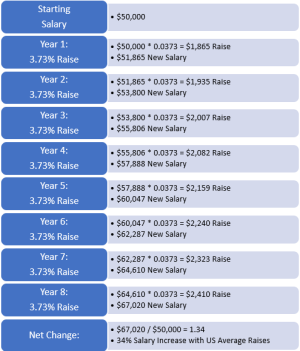
With those assumptions, the image below is what happens after 8 years: $50,000 -> $67,020. A person who got the US average raise over 8 years will have a 34% increase in salary. That is close but not quite the 40% that @Zeze bemoaned. But, it isn't hard to imagine with his promotion, that he would have gotten at least a 5% raise in addition to the other raises. If his promotion led to an additional 5% raise, then he'd end up with $67,020 * 1.05 = $70,371. That is a 40.7% increase in 8 years.

1695736047396.png

If Zeze didn't increase his salary by 40% in that time frame, then he either got lower than average raises or a promotion with almost no salary change. Both would be serious red flags to me to look for a better job.
 
Last edited:
  • Like
Reactions: PowerEngineer

[DHT]Osiris

Lifer
Dec 15, 2015
17,564
16,922
146
I don't understand the late stage either, it's correctly functioning capitalism. I don't buy that things have gotten better for people when millennials and generation Z overall aren't reaching the levels of wealth boomers and generation X achieved at the same ages. I don't know how our housing costs sharply rising isn't an inherently capitalist issue when the prices are being driven to the moon by investors.
From what I can see, we're approaching a point where you can't actually afford to 'own' things, at least not the things you used to be able to own. I couldn't afford the vehicles I bought in 2010, and 2017, today. Just no money for a 32k or 17k purchase, much less what they would cost post-inflation. Everything is being squeezed too hard from too many directions, the end result is the economy faltering (which isn't permitted by the ruling class) or new ways of generating money from those without any being developed (see advertising, subscription services for previously owned items).
 
Dec 10, 2005
29,693
15,288
136
I don't understand the late stage either, it's correctly functioning capitalism. I don't buy that things have gotten better for people when millennials and generation Z overall aren't reaching the levels of wealth boomers and generation X achieved at the same ages. I don't know how our housing costs sharply rising isn't an inherently capitalist issue when the prices are being driven to the moon by investors.
Those investors are telling us exactly why the prices are rising in their public disclosures: restrictive laws that prevent more housing from being built in places people want to live is leading to a huge supply crunch. Investors are taking advantage of the supply crunch NIMBYs perpetuate; they aren't causing the supply crunch.
 

SteveGrabowski

Diamond Member
Oct 20, 2014
9,376
8,068
136
Those investors are telling us exactly why the prices are rising in their public disclosures: restrictive laws that prevent more housing from being built in places people want to live is leading to a huge supply crunch. Investors are taking advantage of the supply crunch NIMBYs perpetuate; they aren't causing the supply crunch.
Who do you think writes the laws? It's not the working class.
 
Dec 10, 2005
29,693
15,288
136
Who do you think writes the laws? It's not the working class.
Incumbent land owners are keeping the laws the way they are. Ever been to a local council meeting on land use? It's all old people and busybodies that show up and try to tell people what can and can't be built in the area. Those same busybodies can also cash in on their exploded property values. And they show up because the benefactors of relaxed zoning are diffuse and may not even live in the area yet, whereas people that think they are harmed by more construction are specifically identifiable and loud.

Investors encompass many conflicting interests. I'm sure developers would love to open flood gates to more building and selling of the properties they make. Landlords don't want more buildings because it'll hurt their ability to charge high rents.
 
Dec 10, 2005
29,693
15,288
136
NIMBYs are a convenient scapegoat for the ills caused by the hyper-concentration of income and wealth. Let the squirrels wrestle over the last nut while the rich make off with the tree.

Extremely low vacancy rates in highly desirable metro areas together with an inability for cities to permit new construction says otherwise. The rich (landowners) are calling from within the house.
 

IronWing

No Lifer
Jul 20, 2001
73,676
35,504
136
Extremely low vacancy rates in highly desirable metro areas together with an inability for cities to permit new construction says otherwise. The rich (landowners) are calling from within the house.
That idea might carry more weight if builders weren't building like gangbusters and prices still stay high relative to wages. Building housing that people at the median wage can't afford is a real issue. Raise the median wage and things can start improving.
 
  • Like
Reactions: Pohemi
Dec 10, 2005
29,693
15,288
136
That idea might carry more weight if builders weren't building like gangbusters and prices still stay high relative to wages. Building housing that people at the median wage can't afford is a real issue. Raise the median wage and things can start improving.
The vacancy rates don't lie, and the amount being built is a drop in the bucket of what's needed. NYC needs hundreds of thousands of more units, and only a fraction is being built. Same for the Boston metro area, and many other metros.

And because the cores of cities are restricted and infill is just a trickle, we just get immense sprawl (like Dallas and Houston) and high prices (like San Francisco).
 

IronWing

No Lifer
Jul 20, 2001
73,676
35,504
136
The vacancy rates don't lie, and the amount being built is a drop in the bucket of what's needed. NYC needs hundreds of thousands of more units, and only a fraction is being built. Same for the Boston metro area, and many other metros.

And because the cores of cities are restricted and infill is just a trickle, we just get immense sprawl (like Dallas and Houston) and high prices (like San Francisco).
Who is going to build these houses? The builders are maxed out building houses already.
 
Dec 10, 2005
29,693
15,288
136
Who is going to build these houses? The builders are maxed out building houses already.
Simplify the rules and you could see more builders enter the market. We don't have smaller developers because only the big players know how and have the resources to navigate the insane process that's been created.

Not every building needs a developer to build on huge properties. The current rules impede all sorts of housing: building an ADU for an elderly relative as an attachment on your house or in your backyard, buying a decrepit property and doing a full rebuild as a duplex or triplex, where you might choose to occupy one unit and sell/rent the others, etc...
 

Pohemi

Lifer
Oct 2, 2004
10,959
17,134
146
I'd like to see a more detailed breakdown as opposed to just an average/typical. How much have executive or higher-level positions increased, and how much has that driven up that "average' raise amount? I have a feeling that the biggest raises have come at the top, and the bottom has gotten little to nothing.

With those assumptions, the image below is what happens after 8 years: $50,000 -> $67,020. A person who got the US average raise over 8 years will have a 34% increase in salary. That is close but not quite the 40% that @Zeze bemoaned. But, it isn't hard to imagine with his promotion, that he would have gotten at least a 5% raise in addition to the other raises. If his promotion led to an additional 5% raise, then he'd end up with $67,020 * 1.05 = $70,371. That is a 40.7% increase in 8 years.

If Zeze didn't increase his salary by 40% in that time frame, then he either got lower than average raises or a promotion with almost no salary change. Both would be serious red flags to me to look for a better job.

Again, I don't believe a 40% raise in less than a decade is how the "average" job pay increases. Claiming that any and all jobs should expect this is unrealistic IMHO. And saying to find another job if you didn't get it is also unrealistic for many people.

There isn't some magical vacant job generator that everyone can choose as an option if they feel they aren't paid enough in their current positions. And labor workers tend to hit caps in wages, where executives do not.