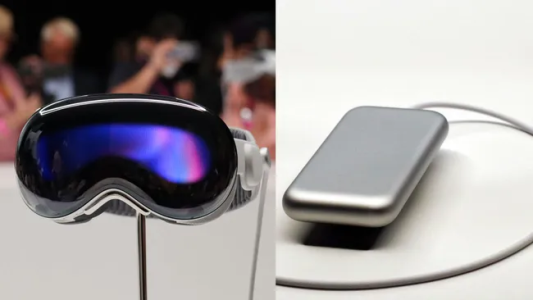
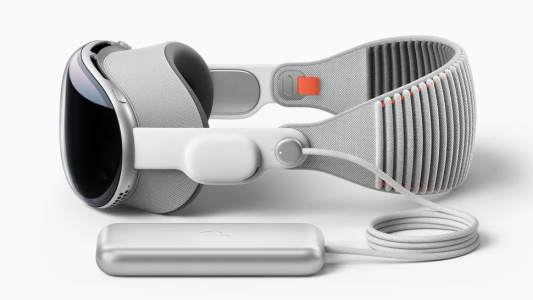
Battery tether to get the weight off your noggin, which is not a bad idea! The headset is about 600g & the battery is about 350g:
View attachment 93246
You only get about 2 hours of battery life, however. Extra batteries are available for $200 (note that you can buy an
entire Quest 2 for $250). However, they're not hot-swappable, so you have to shut down to switch batteries. For $3,500, it seems like they could have put in a small standby battery or a second power jack on the other side of the headset to allow you have to have a longer usage experience:
View attachment 93247
Apple is sneaky about hiding it in their advertisements: (it's on the
other side, huzzah!)
View attachment 93249
Its also a smaller battery than an iPhone has despite being that bulky (I think its like 3800mAh, phones have like 4000-5000mAh batteries these days). They easily could have put 3-5x the battery capacity in a box that size (can easily find powerbanks with 10,000-20,000mAh in similar size, I have one that's 20,000mAh and I think its smaller than their battery). Plus they should have put the processing in an external box so that you could upgrade it.
The external display is terrible too, especially for passthrough of your eyes, the glare on the glass makes it near impossible to see your eyes unless you're in a very dark environment (its so disparate from how Apple presents it that I think there might be a case for false advertising). And the outer glass is laminated (glass fused with plastic), making it easy to scratch (JerryRigEverything found it scratches at 2 on Mohs scale; also it can melt and I'd be willing to bet it'll discolor from exposure to sunlight/UV). It also costs $799 to replace (even if you pony up the $499 for AppleCare it costs $299). That's just the glass, not the display underneath, which is lenticular to give illusion of depth, and I bet its not cheap either.
Supposedly Apple fast tracked development of a version that doesn't have the external display, which if it also ditches that large single piece of glass, could help a lot in bringing costs down. They could further reduce costs by switching from the motorized lens adjustment (they auto adjust for IPD for instance) to a dial or something (Oculus has it on I think the Quest 1 and 3, they removed it on Quest 2 but brought it back). Also if they move the processing (at least the M series chip), they can probably make the headset thinner by putting the R1 side by side a single fan instead of layered like they have it now where the M2 and R1 chip each have a fan on them, which will lower the weight, and move a heat source elsewhere.
Oh, and that battery connector to the headset is proprietary on both ends (it is detachable pretty easily from the box even, uses a connector similar to Lightning on that end). It kinda makes sense, as they likely needed something better than USB-C, but not sure their solution is optimal.
I was seriously considering buying one, but there's just too many significant flaws for the price. I want it to basically replace my current displays (basically it could potentially replace multiple monitors, and also a projector/large TV for viewing content, all while being portable and enabling privacy).
I'm also disappointed as their spatial videos apparently record at 6.5MP resolution (not sure what framerate, I have a hunch its not even 60fps), which isn't even 4K (which is 8.3MP), so its recording at ~1/4 the resolution of the displays. I feel like it should have dual 12MP cameras placed where the eyes would be, but then it'd need much more storage as the videos would be huge. Which would've been fine if they'd offered hotswappable memory cards (or other storage options). If you do spatial videos on the iPhone they only do 1080p30 which is pathetic.















 Facebook
 Twitter