• We’re currently investigating an issue related to the forum theme and styling that is impacting page layout and visual formatting. The problem has been identified, and we are actively working on a resolution. There is no impact to user data or functionality, this is strictly a front-end display issue. We’ll post an update once the fix has been deployed. Thanks for your patience while we get this sorted.

RapydMark CPU benchmark

Page 2 - Seeking answers? Join the AnandTech community: where nearly half-a-million members share solutions and discuss the latest tech.
RapydMark for Windows (frikiscape.com)

Synthetic highly parallel benchmark.
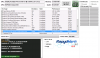
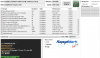
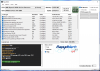
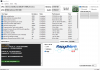
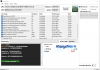
1637755795894.png
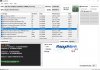
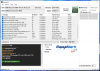
1637755840866.png

My company's dual socket Ivy Bridge-E beat Comet Lake in total time, only due to more cores. Should be fun to see how 5950X and i9-12900K fare in this benchmark. My guess is that 5950X will win.

Update: 5950X did win! But i9-12900K put up a good fight despite fewer cores.

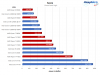
Performance comparison chart so far thanks to Makaveli:
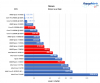
1652705066734.png

Public view-only link for the sheet: RapydMark64 - Google Drive

CCD comparison by Det0x:

1 CCD -> 8 cores / 8 threads = 368.309 seconds
1 CCD -> 8 cores / 16 threads = 230.797 seconds
2 CCD's -> 16 cores / 32 threads = 135.978 seconds

Interesting HT/no-HT comparison:
User
CPU
Cores
Threads
Time
JoeRambo​
i9-12900K​
8​
16​
212.656​
JoeRambo​
5800X​
8​
16​
263.424​
Det0x​
5950X​
8​
16​
230.797​
Det0x​
5950X​
8​
8​
368.309​
JoeRambo​
i9-12900K​
8​
8​
328.88​


Update (17 APRIL 2025): Det0x's video of his 9950X3D benchmark run: https://forums.anandtech.com/threads/rapydmark-cpu-benchmark.2599240/post-41425508

The current champ!
 
Last edited:
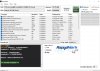
EDIT: putting results of 8C vs 8C side by side i don't even know what to think about this benchmark and whatever virtues it has:
Maybe its better to use my 8 core numbers from the post right above yours as i saved both upper and lower numbers

*edit*
Nevermind, i will do the comparison myself 🙂

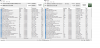
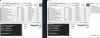
Alder lake @ 5 ghz (?) vs Zen3 @ 4.85 ghz

1638201311622.png
 
Last edited:
Maybe its better to use my 8 core numbers from the post right above yours as i saved both upper and lower numbers 🙂

16C vs 8C is another variable. 8C vs 8C is good to compare "peak IPC". But hard to compare results when some lines just don't make sense:

For example
Matrix Multiplication is 2.4s vs 9.4s
Mem cache performance 28.2s vs 11.6s

I find it hard to believe ADL is 4x worse at matrix multiplication, that usually is about memory subsystem and then proceeds to beat 2.5x is said mem/cache performance.

We might need 8C without HT perf point, to see what really is going on.
 
@igor_kavinski

i'm creating an Excel speadsheet with a graph to track all of these, which I wouldn't mind sending to you so you can add it the first post. The only thing is I would like people to most their memory speeds since it seems to affect this benchmark. For now just like DDR4 3200 don't need CL numbers.
 
Maybe we can compare specific memory tests. I pasted those below with memory in the test name.
Also, remember I am still using fresh Win10 but looking at core utilization all looks good with this test.

Test Type: Fill Memory 256 MB
Iterations: 60K | Performance: 1,552 it/s (16th) | Time: 38.636 s

-------------------------------------
Test Type: Copy Memory 256 MB
Iterations: 60K | Performance: 2,683 it/s (16th) | Time: 22.358 s

-------------------------------------
Test Type: Memory cache performance (max 4 threads)
Iterations: 40 | Performance: 11 it/s (4th) | Time: 13.936 s
Last result: SizeMem= 8 kB Iterations= 65536 Time= 2 ms
SizeMem= 16 kB Iterations= 32768 Time= 1 ms
SizeMem= 32 kB Iterations= 16384 Time= 1 ms
SizeMem= 64 kB Iterations= 8192 Time= 7 ms
SizeMem= 128 kB Iterations= 4096 Time= 7 ms
SizeMem= 256 kB Iterations= 2048 Time= 7 ms
SizeMem= 512 kB Iterations= 1024 Time= 7 ms
SizeMem= 1 MB Iterations= 512 Time= 8 ms
SizeMem= 2 MB Iterations= 256 Time= 14 ms
SizeMem= 4 MB Iterations= 128 Time= 15 ms
SizeMem= 8 MB Iterations= 64 Time= 18 ms
SizeMem= 16 MB Iterations= 32 Time= 47 ms
SizeMem= 32 MB Iterations= 16 Time= 59 ms
SizeMem= 64 MB Iterations= 8 Time= 64 ms
SizeMem= 128 MB Iterations= 4 Time= 78 ms

Test Type: Memory Encrypt/Decrypt AES256 (1 MB)
Iterations: 8K | Performance: 870 it/s (16th) | Time: 9.188 s

-------------------------------------
Test Type: Memory Encrypt/Decrypt Blowfish448 (1 MB)
Iterations: 8K | Performance: 1,290 it/s (16th) | Time: 6.200 s

-------------------------------------
Test Type: Memory Compress/Decompress 1 MB (Gzip)
Iterations: 8K | Performance: 1,044 it/s (16th) | Time: 7.656 s
 
@igor_kavinski

i'm creating an Excel speadsheet with a graph to track all of these, which I wouldn't mind sending to you so you can add it the first post. The only thing is I would like people to most their memory speeds since it seems to affect this benchmark. For now just like DDR4 3200 don't need CL numbers.
That's a great idea! Thanks 🙂
 
16C vs 8C is another variable. 8C vs 8C is good to compare "peak IPC". But hard to compare results when some lines just don't make sense:

For example
Matrix Multiplication is 2.4s vs 9.4s
Mem cache performance 28.2s vs 11.6s

I find it hard to believe ADL is 4x worse at matrix multiplication, that usually is about memory subsystem and then proceeds to beat 2.5x is said mem/cache performance.

We might need 8C without HT perf point, to see what really is going on.
Here you go, i'm down to 8 out of 32 threads now 😛
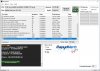
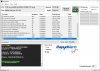
1638204784085.png

1638204809793.png

Same mem settings as before, 1900:3800 CL13 tuned
8 threads 4975mhz
 
Mem cache performance 28.2s vs 11.6s

I find it hard to believe ADL is 4x worse at matrix multiplication, that usually is about memory subsystem and then proceeds to beat 2.5x is said mem/cache performance.
That mem/cache performance may explain why you find the ADL snappier than your 5950X.
 
I ran the test another time, this time with Asus default "optimized" limits setting before I had it set to Intel limits 150w. even though it never passed 125w (well below the Intel 150w) the score increased (clocks all same as before)rapydMarkhigh-no limitst.jpg
 
Last edited:
That i3 shouldn't be there. It was done on Medium. Or you could add High or Medium in parentheses.

You are right I forgot to remove it, I've updated the chart. I'd rather just keep all the high results and not medium.

Also what is the best way to deal with the excel spreadsheet?

i've seen people have them editable online and accessible to everyone but i've never done that any suggestions?
 
Here you go, i'm down to 8 out of 32 threads now 😛
Same mem settings as before, 1900:3800 CL13 tuned
8 threads 4975mhz

I also did 8 no HT test, even went to CL13, so we can do as Apples to Apples now, so pretty much 5Ghz vs 4.975Ghz for AMD
1638208502944.png

1638208526658.png


So 329s vs 368s with no HT.

Also the mysteries with Matrix Multiplication and Memory Cache performance remain, should not be THAT different.
 
Also what is the best way to deal with the excel spreadsheet?

i've seen people have them editable online and accessible to everyone but i've never done that any suggestions?
That's all well and good until people editing stuff left and right and it goes out of control 😀

Maybe one chart with the best score of each CPU+Mem type.

Another chart for all other scores done with different memory speeds/timings etc.
 
That's all well and good until people editing stuff left and right and it goes out of control 😀

Maybe one chart with the best score of each CPU+Mem type.

Another chart for all other scores done with different memory speeds/timings etc.

I was thinking about that think I can host it on google and only have modify access given to you and myself.

Those other suggestions are good aswell but I won't have time to dig into multiple charts as i'm at work right now 🙂 that is something however you can run with.
 
Back
Top