• We’re currently investigating an issue related to the forum theme and styling that is impacting page layout and visual formatting. The problem has been identified, and we are actively working on a resolution. There is no impact to user data or functionality, this is strictly a front-end display issue. We’ll post an update once the fix has been deployed. Thanks for your patience while we get this sorted.

Question Raptor Lake - Official Thread

Page 90 - Seeking answers? Join the AnandTech community: where nearly half-a-million members share solutions and discuss the latest tech.

Hulk

Diamond Member
Since we already have the first Raptor Lake leak I'm thinking it should have it's own thread.
What do we know so far?
From Anandtech's Intel Process Roadmap articles from July:

Built on Intel 7 with upgraded FinFET
10-15% PPW (performance-per-watt)
Last non-tiled consumer CPU as Meteor Lake will be tiled

I'm guessing this will be a minor update to ADL with just a few microarchitecture changes to the cores. The larger change will be the new process refinement allowing 8+16 at the top of the stack.

Will it work with current z690 motherboards? If yes then that could be a major selling point for people to move to ADL rather than wait.
 
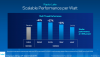
Those numbers are boggus, from 65W to 115W there s 76% higher power for only 21% better perf.

This would mean that Intel s process has a cubic curve at quite low power, wich is not the case at all, actually that s more like 90-100W to perform like a 12900K stock, indeed they use Spec_int_copy as "bench", not something like CB R23...
65 W obviously means PL1. They did a similar comparison with 11th gen back when Alder Lake released.
 
65 W obviously means PL1. They did a similar comparison with 11th gen back when Alder Lake released.

I thought that there was something like this, to boost at a given frequency and way higher POWER and then get back at 65W once most of the job is done.

That wouldnt be serious as methodology, we would expect comparisons at fixed power, actually if it take only 65W it s not even sure that the 12900K is maxed at 240W..

SPECint_rate_base2017_IC2022 means the entire set of integer benchmarks of SPEC2017 compiled with ICC 2022.


And what "n-copy" does mean...?..

Because that s more precisely :

SPECint_rate_base2017_IC2022(n-copy)
 
I thought that there was something like this, to boost at a given frequency and way higher POWER and then get back at 65W once most of the job is done.

That wouldnt be serious as methodology, we would expect comparisons at fixed power, actually if it take only 65W it s not even sure that the 12900K is maxed at 240W..
Fixed power doesn't mean boost=disabled. It's perfectly fine methodology. It's how Intel's Turbo Boost is designed to function.
And what "n-copy" does mean...?..
n-copy means n-instances, n being the number of threads. It is the standard way of denoting SPEC results.
 
Fixed power doesn't mean boost=disabled. It's perfectly fine methodology. It's how Intel's Turbo Boost is designed to function.

n-copy means n-instances, n being the number of threads. It is the standard way of denoting SPEC results.


So they bench the thing at 105W and then the base TDP is used as reference for comparison with the 12900K, that s very intel, indeed.

That sound rather desperation since they are saying that the 13900K@65W has same perf/watt than a 7950X@65W, wich of course you are ready to believe...
 
  • Like
Reactions: ftt
So they bench the thing at 105W and then the base TDP is used as reference for comparison with the 12900K, that s very intel, indeed...
You still have difficulty in understanding PL1 and PL2 it seems. Alder Lake default behaviour is PL2=PL1 on the K parts. The 12900K 241 W is obviously with default operation, so PL2=PL1=241 W.

The comparison fixes PL2 and lowers PL1 down to the values indicated in the graph.

The benchmark is according to the parameters that govern turbo boost.
 
You still have difficulty in understanding PL1 and PL2 it seems. Alder Lake default behaviour is PL2=PL1 on the K parts. The 12900K 241 W is obviously with default operation, so PL2=PL1=241 W.

The comparison fixes PL2 and lowers PL1 down to the values indicated in the graph.

The benchmark is according to the parameters that govern turbo boost.

You ll be for a rude awaking once the reviews land, to match the 12900K a 13900K will require at least 105W, and that s an optimistic estimation...
 
You ll be for a rude awaking once the reviews land, to match the 12900K a 13900K will require at least 105W, and that s an optimistic estimation...
What the hell does 105 W mean, in the context of Intel's way of defining turbo and power consumption numbers? You're making meaningless claims, as usual.
 
That s not the whole SPEC as used by AT, that s a specific test that measure data manipulation capability, there s no real computing done here.
As pointed out by tasm_msc, "n-copy" is the standard way to denote you're running n threads of that test. You can check the SPEC suite yourself. No test by that name exists.
 
What the hell does 105 W mean, in the context of Intel's way of defining turbo and power consumption numbers? You're making meaningless claims, as usual.

Im talking of perf/watt as defined by engineers, not by marketing sleight of hand, if you state a 65W reference then your chip has to not exceed this power under the stated test, otherwise that s just plain lies.

The 105W i m talking about is the minimalistic necessary power for a 13900K to match a stock 12900K in Cinebench R23, and as a prime i ll add that the stock 12900K will be 18% faster than a 13900K@65W in CB...
 
Ok, where are you getting 105W from?

That s my estimation when looking at the perf/power of the 12900K at different power points, if the 13900K@65W was to match the stock 12900K then it means that it would also match the 7950X@65W and that Intel s current process is as efficient, if not more, than TSMC s 5nm.
 
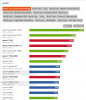
Oh yes, that slide shows SPEC int_rate so it should be representative of an average performance jump in MT workloads (vs 12900K).

thats the thing, I believe now that its not an average, but just an "up to". Notice that the ST "up to" from the slide I posted is also the same number than this one

1664303343286.png
 
thats the thing, I believe now that its not an average, but just an "up to". Notice that the ST "up to" from the slide I posted is also the same than this one

I think they must use the "up to" word because the Spec results are not published (official), or it's just lawyer talk (to be on the safe side). But I might be wrong, who knows.
 
So they bench the thing at 105W and then the base TDP is used as reference for comparison with the 12900K, that s very intel, indeed.

That sound rather desperation since they are saying that the 13900K@65W has same perf/watt than a 7950X@65W, wich of course you are ready to believe...

If you are a goose in the fog, yes everything is possible to believe. :mask:

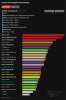
Regardless of the lack of an i9 13900K in this comparison, "this is pretty inconvenient for Intel".In short, how to fit 8P+16E in 65W.

45W 8/16 R7 vs i9 8P+8E 65W.
2022-09-27_200808.jpg

 
thats the thing, I believe now that its not an average, but just an "up to". Notice that the ST "up to" from the slide I posted is also the same number than this one

View attachment 68287
Those two numbers are straight from SPECint, so no average with other benchmarks. So "up to" is Intel playing safe. Or Intel really couldn't find any use cases with better results like @deasd indicated and that's why the focus is on these two SPECint numbers instead on an average of many different benchmarks.
 
Intel Core i9-13900KS Special Edition 6GHz CPU to launch next year
But i'm pretty sure it wont be enough against Zen4 3d..
1664304053254.png
The new part, most likely called Core i9-13900KS will launch next year, and it will be limited in volume. The KS-series SKUs are pre-binned processors, offering the best power efficiency and stable operation at higher clocks. Last year, Intel launched its Core i9-12900KS model, which is the fastest SKU in Alder Lake-S series, offering 5.5 GHz with all cores out of the box.
 
if the 13900K@65W was to match the stock 12900K then it means that it would also match the 7950X@65W and that Intel s current process is as efficient, if not more, than TSMC s 5nm.
It wouldn't have to mean Intel's process is better per se, just that all of the cores they're throwing at the problem actually work.
 
Back
Top