• We’re currently investigating an issue related to the forum theme and styling that is impacting page layout and visual formatting. The problem has been identified, and we are actively working on a resolution. There is no impact to user data or functionality, this is strictly a front-end display issue. We’ll post an update once the fix has been deployed. Thanks for your patience while we get this sorted.

Discussion Qualcomm Snapdragon Thread

Page 173 - Seeking answers? Join the AnandTech community: where nearly half-a-million members share solutions and discuss the latest tech.
ARM standard core is further behind that it may seem at first glance, because, while the performance and efficiency difference is small (in favor of Oryon), there is a decent difference in area, Oryon V2 is quite a bit smaller.
So we have two factors that lead me to believe Qualcomm will be ahead:
-Good difference in area, there is much more potential to be realized by Qualcomm there
-Qualcomm has really good talented Apple engineers with the Nuvia team.

In fact, Apple P core is like 40% larger or so than Oryon V2, depending on which source I've checked. It wouldn't surprise me if Qualcomm catches Apple in single core in not much time.
Oryon v3 is their next chance. Got some time to make it count!
Of course then it’s going up against M6/A20.
 
Maybe. But the leaked Dell chart has it posted in late 2027. So that’s what I’ve used; maybe their (and the other OEMs) cadence is just slower for laptops.

But even if so (or is just in phones), it should be interesting to see how it plays out.
 
Maybe. But the leaked Dell chart has it posted in late 2027. So that’s what I’ve used; maybe their (and the other OEMs) cadence is just slower for laptops.

But even if so (or is just in phones), it should be interesting to see how it plays out.
You have to understand that Oryon and Snapdragon X roadmaps are different.

Oryon CPUCoresProducts
Gen 1PhoenixX Elite
Gen 2Phoenix-L
Phoenix-M
8 Elite
Ride Elite
Cockpit Elite
Gen 3Pegasus-L
Pegasus-M
8 Elite G2
X Elite G2

Snapdragon X Elite G1Snapdragon X Elite G2
CPUOryon Gen 1Oryon Gen 3
Announcement DateSnapdragon Summit 2023 (October 2023)Snapdragon Summit 2025
(October 2025)
Release DateJune 2024January 2026 (?)
 
Well I do blame them for how they’ve released gen 1 and gen 2. Only several months apart with such a difference in performance. Not good.

If your chart comes to fruition then at least they will have finally synced up their laptop and phone core generations.

And then according to that, then Dell will be the one that is releasing on a slower cadence, to me it wouldn’t make sense to wait eight or nine months after v3 comes out.
 
Last edited:
Unreal Engine 5 Nanite didn't work on Arc Alchemist iirc.

Does Arc Battlemage fix this?
Well, that's one aspect where Adreno 8 matches Battlemage.
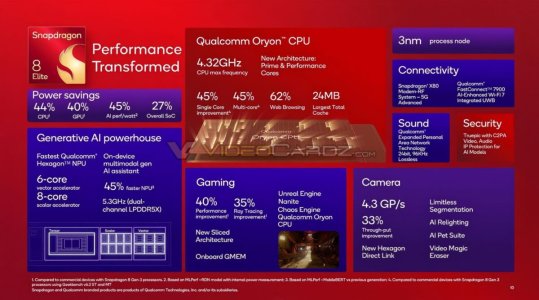
SNAPDRAGON-8-ELITE-1-1200x668.jpg
For the Snapdragon 8 Elite's Adreno 830 GPU, Qualcomm explicitly declares support for Unreal Engine 5 and it's features such as Nanite and Chaos.

Seems like Adreno 8 might be a decent GPU architecture for PCs. The Snapdragon X Elite Gen 2, which will debut next year, will use it.


Adreno 7 was comparable to Nvidia Maxwell.

Maxwell -> Pascal -> Turing -> Ampere -> Ada Lovelace -> Blackwell

If so, Adreno 8 must be around Pascal/Turing level.
 
Well, that's one aspect where Adreno 8 matches Battlemage.
View attachment 113091
For the Snapdragon 8 Elite's Adreno 830 GPU, Qualcomm explicitly declares support for Unreal Engine 5 and it's features such as Nanite and Chaos.

Seems like Adreno 8 might be a decent GPU architecture for PCs. The Snapdragon X Elite Gen 2, which will debut next year, will use it.


Adreno 7 was comparable to Nvidia Maxwell.

Maxwell -> Pascal -> Turing -> Ampere -> Ada Lovelace -> Blackwell

If so, Adreno 8 must be around Pascal/Turing level.
Alchemist can run UE5 just "fine". It's slower than Battlemage because it doesn't natively support execute indirect for example.
 
Alchemist can run UE5 just "fine". It's slower than Battlemage because it doesn't natively support execute indirect for example.
- UE5 needs Execute Indirect.
- Adreno 8 supports UE5
- Therefore, Adreno 8 has Execute Indirect?

Adreno 8 might be architecturally comparable to Intel Xe2, minus Xe2's superior RT and XMX cores.

We won't really know until someone does an architectural deep dive into Adreno 8, but that's probably not going to happen anytime soon.
 
- UE5 needs Execute Indirect.
- Adreno 8 supports UE5
- Therefore, Adreno 8 has Execute Indirect?
Support for certain API extensions is also possible through software rather than µArch.

This was actually how ARM Mali supported tesselation (and geometry?) shaders earlier in their design evolution before the µArch supported the required features natively.
 
The ARM vs Qualcomm Trial starts on Monday (Jury Selection was today). Will we see a settlement over the weekend? I think the Apple vs Qualcomm had its settlement the morning of the trial.
I hope for everybody’s sake there is. The clock is ticking!
 
The ARM vs Qualcomm Trial starts on Monday (Jury Selection was today). Will we see a settlement over the weekend? I think the Apple vs Qualcomm had its settlement the morning of the trial.
How long will this trial take? Will it be done in a few days or drag out over years?
 
How long will this trial take? Will it be done in a few days or drag out over years?
It's a five day trial (Monday to Friday). I am not sure if Jury deliberations will be postponed till after the Holiday or not. If they are not, I would expect the Jury deliberations to be very quick.

Whatever the decision, I would expect either side to Appeal which could take years to resolve definately.
 
Rumors for 8 Gen 4 Clock Frequency: Meeco

Not sure if I have seen the GPU Clock yet.

CPU ClockGPU Clock
8650AB (Snapdragon 8 Gen 3)3.3 GHz903 MHz
8650AC (Snapdragon 8 Gen 3 FG)3.4 GHz1000 MHz
8750AB (Snapdragon 8 Gen 4)4.37 GHz1150 MHz
8750AC (Snapdragon 8 Gen 4 FG)4.47 GHz1250 MHz
8750AB's GPU clock speed in retail devices is 1100 MHz, which is 50 MHz lower than the leaked number. So that implies that 8750AC will also be 50 MHz lower, making it 1200 MHz.

Would it be possible to confirm by taking a look at the Geekbench 6 JSON? Galaxy S25 listings with 8750AC have been popping up;

 
Intel’s new CEO throwing shade at QC over their high Windows laptops return rate.

"I mean, if you look at the return rate for Arm PCs, you go talk to any retailer, their number one concern is 'I get a large percentage of these back,' because you go to set them up and the things that we just expect do not work, right,"

I don't think Intel is currently in any condition to criticise other for software not working right on their hardware.
 
Was reading this blogpost:

Qualcomm: Future support is planned.
Qualcomm plans to support Mesh Nodes and Work Graphs in a future Adreno architecture.
 
Back
Top