That's what I am thinking... if goes with Mali will crash awfully, but with nVIDIA iGPU is another story and even more, would be better than Adreno.MTK will face the same problems QCOM has. The supposedly Nvidia IGP will be a good draw and alleviate the gaming and content creation compatibility issues and concerns.

-
We’re currently investigating an issue related to the forum theme and styling that is impacting page layout and visual formatting. The problem has been identified, and we are actively working on a resolution. There is no impact to user data or functionality, this is strictly a front-end display issue. We’ll post an update once the fix has been deployed. Thanks for your patience while we get this sorted.
You are using an out of date browser. It may not display this or other websites correctly.
You should upgrade or use an alternative browser.
You should upgrade or use an alternative browser.
Discussion Qualcomm Snapdragon Thread
Page 138 - Seeking answers? Join the AnandTech community: where nearly half-a-million members share solutions and discuss the latest tech.
LightningZ71
Platinum Member
I dare say that if Qcom and Mtek want to compete in the $500-$800 market, AMD is going to provide notable competition with Kraken. It won't suffer for ST performance, will have plenty of MT performance, will have iGPU performance very near 780M, and be cost competitive. HawkPoint is also still heavy in the market as well.
Ghostsonplanets
Senior member
AMD problem is that they don't have volume and availability is slow to ramp up.I dare say that if Qcom and Mtek want to compete in the $500-$800 market, AMD is going to provide notable competition with Kraken. It won't suffer for ST performance, will have plenty of MT performance, will have iGPU performance very near 780M, and be cost competitive. HawkPoint is also still heavy in the market as well.
If they solve those with Kraken, it will indeed provide a good competition against SDX.
LightningZ71
Platinum Member
Why would it be worse than Phoenix? Assuming that they go with a single CCX, it should have better ST, similar MT, similar sustained iGPU performance with a larger NPU and next generation efficiency.
MT will be similar. ST within 10%. Die size and pricing remain questionable.Why would it be worse than Phoenix? Assuming that they go with a single CCX, it should have better ST, similar MT, similar sustained iGPU performance with a larger NPU and next generation efficiency.
Only selling point is NPU which doesn't even enable any new Windows features in Strix Point. Maybe AMD/Microsoft will have that working by the time 3+5 releases.
Big problem still is the battery life isn’t really good enough. Qualcomm has that cornered at appropriate costs while also offering more peak performance/MT than Lunar or much lower cost as with the new 8 core die.AMD problem is that they don't have volume and availability is slow to ramp up.
If they solve those with Kraken, it will indeed provide a good competition against SDX.
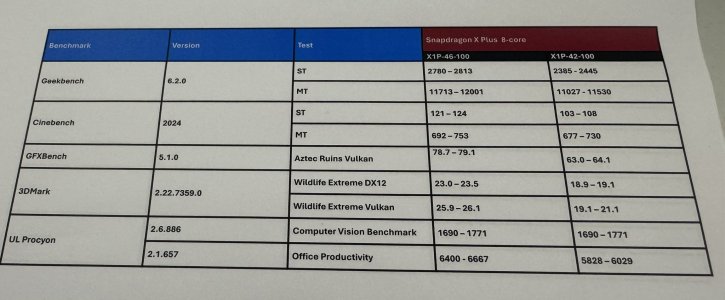
Also what are you talking about with ST? The X1P-46-100 (the new die) has a 4GHz ST boost, which I thought might happen because it’s a new die with a separate yield set. Makes for a very good part besides the GPU but QC is MIA on that for now anyways.
QC says 2750-2850 in GB6 ST which is expected for that.
QC says 2750-2850 in GB6 ST which is expected for that.

FlameTail
Diamond Member
FlameTail
Diamond Member
You were right:I wish I could say I'm surprised, but I'm not.
I think that ARM have gone nuts on licensing costs for post v8-A cores.
Arm chief executive Rene Haas has previously said V9 brings in twice the royalties of the previous generation V8.
Subscribe to read
Ghostsonplanets
Senior member
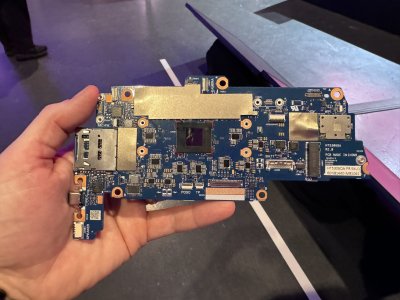
There's quite the gap between 46 and 42. What are the differences? Boost clock/Maximum Clock of CPU/GPU? Or is one Hamoa and the other Purwa?From Ryan Shrout:
View attachment 107006
A direct photo of the Purwa motherboard
View attachment 107007
Qualcomm' official benchmark figures.
FlameTail
Diamond Member
There's quite the gap between 46 and 42. What are the differences? Boost clock/Maximum Clock of CPU/GPU? Or is one Hamoa and the other Purwa?
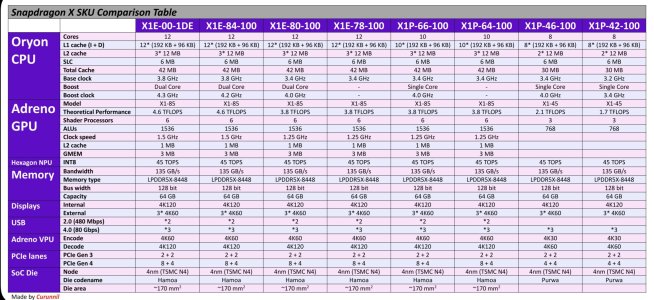
(Some details may be wrong).
Last edited:
FlameTail
Diamond Member
Looking forward to that one.Cristiano Amon said something very funny (paraphrasing):
"We are going to turn the Snapdragon Summit 2024 into a Colosseum of benchmarks"
I'd like to see Lunar Lake vs Snapdragon X power curves.
Ghostsonplanets
Senior member
Quite interesting that there's such boost clock variance. I think there's also the unannounced X1P-24-100, right? I wonder how that will clock or will be cutdown.View attachment 107020
(Some details may be wrong).
They forgot Computex. "Lunar Lake buuust this myth!""Intel is obsessed with Qualcomm and ARM"
Funny video (everytime Intel took a dig at Qualcomm during their Lunar Lake event).
Pat might have many qualities as CEO, but being a good spokesperson is not one of them.
Unlike AMD, Intel is making some bold claims about its energy efficiency. I hope they actually deliver it. Beating, or matching, X Elite battery life will be a huge win for customers.
Xiaomi seems excited about (presumably) the 8 Gen 4. (President at Xiaomi)
But take with a grain of salt. Obviously, they want to hype up their next flagship smartphone.
Google Translate:
But take with a grain of salt. Obviously, they want to hype up their next flagship smartphone.
Google Translate:
2024 is the turning point of the chip industry. In the next month or so, everyone will see the turning point!
The two processor players in the first echelon of the industry have firmly chosen "dual ultra-large cores", and the winner will be revealed soon.
Xiaomi's upcoming flagship new platform will be strongly upgraded, and the new desktop-level micro-architecture will bring "three super features": ultra-high clock speed, ultra-strong performance, and ultra-low power consumption. Regardless of every point, it is a subversive upgrade to the past.
Based on the current baseline data, it is exactly the same as when we jointly defined it three years ago. After three years of in-depth joint research and development, coupled with the comprehensive optimization of our system core this time, it will be the most significant performance experience jump in history, and the chip industry pattern has reached an inflection point.
Ghostsonplanets
Senior member
8G4 is adding a higher IPC uArch, 1GHz clock gains over 8G3, new Slice GPU uArch with 50% perf/W gains, new memory controller and also fabbed on N3E. No wonder he's excited for it. Should be a game-changer for Android SoCs (So much performance wasted on such OS though...).Xiaomi seems excited about (presumably) the 8 Gen 4. (President at Xiaomi)
But take with a grain of salt. Obviously, they want to hype up their next flagship smartphone.
Google Translate:
Granted, it's also rumored there's a 20 to 30% price increase from 8G3 to 8G4. So it will be quite expensive and a major price driver for next year flagships.
It's disappointing that ever since 888 generation, mid and low-end have received negligible advancements while flagship SoC have marched on. 8 Gen 2 performance on mid-end SoCs should have been a reality by now.
The issue is that 8G4 is on par of Mid tier Intel laptop processors in terms of price, is massive the increase.8G4 is adding a higher IPC uArch, 1GHz clock gains over 8G3, new Slice GPU uArch with 50% perf/W gains, new memory controller and also fabbed on N3E. No wonder he's excited for it. Should be a game-changer for Android SoCs (So much performance wasted on such OS though...).
Granted, it's also rumored there's a 20 to 30% price increase from 8G3 to 8G4. So it will be quite expensive and a major price driver for next year flagships.
It's disappointing that ever since 888 generation, mid and low-end have received negligible advancements while flagship SoC have marched on. 8 Gen 2 performance on mid-end SoCs should have been a reality by now.
If Mediatek sells for 30% less, Qualcomm would find trouble and if their D8400 is full big cores (even if is A7XX only), Qualcomm should deliver a game changer in their 7G4 too.
Ghostsonplanets
Senior member
QCOM is the Nvidia of Android SoCs. They'll be fine. MTK has the tech but lacks the mindshare.The issue is that 8G4 is on par of Mid tier Intel laptop processors in terms of price, is massive the increase.
If Mediatek sells for 30% less, Qualcomm would find trouble and if their D8400 is full big cores (even if is A7XX only), Qualcomm should deliver a game changer in their 7G4 too.
The issue is that MTK is not increasing their work in the Android market. With nVIDIA would make massive impact in Windows one.QCOM is the Nvidia of Android SoCs. They'll be fine. MTK has the tech but lacks the mindshare.
Even more, nVIDIA is foreseeing that Intel would ditch them due Arc. And AMD due their own GPU and they need to be in the game.
FlameTail
Diamond Member
Xiaomi 15 rumoured to be the first phone with 8 Gen 4. Will release next month.

MarkizSchnitzel
Senior member
When will 7+ series get Oryon?
I find 7+ G2 and G3 to be great chips for that price segment (~400€), but a small single thread bump never hurts (unless it decimates the battery at the same time).
What are the expectations for battery life with reasonably clocked Oryon?
I find 7+ G2 and G3 to be great chips for that price segment (~400€), but a small single thread bump never hurts (unless it decimates the battery at the same time).
What are the expectations for battery life with reasonably clocked Oryon?
I was also waiting for GPU improvements. Apple Silicon CPU are great, but the GPUs still have room for improvements.However I really want to see if there’s any movement on GPU. M4 also made little progress on that front so I’m interested to see if A18 moves things forward there.
I have been under that impression for a while now. Apple seems to be on a 'rolling release' scheme, with features added as they're ready.One of the most interesting things to me in the Apple Silicon CPU Optimization Guide is that Apple appears to use architectural features when they are ready to, and don’t maintain a strict generation across the line.
I wonder if this is because their hardware team can't move as fast as their silicon team. Think about the Mac Studio. If the rumors are to be believed, the M4 Max will be released about a year after the original M4. There is plenty of space for improvements in this meantime.
TRENDING THREADS
-
 Discussion Zen 5 Speculation (EPYC Turin and Strix Point/Granite Ridge - Ryzen 9000)
- Started by DisEnchantment
- Replies: 25K
-
Discussion Intel Meteor, Arrow, Lunar & Panther Lakes + WCL Discussion Threads
- Started by Tigerick
- Replies: 24K
-
 Discussion Intel current and future Lakes & Rapids thread
- Started by TheF34RChannel
- Replies: 24K
-

-
