• We’re currently investigating an issue related to the forum theme and styling that is impacting page layout and visual formatting. The problem has been identified, and we are actively working on a resolution. There is no impact to user data or functionality, this is strictly a front-end display issue. We’ll post an update once the fix has been deployed. Thanks for your patience while we get this sorted.

Q: max-OC'd FTW GTX460 vs max-OC'd XFX Vapor Chamber 6850, which wins? Answer inside.

blastingcap

Diamond Member
Article here: http://www.hardwarecanucks.com/foru...d-6850-vs-gtx-460-1gb-overclocking-study.html

My summary is below:

Stock voltage, EVGA FTW could only go to 860 stable (10 Mhz above the "stock" clock for FTW edition). Max voltage on Afterburner (1.1V) let it run at 895. Memory oc'd from 1000 MHz (standard for FTW edition) to 1023 MHz.

Sapphire Reference 6870 hit 972/1021 at stock voltage/1.22V and Memory oc'd from 1000 to 1185.

XFX Vapor Chamber 6850 hit 891/1010 at stock voltage/1.22V. Memory oc'd from 1000 to 1092.

The final clocks then, are:

EVGA max-oc FTW GTX460 = 895/1023
Sapphire max-oc 6870 = 1021/1185
XFX max-oc VC 6850 = 1010/1092

Roughly speaking:

Pushing all cards to max clocks at stock voltage, the FTW is about as fast as a stock 6870, 7% faster than the 6850, and 6% slower than the 6870. So it sits right in the middle of the 6870 and 6850 in that regard. Cooler, but draws more wattage (which will cost $ in the end).

Power:

Under load, the max-oc FTW stayed pretty cool at 67 degrees C (same as the "stock" FTW@850!), compared to 80 and 88 degrees C for the max-oc XFX VC 6850 and max-oc Sapphire 6870. Clearly the FTW cooling is in another league.

As for power consumption, things get ugly with the higher voltage. System watts, at load:

stock 6850 = 268w
stock 6870 = 287w
stock gtx460-1GB = 288w
max oc@stock volts 6850 = 290w
stock gtx460-1GB FTW = 318w
max-oc XFX VC 6850 = 307w (39w over stock)
max oc@stock volts 6870 = 321w
max-oc FTW GTX460 = 333w (45w over stock reference GTX460; 15w over stock FTW)
max-oc Sapphire 6870 = 339w (52w over stock)

If you try for maximum clocks WITHOUT overvolting, the power consumption isn't as bad: an additional 30 watts for the FTW over stock; an additional 34 watts for the 6870 over stock; and an additional 22 watts for the 6850 over stock.

Bottom line:

Sapphire reference 6870 > EVGA FTW GTX460-1GB > XFX VC 6850 but the differences are minor (5-10%) (performance in games tested by hardwarecanucks) The Radeons don't slow down as much at higher resolution, but the difference isn't that significant unless you go up to 25x16, and at that point you should probably get a more expensive card anyway.

It's hard to go wrong with any of these cards, but picking up a non-FTW GTX460 or HD6850 for ~$180 and oc'ing the hell out of them will give you better price/perf than buying a FTW GTX460 or HD6870. The FTW is factory oc'd. The stock 6870 is also basically factory oc'd in all but name. Neither have the oc'ing headroom of a 6850 or of a stock GTX460@675MHz. Nevertheless, getting the FTW or a 6870 (which is essentially pre-oc'd), would make sense for people who don't like to oc, or who watch their power usage carefully.

Also note that oc'ing is inherently hit-or-miss so different cards could overclock differently despite being the same brand and model.

Other References:

See http://www.techpowerup.com/reviews/ASUS/Radeon_HD_6850_Direct_Cu/31.html where the ASUS DirectCU 6850 maxed out at 945MHz@stock voltage (which is apparently 1.15V so it's already a bit high) but didn't climb up as quickly as the XFX VC when overvolted. On the other hand, its memory clocked better (1165MHz). Eyeballing it, it looks like the ASUS@1.22V maxed out at about 980 or 985 MHz.
 
Last edited:
its good no matter how you decide,
there is 460 and there is 6800 series and its good price/performance ratio on each serie.
cant go wrong with any of them at 1920x1080.
 
All three cards trade places throughout each benchmark, but it looks like if you aren't driving a 2560x1600 display, gtx460 OC'd is still generally faster, or at least as fast, as the the fastest 6870. And if you are running an ultra high resolution, none of those cards are adequate.
 
Have there been benchmarks of two gtx460 FTW's, or at least to other ones at those speeds, compared against crossfire 6870's? If so, can you link it?

http://www.kitguru.net/components/graphic-cards/zardon/his-hd6870-crossfirex-review/7/

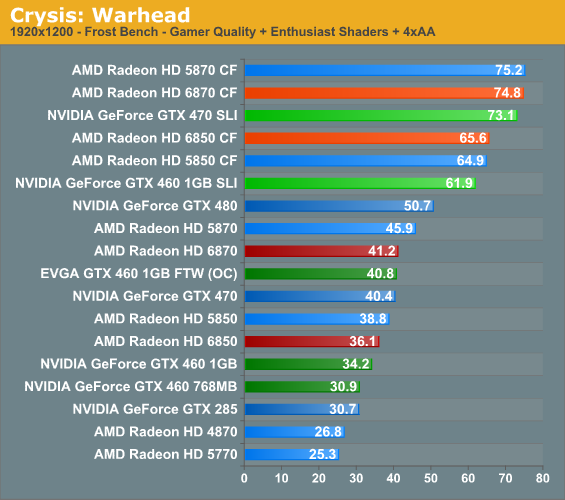
6870 Crossfire at stock is faster than highly overclocked GTX460 SLI in 6 out of 7 games, this is before you even overclock the 6870s at all.

Even before seeing this data one could look at the anandtech reviews, note the 460 scaling in SLI, take note of the single 460 FTW numbers and do the math for two of those in SLI, still slower, but this review confirmed it.

33214.png


33229.png


460 is a great card, but AMD has gained superiority with Crossfire over SLI with current scaling and multi-gpu results in the 6XXX series.
 
460 is a great card, but AMD has gained superiority with Crossfire over SLI with current scaling and multi-gpu results in the 6XXX series.

Hey Groove, has there been any in-depth architectural review articles on Barts that explain why crossfire scaling is improved over that of Evergreen?

If there aren't, or even if there are, what is the generally accepted reasoning for the improved xfire results?

And while it is on my mind, and a pm response is fine so we don't take this thread off-topic, but what ever happened with that hydra stuff...did it ever pan out or was it just the latest hype-fad like the Killer nic turned out to be?
 
Hmmmm I don't think crossfire scaling is superior. I think it's now better vs. some cards, but maybe slightly slower vs. others. GTX470 scaled 1% worse on Crysis but 7% better on Metro2033. But thanks for the link that was what I was looking for.
 
So you don't have a link. Ok.

Hmmmm I don't think crossfire scaling is superior. I think it's equal. GTX470 scaled 1% worse on Crysis but 7% better on Metro2033 - which is why I asked if there specifically was results of 850mhz gtx460's.

I posted a link in my reply.
 
It's hard to go wrong with any of these cards, but picking up a non-FTW GTX460 or HD6850 for ~$180 and oc'ing the hell out of them will give you better price/perf than buying a FTW GTX460 or HD6870. The FTW is factory oc'd. The stock 6870 is also basically factory oc'd in all but name. Neither have the oc'ing headroom of a 6850 or of a stock GTX460@675MHz. Nevertheless, getting the FTW or a 6870 (which is essentially pre-oc'd), would make sense for people who don't like to oc, or who watch their power usage carefully.

I sorry but I confused here alot. The reviewer never O/C the $188 dollar Stock 460. Unless I missed it . If so someone post the results because I don't see it . If its not in there How can you make the above statement . Tired so I may have missed it. But if I didn't Your $188 comparsion is bogus as all hell. There has to be a reason the reviewer didn't O/C that part. So As it stands right now the real deal is the 6850 is the bargin king . Like I said I may have missed it but I looking hard . Why is this happening???
 
Since it appears SLI\CF are affected by profiles created within the driver for specific games. I would say AMD created a better profile for these games with the 6000 series than they have with the 5000 series.
 
Hey Groove, has there been any in-depth architectural review articles on Barts that explain why crossfire scaling is improved over that of Evergreen?

If there aren't, or even if there are, what is the generally accepted reasoning for the improved xfire results?

And while it is on my mind, and a pm response is fine so we don't take this thread off-topic, but what ever happened with that hydra stuff...did it ever pan out or was it just the latest hype-fad like the Killer nic turned out to be?

I haven't seen anything giving a full explanation, beyond generic 'nice scaling results seen here again' If I were to assume on what I've read, I've seen recurring mention of inefficiencies of Cypress found in 58XX being eliminated in the 6XXX series. Bottlenecked TMU & SP corrections and overall underutilized areas of the 5 series being made more efficient in the 6 series card.

Speculation of course. I've always been curious how much of multi-gpu performance is related to hardware and how much is drivers and have asked a few times. No one ever has provided something in-depth on that, I'd love to understand how much can be attributed where.

Hydra suffered from poor game support, there are still Big Bang boards around, but performance on Hydra is nowhere close to SLI or Crossfire and it did not take off.
 
Since it appears SLI\CF are affected by profiles created within the driver for specific games. I would say AMD created a better profile for these games with the 6000 series than they have with the 5000 series.

If were merely that simple, a profile "fix", wouldn't AMD roll that out for the Cypress cards too?

Or did they and people haven't gone back to re-bench with the new drivers? I always assumed the data in a review graph is entirely "recently generated with all the recent drivers"...but I must admit I've never tested that assumption by verifying it to be true or false.

I haven't seen anything giving a full explanation, beyond generic 'nice scaling results seen here again' If I were to assume on what I've read, I've seen recurring mention of inefficiencies of Cypress found in 58XX being eliminated in the 6XXX series. Bottlenecked TMU & SP corrections and overall underutilized areas of the 5 series being made more efficient in the 6 series card.

Speculation of course. I've always been curious how much of multi-gpu performance is related to hardware and how much is drivers and have asked a few times. No one ever has provided something in-depth on that, I'd love to understand how much can be attributed where.

Hydra suffered from poor game support, there are still Big Bang boards around, but performance on Hydra is nowhere close to SLI or Crossfire and it did not take off.

Thanks, yeah I've been assuming it is "something under the hood" meaning an architecturally tweak they did and not just a better driver situation but I don't/can't know for sure so I wanted to ask.

Is it just me or doesn't it seem odd that no one has really looked to see why xfire has improved? For all the attention that other microarchitecture features attract (like tessellation) I would have thought someone out there on a site like RWT or B3D would have torn into it (xfire improvement) already.
 
If were merely that simple, a profile "fix", wouldn't AMD roll that out for the Cypress cards too?

Or did they and people haven't gone back to re-bench with the new drivers? I always assumed the data in a review graph is entirely "recently generated with all the recent drivers"...but I must admit I've never tested that assumption by verifying it to be true or false.

Unless they want to offer an additional reason to purchase a 6800 series card? These SLI\CF configs seem very tempermental when it comes to profiles. If you dont have a good profile or a profile at all, the benefits of dual cards can be very minimal to no benefit at all over a single card. One of the reasons besides micro-stutter I cant get excited about dual GPUs.
 
Thanks, yeah I've been assuming it is "something under the hood" meaning an architecturally tweak they did and not just a better driver situation but I don't/can't know for sure so I wanted to ask. Is it just me or doesn't it seem odd that no one has really looked to see why xfire has improved? For all the attention that other microarchitecture features attract (like tessellation) I would have thought someone out there on a site like RWT or B3D would have torn into it (xfire improvement) already.

I was wondering about that too, but only Cypress chip had scaling issues. Juniper OTOH was much better scaling than cypress( 2X5770 equaled or sometimes even beat a single 5870) and 5770 is exactly half of a 5870.

http://www.legionhardware.com/articles_pages/ati_radeon_hd_5770_crossfire_performance,9.html

My setup actually performs in between 5850 and 5870 on stock.
 
Last edited:
If were merely that simple, a profile "fix", wouldn't AMD roll that out for the Cypress cards too?

Or did they and people haven't gone back to re-bench with the new drivers? I always assumed the data in a review graph is entirely "recently generated with all the recent drivers"...but I must admit I've never tested that assumption by verifying it to be true or false.


Thanks, yeah I've been assuming it is "something under the hood" meaning an architecturally tweak they did and not just a better driver situation but I don't/can't know for sure so I wanted to ask.

Is it just me or doesn't it seem odd that no one has really looked to see why xfire has improved? For all the attention that other microarchitecture features attract (like tessellation) I would have thought someone out there on a site like RWT or B3D would have torn into it (xfire improvement) already.


Hmm I think xfire improvement could be a combo of minor architectural AND drivers improvement. I ain't no engineer nor computer guy, but don't software and hardware generally go hand in hand? If the xfire improvement is a resultant of let's say 50% hardware and 50% software improvement, then it's kinda hard for any bloke to see that unless that bloke is an AMD engineer right.
 
Hmm I think xfire improvement could be a combo of minor architectural AND drivers improvement. I ain't no engineer nor computer guy, but don't software and hardware generally go hand in hand? If the xfire improvement is a resultant of let's say 50% hardware and 50% software improvement, then it's kinda hard for any bloke to see that unless that bloke is an AMD engineer right.

Absolutely, but those AMD blokes tend to go some distance towards ensuring the non-AMD blokes who review their products have some manner of slideware and education regarding architecture/driver improvements that come with the new product.

I'm not looking for a person of my background to dispel the secret ingredients to the magic sauce, I was more looking for a reviewer that had been tipped off about it as tends to happen with a lot of this stuff. (which is why I commented about tessellation)

Surely someone in the review world paused for a moment and said to themselves "hmmm...now I wonder why xfire suddenly improved so much, there might be a story there and good stories means more traffic to my website, lemme shoot my AMD contact an email to see if I can get more info on the situation here...".

I'm just looking for a link to that good story. If no one wrote about it then I guess no one really cared to, but it would be odd if people wanted to write about it but AMD told them to piss-off that their engineers were keeping that marketing opportunity to themselves (unlike all the marketing info we get about tessellation).
 
Perhaps one theory (or contributing theory) for improved Crossfire performance is the re-balancing of Barts somehow lends itself to improved scaling over Cypress. Ryan Smith said Cypress had more shader power than it needed. Perhaps the thing(s) bottlenecking shader performance were also bottlenecking Crossfire scaling?

This is all speculation on my part. I really don't have an answer. I think there could be several possible reasons and I too wish someone experienced would get to the bottom of it.
 
So I take it the stock 460 was not O/Ced . The OP didn't reply so I guess I go out of this topic . Sorry for the inconvenience.
 
So I take it the stock 460 was not O/Ced . The OP didn't reply so I guess I go out of this topic . Sorry for the inconvenience.

???

The original link in the first post was using the FTW which was also overclocked somewhat.

The kitguru link looks like cards are at stock speeds.

The graphs from the post with the kitguru link are from the Anandtech review which looks like all run at stock speeds.

The $188 GTX 460 (1gb) would have similar results to the GTX 460 FTW when overclocked depending on the chip as overclocking is YMMV.
 
It's still a toss-up between a highly overclocked 460 or a stock 6870.

I thought he said gtx460 and 6850 in the title?

Take a 189$gtx 460 vs the 187$ 6850 and overclock them both, who wins?
Take a 250$ gtx 470 and a 240$ 6870 and overclock them, who wins?

I think thats a better comparison.
 
Last edited:
Back
Top