Oldgamer
Diamond Member
Link to Source

Profits have grown five times faster than jobs at America’s largest publicly-traded companies over the past dozen years, according to a new analysis by Reuters.
Staff levels rose by 31 percent from 2001 to 2013 at the companies analyzed while inflation-adjusted profits grew 150 percent, the wire service reports.
The analysis is based on corporate filings by 100 of the largest publicly owned U.S. companies. The filings do not specify where hiring took place, and it is likely that a significant portion of the job growth reported in the documents came from outside the U.S.
Nearly a third of the companies actually shed jobs over the period Reuters examined, including several that shrank payrolls amid rising profits and revenues. Verizon, for example, sliced its workforce by over 30 percent while doubling its profits.
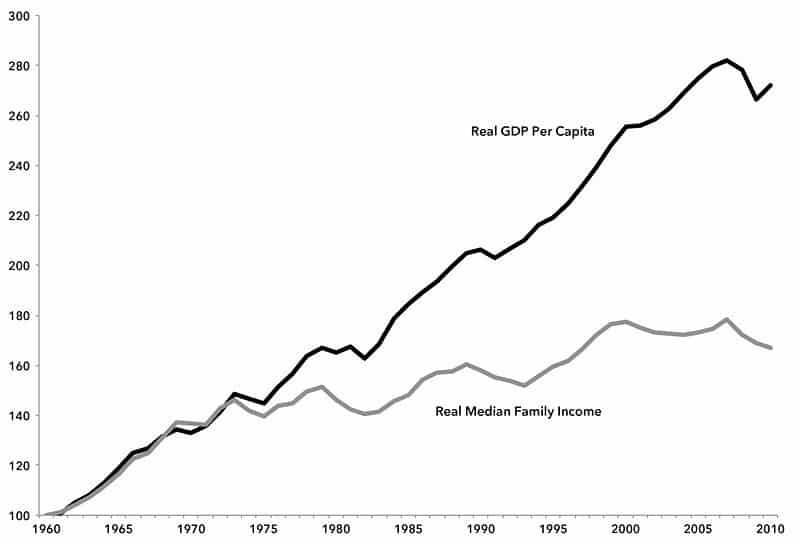
The analysis adds to the wealth of evidence that the success of businesses and their shareholders has become decoupled from workers’ success. Wages have been stagnant throughout the same period despite steadily rising worker productivity, leading the economists at the Economic Policy Institute to label the past 10 years a “lost decade” for the American worker. If the minimum wage had risen in proportion to worker productivity over the past several decades, it would now stand at nearly $22 an hour.
Low-wage work has been the primary source of job growth so far in the slow recovery from the Great Recession. Wages in those job categories have gotten steadily worse over the period Reuters examined. Wages fell by 5.5 percent in the 10 lowest-paying employment categories tracked by government statisticians even as the ranks of those workers swelled by 15 percent from 2001 to 2013. At the same time, earnings for the top categories rose by more than 25 cents on the dollar.
Trends like these exacerbate economic inequality in ways that contradict the trickle-down narrative of American capitalism. According to that story, boom times on corporate balance sheets would inevitably translate into benefits for the middle class as well as the wealthy ownership class.
But the message that severe inequality is actively harming economic growth and security for the country as a whole may be starting to take hold in mainstream analysis as more and more evidence piles up that the trickle-down approach to growth is wrong.
A report prepared for investors last week by Standard & Poor’s summed up much of the years-old evidence that wealth and income inequality undermine growth and even make recessions more likely.
As the New York Times noted, the S&P report’s conclusions and sources were not new. But the fact that an old-line elite institution like S&P would take the time to spell out the practical case against inequality, if not the moral one, indicates that “a debate that has been largely confined to the academic world and left-of-center political circles is becoming more mainstream.”
Profits have grown five times faster than jobs at America’s largest publicly-traded companies over the past dozen years, according to a new analysis by Reuters.
Staff levels rose by 31 percent from 2001 to 2013 at the companies analyzed while inflation-adjusted profits grew 150 percent, the wire service reports.
The analysis is based on corporate filings by 100 of the largest publicly owned U.S. companies. The filings do not specify where hiring took place, and it is likely that a significant portion of the job growth reported in the documents came from outside the U.S.
Nearly a third of the companies actually shed jobs over the period Reuters examined, including several that shrank payrolls amid rising profits and revenues. Verizon, for example, sliced its workforce by over 30 percent while doubling its profits.
The analysis adds to the wealth of evidence that the success of businesses and their shareholders has become decoupled from workers’ success. Wages have been stagnant throughout the same period despite steadily rising worker productivity, leading the economists at the Economic Policy Institute to label the past 10 years a “lost decade” for the American worker. If the minimum wage had risen in proportion to worker productivity over the past several decades, it would now stand at nearly $22 an hour.
Low-wage work has been the primary source of job growth so far in the slow recovery from the Great Recession. Wages in those job categories have gotten steadily worse over the period Reuters examined. Wages fell by 5.5 percent in the 10 lowest-paying employment categories tracked by government statisticians even as the ranks of those workers swelled by 15 percent from 2001 to 2013. At the same time, earnings for the top categories rose by more than 25 cents on the dollar.
Trends like these exacerbate economic inequality in ways that contradict the trickle-down narrative of American capitalism. According to that story, boom times on corporate balance sheets would inevitably translate into benefits for the middle class as well as the wealthy ownership class.
But the message that severe inequality is actively harming economic growth and security for the country as a whole may be starting to take hold in mainstream analysis as more and more evidence piles up that the trickle-down approach to growth is wrong.
A report prepared for investors last week by Standard & Poor’s summed up much of the years-old evidence that wealth and income inequality undermine growth and even make recessions more likely.
As the New York Times noted, the S&P report’s conclusions and sources were not new. But the fact that an old-line elite institution like S&P would take the time to spell out the practical case against inequality, if not the moral one, indicates that “a debate that has been largely confined to the academic world and left-of-center political circles is becoming more mainstream.”