• We’re currently investigating an issue related to the forum theme and styling that is impacting page layout and visual formatting. The problem has been identified, and we are actively working on a resolution. There is no impact to user data or functionality, this is strictly a front-end display issue. We’ll post an update once the fix has been deployed. Thanks for your patience while we get this sorted.

PlayStation 4 Pro SoC Discussion

Page 6 - Seeking answers? Join the AnandTech community: where nearly half-a-million members share solutions and discuss the latest tech.

What do you expect from a a potential PlayStation 4 mid-generation refresh?

  • More Powerful Playstation: New 14nm APU including higher-end Polaris - Default 4K, HDMI 2.0 support

  • Playstation 4 Evolved: New APU including same generation components - Larger GCN 1.1 GPU

  • Playstation 4 Plus (Slim): Die shrink of existing Liverpool APU - Higher clocks, lower cost

  • None (explain below)


Results are only viewable after voting.
Believe it or not, but in some countries consoles are pretty expensive. A lot of people can't afford one.
Introducing an elite unite sometime in the console lifecycle gives an upgrade path to early adopters that already enjoyed their regular console. This will create increased supply of used consoles in second hand market.

This way sony is selling Beefed up PS4 for elite console peasants. Meanwhile a poor console peasants get their second hand PS4 end enjoy the sweet games from PS+. Everyone is happy and sony makes $ two times in single console generation.
It is almost as good as a RROD at increasing console demand 😀
 
I have to be super careful in this topic.

If this PS4.5 ever come out, it should allow a normal PS4 mode and map exactly the same functionality. Why? Because there are a lot of heavily tuned machine code optimization in the PS4 games, and even a little latency change in the hardware may break the ability to perfectly execute a program. A shiny new hardware may not be fast enough emulate the execution.
 
I have to be super careful in this topic.

If this PS4.5 ever come out, it should allow a normal PS4 mode and map exactly the same functionality. Why? Because there are a lot of heavily tuned machine code optimization in the PS4 games, and even a little latency change in the hardware may break the ability to perfectly execute a program. A shiny new hardware may not be fast enough emulate the execution.

Which is exactly why a real PS4.5 (and not just a PS4 with UHD disks or VR bolted on) would be a shock.
 
I have to be super careful in this topic.

If this PS4.5 ever come out, it should allow a normal PS4 mode and map exactly the same functionality. Why? Because there are a lot of heavily tuned machine code optimization in the PS4 games, and even a little latency change in the hardware may break the ability to perfectly execute a program. A shiny new hardware may not be fast enough emulate the execution.

Well if the hardware is faster, executed natively, and with no latency changes, it doesn't sound like a problem. If the PS4K does become a reality, with much faster CPU cores as well as graphics, I expect some 1080p/30 FPS games to be unlocked to 60 FPS. Some titles like Killzone: Shadow Fall even have an option for unlocked framerate.

If the new APU is on 14nm (which would be a big part of keeping cost manageable), there is certainly room to add more CUs, and faster processing cores, either with a clock bump or maybe even more powerful Zen cores. While I would be pessimistic about CPU core changes, an increased number of CUs is likely along with faster memory, maybe even GDRR5X to keep things moving along nicely if there is no increase in latency. It's also possible to see an HBM equipped APU be used, which despite the cost, would allow for a smaller, more simple motherboard.
 
Last edited:
AMD has no say in this. They really don't. This is purely a one-sided transaction.

So it's different from every other business deal ever made by any two companies? Please explain.

We don't even know how detailed Sony's contract is. Maybe Sony will explicitly spec out "Graphics Core Next 2nd generation" features (GCN 1.1) and AMD will push back, saying that, sure, they can do that, but it'll mean more work, a longer lead time, and be much more expensive than just using 4th generation (Polaris) cores (which are already on 14nm). Maybe Sony then decides that backward compatibility with a handful of badly programmed titles (assuming less than 5% of games show actual glitches/problems) isn't that big a deal. Imperfect backward compatibility has been done before. And it's also possible that Sony's contract for the new chip will simply specify that the GPU and CPU need to be "compatible" with those of the old PS4, and leave it to AMD to determine exactly what that means. Unless you have inside information, I don't see how you get the level of certainty that you expressed in your post.
 
We don't even know how detailed Sony's contract is. Maybe Sony will explicitly spec out "Graphics Core Next 2nd generation" features (GCN 1.1) and AMD will push back, saying that, sure, they can do that, but it'll mean more work, a longer lead time, and be much more expensive than just using 4th generation (Polaris) cores (which are already on 14nm).

AMD presumably doesn't have a Jaguar+Polaris APU die in any shape or form, so any theoretical savings is going to be moot. I'm also assuming that AMD agreed to shrink it as part of the original contract. So they were going to have to do the work anyway. Besides, it's probally easier to shrink Liverpool as it is and maybe stuff in some more CUs and the 4K video decoder block then to come up with something completely new.
 
I agree with everything you say but 1080p isn't that bad. It shows its weakness only when you get up to 93" and above. It was even used in earlier digital cinema and I think some digital movie theaters are still 1080p.

I think this 4:0:0 chroma subsampling is more of a let down than the resolution itself. However I can't deny that 1440p would have been a lot better. It would have been perfect for pretty much all reasonably possible screen sizes in a home theater or even commercial theater. It would have been future proof for a very long time.

The reason 4k sources look good downsampled is mostly because the extra pixels restore all chroma information back to 1080p signal 4 pixels -> 1 pixel.
Reduced gamut would have been less of an issue with 1440 because there is less data to compress, putting less pressure on throwing away color info.
If you want to look up what you're doing, the technical term is either "argument from fallacy" or "Argumentum ad logicam".
I don't need to look it up. It has been erroneously said to apply to a post of mine in the past. So, I am familiar with the trick already.
 
Last edited:
More rumors/possible confirmation (Giant Bomb):
Earlier this year, rumors began to fly that Sony would release an upgraded version of the PlayStation 4, a console often called the PS4.5 or the PS4K by fans and press. Today, multiple sources have confirmed for us details of the project, which is internally referred to as the NEO. No price was provided, but previous reports indicate that the NEO would sell at $399. At time of publishing, Sony has not returned our request for comment, but we will update this story if the company responds.
Starting in October, every PS4 game is required to ship with both a “Base Mode” which will run on the currently available PS4 and a “NEO Mode” for use on the new console.
Games running in NEO mode will be able to use the hardware upgrades (and an additional 512 MiB in the memory budget) to offer increased and more stable frame rate and higher visual fidelity, at least when those games run at 1080p on HDTVs. The NEO will also support 4K image output, but games themselves are not required to be 4K native.
The NEO will not supplant the current PS4, but will exist alongside of it and use the same user environment. The PS4 and NEO will use the same PSN store, connect to the same online communities, and offer the same user experience, so expect to see the same cross media bar that you’re used to. Players will be able to retain all of the purchases they made on the PS4.
Sony seems committed to keeping the NEO and the original PS4 player bases connected. As such, there will be no NEO-only games, and Sony will not let developers separate NEO users from original PS4 players while playing on PSN. Likewise, Sony explicitly and repeatedly states that developers cannot offer exclusive gameplay options or special unlockables for NEO players—so don’t expect NEO owners to get a level editor or a special Rocket League car that you won’t have access to on your original PS4.
Original PS4:
CPU: 8 Jaguar Cores at 1.6 GHz
GPU: AMD GCN, 18 CUs at 800 MHz
Memory: 8 GB GDDR5, 176 GB/s

NEO:
CPU: 8 Jaguar Cores at 2.1 GHz
GPU: Improved AMD GCN, 36 CUs at 911 MHz (almost certainly Polaris 10 IMO)
Memory: 8 GB GDDR5, 218 GB/s
http://www.giantbomb.com/articles/so...-ne/1100-5437/

Interesting stuff. Shame about the CPU. I get the feeling that a lot of games are limited to 30 FPS because of a CPU bottleneck. This 31% speed improvement is a step in the right direction, but I don't know if we'll be seeing too many new 60 FPS games, despite the huge increase in GPU performance. Likely we'll be seeing games that are a solid 30 with much greater image quality. Zen would have been a marvelous surprise.

Hopefully Polaris's color compression is up to the task. That bandwidth bump is less than ideal.
 
Last edited:
Hm... if they are going with a P10, I wonder if the entire die will be on 14nm or if they will back-port Polaris to 28nm to keep overall die costs down. If everything will be on 14nm, then we're talking about a 350 mm^2 on 14nm and that can't be cheap to produce.

Desktop P10 should be somewhere between $250 and $350, but the consoles should have the benefit of mass production to bring down costs. Does a speculated price of $399 make sense anymore?

What was the bill of materials cost for the original PS4?
 
Interesting stuff. Shame about the CPU. I get the feeling that a lot of games are limited to 30 FPS because of a CPU bottleneck. This 31% speed improvement is a step in the right direction, but I don't know if we'll be seeing too many new 60 FPS games, despite the huge increase in GPU performance.

I don't know why people think this, going from hand coded optimised code for 360/PS3 code to jaguar saw around 5-6 times IPC jump to unoptimized code for jaguar. Now while jaguar isn't clocked that high it has some really interesting capabilities like 2 cycle AVX add/mul etc, on bulldozer/haswell it's 5 cycles. So there are some real opportunity to optimise on jaguar compared to what you see in generic x86 benchmarks for critical paths.

a PS4 = 16x128 AVX units @ 1.6ghz and if rumor is true now 2.1, it has solid IPC, honestly what is going to do better for gaming workloads. Dev's have spent the last 10 years working with parallel code, more IPC and less AVERAGE throughput is not a win.
 
Hm... if they are going with a P10, I wonder if the entire die will be on 14nm or if they will back-port Polaris to 28nm to keep overall die costs down. If everything will be on 14nm, then we're talking about a 350 mm^2 on 14nm and that can't be cheap to produce.
And if they're going with 28nm... how big would that be and more importantly how would they cool it efficiently?
 
So how would the die sizes of 8x Jaguars @28nm vs 4x Zen @14nm (I assume) compare?

A 4C Jag module + L2 is 26.2 mm^2.
Worst case: 0.5x scaling. The GloFo engineering slides did show more like 0.25x scaling.
-> ~25-50 mm^2 for 8 cores + L2
A Zen core complex with L3 might be (depending on achieved scaling) 30-60 mm^2.

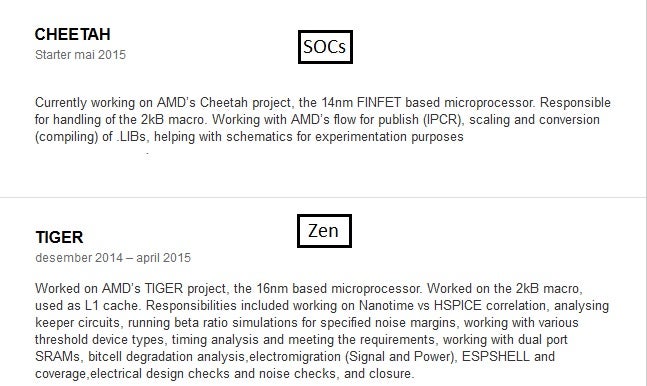
Could the core variant actually be Cheetah?
1000
 
A 4C Jag module + L2 is 26.2 mm^2.
Worst case: 0.5x scaling. The GloFo engineering slides did show more like 0.25x scaling.
-> ~25-50 mm^2 for 8 cores + L2
A Zen core complex with L3 might be (depending on achieved scaling) 30-60 mm^2.

Could the core variant actually be Cheetah?
1000
Why is there 16nm referenced for AMD "tiger" 😵

I thought Zen was solely 14nm GF/Samsung :\

The first one makes sense, it could be a Puma+ successor or just a derivative at 14nm.
 
The GloFo engineering slides did show more like 0.25x scaling.

You should be smart enough not to use that number for anything.

On the topic, a Core change in terms of a new uarch etc is unlikely due to latency based optimizations. Even a slightly faster better uarch could give worse performance. PC ports isn't exactly running like they should in relation to speed either.
 
Last edited:
all that gpu compute.
with some graphics devs prototyping spawning graphics tasks from the gpu itself, I doubt the cpu is really that important save for non-trivially parallel code.
the problem is concurrent compatibility ps4-non-k.
 
the problem is concurrent compatibility ps4-non-k.

The only way I can see them making the PS4.5 compatible is if they run it like a PS4 (ie. the cpu + gpu cores are identical and run at the same speed when running older games) which means the GPU cores would have to be identical to those in the original PS4, and they'd just use the same number as the PS4 has for all existing PS4 games.

Which means no polaris, or zen or anything new. Not that they would just work anyway - polaris is a GPU, the PS4 chip is an apu with shared memory and other special console stuff.

The whole idea still seems a bit strange - I mean you have now split your player base. Sure you can *say* everything must work for both, but you can bet a load of say the VR games only really work well on the 4.5. It will force developers to optimise for 2 different consoles, and while they say the new console is 4k the PS4.5 hasn't got 4* the power of a PS4 which is barely capable of 1080p so it's not really 4K. You could say "but this makes everyone buy a new console" only Sony never made money on the console - they made money on the games and they'd sell the game whether it's on the new or the old console. Also they already had the fastest console, so why make a slightly faster one?
 
Last edited:
Eurogamer confirms the spec leak. It's happening.

Revealed: Sony's plan for PlayStation 4K - codename Neo
The spec leak is genuine - here's everything you need to know.


We have been sitting on a number of details awaiting a second source before going to press, but events have overtaken us somewhat - Sony is now openly sharing this specification with developers and while Giant Bomb beat us to the punch, we have access to the same documentation. There is no doubt - this is real. This is the new, more powerful PlayStation 4.

The release window is unclear, but the schedule for hardware roll-out to developers is black and white: development kits prototype are on their way to studios now. A test kit (debug station, if you like) housed within a non-final chassis - which Sony is asking developers not to show - follows shortly. A second-gen test kit, again not based on the actual retail shell, goes out in June. Sony gives more intensive Neo briefings at its DevCon event in in May, while code submission for Neo-compatible titles begins in August.

Our concern was that PS4's low-level APIs may not be compatible with the newer architecture, meaning problems running older games, but it seems that this is not an issue. And the good news here is that Polaris' efficiency improvements could add still further to the expected increase in performance. Certainly, we should expect to see cumulative improvements to memory compression, which should help us to get more out of the constricted 256-bit GDDR5 interface. To the best of our knowledge, there were no such technologies in place on the original PlayStation 4.

Well, according to Sony's own documents, there is a focus on delivering 4K gaming content, though upscaling to UHD resolution is likely. Owners of 1080p screens can expect benefits too, explicitly stated as:

Higher frame-rates
More stable frame-rates
Improved graphics fidelity
Additional graphics features
Sony describes 'forward compatibility' via patches, allowing developers to revisit their existing PS4 library and add Neo features to existing games. Sony has opened up more memory for Neo titles too. Quite why this extra RAM can't be given to games running in Base mode isn't revealed but Sony states that Neo titles will have access to 5.5GB of memory, with 512MB "only available" for Neo mode. Sony also reveals that the background media functions of the PS4 "might be" expanded - such as the addition of 1080p gameplay recording.

www.eurogamer.net/articles/digitalfoundry-2016-sonys-plan-for-playstation-4k-neo-revealed

I wonder how current PS4 owners will react to this product.
 
Last edited:
That's a bold or stupid move by Sony. Time will tell.

I wonder if they keep GCN 1.1 for graphics, else they have a compatibility issue. They can always down clock CPU and GPU for legacy support.
 
That's a bold or stupid move by Sony. Time will tell.

I wonder if they keep GCN 1.1 for graphics, else they have a compatibility issue. They can always down clock CPU and GPU for legacy support.

Seems unlikely. 36 CU on a 256GB/s memory bus would be really memory bottlenecked without the memory compression from later GCN generations, especially considering the memory bandwidth isn't exclusive to the GPU.
 
In a time where people dont have much money. Telling people to buy a new console to replace one that isn't old is not what I would do. Specially not when you earn money on games and not hardware.
 
In a time where people dont have much money. Telling people to buy a new console to replace one that isn't old is not what I would do. Specially not when you earn money on games and not hardware.

Sony want to push 4K media- they sell 4K TVs and 4K Blu-Rays.
 
Sony want to push 4K media- they sell 4K TVs and 4K Blu-Rays.

True, and the current PS4 cant do any.

Bluray4K also gives a pointer. Only the UVD in GCN 1.3 can do it. It requires around 128Mbit in HEVC 10bit.

But still with that said, it could be their "Wii U".
 
Back
Top