• We’re currently investigating an issue related to the forum theme and styling that is impacting page layout and visual formatting. The problem has been identified, and we are actively working on a resolution. There is no impact to user data or functionality, this is strictly a front-end display issue. We’ll post an update once the fix has been deployed. Thanks for your patience while we get this sorted.

Pickles are 0 calorie? or Marketing trick

JEDI

Lifer
51ASvMoMxgL._SY355_.jpg

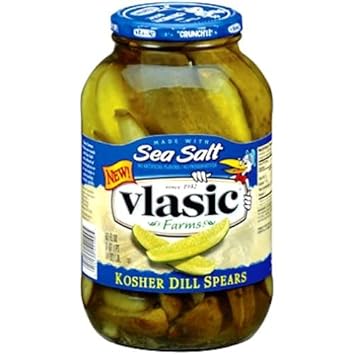
62 oz jar.

from nutritional label:
calories = 0
serving size = about 1 oz
# of servings per jar = 36 😱
hm...

oh, and each spear is 9% of daily salt intake. 😱
so if you did just like I did and eat about a dozen in 1 sitting, you've overmax
 
Last edited:
1) Companies are allowed "natural variation" (scroll down to the 4. Construct a one-sided 95% prediction interval section):
https://www.fda.gov/food/guidancere...mation/labelingnutrition/ucm063113.htm#stat_5

Not all pickles are exactly the same size. Thus the FDA allows for variations from serving to serving. That means that companies can use the mean calorie value or tweak the calorie value up/down as they wish as long as there is a 95% chance that a given pickle will be within the calorie range specified.

2) After the company chooses a calorie value to use on the label, they must to round. Low calorie items (under 5 calories) must be rounded down to 0.
https://www.fda.gov/Food/GuidanceRe...ryInformation/LabelingNutrition/ucm064932.htm

3) Both of the above apply. For example, a product that is normally 6 calories can be considered to naturally vary down to 5 calories, and then can be rounded down to 0 calories.

 
Cucumbers and salt water. Salt is no calories, and cucumbers might as well be a rounding error.

Eat your vegetables, like your granny said.
 
Cucumbers and salt water. Salt is no calories, and cucumbers might as well be a rounding error.

Eat your vegetables, like your granny said.

Many pickles have some sugar added to the mix. So they won't *technically* be zero calories, but in practice pickles are a negative calorie food even with a little added sugar. You burn off more calories eating and digesting them than there are in them, so you come out ahead.

The pickles in the OP have no sugar added, so they really are zero calories, or at least zero with a rounding error. Bread and butter pickles might have 20-25 calories each, a standard kosher dill maybe 10-15.
 
1) Companies are allowed "natural variation" (scroll down to the 4. Construct a one-sided 95% prediction interval section):
https://www.fda.gov/food/guidancere...mation/labelingnutrition/ucm063113.htm#stat_5

Not all pickles are exactly the same size. Thus the FDA allows for variations from serving to serving. That means that companies can use the mean calorie value or tweak the calorie value up/down as they wish as long as there is a 95% chance that a given pickle will be within the calorie range specified.

2) After the company chooses a calorie value to use on the label, they must to round. Low calorie items (under 5 calories) must be rounded down to 0.
https://www.fda.gov/Food/GuidanceRe...ryInformation/LabelingNutrition/ucm064932.htm

3) Both of the above apply. For example, a product that is normally 6 calories can be considered to naturally vary down to 5 calories, and then can be rounded down to 0 calories.
Ah, thanks for the info. I'd always wondered why a 12oz can of Coke Zero was "0 calories" and a 20oz bottle was 10 calories, but I'd never bothered to look it up.
 
1) Companies are allowed "natural variation" (scroll down to the 4. Construct a one-sided 95% prediction interval section):
https://www.fda.gov/food/guidancere...mation/labelingnutrition/ucm063113.htm#stat_5

Not all pickles are exactly the same size. Thus the FDA allows for variations from serving to serving. That means that companies can use the mean calorie value or tweak the calorie value up/down as they wish as long as there is a 95% chance that a given pickle will be within the calorie range specified.

2) After the company chooses a calorie value to use on the label, they must to round. Low calorie items (under 5 calories) must be rounded down to 0.
https://www.fda.gov/Food/GuidanceRe...ryInformation/LabelingNutrition/ucm064932.htm

3) Both of the above apply. For example, a product that is normally 6 calories can be considered to naturally vary down to 5 calories, and then can be rounded down to 0 calories.
thx.

so marketing trick.
keep the serving size low to get it down to 0 cal
 
Ah, thanks for the info. I'd always wondered why a 12oz can of Coke Zero was "0 calories" and a 20oz bottle was 10 calories, but I'd never bothered to look it up.
surprised coke didn't say 2 servings and make the serving size =10 oz = 0cal
 
Back
Top