• We’re currently investigating an issue related to the forum theme and styling that is impacting page layout and visual formatting. The problem has been identified, and we are actively working on a resolution. There is no impact to user data or functionality, this is strictly a front-end display issue. We’ll post an update once the fix has been deployed. Thanks for your patience while we get this sorted.

PC GAMER CPU of the Year: Intel Core i5-8400

goldstone77

Senior member
CPU of the Year: Intel Core i5-8400
By Jarred Walton, PC Gamer 2 days ago
2017 was the year of the CPU, but when the dust settles, this is our favorite.
vzRHa74rYDyiQFiD7zmgU5-650-80.jpg

More cores is the easy way to improve performance, and Intel gives us exactly that with its 8th Generation Coffee Lake processors—50 percent more cores than the previous generation, to be precise. But it's not just about cores, because clockspeed and per-core performance still matter, especially for games. While the Core i5-8400 has a base clockspeed that's relatively low (2.8GHz), on all the Z370 boards I've tried the chip runs at 3.8GHz when fully loaded, and up to 4.0GHz on two cores. Even better, it costs less than $200 and doesn't need any exotic cooling.
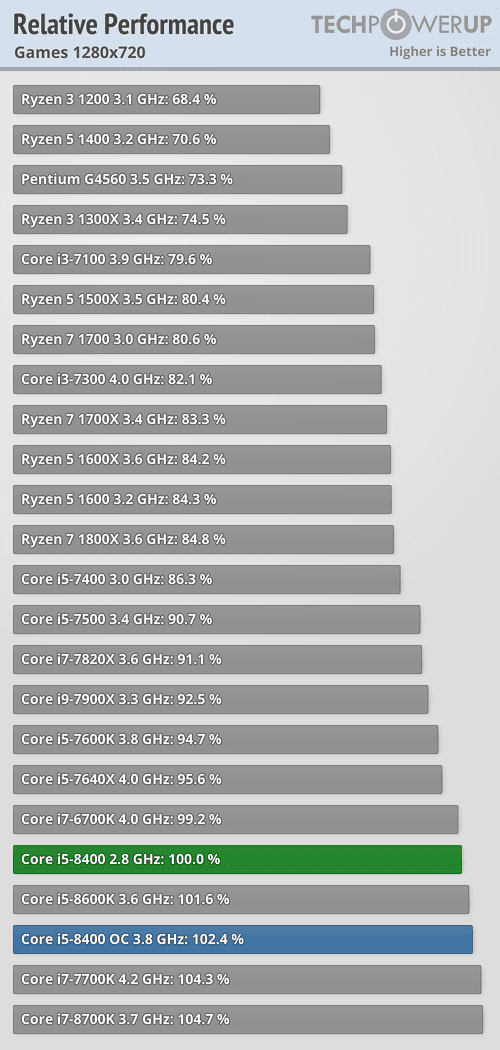
In performance tests, the i5-8400 basically matches the previous generation i7-7700K (running stock) in games and applications. It's clocked a bit lower, but the extra cores make up the difference. The only reason to go beyond the i5-8400 for a gaming PC is if you're thinking of running multiple GPUs, something we don't generally recommend, or if you like overclocking. For that, the Core i7-8700K is the way to go, but at double the price it's not something generally needed (and you'll still need to bring your own cooling solution).

Of course we have to give an honorable mention to AMD's Ryzen and Threadripper processors, without which we likely wouldn't have Intel's Coffee Lake or Core i9. Intel is still the best CPU choice for gaming, but the Zen architecture is a huge leap forward in AMD processor performance. 2017 was the year of the CPU, with five new platform launches and over 40 new individual CPU models—and that's not even counting mobile and specialized chips. It's the most excitement we've seen since the heady days of the race to 1GHz in 1999.

What does 2018 hold for us? There are rumors of an improved Ryzen architecture, 8-core Intel parts for the 300-series platform, and even processors with greatly improved integrated graphics. I'm not sure it can top 2017, but next year's CPUs should continue to bring more excitement to your PC's core component.
 
Yeah the i5-8400 is the best budget 6 core CPU out right now, and I would build a mid-range system using it if I needed a new mid-range build.
 
Yeah the i5-8400 is the best budget 6 core CPU out right now, and I would build a mid-range system using it if I needed a new mid-range build.
I agree if you can find it in stock it offers a great value. It also shows that you don't need high clock speeds to have good FPS.
 
In real world applications (games mostly) how would this compare to a 2600K @ 4.8ish? Those chips can easily be had for $100 - $120.
 
this CPU + "h210" or whatever is called is going to be hard to compete for any other combination in terms of high performance value.
 
While the Core i5-8400 has a base clockspeed that's relatively low (2.8GHz), on all the Z370 boards I've tried the chip runs at 3.8GHz when fully loaded, and up to 4.0GHz on two cores.
Hmm. I thought people here on the forums tested MCE, and it didn't work on the locked CFL CPUs?

Edit: And no honorable mention for the Ryzen 5 1600X CPU? C'mon.
 
Hmm. I thought people here on the forums tested MCE, and it didn't work on the locked CFL CPUs?

The FCT is 3.8 without MCE. In theory anyway, remember Intel no longer publishes turbo clocks so it's not guaranteed. I do wonder if post-full Coffee Lake release the clocks on the 8400 will go down on average.
 
In real world applications (games mostly) how would this compare to a 2600K @ 4.8ish? Those chips can easily be had for $100 - $120.
Here are some comparisons. Depending on title, you probably wouldn't notice too much difference in gameplay if you don't look at the FPS meter.

2600k stock 113/67/56.3
2600k OC 4.7GHz 130/95/89.3
8400 stock 155/95.5/79
I realize too late that 2 different video cards were used. 1080 and 1080Ti.

https://www.gamersnexus.net/hwreviews/3157-intel-i5-8600k-review-overclocking-vs-8700k-8400/page-2
https://www.gamersnexus.net/hwreviews/2875-amd-r5-1600x-1500x-review-fading-i5-argument/page-4

amd-r5-tww-benchmark.png
8600k-tww-1080p.png

Edit: this is not an apples to apples comparison 1 is using a 1080Ti vs. 1080.
 
Last edited:
Hmm. I thought people here on the forums tested MCE, and it didn't work on the locked CFL CPUs?

Edit: And no honorable mention for the Ryzen 5 1600X CPU? C'mon.

Of course we have to give an honorable mention to AMD's Ryzen and Threadripper processors, without which we likely wouldn't have Intel's Coffee Lake or Core i9. Intel is still the best CPU choice for gaming, but the Zen architecture is a huge leap forward in AMD processor performance.

What, that wasn't enough?
 
Hmm. I thought people here on the forums tested MCE, and it didn't work on the locked CFL CPUs?

Edit: And no honorable mention for the Ryzen 5 1600X CPU? C'mon.

Ryzen with fast RAM 3200MHz or faster reduces the intra CCX latency, and improves FPS substantially especially in newer AAA titles.


amd-r5-tww-benchmark.png

8600k-tww-1080p.png

8600k-wd2-1080p.png

amd-r5-wd2-benchmark.png
https://www.gamersnexus.net/hwreviews/3157-intel-i5-8600k-review-overclocking-vs-8700k-8400/page-2
https://www.gamersnexus.net/hwreviews/2875-amd-r5-1600x-1500x-review-fading-i5-argument/page-4

Edit: this is not an apples to apples comparison 1 is using a 1080Ti vs. 1080.
 
Hmm. I thought people here on the forums tested MCE, and it didn't work on the locked CFL CPUs?

Edit: And no honorable mention for the Ryzen 5 1600X CPU? C'mon.
I believe those are the stock turbo clocks for the 8400, and they honorably mentioned all of the Ryzen and threadripper chips. (not sure why they would mention TR, but they did)
 
The FCT is 3.8 without MCE. In theory anyway, remember Intel no longer publishes turbo clocks so it's not guaranteed. I do wonder if post-full Coffee Lake release the clocks on the 8400 will go down on average.
Intel no longer publishes turbo clocks because they won't guarantee those clocks for people who incorrectly use\setup their systems. They will never release an 8400 that doesn't run 3.8ghz All core and still call it an 8400.
The 8400 running all cores at 3.8ghz doesn't consume or generate insane amounts of heat. My guess is they released the 8400 with a low base clock because they wanted the more expensive 8600k to look like a better deal. At the end of the day, base clocks mean absolutely nothing because a CPU can throttle itself to any frequency it needs to.

I have to say while I am an Intel fan and enjoy current generation of chips, The 8400 should not have got this award. Every coffee lake CPU has been available since a month after launch with the exception of the 8400. The 8400 has been so limited I would have never given it this award. The 8700k was one of the biggest launches Intel has ever made and the chip has insane headroom. It's clear that Intel's 14++ process is so advanced most if not all of the 6core dies are reaching 8700k speeds and intel has decided to try to keep up with the 8700k by sacrificing 8400 availability. The 8400 should and will get tons of awards and accolades next year when it finally is available along with the cheaper motherboards.
 
Intel no longer publishes turbo clocks because they won't guarantee those clocks for people who incorrectly use\setup their systems. They will never release an 8400 that doesn't run 3.8ghz All core and still call it an 8400.
The 8400 running all cores at 3.8ghz doesn't consume or generate insane amounts of heat. My guess is they released the 8400 with a low base clock because they wanted the more expensive 8600k to look like a better deal. At the end of the day, base clocks mean absolutely nothing because a CPU can throttle itself to any frequency it needs to.

I have to say while I am an Intel fan and enjoy current generation of chips, The 8400 should not have got this award. Every coffee lake CPU has been available since a month after launch with the exception of the 8400. The 8400 has been so limited I would have never given it this award. The 8700k was one of the biggest launches Intel has ever made and the chip has insane headroom. It's clear that Intel's 14++ process is so advanced most if not all of the 6core dies are reaching 8700k speeds and intel has decided to try to keep up with the 8700k by sacrificing 8400 availability. The 8400 should and will get tons of awards and accolades next year when it finally is available along with the cheaper motherboards.

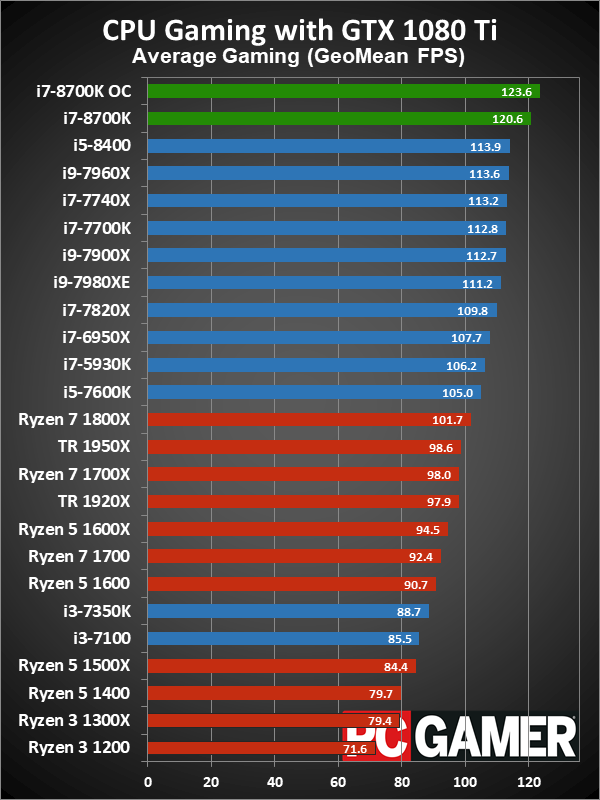
I personally think the 8400 deserves it. Availability aside, you can purchase 2 8400 and a extra value meal at McDonalds for the price of the 8700K. Averaging ~10-~20 higher average FPS isn't worth the extra money, not counting the ~$100 for the cooler you need for the 8700K. 8400 hands down in my book.
 
Agreed it's a great gaming CPU, with some caveats.

Pros: Great bang for buck, no fuss, just high fps out of the box. Minimum CPU I would recommend for 144Hz gaming.
Runs well with DDR4-2666 for gaming. No need for expensive DDR4 3200 CL 14 kits just to ’keep up' in gaming (yes I'm talking about Ryzen here)

Cons: No H or B series mobos until 2018 which pushes platform costs up. Not ideal for a budget oriented CPU that can't be overclocked to only have Z370 mobos available. That said, entry level Z370 mobos are getting close to $100 now which makes it easier to stomach for budget builds. Is it worth waiting a few months just to save $30 on a mobo?
 
Agreed it's a great gaming CPU, with some caveats.

Pros: Great bang for buck, no fuss, just high fps out of the box. Minimum CPU I would recommend for 144Hz gaming.
Runs well with DDR4-2666 for gaming. No need for expensive DDR4 3200 CL 14 kits just to ’keep up' in gaming (yes I'm talking about Ryzen here)

Cons: No H or B series mobos until 2018 which pushes platform costs up. Not ideal for a budget oriented CPU that can't be overclocked to only have Z370 mobos available. That said, entry level Z370 mobos are getting close to $100 now which makes it easier to stomach for budget builds. Is it worth waiting a few months just to save $30 on a mobo?
I would spend ~$100 on a board to make sure I would a decent one that will last a long time.
 
Intel no longer publishes turbo clocks because they won't guarantee those clocks for people who incorrectly use\setup their systems. They will never release an 8400 that doesn't run 3.8ghz All core and still call it an 8400.

What do you mean they don't publish turbo clocks anymore?
They do for the 8400:

https://ark.intel.com/products/126687/Intel-Core-i5-8400-Processor-9M-Cache-up-to-4_00-GHz

And all the other Coffe Lake cpu's as far as I can tell. Here's the 8600K:

https://ark.intel.com/products/126685/Intel-Core-i5-8600K-Processor-9M-Cache-up-to-4_30-GHz
 
I would spend ~$100 on a board to make sure I would a decent one that will last a long time.
Personally I agree, plus Z chipsets can take advantage of K chips should you wish to upgrade the 8400 down the track.

With a $30 price difference I think anyone thinking of doing a 8400 build should just do it.
 
What do you mean they don't publish turbo clocks anymore?

It's the anycore turbo that Intel is no longer publishing. The implication is that Intel is now free to bin chips much looser since the chips now only have to be able to meet the base specs, and one core at the turbo spec.
 
It's the anycore turbo that Intel is no longer publishing. The implication is that Intel is now free to bin chips much looser since the chips now only have to be able to meet the base specs, and one core at the turbo spec.

Even older chips only published max turbo for single core. 6600K:

https://ark.intel.com/products/88191/Intel-Core-i5-6600K-Processor-6M-Cache-up-to-3_90-GHz

2500K:

https://ark.intel.com/products/52210/Intel-Core-i5-2500K-Processor-6M-Cache-up-to-3_70-GHz

Seems like they are publishing turbo speeds as they always have.
 
Even older chips only published max turbo for single core. 6600K:

https://ark.intel.com/products/88191/Intel-Core-i5-6600K-Processor-6M-Cache-up-to-3_90-GHz

2500K:

https://ark.intel.com/products/52210/Intel-Core-i5-2500K-Processor-6M-Cache-up-to-3_70-GHz

Seems like they are publishing turbo speeds as they always have.

Intel no longer advertises or displays multi-core Turbo frequency information
ARK goes dark on Turbo Boost data
By Greg Synek on Oct 10, 2017, 1:25 PM
Moving forward, Intel has decided to stop disclosing information on its Turbo Boost Technology feature beyond single-core maximum frequencies.
Looking at the newest Coffee Lake CPUs on Intel's ARK page, all Turbo frequencies have been taken down besides the single-core maximum frequency.

Here's Intel's stance as provided to ExtremeTech:

[W]e’re no longer disclosing this level of detail as its proprietary to Intel. Intel only specifies processor frequencies for base and single-core Turbo in our processor marketing and technical collateral, such as ARK, and not the multi-core Turbo frequencies. We’re aligning communications to be consistent. All Turbo frequencies are opportunistic given their dependency on system configuration and workloads.

Official response aside, there is some speculation as to what the 'true' reasoning is in not publishing information that would be helpful to know if shopping for a new CPU.
 
Back
Top