

Obama to propose $3.99 trillion budget
Page 4 - Seeking answers? Join the AnandTech community: where nearly half-a-million members share solutions and discuss the latest tech.
You are using an out of date browser. It may not display this or other websites correctly.
You should upgrade or use an alternative browser.
You should upgrade or use an alternative browser.

Doc Savage Fan
Lifer
- Nov 30, 2006
- 15,456
- 389
- 121
Bush significantly decreased (not increased) the US's deficit to GDP ratio during 2005-2007 and total debt to GDP ratio moderated during this time at levels well below that seen during Clinton's administration before the tech bubble.2005-2007 the US was effectively at full employment. Full employment is not calculated as a percentage, it is the maximum level of employment that is not accompanied by above-target inflation.
http://research.stlouisfed.org/fred2/series/FYFSGDA188S
http://research.stlouisfed.org/fred2/series/GFDEGDQ188S
Seems to me that you're greatly exaggerating Bush's economic failures during this 3 year period. And for what purpose? So you can make a case that Obama's efforts have been much better in comparison had the recession not occurred?
So basically when we are at full employment, inflation is high, GDP is where you want it, all the planets align and the moon is full we can finally start cutting the budget?
When we see inflation the first thing we should do is increase interest rates. Then once interest rates return to more normal levels we should implement fiscal austerity of some sort. That could either be through higher taxes or lower spending. We can then offset that with looser monetary policy, which would allow us to reduce our debt/GDP ratio without screwing over our economy.
Saying we should cut the budget when we have low inflation and interest rates at the zero lower bound makes absolutely zero economic sense. It is an ideological argument against government spending, it is not an economic one.

OverVolt
Lifer
- Aug 31, 2002
- 14,278
- 89
- 91
Yes the government is supposed to be the smart money and go counter cyclical, which is a mistake we made during the great depression that caused unnecessary suffering.
Like the last 30 years Japan has been going counter cyclical and they will hit escape velocity anytime now and pay off their 1 Quadrillion Yen 260% of GDP debts with QE 9. Cause it works so well.
Like the last 30 years Japan has been going counter cyclical and they will hit escape velocity anytime now and pay off their 1 Quadrillion Yen 260% of GDP debts with QE 9. Cause it works so well.
Bush significantly decreased (not increased) the US's deficit to GDP ratio during 2005-2007 and total debt to GDP ratio moderated during this time at levels well below that seen during Clinton's administration before the tech bubble.
http://research.stlouisfed.org/fred2/series/FYFSGDA188S
http://research.stlouisfed.org/fred2/series/GFDEGDQ188S
Seems to me that you're greatly exaggerating Bush's economic failures during this 3 year period. And for what purpose? So you can make a case that Obama's efforts have been much better in comparison had the recession not occurred?
He decreased the DEFICIT to GDP ratio, but not the DEBT to GDP ratio, which is the part that matters. As I said before, going only modestly more into debt at a time you should be reducing your debt burden is incredibly irresponsible. I'm in no way exaggerating his failures, they are very large.
You're just proving my point with the debt/GDP chart. You can certainly say that deficits were helped under Clinton, but during the tech bubble Clinton shaved 10-12 points off our debt/GDP ratio. With a much larger and even more catastrophic bubble Bush added 4 points.
Doc Savage Fan
Lifer
- Nov 30, 2006
- 15,456
- 389
- 121
Not much we can do about it other than do our best to recover and not be so stupid in the future.Potential GDP is important because when we are running below that we're basically flushing money down the toilet.
I'm interested to see how potential GDP has been used in the past to compare the effectiveness of different administrations. Any links you have to show this was common practice would be appreciated.Potential GDP has been used for a long time, and if you have an issue with it you should contact the Fed, the CBO, etc, etc. They seem to think it is a perfectly viable analysis method. Can you explain why you think they are wrong?

Subyman
Moderator <br> VC&G Forum
- Mar 18, 2005
- 7,876
- 32
- 86
This is wrong for several reasons. Above all else, your last argument is saying that the success of stimulative policies should be used as an argument against stimulus. haha.
All that aside, my graph wasn't intended to show trends, lol. It was intended to show that Bush was deficit spending at a time when real GDP growth closely matched potential GDP. ie: it was wasteful. Obama was/is deficit spending at a time when real GDP was substantially below potential GDP. People were attempting to argue that the two were equivalent, which they obviously are not.
Given what we know about fiscal multipliers, it should be obvious why the first is bad and the second is good.
Second, your chart not only doesn't support your argument but it's misleading as well.
1. Your chart ends right at the beginning of 2010, meaning it only includes one year out of six years of depressed GDP growth. If you're going to try to analyze trends you can't possibly show up in the graph you provided, as it only includes about 15% of the trend you're trying to analyze. That's a big no-no.
2. We're talking about a several percent change in overall GDP. That's very meaningful in real terms but you're trying to get people to eyeball a change like that out of a 120 years of economic data by using such a large graph. That's extremely misleading.
I could go on, but considering that this wasn't even about analyzing trends that seems pointless, no?
"Potential GDP" is the upper bounds of the steady state growth path of the economy (or balanced growth.) Like I said, perturbations away from that path happen, but always move back to balanced growth. In fact, we do not need stimulus to return to balanced growth in the long term, but stimulus is used to get back to balance growth faster. The government tries to reduce the amplitude and duration of economic perturbations. That is the number one goal and we've done a great job of it since the great depression and WWII, as you can see from the graph I provided.
I see what you are saying. Your point is fine, I'm not arguing against your point about when to spend or when not to spend. I reread the posts and have no issue with your points.
Doc Savage Fan
Lifer
- Nov 30, 2006
- 15,456
- 389
- 121
The increase in debt to GDP during 2005-2007 was very modest in my opinion hovering in the 61-62% range. I seem to recall that we've discussed this subject in the past and you indicated the our debt to GDP ratio now being over 100% wasn't really a problem. If I get some time I do a search.He decreased the DEFICIT to GDP ratio, but not the DEBT to GDP ratio, which is the part that matters. As I said before, going only modestly more into debt at a time you should be reducing your debt burden is incredibly irresponsible. I'm in no way exaggerating his failures, they are very large.
You're just proving my point with the debt/GDP chart. You can certainly say that deficits were helped under Clinton, but during the tech bubble Clinton shaved 10-12 points off our debt/GDP ratio. With a much larger and even more catastrophic bubble Bush added 4 points.
Last edited:

Matt1970
Lifer
- Mar 19, 2007
- 12,320
- 3
- 0
When we see inflation the first thing we should do is increase interest rates. Then once interest rates return to more normal levels we should implement fiscal austerity of some sort. That could either be through higher taxes or lower spending. We can then offset that with looser monetary policy, which would allow us to reduce our debt/GDP ratio without screwing over our economy.
Saying we should cut the budget when we have low inflation and interest rates at the zero lower bound makes absolutely zero economic sense. It is an ideological argument against government spending, it is not an economic one.
So we need to see full employment, high inflation, GDP is where you want it, then we can raise interest rates to bring down the inflation, and then once interest rates return to more normal levels we can implement fiscal austerity, and even then it may just be tax hikes and not spending cuts. Got it.
So we need to see full employment, high inflation, GDP is where you want it, then we can raise interest rates to bring down the inflation, and then once interest rates return to more normal levels we can implement fiscal austerity, and even then it may just be tax hikes and not spending cuts. Got it.
Well you have to remember that I think we should have a larger government, so of course I would prefer tax hikes to spending cuts. That's a policy choice though.
What I'm telling you otherwise is simply economics. Don't allow your ideology to overcome economics. Use your head.
OverVolt
Lifer
- Aug 31, 2002
- 14,278
- 89
- 91
The difference is letting the recession happen and just making it less miserable versus trying to paper over the whole thing with trillions. The bad debts still need to be cleared out from the economy. And things are getting goofy because of it.
Glut of houses? 2 years later, building more houses while others sit in inventory. Brilliant. We might as well build China ghost towns.
In 2008 auto sales collapsed and it was hard to lease a car, etc. In 2015 you can get approved for twice what you can afford per month on a 7 year term at 1.99% interest. Brilliant. BMMB!
Bring my my BMW! I like this one I demand another!
Seriously there are so many BMW's and Audi's on the road that get a "meh" reaction out of me looks/luxury wise that I later find out cost $65,000. I just laugh at the absurdity of it all.
Glut of houses? 2 years later, building more houses while others sit in inventory. Brilliant. We might as well build China ghost towns.
In 2008 auto sales collapsed and it was hard to lease a car, etc. In 2015 you can get approved for twice what you can afford per month on a 7 year term at 1.99% interest. Brilliant. BMMB!
Bring my my BMW! I like this one I demand another!
Seriously there are so many BMW's and Audi's on the road that get a "meh" reaction out of me looks/luxury wise that I later find out cost $65,000. I just laugh at the absurdity of it all.
Last edited:
michal1980
Diamond Member
- Mar 7, 2003
- 8,019
- 43
- 91
Well you have to remember that I think we should have a larger government, so of course I would prefer tax hikes to spending cuts. That's a policy choice though.
What I'm telling you otherwise is simply economics. Don't allow your ideology to overcome economics. Use your head.
When are you going to start?
The increase in debt to GDP during 2005-2007 was very modest in my opinion hovering in the 61-62% range. I seem to recall that we've discussed this subject in the past and you indicated the our debt to GDP ratio now being over 100% wasn't really a problem. If I get some time I do a search.
Anything that was not a significant debt/GDP decrease during that time was extremely irresponsible. End of story. Bush kept adding to the debt at a time he should have been decreasing it.
As per the debt in excess of 100% of GDP not being a problem, you're conflating two different issues. There are all sorts of negative issues in carrying a large debt/GDP burden, they just don't outweigh the real and current costs of austerity in a depression. (and the whole debt crisis nonsense was silliness)
"Potential GDP" is the upper bounds of the steady state growth path of the economy (or balanced growth.) Like I said, perturbations away from that path happen, but always move back to balanced growth. In fact, we do not need stimulus to return to balanced growth in the long term, but stimulus is used to get back to balance growth faster. The government tries to reduce the amplitude and duration of economic perturbations. That is the number one goal and we've done a great job of it since the great depression and WWII, as you can see from the graph I provided.
I see what you are saying. Your point is fine, I'm not arguing against your point about when to spend or when not to spend. I reread the posts and have no issue with your points.
I agree that stimulus is not needed to return to growth, but I'm not sure that I agree that growth would be the same with or without it. (from what I have read there is evidence for a permanent reduction that comes from extended underutilization)
Another interesting fact is that if you look at US growth over such a long period you'll see that average growth in the last 40 years or so has been markedly slower than in previous years. I haven't read much on why this might be, but it's certainly an interesting and potentially dangerous problem.
Matt1970
Lifer
- Mar 19, 2007
- 12,320
- 3
- 0
Well you have to remember that I think we should have a larger government, so of course I would prefer tax hikes to spending cuts. That's a policy choice though.
What I'm telling you otherwise is simply economics. Don't allow your ideology to overcome economics. Use your head.
No, what you are doing is using your ideology find excuses for more spending.
No, what you are doing is using your ideology find excuses for more spending.
You're projecting. Can you find me support in the data for cutting government spending with interest rates are at the zero lower bound leading to superior economic outcomes?
If you can, I'm right with you. If you can't, you should admit you're putting ideology before reality. (hint: I already know you won't be able to)

BoberFett
Lifer
- Oct 9, 1999
- 37,562
- 9
- 81
Wait, did you just draw a red line on that graph using 3 years of data? LOL. Are you kidding me? Potential GDP is a calculated output. To learn more about it read here:
https://research.stlouisfed.org/publications/es/12/ES_2012-04-20.pdf
It goes back to 2000 because it makes the difference easier to see and the point remains the same. Hell, let's take it back another 10 years and see what it says, eh? By the way you can go back as far as you want, just visit FRED and do it yourself.

So did you get that from some other dishonest place, did you actually draw on that chart yourself, or something else? If it's option one, you were duped yet again. If it was option 2 or 3 you either did something really dumb, or really dishonest.
Boberfett economics, for people who want to draw on data with MS Paint.
LMAO, you say I can't draw a line based on three years, yet the very graph you posted is pulling numbers of somebody's ass claiming what GDP should be.
LOL, economists. Pretend scientists.

werepossum
Elite Member
- Jul 10, 2006
- 29,873
- 463
- 126
Let the economists predict the climate and the climatologists* predict the economy and no one would ever know the difference.LMAO, you say I can't draw a line based on three years, yet the very graph you posted is pulling numbers of somebody's ass claiming what GDP should be.
LOL, economists. Pretend scientists.
* Had to change from meteorologists to climatologists since the former actually appear to be getting good at predicting the weather.
OverVolt
Lifer
- Aug 31, 2002
- 14,278
- 89
- 91
Let the economists predict the climate and the climatologists* predict the economy and no one would ever know the difference.
* Had to change from meteorologists to climatologists since the former actually appear to be getting good at predicting the weather.
You talking about the guys who didn't see 2008 coming?
:awe:
Doc Savage Fan
Lifer
- Nov 30, 2006
- 15,456
- 389
- 121
The latest hockey stick.Let the economists predict the climate and the climatologists* predict the economy and no one would ever know the difference.
* Had to change from meteorologists to climatologists since the former actually appear to be getting good at predicting the weather.
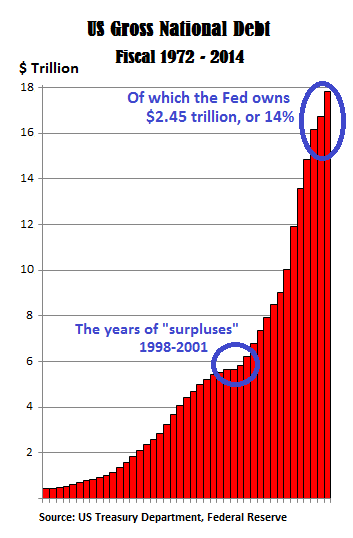
OverVolt
Lifer
- Aug 31, 2002
- 14,278
- 89
- 91
The latest hockey stick.
To be fair on a log scale it would kinda make sense.
To be fair on a log scale it would kinda make sense.
And relating it to GDP would make sense, but let's not get carried away with this sense making business.
Doc Savage Fan
Lifer
- Nov 30, 2006
- 15,456
- 389
- 121
You should take that up with the Federal Reserve.And relating it to GDP would make sense, but let's not get carried away with this sense making business.
You should take that up with the Federal Reserve.
There's no need. They know what they're doing and they would never publish any product that provided a chart like that without the necessary context of GDP.
Other people who are trying to push an agenda might though.
Doc Savage Fan
Lifer
- Nov 30, 2006
- 15,456
- 389
- 121
If you want Debt/GDP...here you go. Here's another "misleading" graph with an "agenda".There's no need. They know what they're doing and they would never publish any product that provided a chart like that without the necessary context of GDP.
Other people who are trying to push an agenda might though.

TRENDING THREADS
-
 Discussion Zen 5 Speculation (EPYC Turin and Strix Point/Granite Ridge - Ryzen 9000)
- Started by DisEnchantment
- Replies: 25K
-
Discussion Intel Meteor, Arrow, Lunar & Panther Lakes + WCL Discussion Threads
- Started by Tigerick
- Replies: 24K
-
 Discussion Intel current and future Lakes & Rapids thread
- Started by TheF34RChannel
- Replies: 23K
-

-


AnandTech is part of Future plc, an international media group and leading digital publisher. Visit our corporate site.
© Future Publishing Limited Quay House, The Ambury, Bath BA1 1UA. All rights reserved. England and Wales company registration number 2008885.
 Facebook
 Twitter