
-
We’re currently investigating an issue related to the forum theme and styling that is impacting page layout and visual formatting. The problem has been identified, and we are actively working on a resolution. There is no impact to user data or functionality, this is strictly a front-end display issue. We’ll post an update once the fix has been deployed. Thanks for your patience while we get this sorted.
You are using an out of date browser. It may not display this or other websites correctly.
You should upgrade or use an alternative browser.
You should upgrade or use an alternative browser.
Nvidia's Performance Under Vulkan API Explored
Page 3 - Seeking answers? Join the AnandTech community: where nearly half-a-million members share solutions and discuss the latest tech.

you are a very nice guy, and have the patience of a saint. I wish I could be like this sometime in the future.I think you are missing the point.
I am challenging your interpretation of what you think that FAQ entry states.
You take that to mean an API issue, and I am saying it can't be a API issue, it is a driver (or hardware) issue that they must work around.

Here's some new benchmarks from Swedish overclockers of Doom Vulkan vs OpenGL using the new NVidia 372.xx drivers which fixed the poor performance in Vulkan. As you can see, performance has improved considerably with the 372.xx driver set in Vulkan mode for all NVidia GPUs with the exception of the GTX 780 Ti. The GTX 1060 even manages to overcome the RX 480 at 1440p.
And this is without the benefit of NV shader intrinsic functions and asynchronous compute capability which will be added at a later date by ID..


And this is without the benefit of NV shader intrinsic functions and asynchronous compute capability which will be added at a later date by ID..
As you can see, performance has improved considerably with the 372.xx driver set in Vulkan mode for all NVidia GPUs with the exception of the GTX 780 Ti. The GTX 1060 even manages to overcome the RX 480 at 1440p.
Sounds like a lot of people owe id an apology then, since it was a Nvidia driver issue after all
Yes but some posters are really desperate to make AMD look good.Sounds like a lot of people owe id an apology then, since it was a Nvidia driver issue after all
Flamebaiting is not allowed
Markfw900
Last edited by a moderator:
Sounds like a lot of people owe id an apology then, since it was a Nvidia driver issue after all
But it wasn't only a Nvidia driver issue, ID still hasn't put in the NV shader intrinsic functions and asynchronous compute capability yet.
They will and they are working on Nvapi ,which was updated for Vulkan on 29th July and they are working on SLI as well.But it wasn't only a Nvidia driver issue, ID still hasn't put in the NV shader intrinsic functions and asynchronous compute capability yet.
They will and they are working on Nvapi ,which was updated for Vulkan on 29th July and they are working on SLI as well.
Good to know, thank you.

AtenRa
Lifer
Nvidia GeForce Game Ready Driver 372.54
no AA ??
http://www.techspot.com/review/1237-msi-geforce-gtx-1060-3gb/page2.html
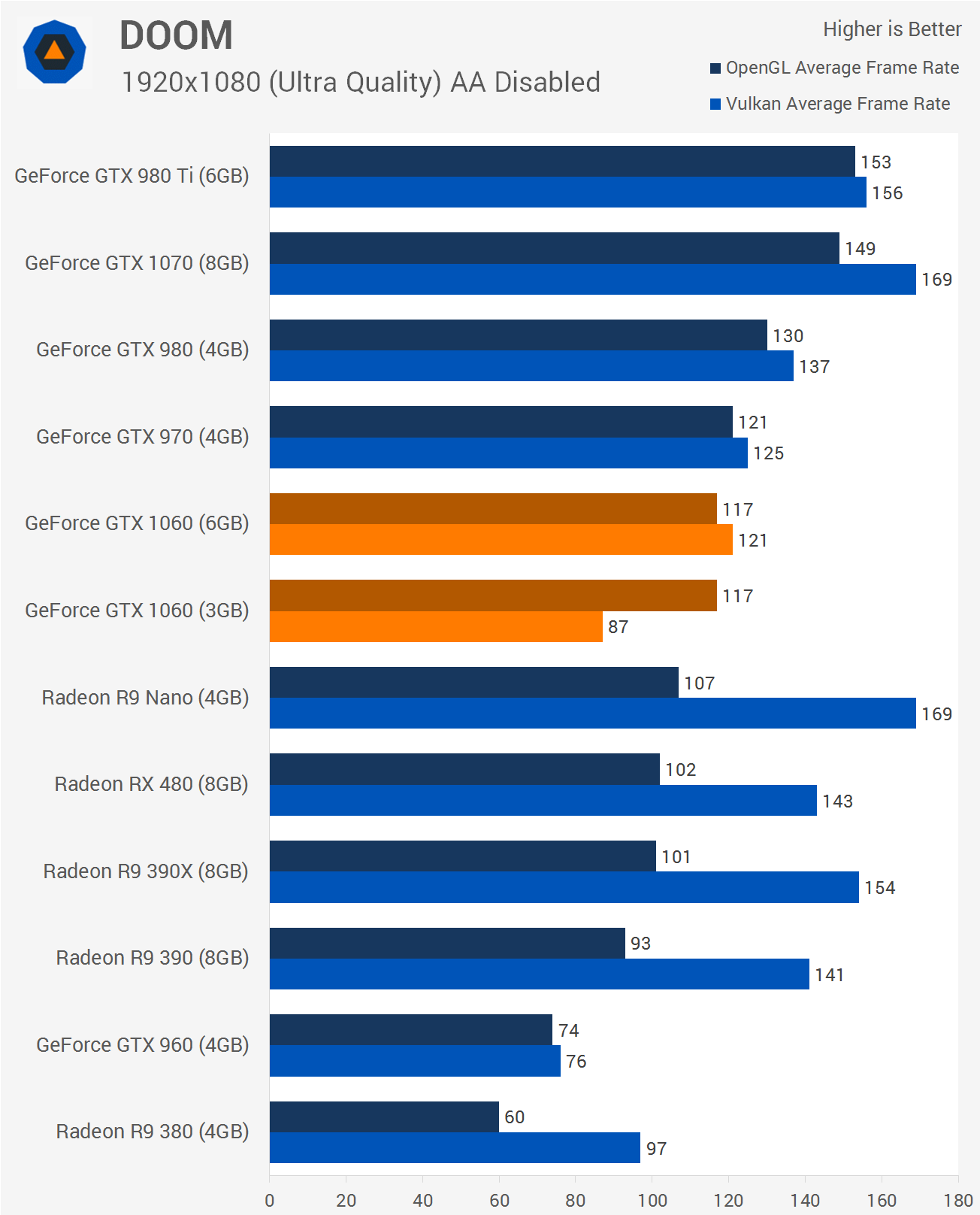
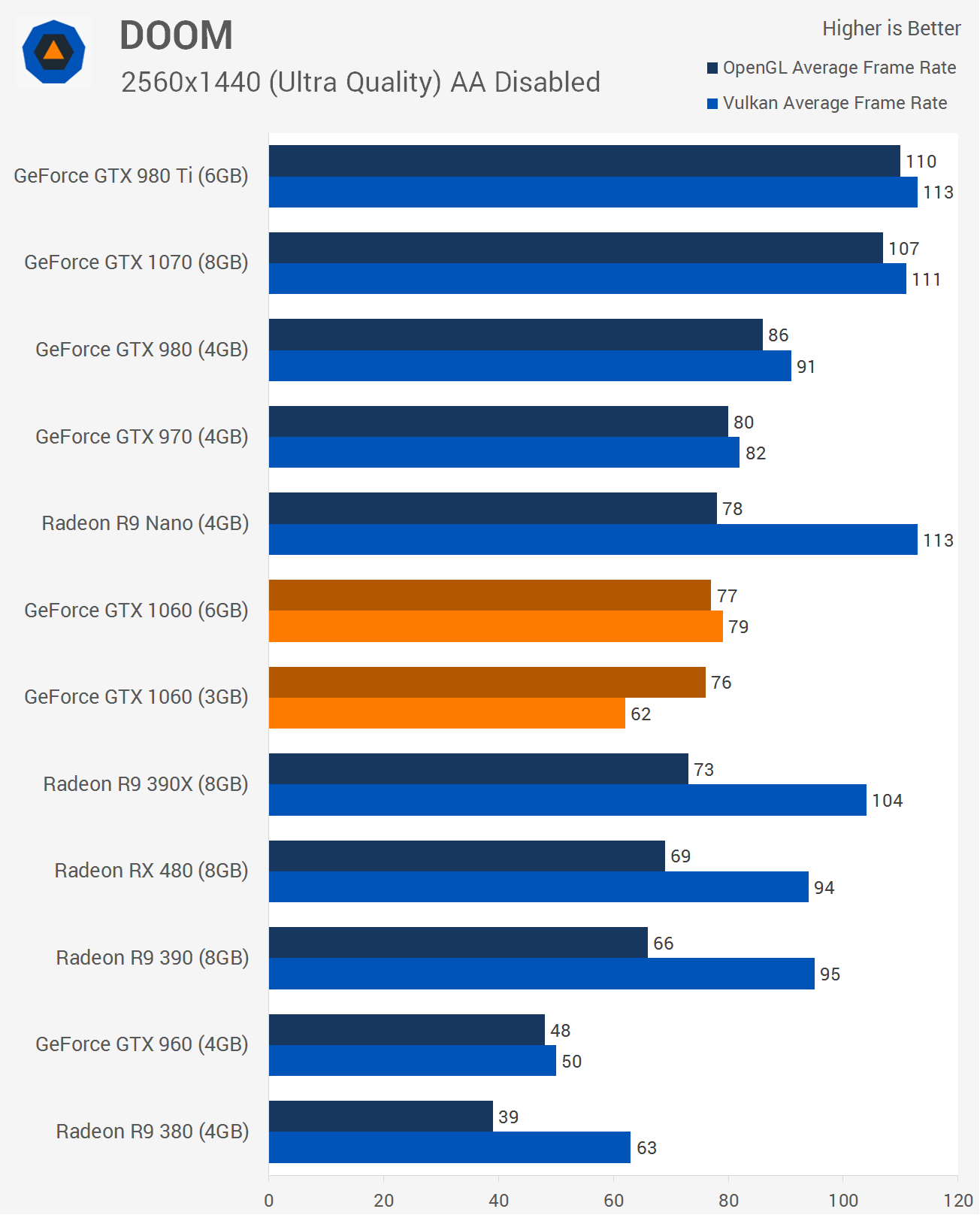
no AA ??
http://www.techspot.com/review/1237-msi-geforce-gtx-1060-3gb/page2.html
Sounds like a lot of people owe id an apology then, since it was a Nvidia driver issue after all
I said as much when this thread first started. But as others have said, ID still have work to do when it comes to implementing NV shader intrinsic functions and asynchronous compute.

Arachnotronic
Lifer
I said as much when this thread first started. But as others have said, ID still have work to do when it comes to implementing NV shader intrinsic functions and asynchronous compute.
They need to get SLI/CrossFireX working too. Inexcusable that a triple-A title like Doom doesn't support multi-GPU.
Nvidia GeForce Game Ready Driver 372.54
no AA ??
Those benches look weird. I wish they would tell you what level they used to the benches. Benchmarking Vulkan is really tricky to begin with, but there are some spots that show some massive increases compared to OpenGL.
The biggest spot I've found is the beginning of the Argent Tower level. If you point the camera at the Argent Tower, the framerate will drop in OpenGL due to how many draw calls are being issued and because OpenGL has basically no multithreaded rendering model.
With Vulkan enabled though, there is no framerate drop. On my rig, I've seen as much as a whopping 150% increase in this area from Vulkan! 😱
They need to get SLI/CrossFireX working too. Inexcusable that a triple-A title like Doom doesn't support multi-GPU.
The delay for multi GPU if I'm not mistaken, is because Vulkan itself doesn't support it yet. It's scheduled to be implemented in Vulkan 1.1 though. The OpenGL version might already support it, but due to OpenGL's poor CPU optimization, it's probably useless anyway as the API can barely feed one high end GPU let alone two.
ID really has a hit though with ID Tech 6. If they continue with Vulkan support, and I'm sure they will, the engine has some serious potential to compete with the big boys ie Frostbite 3, Unreal Engine 4, CryEngine etcetera...
One thing I really love about Doom and ID Tech 6 is the support for dynamic effects. There are so many dynamic lights and shadows in the game.. Too many games these days rely on baked in effects when they should be dynamic, and considering it's 2016, that's kind of shameful if you ask me...
why does that irk you ? Isn't every new thread and every post made by you is to glorify Nvidia and bash AMD?Yes but some posters are really desperate to make AMD look good.
Personal attacks are not allowed
Markfw900
Last edited by a moderator:
Here's some new benchmarks from Swedish overclockers of Doom Vulkan vs OpenGL using the new NVidia 372.xx drivers which fixed the poor performance in Vulkan. As you can see, performance has improved considerably with the 372.xx driver set in Vulkan mode for all NVidia GPUs with the exception of the GTX 780 Ti. The GTX 1060 even manages to overcome the RX 480 at 1440p.
And this is without the benefit of NV shader intrinsic functions and asynchronous compute capability which will be added at a later date by ID..
Nice find, and I'm sure there's room for improvement.


Red Hawk
Diamond Member
Here's some new benchmarks from Swedish overclockers of Doom Vulkan vs OpenGL using the new NVidia 372.xx drivers which fixed the poor performance in Vulkan. As you can see, performance has improved considerably with the 372.xx driver set in Vulkan mode for all NVidia GPUs with the exception of the GTX 780 Ti. The GTX 1060 even manages to overcome the RX 480 at 1440p.
And this is without the benefit of NV shader intrinsic functions and asynchronous compute capability which will be added at a later date by ID.
"Poor performance in Vulkan"? The benches I saw mostly showed Maxwell and Pascal GPUs having measurable gains with Vulkan, just not to the extent that AMD did. It was only Kepler that saw objectively bad performance in Vulkan, with performance dropping from OpenGL. And that issue doesn't appear to be fixed with this driver. Either there is some fundamental feature of Vulkan that Kepler can't work with, or Nvidia really just does not care to update Kepler drivers for Vulkan in this game. Meanwhile, my old GCN 1.0 based 270X sees a considerable boost from Vulkan. 😛
In any case, it is nice to see Nvidia getting more performance out of Vulkan with Pascal and Maxwell at least. One thing I like about these benchmarks is that it puts to bed the idea that Nvidia's OpenGL driver was just so good that Vulkan really only offered a marginal improvement, and Vulkan's performance leap on AMD cards was representative of what AMD's performance should have really been if they just had proper OpenGL support. I've seen people try to downplay DX12/Vulkan as just an attempt by AMD to shore up their crappy driver support, and these benchmarks prove that no, low-level APIs offer considerable improvement to Nvidia GPUs, too.
As for possible further improvements...I'm just not so sure. Nvidia hardware still doesn't support asynchronous compute in the way AMD does, so there's no guarantee they can use it for the same kind of boost in a game like Doom. And shader intrinsics are an AMD initiative made easier by the fact that they can be ported over from development on the GCN hardware in the PS4/Xbone. So who knows if Nvidia will even bother with that.
One thing I like about these benchmarks is that it puts to bed the idea that Nvidia's OpenGL driver was just so good that Vulkan really only offered a marginal improvement, and Vulkan's performance leap on AMD cards was representative of what AMD's performance should have really been if they just had proper OpenGL support. I've seen people try to downplay DX12/Vulkan as just an attempt by AMD to shore up their crappy driver support, and these benchmarks prove that no, low-level APIs offer considerable improvement to Nvidia GPUs, too.
Great point and proves that the current APIs are holding back all cards.
Indeed but in order to see actual benefits of lowlevel API and not regression, the game making softwares have to be overhauled significantly for dx12 and not just patched as an another layer.Great point and proves that the current APIs are holding back all cards.
Great point and proves that the current APIs are holding back all cards.
I just showed the contrary 2 posts ago!
Maverick177
Senior member
I just showed the contrary 2 posts ago!
So you meant the current API is NOT holding back all cards ?
If so then please do give me an explanation because I have a hard time just thinking about it.
So you meant the current API is NOT holding back all cards ?
If so then please do give me an explanation because I have a hard time just thinking about it.
Well, on a 750TI works worse, just tell me how that is better.
The problem is mostly about CPU, low level api are meant to better use the CPU so your GPU is not holded back by cpu, then along came in Async Shader Compute, and right now its what brings in a real avance over DX11 in terms of GPU usage.
But the problem is PC is not a console, here we have multiple archs, and a proper implementation of DX12 just takes too much time, and thats something that devs did not had to do before, and as our hardware will keep expanding fast over the years, its gona get more and more complicated.
And introduces LONG TERM problems, like trying to play a DX12 game with a 4 year old DX12 card that they may have no bother to program DX12 for, or the other way around, a 4 year old DX12 only game with modern hardware, no way the game was programed to use an arquiecture that did not existed 4 years ago, so it will run like crap or not at all, its a good excuse to sell us remasters.
So i really dont think DX12 will solve any of our problems, it does introduce new issues, and the extra time devs have to take to program a game for it, its time that is taken off other parts of the game development.
Great point and proves that the current APIs are holding back all cards.
Not in all cases though. In completely GPU limited scenarios it's possible that a change in API makes no difference at all.
You can even kinda see in these bench, it's really only the high end nvidia cards that really benefit much.
TRENDING THREADS
-
 Discussion Zen 5 Speculation (EPYC Turin and Strix Point/Granite Ridge - Ryzen 9000)
- Started by DisEnchantment
- Replies: 25K
-
Discussion Intel Meteor, Arrow, Lunar & Panther Lakes + WCL Discussion Threads
- Started by Tigerick
- Replies: 25K
-
 Discussion Intel current and future Lakes & Rapids thread
- Started by TheF34RChannel
- Replies: 24K
-

-
