

[Motley Fool] 3 Reasons AMD is Falling Apart Before Our Eyes
Page 4 - Seeking answers? Join the AnandTech community: where nearly half-a-million members share solutions and discuss the latest tech.
You are using an out of date browser. It may not display this or other websites correctly.
You should upgrade or use an alternative browser.
You should upgrade or use an alternative browser.


ShintaiDK
Lifer
- Apr 22, 2012
- 20,378
- 146
- 106
if you want a monopoly, you shouldn't be on this forum. RnD would not be cut? same 30 to 50% increase? I don't think even a 3 year old is that naive. just look at how bad the cpu market has become, you would think they would understand it without someone pointing out the obvious. 5 to 10% would become the damn norm, you monopoly supporters want this???????????????? 980 is only 15% faster than a 290x you know. and that is with competition.
If you support monopoly, either you own stock in the company or work for it, or you are something so bad I don't think I can name without the mod hammer hitting me.
Look at Intels R&D budget.
Also dont confuse a dynamic market with a static. Not to mention this market requires a huge cashflow. No innovation? No sales. High prices? Low sales. Both would put your monopoly in the track for bankruptcy. Funny enough we never had cheaper CPUs since the competition dissapeared. Its all about volume/profit ratio.
The CPU side of things actually still have great advances and innovation. R&D budgets have never been higher. However, the focus is just not desktop. The 99% crowd wants performance/watt. Not 500W CPUs.
The marketleader on GPUs set the price that people are willing to pay for many years. So dont expect any changes there.
Last edited:

Keysplayr
Elite Member
- Jan 16, 2003
- 21,219
- 56
- 91
Really? You think Intel CPU performance has been stagnating (relatively speaking) because too many people have been buying unnecessary upgrades and that millions of people did? Not that AMD haven't released anything vaguely competitive since 2009? I don't agree.
I'd say think about it. What if everyone saw that Ivy only performed 5% over Sandy and nobody bought it for that reason. Might hurt Intels bottom line. They don't like when their bottom line is hurt. Maybe offer up a better CPU that Haswell turned out to be.
I would say Intel has had some room to move on frequency and price. Ivy Bridge 4C was 160mm2 (vs 216mm2 for SB) if AMD had hit it out of the park with Bulldozer, not driven into a parked car, then I'd say it's safe to bet the consumer would have had a cheaper or faster clocked Ivy part or both. Hard to divine if that competition would have meant a fundamentally better product but it's not insanity to speculate it may have.
Everyone should be hoping for at least a modestly competitive AMD for obvious reasons.
You are welcomed to disagree, but, when I see 4 generations of CPU's (Sandy, Ivy, Haswell, Broadwell) only about 20% is apart in benches, it makes me think that yes, they are stagnating. Intel is for all intents and purposes, a monopoly, and they are only keeping AMD in the game (CPU wise) to avoid legal issues of being a monopoly. What percentage does AMD have of the desktop/server CPU market? I am not certain but I think Intel has 90% or above in the server market....
Here, as of November 2014
source: Forbes
http://www.forbes.com/sites/rogerkay/2014/11/25/intel-and-amd-the-juggernaut-vs-the-squid/
"Which brings us to today. The gloves are definitely off now. Intel no longer seems to care about maintaining AMD’s market share and has pounded it into the ground in most markets, notably server, where Intel’s unit share hit 98.3% in 3Q14, according to Mercury Research’s PC Processor Report, and 98.5%, according to IDC. In notebooks, Mercury’s 3Q14 figure is 92.9%, while IDC pegs it at 90.3%. Mercury says Intel’s desktop share was 82.7%, while IDC puts it at 81.8%, but those desktop figures are small comfort to AMD, since desktop is the least profitable of the three segments. At this point, Intel’s revenue is an order of magnitude larger than AMD’s, and its market cap is nearly two orders of magnitude greater."
Isn't it true that any market share over 80% is considered monopolistic?
Intel has been stagnating. But the good news is that even a 3 year old Sandy can run everything you throw at it with ease, today. At least in the gaming world.
I'd also ask why some of you only see in black and white. Hot and cold. On or off? (not you specifically Spanners)
Just because I don't see DOOOM in an Nvidia monopoly, doesn't mean I want it to become reality.
I see some adjusting. Slightly higher pricing. Slower innovation. Better Game Dev relationships, and proprietary will no longer be such an issue for some.
Anyway, not everything is either sharply on or off. Lot's of middle road.
ShintaiDK
Lifer
- Apr 22, 2012
- 20,378
- 146
- 106
People should look outside the desktop segment when they want to look at CPUs. Desktop CPUs is the lowest revenue segment of the 3.
Mobile? Massive advances.
Server? Massive advances.
Desktop? Some advances.
And this is due to consumer decision. What the wast majority of the consumers want.
Mobile? Massive advances.
Server? Massive advances.
Desktop? Some advances.
And this is due to consumer decision. What the wast majority of the consumers want.
Last edited:
Silverforce11
Lifer
- Feb 19, 2009
- 10,457
- 10
- 76
People should look outside the desktop segment when they want to look at CPUs. Desktop CPUs is the lowest revenue segment of the 3.
Mobile? Massive advances.
Server? Massive advances.
Desktop? Some advances.
And this is due to consumer decision. What the wast majority of the consumers want.
Whats their recent revenue share data? Last I read, Intel still earns the majority on PC & Servers and not on mobiles (competing and losing $ versus ARM)!
ShintaiDK
Lifer
- Apr 22, 2012
- 20,378
- 146
- 106
Whats their recent revenue share data? Last I read, Intel still earns the majority on PC & Servers and not on mobiles (competing and losing $ versus ARM)!
Mobile I refer to laptops. Revenue wise desktop is the smallest segment of the 3.
Keysplayr
Elite Member
- Jan 16, 2003
- 21,219
- 56
- 91
Whats their recent revenue share data? Last I read, Intel still earns the majority on PC & Servers and not on mobiles (competing and losing $ versus ARM)!
If you're talking x86 notebooks then Intel is at 90% or above as of November 2014.
And as for ARM? Intel has set it's sights on all things mobile and will gradually erode ARM's mobile market share as well. Although ARM vs Intel, as opposed to AMD vs Intel, is a stronger competitor.
beginner99
Diamond Member
- Jun 2, 2009
- 5,320
- 1,768
- 136
and perhaps shorts AMD
Or the opposite. Paint a bad picture, stock goes down and when the new 300 series is released including new SKUs for midrange (contrary to rumors which say rebrands) stock will rise.

frozentundra123456
Lifer
- Aug 11, 2008
- 10,451
- 642
- 126
I am not really sure that intel is sitting on tbese huge improvements in cpus and just not bringing them to market because of lack of competition from AMD. Nobody really knows except intel insiders, but i think cpus are so fast and efficient now that it may not really be possible to make much larger improvements than what we are seeing, at least at reasonable cost. I mean, intel spends billions on R and D every year. Does it make sense to spend all that money and not bring the best possible product to market?
OTOH, I do think intel might have brought a mainstream hex core to the market if amd's top end were more competitive.
OTOH, I do think intel might have brought a mainstream hex core to the market if amd's top end were more competitive.

Dave2150
Senior member
- Jan 20, 2015
- 639
- 178
- 116
I am not really sure that intel is sitting on tbese huge improvements in cpus and just not bringing them to market because of lack of competition from AMD. Nobody really knows except intel insiders, but i think cpus are so fast and efficient now that it may not really be possible to make much larger improvements than what we are seeing, at least at reasonable cost. I mean, intel spends billions on R and D every year. Does it make sense to spend all that money and not bring the best possible product to market?
OTOH, I do think intel might have brought a mainstream hex core to the market if amd's top end were more competitive.
Intel are slowly nudging down hex cores to the more affordable mainstream realm.
The 5820k is evidence of this, though still on the more expensive enthusiast platform of course.
4790k/z97 vs 5820k/x99 doesn't command a huge premium, especially if you'd have to buy new memory anyway.
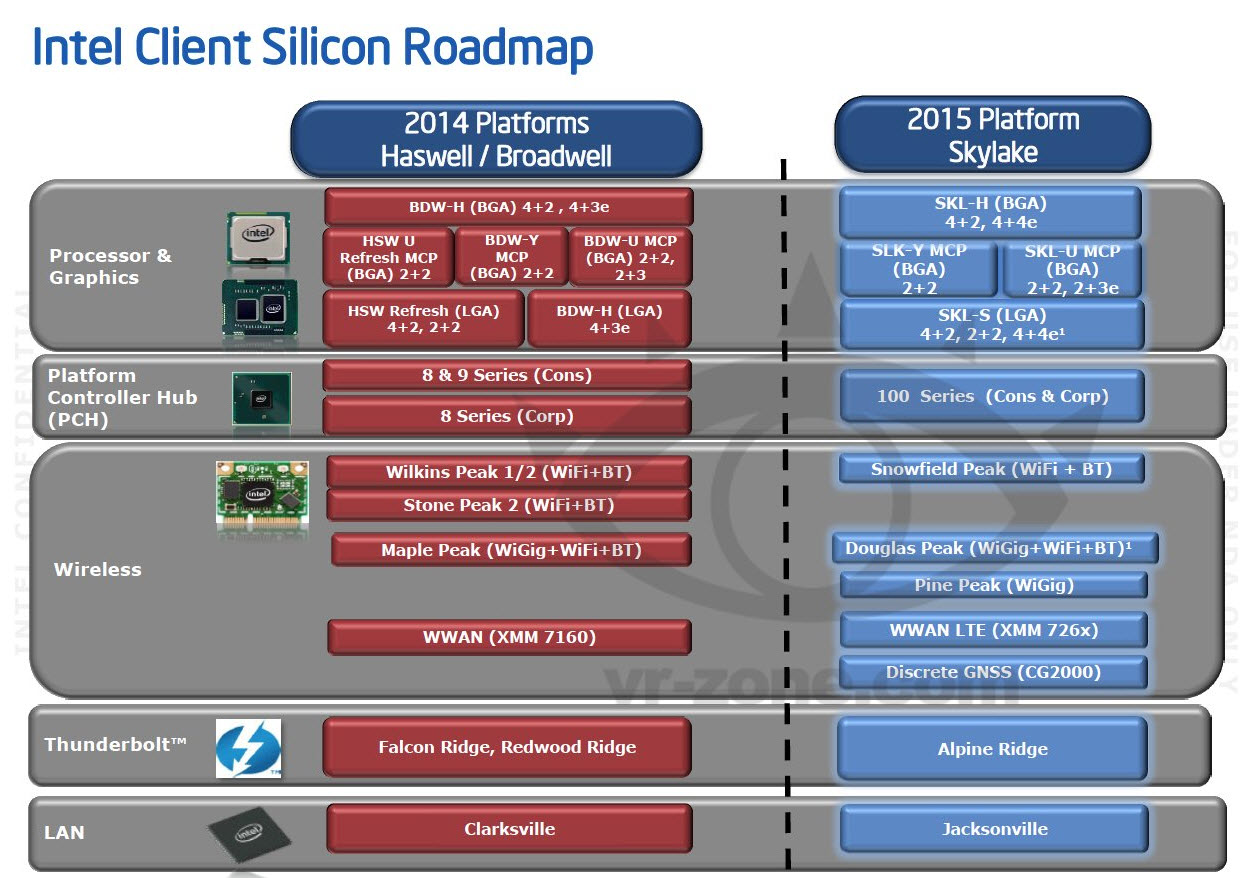
Maybe we'll see a hexcore on z170 for skylake? Doubt it, but you never know.
ShintaiDK
Lifer
- Apr 22, 2012
- 20,378
- 146
- 106
Maybe we'll see a hexcore on z170 for skylake? Doubt it, but you never know.
No we wont. You can however get GT4e graphics.
positivedoppler
Golden Member
- Apr 30, 2012
- 1,149
- 256
- 136
I wouldn't bet on the demise of AMD at this point. Too much rumor floating around. AMD and BLX now AMD and Samsung. AMD has what a lot of companies with deep pocket envy and wants, access to x86 PC market and servers dominated by Intel. While a buyout might not be feasible, a semi-custom deal probably is. All the recent rumor might be negotiation of how low of a margin AMD is willing to accept. It makes too much sense for these companies. If you want in on the still very lucrative x86 PC and Server market, squeezing AMD for a good long term semi custom deal is the best way. The only leverage AMD has is to negotiate with multiple companies.

witeken
Diamond Member
- Dec 25, 2013
- 3,899
- 193
- 106
A lot of people on SA own shares obviously. Doesn't mean they (or he) can't do good analysis.guy owns Intel stock
http://my.fool.com/profile/TMFAeassa/info.aspx
"Stocks I Own: INTC, QCOM, INVN, IBM"
witeken
Diamond Member
- Dec 25, 2013
- 3,899
- 193
- 106
This is economics 101 stuff. Monopolies will price higher and produce less quantity than if in a competitive environment for a greater producer surplus. The notion that somehow there'll be greater value to consumers in a monopolistic environment is so warped it's funny. That's like saying it's more democratic to live under a dictator than an elected government.
I broadly agree, but it's too simplistic for the technology industry (mostly the semiconductor industry).
ShintaiDK
Lifer
- Apr 22, 2012
- 20,378
- 146
- 106
I wouldn't bet on the demise of AMD at this point. Too much rumor floating around. AMD and BLX now AMD and Samsung. AMD has what a lot of companies with deep pocket envy and wants, access to x86 PC market and servers dominated by Intel. While a buyout might not be feasible, a semi-custom deal probably is. All the recent rumor might be negotiation of how low of a margin AMD is willing to accept. It makes too much sense for these companies. If you want in on the still very lucrative x86 PC and Server market, squeezing AMD for a good long term semi custom deal is the best way. The only leverage AMD has is to negotiate with multiple companies.
Why would they want to compete with Intel in the PC segment? How much money would they have to invest before even starting to make any profit? No to mention all the years they have to wait before any investment starts to manifest as an actual product.
The question is rather, when will AMD witthdraw from the PC segment and only focus on semicustom. AMDs PC segment revenue may drop below 500M$ in Q1 and continue its downward spiral. And thats PC+Graphics combined. Its being hammered on both fronts.
Last edited:
positivedoppler
Golden Member
- Apr 30, 2012
- 1,149
- 256
- 136
Why would they want to compete with Intel in the PC segment? How much money would they have to invest before even starting to make any profit?
Because they can and there's A LOT of money to be made. Paying AMD even a few billion to get your foot in the door is dirt cheap for a company like Samsung. Samsung is the one company that can go toe to toe with Intel and win. A decade and a half ago Samsung is a company known mostly for making RAM outside of Korea. This is a company that knows how to grow into new markets and steamroll past established competitions along the way. They can easily afford a bill the size of AMD 10 times over without even blinking to get their foot into 50 billion dollar x86 pc and server market. It's no secret that they already have their eye on the ARM server market, it would just be wishful thinking on Intel's part Samsung is not eyeing the rest of the pie. The only question is how much AMD is willing to mortgage their own future in their negotiation. Samsung holds most of the cards here. A semi custom deal with AMD for x86 chips in PC, laptops, and servers pumped out in Samsung's latest Fab that rival's Intel should give Intel plenty to fear.
Unlike Intel that just makes Chips, Samsung makes chips, memory, tablets, phones, all forms electronics, Ships, Cars, furniture, etc..
For BLX, it's more about the Chinese national security having access to the design from Top to Bottom outside of US soil that would be worth every penny.
ShintaiDK
Lifer
- Apr 22, 2012
- 20,378
- 146
- 106
Even if you payed AMD 5-10B$ today, the result is pretty much 4-5 years away. And then you need to start earning it back. Assuming you are in a position to compete and generate money.
There is a reason why all the other x86 companies left the competition, including IBM. And its not because Intel is easy to compete with and you just need a few B$ to do it with. Intel uses what, 11B$ in R&D every year?
There is a reason why all the other x86 companies left the competition, including IBM. And its not because Intel is easy to compete with and you just need a few B$ to do it with. Intel uses what, 11B$ in R&D every year?
Last edited:
positivedoppler
Golden Member
- Apr 30, 2012
- 1,149
- 256
- 136
Even if you payed AMD 5-10B$ today, the result is pretty much 4-5 years away. And then you need to start earning it back. Assuming you are in a position to compete and generate money.
There is a reason why all the other x86 companies left the competition, including IBM. And its not because Intel is easy to compete with and you just need a few B$ to do it with. Intel uses what, 11B$ in R&D every year?
So what if it's 4-5 years away?
This is short sighted Western Style thinking. Eastern philosophy can go a few hundred years down the road when planning against competition. Who says they need to pay 5-10 billion today? You Fab a PC chip that cost $50 to make and sale it under Samsung's name for $250 and compete with the i5. $200 profit it's negotiation between Samsung and AMD. Depending on how desperate AMD is, Samsung can probably talk AMD into walking out with $20. This is not different then the Sony and MS console deal.
Server margin is even higher.
I'm speculating that Zen will be a very customizable part design to go Semi-Custom from the get go. If that's the case, it won't even be 4-5 years down the road, it be more like a year for Samsung or anyone else who wants to build a system with their own x86 cpu name.
MiddleOfTheRoad
Golden Member
- Aug 6, 2014
- 1,123
- 5
- 0
There is a reason why all the other x86 companies left the competition, including IBM. And its not because Intel is easy to compete with and you just need a few B$ to do it with. Intel uses what, 11B$ in R&D every year?
IBM left the market because they made pretty terrible CPU's (Cyrix) that most consumers avoided buying. Had they manufactured chips with similar quality and performance to Intel -- things might have been different.
MiddleOfTheRoad
Golden Member
- Aug 6, 2014
- 1,123
- 5
- 0
Really? You think Intel CPU performance has been stagnating (relatively speaking) because too many people have been buying unnecessary upgrades and that millions of people did? Not that AMD haven't released anything vaguely competitive since 2009? I don't agree.
Agreed.
AMD is still very competitive in desktops, it's just at the low price point for the most part (under $150).
An FM2 Athlon X4 860K is a very good product and competes well against similarly priced Intel chips. Even the ancient AM3 offerings are pretty good performers for between $100 to $140 or so. Once you are in the i5 price range, though..... That's where AMD fields no competition.
Stoneburner
Diamond Member
- May 29, 2003
- 3,491
- 0
- 76

TurtleCrusher
Lifer
- Apr 20, 2008
- 10,067
- 990
- 126
MotleyFool is a doom&gloom or praise site. It's the tabloid site for financial data. There's countless articles going way back saying Nintendo would be gone completely. They're throwing as much fud on the wall and seeing what sticks.
frozentundra123456
Lifer
- Aug 11, 2008
- 10,451
- 642
- 126
And what 50$ chip would that be to compete with 250$ i5 that requires no R&D.
Well, that is the question. You cant just decide to make a chip and start production in a year or two. Samsung would either have to design the chip themselves or use an AMD designed chip. I'm not sure Samsung could design a chip themselves because they dont have an x86 license and anyway, it would take several years and billions of dollars, which admittedly they have, but not sure it would be an efficient use of the resources. A semi-custom deal with AMD might make sense, but that depends on AMD having an appropriate chip available. We wont know that until a year or two when Zen supposedly will come out.
Honestly, I think Samsung (and the other ARM makers) will be a lot more successful trying to shoehorn ARM into traditional x86 market segments than trying to design and sell their own x86 designs. I see this as the bigger (and quite significant) danger to Intel, rather than ARM makers starting to make x86 chips.
TRENDING THREADS
-
 Discussion Zen 5 Speculation (EPYC Turin and Strix Point/Granite Ridge - Ryzen 9000)
- Started by DisEnchantment
- Replies: 25K
-
Discussion Intel Meteor, Arrow, Lunar & Panther Lakes + WCL Discussion Threads
- Started by Tigerick
- Replies: 24K
-
 Discussion Intel current and future Lakes & Rapids thread
- Started by TheF34RChannel
- Replies: 23K
-

-


AnandTech is part of Future plc, an international media group and leading digital publisher. Visit our corporate site.
© Future Publishing Limited Quay House, The Ambury, Bath BA1 1UA. All rights reserved. England and Wales company registration number 2008885.
 Facebook
 Twitter