

Massive earthquake in Turkey
Page 2 - Seeking answers? Join the AnandTech community: where nearly half-a-million members share solutions and discuss the latest tech.
You are using an out of date browser. It may not display this or other websites correctly.
You should upgrade or use an alternative browser.
You should upgrade or use an alternative browser.


Saylick
Diamond Member
- Sep 10, 2012
- 4,137
- 9,668
- 136
Yeah... Mortar/concrete/aggregate is cheap, and steel is expensive. But even in buildings with the proper amount of rebar, how the rebar is detailed plays just as an important role, if not more of an important role, as the amount of rebar itself. For example, you can design a concrete wall with a bunch of rebar in it, but if the rebar is not properly hooked or anchored into its foundation, the wall will simply topple over if you apply enough lateral force to overcome its own weight.Sad indeed. I was surprised to not see any rebar or steel in those 8 and 10 story buildings as they crashed to the ground.
Even in the USA where we have a ton of lessons learned that are baked into the current building code, with every large earthquake that lands on a major population center we always learn new, often times leading to discoveries that our current code is deficient in some way or form.
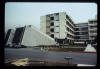
One of the biggest embarrassments to the seismic engineering profession here in California was the Olive View Hospital. It was a brand spanking new acute care hospital that had an opening date merely weeks before the 1971 Sylmar Earthquake hit. This was a building constructed with the latest and greatest (at the time) techniques in seismic engineering. Furthermore, hospitals are designed to a higher importance level so there should be even less chance of damage. In other words, if there was at least one building that would serve as a poster child for the quality of our building code, this building would have been it.
So what happened? Simply put, disaster.
There was a partial collapse of the building. The stair tower, which is a vital egress path for occupants, completely toppled over. The building drifted so much at the ground level that the hospital was beyond repair. Over the next few months, the building was demolished.
Hundreds of millions of dollars in today's currency. Wasted, just like that. In hindsight, it was almost a blessing that it had just opened when the earthquake hit. Had the hospital been open for longer and thus closer to full occupancy, the number of casualties likely would be higher. Ultimately, the event upended the profession's understanding of earthquakes. It was a huge eye-opening experience that was a metaphorical middle finger to structural engineers. If we thought we knew anything about seismic engineering, we were bluntly told we knew nothing.
If this can happen in the USA, other countries don't stand a chance.

Changes were made after that, but those changes were insufficient for your 1994? quake. USGS Dr. Lucy... I forget her name mentioned in interviews yesterday that their building code is one with the US and the rest of the developed world. It comes down to technique and whether the material is strong. Concrete is concrete to most of us here but concrete quality is special to engineers who work with it. Was someone bribed?
Quakes in this region are par for the course, but they suffered a quake in 99 that devastated one of their major hubs. These southern plate quakes may increase the likelihood of the top plates being triggers at any time to slip. If you think this is bad, that would be worse.
These quakes this week destroyed major manufacturing sectors and a port is in disarray. Should a 99 style quake hit but even worse due to the higher magnitude, it'll all but destroy their economy to less than a third or fourth of what it is now. Such a quake would also destroy a large portion of Greece. Both would need injections of trillions of dollars to recover.
All this makes you wonder what the heck we're doing on this little blue and green planet.
Quakes in this region are par for the course, but they suffered a quake in 99 that devastated one of their major hubs. These southern plate quakes may increase the likelihood of the top plates being triggers at any time to slip. If you think this is bad, that would be worse.
These quakes this week destroyed major manufacturing sectors and a port is in disarray. Should a 99 style quake hit but even worse due to the higher magnitude, it'll all but destroy their economy to less than a third or fourth of what it is now. Such a quake would also destroy a large portion of Greece. Both would need injections of trillions of dollars to recover.
All this makes you wonder what the heck we're doing on this little blue and green planet.
Saylick
Diamond Member
- Sep 10, 2012
- 4,137
- 9,668
- 136
Sweeping changes were made to the building code after the 1971 'quake. Laws were passed which established key organizations that tackled the earthquake problem from multiple angles, such as regulatory bodies to establish stricter standards for hospital construction, geological agencies whose sole purpose is to develop fault maps and statistical models, and requirements to provide seismic instrumentation in various locations across major cities. The decision to take a proactive approach is a crucial one, but what we lacked then (and still true today) is data. Without data, any changes you propose to the building code is analogous to shooting in the dark. If you noticed a trend that certain types of buildings were more damaged in the earthquake, how do you propose revising the code to mitigate that issue? This is a gross simplification, but do you tell engineers to use 2x larger loads when designing those kinds of buildings? Why not 3x? How large of an increase is enough? Without real data or research, the best you can do is guess and check. The only issue is that the "check" doesn't happen until the next Big One strikes. Unlike Boeing or other large mechanical engineering companies who can test to failure various critical components of whatever they make, most buildings don't have the luxury of large-scale shake table testing nor will most buildings fit on a shake table. Furthermore, revising building codes is always a tug-of-war between researchers, building officials, practicing engineers, and the public. If you propose a change that raises the cost of construction, you'll get pushback from at least one stakeholder, which is a sentiment I agree with. If researchers always had their way with revisions to the building code, we'd all be living in concrete bunkers.Changes were made after that, but those changes were insufficient for your 1994? quake.
Anyways, when the 1994 Northridge Earthquake hit, we suffered a ton of damage as well. We had residential multi-unit apartment buildings pancaking on their first floor (a "soft story" or a "weak story" deficiency) and a bunch of steel buildings had their welded connections fracture, which was the real surprise because those connections were designed such that the weld was NOT supposed to be the weak point. A FEMA program that was established shortly after to study and determine the cause of these weld fractures, which led to a bunch of lab testing in various universities to try and reproduce the failure mechanism. Long story short, that type of connection is now prohibited in high-seismic regions and an improved version suitable for high-seismic regions was rolled out in a subsequent version of the building code.
Yes, Dr. Lucy Jones is kind of like a celebrity in these circles because she's become the face of the seismic community. Whenever there's anything newsworthy about earthquakes, you can be sure she'll be on the news.USGS Dr. Lucy... I forget her name mentioned in interviews yesterday that their building code is one with the US and the rest of the developed world. It comes down to technique and whether the material is strong. Concrete is concrete to most of us here but concrete quality is special to engineers who work with it. Was someone bribed?
I'd argue technique is more important than material strength. Strength is important, up to a point. Earthquakes deliver energy to buildings via acceleration, and force is simply acceleration times mass. More often than not, if you design a bigger, stronger building, you end up chasing your own tail because a bigger, stronger building tends to also be a stiffer, heavier building, which attracts even more force. Such an approach becomes not economical nor aesthetically pleasing (see previous mention of concrete bunkers). The more important indicator of seismic performance is ductility, or the ability of a material to yield and undergo large amounts of plastic deformation. As the structural engineer, your job is to designate a ductile fuse within the building structure and then design the rest of the system to be stronger than that fuse.
Yeah, one thing the industry is heading towards is the concept of resilience, or the goal of minimizing downtime and economic loss between a seismic event and when the building is fully operational. When buildings are built with resilience in mind, it leads to better and more stable communities. Designing for resilience means reaching for a higher goal than what the building code prescribes, which is only to prevent the loss of life, not the loss of property. We have first-hand experience with a building's structural system performing admirably in a moderate seismic event only to have the internal components trashed because they weren't properly braced to the building structure. Internal components including dry wall, ceilings, furniture, and equipment like HVAC, electrical, and even hospital systems. Arguably, the guts of the building are just as important as the skeleton when it comes to getting the building back to full operation. The moment you need a hospital up and running no doubt coincides when disaster strikes. What's the point if the hospital didn't collapse but it's shut down for 6 months post-earthquake and it can't serve the community? Now take that mental picture and apply it to local businesses, etc. A lack of resilience is what happened to Christchurch in 2011. The city has never been the same since.These quakes this week destroyed major manufacturing sectors and a port is in disarray. Should a 99 style quake hit but even worse due to the higher magnitude, it'll all but destroy their economy to less than a third or fourth of what it is now. Such a quake would also destroy a large portion of Greece. Both would need injections of trillions of dollars to recover.
Alright, I've rambled long enough about my job. I hope everyone enjoyed my TED talk. Back to the computer forums I go.
Last edited:

- Jan 2, 2001
- 25,379
- 5,095
- 146
As of 9AM EDT CNN shows 11,000+ people have been killed. They have a series of photos of an 8 yr-old being pulled out of the rubble and passed hand to hand to his mother that brought tears to my eyes.

 www.cnn.com
February 8, 2023 Turkey-Syria earthquake news
More than 15,000 people have been killed and tens of thousands injured after a magnitude 7.8 earthquake struck Turkey and Syria on Monday, according to officials. At least three US citizens were killed in Turkey, the State Department said.

Kaido
Elite Member & Kitchen Overlord
- Feb 14, 2004
- 52,416
- 7,657
- 136
As of 9AM EDT CNN shows 11,000+ people have been killed. They have a series of photos of an 8 yr-old being pulled out of the rubble and passed hand to hand to his mother that brought tears to my eyes.
February 8, 2023 Turkey-Syria earthquake news
More than 15,000 people have been killed and tens of thousands injured after a magnitude 7.8 earthquake struck Turkey and Syria on Monday, according to officials. At least three US citizens were killed in Turkey, the State Department said.
I have mixed feelings on comparative suffering, as I tend to get whiny about my first-world problems, but I also recognize that my struggles are valid because what's hard for me is hard for me. Today, however, I don't need to whine about things like the skyrocketing price of eggs. 11,000 people are gone from a single natural disaster in 2023. My heart goes out to them. I'm extremely grateful to live in a country (USA) where we have excellent first responders, FEMA, the National Guard, building codes, etc. I lived through earthquakes growing up as a kid in California & we never had anything remotely like what Turkey & Syria has experienced this past week.

Captante
Lifer
- Oct 20, 2003
- 30,354
- 10,882
- 136

misuspita
Senior member
- Jul 15, 2006
- 799
- 966
- 136
The worst thing is that none of them can return to their homes, as none is safe and they are not aloud in until they are inspected from a safety pov. Anfd that cannot happen until they finish rescuing anyone and then start sorting viable standing buildings from ones that are not safe. And the region usually has temperatures over 10 degrees except 1-2 months and this period is proper cold for them. I was there last year and have made friends and they sleep in their cars.... It really is terrible. To run from your home with only your clothes on and then become homeless in 1 minute.
igor_kavinski
Lifer
- Jul 27, 2020
- 28,174
- 19,219
- 146
I've been told that Turkish people have paid well over $500 billion in Earthquake prevention taxes since 1999, to minimize the impact of earthquakes and yet, it seems their govt is ill-prepared.
Saylick
Diamond Member
- Sep 10, 2012
- 4,137
- 9,668
- 136
I read something similar as well... it sounded like that money was repurposed for road and highway infrastructure, along with repaying some debt to the IMF.I've been told that Turkish people have paid well over $500 billion in Earthquake prevention taxes since 1999, to minimize the impact of earthquakes and yet, it seems their govt is ill-prepared.
The Atlantic article? I read the same during my lunch break today. The current party promised to make sweeping changes when they took hold in 2000 or 2001. Most of their citizens are realizing it's the same shit with a fresh coat of paint and lies.I've been told that Turkish people have paid well over $500 billion in Earthquake prevention taxes since 1999, to minimize the impact of earthquakes and yet, it seems their govt is ill-prepared.
igor_kavinski
Lifer
- Jul 27, 2020
- 28,174
- 19,219
- 146
My Turkish friend was discussing it with me. He couldn't understand where all the money went.The Atlantic article?

Red Squirrel
No Lifer
That's par for the course with taxation. It's rare the money actually goes towards the greater good of the people. Even here in the west which is much richer, we pay ridiculous taxes that keep going up each year yet our infrastructure and services continue to crumble.

deadlyapp
Diamond Member
- Apr 25, 2004
- 6,680
- 751
- 126
Don’t conflate corruption (more present in emerging countries) to an inability to serve the people who have relied on low taxes and government interventions over tens if not hundreds of years.That's par for the course with taxation. It's rare the money actually goes towards the greater good of the people. Even here in the west which is much richer, we pay ridiculous taxes that keep going up each year yet our infrastructure and services continue to crumble.

Pohemi
Lifer
- Oct 2, 2004
- 10,961
- 17,137
- 146
That's just it. It is dropping to 20F (-7C) overnight and raining during the day. There are hundreds if not thousands who were lucky enough not to be crushed and trapped by a building...only to starve and/or freeze because they have nowhere left to go. Nothing but the shirts on their backs in many cases.And the region usually has temperatures over 10 degrees except 1-2 months and this period is proper cold for them. I was there last year and have made friends and they sleep in their cars.... It really is terrible.
The affected regions of Turkey and Syria are in horrific shambles.

SteveGrabowski
Diamond Member
- Oct 20, 2014
- 9,379
- 8,075
- 136
I have mixed feelings on comparative suffering, as I tend to get whiny about my first-world problems, but I also recognize that my struggles are valid because what's hard for me is hard for me. Today, however, I don't need to whine about things like the skyrocketing price of eggs.
Meh what does the earthquake have to do with us being price gouged on eggs? I'll never stop complaining about egg prices as long as producers are screwing us over on price while pushing BS excuses in the corporate media about bird flu being the reason.
misuspita
Senior member
- Jul 15, 2006
- 799
- 966
- 136
My teacher friend from there just called me in tears... She was happy just 3 months ago that she finished her PhD and was resting to just live life a bit after so many years of dedication to work and in parallel PhD... and now she was crying and saying she only has her car that luckily was not destroyed. Thankfully she has no big injuries, but she told me that they feel like living in an episode of Surviver (TV show). In some cities help didn't come, no cell signal, no electricity, no way to warm... Sometime you can't really understand all this from a mile high, but then when real people, friends, start telling their drama.... It is a tragedy. Of course fueled by corruption on a grand scale, but still dramaThat's just it. It is dropping to 20F (-7C) overnight and raining during the day. There are hundreds if not thousands who were lucky enough not to be crushed and trapped by a building...only to starve and/or freeze because they have nowhere left to go. Nothing but the shirts on their backs in many cases.
The affected regions of Turkey and Syria are in horrific shambles.
Kaido
Elite Member & Kitchen Overlord
- Feb 14, 2004
- 52,416
- 7,657
- 136
Over 17,000.
Coming up on 20,000 now. Literally unbelievable.
Turkey-Syria Earthquake Latest Updates: Death Toll Passes 23,000
Rescue teams battled snow and freezing temperatures to search for survivors following two earthquakes in Turkey and Syria.
Kaido
Elite Member & Kitchen Overlord
- Feb 14, 2004
- 52,416
- 7,657
- 136
Meh what does the earthquake have to do with us being price gouged on eggs? I'll never stop complaining about egg prices as long as producers are screwing us over on price while pushing BS excuses in the corporate media about bird flu being the reason.
Well, that's the concept of comparative suffering, right? Trying to make sense of our pain by comparing it in relation to other people's pain. Eggs have nothing to do with earthquakes, but at the same time, I've been whining about egg prices (I use a LOT of eggs) when nearly 20k people have been lost to a natural disaster, so in comparison, my problems really aren't too bad! Really, it's a fallacy of relative privation, i.e. being dismissive of an actual problem or experience simply because bigger problems exist in the world, even if they're not relative to that problem (first world problems is a subset of this).
- Jan 2, 2001
- 25,379
- 5,095
- 146
Coming up on 20,000 now. Literally unbelievable.
Over 21,000 now with over 78,000 injured. The sheer numbers are just inconceivable.
Last edited:
Red Squirrel
No Lifer
[DHT]Osiris
Lifer
- Dec 15, 2015
- 17,565
- 16,930
- 146
There's an old adage, 'have everyone throw their problems in a big pile, most will take theirs back'. We can acknowledge the things we'd prefer were better in our lives while acknowledging shit could be a lot worse. It's okay to feel both.Well, that's the concept of comparative suffering, right? Trying to make sense of our pain by comparing it in relation to other people's pain. Eggs have nothing to do with earthquakes, but at the same time, I've been whining about egg prices (I use a LOT of eggs) when nearly 20k people have been lost to a natural disaster, so in comparison, my problems really aren't too bad! Really, it's a fallacy of relative privation, i.e. being dismissive of an actual problem or experience simply because bigger problems exist in the world, even if they're not relative to that problem (first world problems is a subset of this).

VirtualLarry
No Lifer
- Aug 25, 2001
- 56,587
- 10,227
- 126
HAARP's a real mofo.Coming up on 20,000 now. Literally unbelievable.
Wait 'till they unplug the stoppers at the bottom of the oceans.Up the ruling party's ass apparently. If your friend wasn't held back half his life in school he should question why a dirt poor hick from a village became a two decade ruler.My Turkish friend was discussing it with me. He couldn't understand where all the money went.
TRENDING THREADS
-
 Discussion Zen 5 Speculation (EPYC Turin and Strix Point/Granite Ridge - Ryzen 9000)
- Started by DisEnchantment
- Replies: 25K
-
Discussion Intel Meteor, Arrow, Lunar & Panther Lakes + WCL Discussion Threads
- Started by Tigerick
- Replies: 24K
-
 Discussion Intel current and future Lakes & Rapids thread
- Started by TheF34RChannel
- Replies: 23K
-

-


AnandTech is part of Future plc, an international media group and leading digital publisher. Visit our corporate site.
© Future Publishing Limited Quay House, The Ambury, Bath BA1 1UA. All rights reserved. England and Wales company registration number 2008885.
 Facebook
 Twitter