Man-Made Warming in Antarctica

Jaskalas

Lifer
Jun 23, 2004
36,030
10,357
136
Data manipulation at its finest? In 2004 there was a cooling trend and in 2007 it was changed to a warming trend - even though there has been no significant change as clearly demonstrated by the temperature record, shown below.

This certainly IS man-made warming, the problem is it appears to be fabricated. Would someone please tell NASA to stop turning COOLING tends into WARMING trends? You could only imagine how warm they'd make a flat trend look....

NASA – Heating Up Antarctica

Posted on April 10, 2011 by stevengoddard


In grade school, we learned about geographical maps – and political maps.


In 2004, NASA showed Antarctica in a long-term cooling trend. But Gavin forecast the future.
Antarctic cooling, global warming? …. the continent and in the interior appear to have cooled slightly …… we fully expect Antarctica to warm up in the future.
Sure enough, in 2007 NASA flipped the long-term trend from cooling to warming.
Did Antarctica suddenly heat up between 2004 and 2007? No.

http://vortex.nsstc.uah.edu/data/msu/t2lt/uahncdc.lt
 

Paul98

Diamond Member
Jan 31, 2010
3,732
199
106
From the first link this as you can see is the one through 2004. published in 2006. Read the editor's note at the top. It wasn't the trend from 2004 to 2007 that changed everything so much but that it was "The new version extended the data range through 2007, and was based on a revised analysis that included better inter-calibration among all the satellite records that are part of the time series." So you have better data through the entire timeline.

http://earthobservatory.nasa.gov/IOTD/view.php?id=6502

(Editor’s note: This image was first published on April 27, 2006, and it was based on data from 1981-2004. A more recent version was published on November 21, 2007. The new version extended the data range through 2007, and was based on a revised analysis that included better inter-calibration among all the satellite records that are part of the time series.)

Cold, snowy, and stuck at the “bottom” of the Earth, Antarctica might seem like a dull place. But this big continent can produce a surprisingly dynamic range of conditions. One example of this range is temperature trends. Although Antarctica warmed around the perimeter from 1982 to 2004, where huge icebergs calved and some ice shelves disintegrated, it cooled closer to the pole.

This image shows trends in skin temperatures—temperatures from roughly the top millimeter of the land or sea surface—not air temperatures. The data were collected by the Advanced Very High Resolution Radiometer (AVHRR) sensors that were flown on several National Oceanic and Atmospheric Administration (NOAA) satellites. The data come from the AVHRR’s thermal infrared channel—a portion of the light spectrum we can sense as heat but that human eyes cannot see. This image shows temperature trends for the icy continent from 1982 to 2004. Red indicates areas where temperatures generally increased during that period, and blue shows where temperatures predominantly decreased.

The area of strongest cooling appears at the South Pole, and the region of strongest warming lies along the Antarctic Peninsula. In some instances, bright red spots or streaks along the edge of the continent show where icebergs calved or ice shelves disintegrated, meaning the satellite began seeing warmer ocean water where there had previously been ice. One example of this is the bright red line along the edge of the Ross Ice Shelf.

Why is Antarctica getting colder in the middle when it’s warming up around the edge? One possible explanation is that the warmer temperatures in the surrounding ocean have produced more precipitation in the continent’s interior, and this increased snowfall has cooled the high-altitude region around the pole. Another possible explanation involves ozone. Ozone in the Earth’s stratosphere absorbs ultraviolet radiation, and absorbing this energy warms the stratosphere. Loss of UV-absorbing ozone may have cooled the stratosphere and strengthened the polar vortex, a pattern of spinning winds around the South Pole. The vortex acts like an atmospheric barrier, preventing warmer, coastal air from moving in to the continent’s interior. A stronger polar vortex might explain the cooling trend in the interior of Antarctica.
 

Paul98

Diamond Member
Jan 31, 2010
3,732
199
106
now new analysis through 2007.

http://earthobservatory.nasa.gov/IOTD/view.php?id=8239

Also note the level of uncertainty.

Climate scientists who want to know how average temperatures on Antarctica might be changing must wrestle with the fact that ground-based weather stations are few and far between, especially in the continent's high-altitude interior. Although automated weather stations are generally assumed to be the most accurate record-keepers, their sparseness makes it hard for scientists to be confident of what is happening across the entire continent. In addition, the harsh environment takes a toll on equipment, and long gaps of missing data interrupt the time series of some stations.

Although satellite-based temperature records have their own limitations (most significantly, cloud interference), they provide a complete, continuous view of the continent from the early 1980s onward. Scientists from NASA’s Goddard Space Flight Center have been working for several years to create and refine a satellite map of long-term temperature change in Antarctica. This image illustrates long-term changes in yearly surface temperature in and around Antarctica between 1981 and 2007. (An earlier version of this map is pictured in a previous posting on the Earth Observatory.) Places where it warmed over time are red, places where it cooled are blue, and places where there was no change are white.

The map is based on thermal infrared (heat) observations made by a series of National Oceanic and Atmospheric Administration satellite sensors. Because the satellite is observing energy radiated from the Earth’s surface, the image shows trends in skin temperatures—temperatures from roughly the top millimeter of the land, sea ice, or sea surface—not air temperatures. Making a long-term record out of data from different sensors is challenging because each sensor has its own quirks and may measure temperatures a bit differently. None of the sensors were in orbit at the same time, so scientists could not compare simultaneous observations from different sensors to make sure each was recording temperatures exactly the same. Instead, the team checked the satellite records against ground-based weather station data to inter-calibrate them and make the 26-year satellite record. The scientists estimate the level of uncertainty in the measurements is between 2-3 degrees Celsius.

Across most of the continent and the surrounding Southern Ocean, temperatures climbed. In some places the rate of warming approached a tenth of a degree Celsius each year, which would translate to more than two degrees over the entire period. The most dramatic changes appear as solid red streaks and splotches. In most cases, these changes are likely linked to major iceberg calving events on the ice shelves that fringe the Antarctic coastline, including the Ross Ice Shelf and the West and Shackleton Ice Shelves in East Antarctica. In the case of the Larsen B Ice Shelf on the Antarctic Peninsula, the entire ice shelf collapsed. After the calving or collapse, the satellite saw open water where there had previously been ice, so the temperature increase was stark.

The temperature increases were greater and more widespread in West Antarctica than in East Antarctica, where some areas showed little change or even a cooling trend. This variability in temperature patterns across Antarctica complicates the work of scientists who are trying to understand the relative influence of natural cycles and human-caused climate change in Antarctica.
 

NeoV

Diamond Member
Apr 18, 2000
9,504
2
81
get a clue OP - just because you don't know jack doesn't mean your obviously slanted opinion on this matter amounts to anything

Greenland could be ice-free tomorrow and you would tell us otherwise
 

WHAMPOM

Diamond Member
Feb 28, 2006
7,628
183
106
Please read your sources Mr. J, they don't support your hysterical postings.
 

Jaskalas

Lifer
Jun 23, 2004
36,030
10,357
136
Okay, so you’re inclined to believe the new fashioned red map over the historical blue one. It’s more ‘accurate’. Accurate to what?

The UAH temperature record does not support that map. Just look at it, again if you have to, since it did not catch on the first time.


There is no reason there for the red temperature anomaly map.

Aside from the temperature record itself, antarctic sea ice has trended positive during this period, signaling that the UAH temperature record and the historical blue map are accurate.

Greenland could be ice-free tomorrow and you would tell us otherwise

There could be ice in the arctic tomorrow and you would tell us otherwise. Interesting that you switch poles when I present information on the antarctic.
 

iGas

Diamond Member
Feb 7, 2009
6,240
1
0
Climate models go cold

The debate about global warming has reached ridiculous proportions and is full of micro-thin half-truths and misunderstandings. I am a scientist who was on the carbon gravy train, understands the evidence, was once an alarmist, but am now a skeptic. Watching this issue unfold has been amusing but, lately, worrying. This issue is tearing society apart, making fools out of our politicians....
 

JSt0rm

Lifer
Sep 5, 2000
27,399
3,948
126
get a clue OP - just because you don't know jack doesn't mean your obviously slanted opinion on this matter amounts to anything

Greenland could be ice-free tomorrow and you would tell us otherwise

This ^

Op, cut off your face.
 

Nemesis 1

Lifer
Dec 30, 2006
11,366
2
0
You really need to go to utube there are some good videos that can't be faked unless its a high budget video
 

wuliheron

Diamond Member
Feb 8, 2011
3,536
0
0
Oooooh, pretty pictures and graphs with lots of techno-babble.

Woo+Table+v2.1.png
 

NeoV

Diamond Member
Apr 18, 2000
9,504
2
81
so if it's not getting warmer there - why is the loss of LAND ice accelerating?
 

werepossum

Elite Member
Jul 10, 2006
29,873
463
126
Excellent article, thanks. The OP's link also illustrates why NASA in particular has lost almost all its credibility, data manipulation beyond any plausibility or shame.

Clearly there are quite significant negative feed-back forcers to any type of warming, else the planet would long ago have become Venus 2: The Revenge. One point though: Just because man-made CO2 is not producing runaway global warming doesn't mean it isn't a dangerous pollutant. High atmospheric CO2 levels are still unarguably stressing marine life, especially reef life which is already stressed by other pollution such as agricultural and chemical run-off, and arguably stressing aquatic ecosystems through acidification.
 
Nov 30, 2006
15,456
389
121
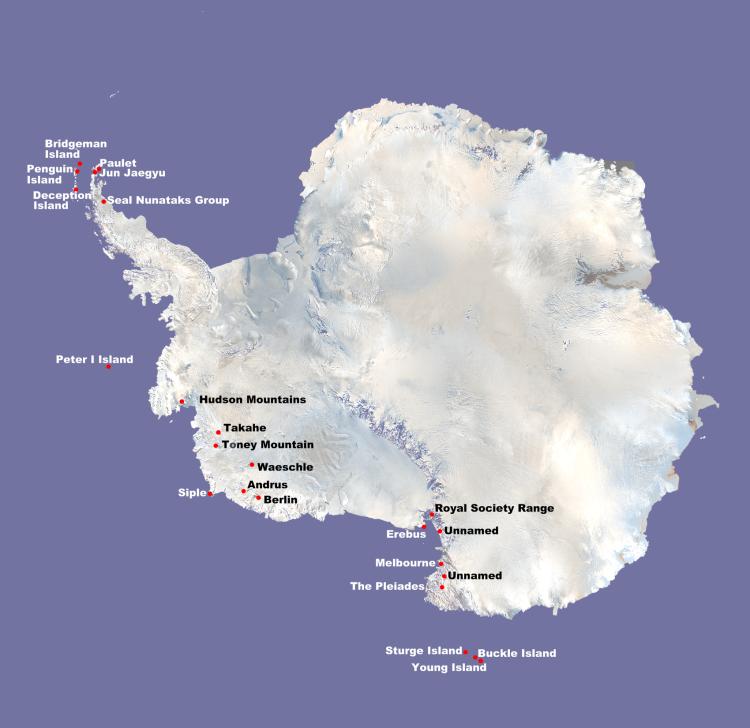
There are many active oceanic volcanos that extend from the Ross Ice Shelf to the Antarctic Peninsula...what a coincidence that global warming picked that specific spot to manifest itself!

antarcticvolcanoes2.jpg
 
Last edited:

umbrella39

Lifer
Jun 11, 2004
13,816
1,126
126
Some people pull their hands off the hot stove before it burns. It's clear others still need to be burnt a little while longer before waking up.
 

DominionSeraph

Diamond Member
Jul 22, 2009
8,386
32
91
There are many active oceanic volcanos that extend from the Ross Ice Shelf to the Antarctic Peninsula...what a coincidence that global warming picked that specific spot to manifest itself!

>thinks "active" means "constantly erupting."
>thinks that an average volcano puts out a significant amount of energy on a continental scale.
>thinks that a volcano is a "warming trend"

Ooh, look at what 800 megatons can do. Toasty!
http://en.wikipedia.org/wiki/Year_Without_a_Summer
 
Nov 30, 2006
15,456
389
121
>thinks "active" means "constantly erupting."
>thinks that an average volcano puts out a significant amount of energy on a continental scale.
>thinks that a volcano is a "warming trend"

Ooh, look at what 800 megatons can do. Toasty!
http://en.wikipedia.org/wiki/Year_Without_a_Summer
Wouldn't active volcano vents below the ice shelf cause ocean warming?

*************************************************
Edit: Interesting animation for those who care about such things.
http://www.coaps.fsu.edu/~maue/extreme/gfs/current/nhdt.html
 
Last edited:

NeoV

Diamond Member
Apr 18, 2000
9,504
2
81
/facepalm

hey everyone - Doc has solved global warming all by his lonesome little mind.....it's undersea volcanoes!

the only positive here is that you at least acknowledge the ocean is warming..

as to your theory......um no

"Volcanic activity is driven by a very, very, very slow circulation quite deep in the mantle. It is not at all subject to change in the space of a few decades. Or even a few hundred years. Look at Hawaii, or Iceland. They are surface manifestations of processes that normally take place in the deep ocean, like the mid Atlantic ridge, where there are numerous hot geothermal vents. Those vents do change over the space of a few decades, but not in response to volcanic changes somewhere else in the world.

The temperature around those vents is several hundred degrees. That causes the water to rise locally, because it's less dense than the surrounding cold water. However, it rapidly becomes mixed with the surrounding cold water to such an extent that it is not detectable at the surface of the ocean. The existence of the vents was discovered by accident a few decades ago during underwater explorations, not by anything detectable on the surface of the ocean.

<<guest speaker brought up an interesting point. It was simply that submarine volcanoes could have caused the oceans to warm these last 30 years.>>

It's just not true. Quite a lot of global warming deniers make claims like, "How do we know ..... is not the problem?" Really, the science is very clear.

NASA - http://apod.nasa.gov/apod/ap090421.html
NSF - http://www.nsf.gov/news/special_reports/&#8230;
NOAA - http://www.ncdc.noaa.gov/paleo/globalwar&#8230;
MIT - http://web.mit.edu/newsoffice/2009/roule&#8230;
UCLA - http://newsroom.ucla.edu/portal/ucla/glo&#8230;
NAS - http://americasclimatechoices.org/study-&#8230;

http://www.rkm.com.au/ANIMATIONS/carbon-&#8230; <== here's the physics.
http://www.rsc.org/images/CA1_tcm18-1379&#8230; <== Word doc. Page 6 shows where H2O and CO2 intercept different wavelengths
"
 
Last edited:

DominionSeraph

Diamond Member
Jul 22, 2009
8,386
32
91
Wouldn't active volcano vents below the ice shelf cause ocean warming?

Take a pebble with some tongs. Heat it up good and hot with a propane torch. Throw it in a 50 degree Olympic-sized swimming pool.
Enjoy your "heated pool."


Mauna Loa is the largest mountain on Earth by volume. ~18,000 cubic miles. Most other volcanoes would be a pimple on her ass. (Mt Fuji is maybe 100 cubic miles, being very generous, and that ain't a small volcano)

The oceans are 310 million cubic miles of this dense substance we call "water."

And Mauna Loa wasn't created in a day. Or a year. More like a good chunk of the way to a million years.

The oceans are a very, very, very large bucket, and the drop in that bucket that is the average volcanism level is already included in the ocean's temperature.
 
Last edited:

piasabird

Lifer
Feb 6, 2002
17,168
60
91
How do you prove it is man-made warming, and it is not part of a cycle caused by the sun and the stars?

Just because someone puts something on the internet or some journal, it does not make it true? Scientists are always making statements they can not prove.

So What? The artic ice is melting differently. Who cares? Can you do anything about it? Even if you want to go green, that does not prove it will make the climate any better. It is just a way to divert government money.

I purchased an electric lawn mower once thinking I was going green. The energy that it took to replace power cords to run it probably was more than the gas I would have used for a normal lawn mower. Half a dozen one way; Six Another.
 
Last edited:

KlokWyze

Diamond Member
Sep 7, 2006
4,451
9
81
www.dogsonacid.com
How do you prove it is man-made warming, and it is not part of a cycle caused by the sun and the stars?

Just because someone puts something on the internet or some journal, it does not make it true? Scientists are always making statements they can not prove.

So What? The artic ice is melting differently. Who cares? Can you do anything about it? Even if you want to go green, that does not prove it will make the climate any better. It is just a way to divert government money.

I purchased an electric lawn mower once thinking I was going green. The energy that it took to replace power cords to run it probably was more than the gas I would have used for a normal lawn mower. Half a dozen one way; Six Another.

Global warming isn't real because the government politically takes advantage of it. Makes sense now. :D

I agree that there is so much waste when it comes to switching to new technology..... all these energy saving bulbs have mercury in them and you know everyone just throws them in the trash.....
 
Aug 23, 2000
15,509
1
81
There's 2 types of people when it comes to global warming. Those that believe anything told to them that fits their personal views, and those that look at facts and actual, unmanipulated evidence.
The truth is, there's a lot of money to be made in the global warming scam. Which is what it is. Hmm, Al Gore "proves the Earth is warming and we have to all buy into a carbon credit system. Amazingly, that system was created by Al Gore.
If this was a real problem and the people that were telling you to be concerned about it, were actually concerned themselves, they (Al Gore) wouldn't be living in mansions using more electricty that most neighborhoods.

It's like listening to the idiots that complain about how hot it is in Texas or Arizona.
No shit. It's hot there. Has been for thousands of years.
 

iGas

Diamond Member
Feb 7, 2009
6,240
1
0
Take a pebble with some tongs. Heat it up good and hot with a propane torch. Throw it in a 50 degree Olympic-sized swimming pool.
Enjoy your "heated pool."


Mauna Loa is the largest mountain on Earth by volume. ~18,000 cubic miles. Most other volcanoes would be a pimple on her ass. (Mt Fuji is maybe 100 cubic miles, being very generous, and that ain't a small volcano)

The oceans are 310 million cubic miles of this dense substance we call "water."

And Mauna Loa wasn't created in a day. Or a year. More like a good chunk of the way to a million years.

The oceans are a very, very, very large bucket, and the drop in that bucket that is the average volcanism level is already included in the ocean's temperature.
Does magnetic poll shift and solar flare has something to do with weather pattern and "global warming"?