Low & Mid end Kaveri getting late - AMD mistake that will cost them?

Page 3 - Seeking answers? Join the AnandTech community: where nearly half-a-million members share solutions and discuss the latest tech.

Piroko

Senior member
Jan 10, 2013
905
79
91
What would make a lot more sense is their code names.

Haswell Dual
Haswell Quad
Haswell Quad Extreme
Haswell Dual M
Haswell Quad M
I'd replace the code name with a simple '2014' moniker, even less to explain.
Same for AMD, 2014 + clear description of market segment + perhaps short number for bin. Someting like
'2014 Desktop A10' for the top bin Kaveri, A1 for the lowest bin;
'2014 Slim Desktop E10' for the top bin Kabini.
 
Last edited:

Shivansps

Diamond Member
Sep 11, 2013
3,875
1,530
136
Actually its very easy, give the Mullins the "E" code name, from E1 to E10 if you wish, keeping a lower overall number than the lowerest Beemas:

E1 6200T / R2 -> E2-6200 / R1
A4 6400T / R3 -> E4-6400 / R2
A10 - 6700T / -> E6-6700 / R3

And Beemas using Ax.
E1-6010 / R2 -> A2-6250 / R2
E2-6110 / R2 -> A2-6450 / R3
A4-6210 / R3 -> A4-6750 / R4
A6-6310 / R4 -> A6-6850 / R5

That does the job a lot better, mixing A and E on both its meant to create confusion, and the numbering its very important. It turns out im just figuring out that going to Rx and A/E pre numbers is all intended to create confusion.
 
Last edited:

blackened23

Diamond Member
Jul 26, 2011
8,548
2
0
You seem to be confusing Apple with (all other) OEMS, and revising Apple's history a bit.

My first Mac was an iBook G3, 2nd was an eMac G4. The first Apple devices with Intel chips were the Core Duo line. Core Duo was not better than AMD's Athlon X2 line on the desktop, though Intel mobile was arguably better at the time. That didn't happen until Core 2.

I think Apple went with Intel because it was a safe bet. Apple needed a mobile chip though. The G5 at the time was fine for high end desktops, but laptops were booming and they needed a good mobile G4 which wasn't forthcoming. So they stopped fighting fate and went x86. I think they had their share of taking risks with CPU makers.

Most OEM tablets are cheap crap. Samsung puts MediaTek processors in the Galaxy Tab 3 7.0 They use a 2 year old Exynos chip in the Tab 3 8.

The Tab 3 10.1 used a Cedar Trail Atom - and got nailed on review after review for sluggish performance. You can pick one of those up for ~$200 now. The Tab 4 10.1 upgraded to a Snapdragon 400 - bottom of the Qualcomm Snapdragon line...

Their premier Galaxy Tab Pro products use Snapdragon 800 and Exynos Octa.

Again, I think neither AMD nor Intel really has a premier high end SoC for tablets yet.

Intel should be worried though. The importance of the iGPU is underrated by a PC industry that is used to desktops. an industry that for a decade derided integrated GPUs as garbage due to the abysmal performance of Intel iGPUs. Intel has a direct competitor in AMD in this segment, but even if AMD fails it does not mean that Intel will win. It may just mean that neither of them can hack it in mobile SoCs.

By all rights Intel should win easily. They have the best process tech and loads of cash.

They are doing something wrong to get one-upped by AMD on x86 SoC for tablets (even if only for a little while), and have their last gen mobile part in what was probably their most significant non-Windows 8 OEM design win (Tab 3 10.1) replaced by a low end Qualcomm part.

One upped? We know nothing about the performance per watt or battery life characteristics of the Beema/Mullins parts except for AMD marketing slides. And we've been through enough AMD CPU releases in the past few years to know that their marketing slides are generally exaggerated.

We know that Bay Trail does fare just fine in battery life tests. And we also know that AMD intentionally withheld all performance per watt and battery life metrics of the Beema/Mullins APU in actual tests, we only have marketing slides. We also know that AMD does not support idle standby. What does that tell you? It is EASY to take any mobile architecture and make it win benchmarks with unrealistic turbo speeds. What isn't easy is doing so at decent battery life levels, and that is an area that AMD has done horribly in over the years. For good performance, their battery life has typically sucked. For good battery life, their performance has always sucked. Will beema and mullins change that? I don't know and AMD has hidden that information. We know absolutely no objective battery life benchmarks. So to say that intel has been "one upped", well, if you say so.

Winning benchmarks is easy. Winning benchmarks with good performance per watt and good battery life is another thing altogether. And for that we have ZERO information on beema/mullins. Now you can cite a million examples as to why AMD didn't let reviewers test this, but it is what it is. Perhaps mullins and beema will fare well in this respect but as of NOW? We don't know. Therefore saying anyone was "one upped" is ridiculous. Again, performance with a mobile architecture and winning benchmarks is the EASY part. Intel could make a specific reference tablet designed to win benchmarks if they so wanted, but at the cost of battery life. Performance means nothing without context of battery life, and performance per watt is an area that intel has been making strides in.

So i'd hold off on the "one upped" nonsense until actual battery life tests are here. And apparently we won't have that until actual OEMs release products using these parts.This also doesn't change my main point: OEMs are well aware of what SKUs can do in terms of battery life and performance per watt, they will choose the right part for their intended demographic.

That aside. Back to the topic at hand. I also think that the lower end Kaveri parts should be released sooner - the 7850k is overpriced for what you get at 190$, but the 7600 could be a true sweet spot. I don't know if Q4 is true, but i'd hope not.
 
Last edited:

Enigmoid

Platinum Member
Sep 27, 2012
2,907
31
91
Exactly - people don't look at the benchmark sites much, if they look at all they're actually more likely to be reading reviews on bestbuy.com or amazon.com than even engadget and theverge.

With that said, one of the biggest things on any high end mobile device SoC is its GPU. There's a reason for that - the buggers are higher rez now than most people's desktop monitors, and smooth scrolling UI along with decent 3D is high on the list of user experience needs when you're using a touch screen.

AMD may now be better positioned in that regard, but I don't think either Intel or AMD are doing anything outstanding. They get knocked around pretty hard by the A7, high end Qualcomm chips, and even the older A6X in the iPad 4.

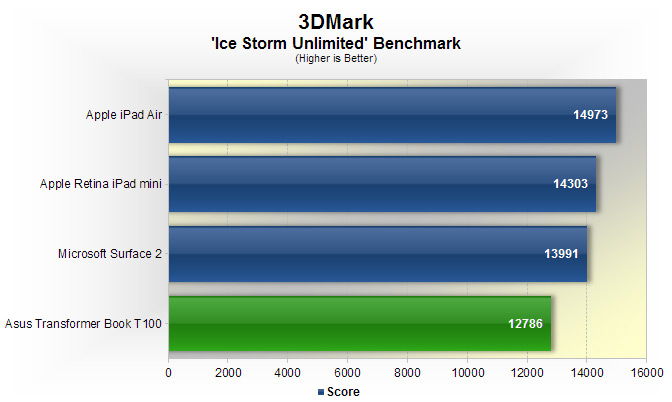
So to your point about high end parts - Bay Trail isn't it, and I doubt Kaveri is either. Look at where the iPad 4 (A6X), iPad Air (A7), and SnapDragon 800 sit in relation to the Z3470 Asus T100 \ BayTrail FFRD :

i.e. :

59408.png


58104.png


58094.png

Baytrail launched with poor drivers. Better drivers had made a massive improvement.

3dmark.png


3dmark-ice-storm.png


And Onscreen benchmarks can't be used for apples to apples comprarisons. Furthermore the triangle performance test is completely synthetic as the razar tablet (640m LE) loses to the kabini APU while thrashing it in real world tests.
 
Last edited:

shady28

Platinum Member
Apr 11, 2004
2,520
397
126
...

And Onscreen benchmarks can't be used for apples to apples comprarisons. Furthermore the triangle performance test is completely synthetic as the razar tablet (640m LE) loses to the kabini APU while thrashing it in real world tests.

The reason I chose onscreen benchmarks is twofold :

1 - It shows an iPad 4 trouncing a Bay Trail T100 - even though the iPad 4 has a higher screen resolution than the T100.

2 - Offscreen tests are often unreliable and not reflective of real performance; for example, the iPad 4 trounces Bay trail on Onscreen with the iPad having a higher resolution, but offscreen the gap narrows.

The reason has to do with how the hardware handles onscreen (important stuff) vs offscreen (not so important). As far as a user is concerned, offscreen really does not matter.


The benchmarks you provided primarily compare AMD to Intel. I'm saying neither of them is good enough right now.

Here are some more recent benchmarks - browser, and 3D.

Probably worth mentioning that the Tegra 4 Surface 2 is also beating Bay Trail here.

The higher resolution iPad, running on a 28nm A7, is simply walking away from the Z3470 T100.


T100Chart-1.jpg


T100Chart-3.jpg


T100Chart-4.jpg
 
Aug 11, 2008
10,451
642
126
The ipad mini compares in price to the T100, but lacks a keyboard, has a smaller screen, and doesnt run x86 apps, while the ipad retina is in a totally different price class. So it is not really an "apples to apples" comparison.

Personally I would give up some performance in order to be able to run x86 apps and use the device as a mini-laptop as well, but that is a matter of my own personal preferences. I havent tried a T-100, so I cannot say if the relatively weak graphics is a big drawback in everyday use, but I suspect not unless you are trying to game on it.
 
Last edited:

shady28

Platinum Member
Apr 11, 2004
2,520
397
126
The ipad mini compares in price to the T100, but lacks a keyboard, has a smaller screen, and doesnt run x86 apps, while the ipad retina is in a totally different price class. So it is not really an "apples to apples" comparison.

Personally I would give up some performance in order to be able to run x86 apps and use the device as a mini-laptop as well, but that is a matter of my own personal preferences. I havent tried a T-100, so I cannot say if the relatively weak graphics is a big drawback in everyday use, but I suspect not unless you are trying to game on it.

That's a valid answer, but keep in mind the thread just got off a "If you want a premium part, you'll pay a premium price for Intel" line of thought.

Now we're saying we'll settle for lower performance from the 22nm Intel part..

Main point being, too many here focus too much on process technology. Yet here we have a dual core 28nm part (A7) wiping the floor with a quad core 22nm Intel part (Z3470).

Design does matter, 14nm is not going to be a magic bullet for Intel - and it's entirely possible for the new 28nm AMD part to be both lower power and better performing than Intel's Bay Trail. In fact, there's every indication that it is. That does not bode well for Cherry Trail.

But I don't think either of them are ready to compete head to head with high end Qualcomm or Apple SoCs.
 

Enigmoid

Platinum Member
Sep 27, 2012
2,907
31
91
The reason I chose onscreen benchmarks is twofold :

1 - It shows an iPad 4 trouncing a Bay Trail T100 - even though the iPad 4 has a higher screen resolution than the T100.

2 - Offscreen tests are often unreliable and not reflective of real performance; for example, the iPad 4 trounces Bay trail on Onscreen with the iPad having a higher resolution, but offscreen the gap narrows.

The reason has to do with how the hardware handles onscreen (important stuff) vs offscreen (not so important). As far as a user is concerned, offscreen really does not matter.


The benchmarks you provided primarily compare AMD to Intel. I'm saying neither of them is good enough right now.

Here are some more recent benchmarks - browser, and 3D.

Probably worth mentioning that the Tegra 4 Surface 2 is also beating Bay Trail here.

The higher resolution iPad, running on a 28nm A7, is simply walking away from the Z3470 T100.
<snip>

Offscreen when comparing chips on hardware performance is the only way to go. You can't compare a test at 720p on one tablet to 1080p or 1600p on another. Especially when that SOC could be used in tablets of different resolution.

Browser Benchmarks while a good indicator of user performance cannot be compared for hardware performance. Look at the massive difference between IE and chrome. Safari, written specifically by Apple specifically for its chips is going t be much more efficient (think Mantle).

There is no link to your benchmarks (but I have found it-http://www.techspot.com/review/772-asus-transformer-t100/page3.html) but other newer tests have shown that BT gets around 15,500 on ice storm with newer drivers.

http://www.notebookcheck.net/Review-Asus-VivoTab-Note-8-M80TA-Tablet.115101.0.html

You also left out a test.

T100Chart-2.jpg


It is impossible to compare apple's A7 to the competition as they are under completely different software ecosystems. There is a lot of proof for this from the massive gains ios7 brought the iphone 5 in browser benchmarks and how well older iphones such as the 3gs or iphone 4 did against phones with much stronger CPUs.
 

lefty2

Senior member
May 15, 2013
240
9
81
I'm quite surprised that there still are no A10 7850 or 7700 based desktops from big OEMs like HP, despite those chips having been on the market for 4 months.
 

ShintaiDK

Lifer
Apr 22, 2012
20,378
145
106
I'm quite surprised that there still are no A10 7850 or 7700 based desktops from big OEMs like HP, despite those chips having been on the market for 4 months.

They are very expensive and doesnt exactly deliver something great.

AMDs decision to raise the ASP of Kaveri up to 22% is something OEMs still laugh about.
 
Aug 11, 2008
10,451
642
126
Yea, except for SFF boxes where you cannot add a discrete card, Kaveri is just too much of a compromise in the desktop. The price only adds to the problem, although no one really knows what the price is to an OEM.

The problem is that for demanding current titles at 1080p, any APU is marginal for gaming. If you decide to add a discrete card, then you negate the best part of the APU, and are left with mediocre cpu performance. And if you dont game, even Intel's igp is more than adequate, while the cpu performance is better.

The other problem with APUs, is that they are shooting at a moving target. Yes they are improving, but performance/watt (Maxwell) is improving greatly in dgpus, and hopefully with 20nm performance per watt will improve even more, and performance per dollar will also improve. Not to mention that games are becoming more demanding as well, as noted by watchdogs and the new mordor game which require an Ivy i7 for the recommended specs I believe.