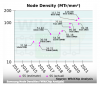
Discussion Leading Edge Foundry Node advances (TSMC, Samsung Foundry, Intel) - [2020 - 2025]

Page 215 - Seeking answers? Join the AnandTech community: where nearly half-a-million members share solutions and discuss the latest tech.

DisEnchantment

Golden Member
Mar 3, 2017
1,779
6,798
136
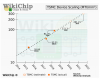
TSMC's N7 EUV is now in its second year of production and N5 is contributing to revenue for TSMC this quarter. N3 is scheduled for 2022 and I believe they have a good chance to reach that target.
1587737990547.png
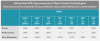
N7 performance is more or less understood.
1587739093721.png

This year and next year TSMC is mainly increasing capacity to meet demands.

For Samsung the nodes are basically the same from 7LPP to 4 LPE, they just add incremental scaling boosters while the bulk of the tech is the same.

Samsung is already shipping 7LPP and will ship 6LPP in H2. Hopefully they fix any issues if at all.
They have two more intermediate nodes in between before going to 3GAE, most likely 5LPE will ship next year but for 4LPE it will probably be back to back with 3GAA since 3GAA is a parallel development with 7LPP enhancements.


1587739615344.png

Samsung's 3GAA will go for HVM in 2022 most likely, similar timeframe to TSMC's N3.
There are major differences in how the transistor will be fabricated due to the GAA but density for sure Samsung will be behind N3.
But there might be advantages for Samsung with regards to power and performance, so it may be better suited for some applications.
But for now we don't know how much of this is true and we can only rely on the marketing material.

This year there should be a lot more available wafers due to lack of demand from Smartphone vendors and increased capacity from TSMC and Samsung.
Lots of SoCs which dont need to be top end will be fabbed with N7 or 7LPP/6LPP instead of N5, so there will be lots of wafers around.

Most of the current 7nm designs are far from the advertized density from TSMC and Samsung. There is still potential for density increase compared to currently shipping products.
N5 is going to be the leading foundry node for the next couple of years.

For a lot of fabless companies out there, the processes and capacity available are quite good.

---------------------------------------------------------------------------------------------------------------------------------------------------


FEEL FREE TO CREATE A NEW THREAD FOR 2025+ OUTLOOK, I WILL LINK IT HERE
 
Last edited:

johnsonwax

Senior member
Jun 27, 2024
472
676
96
The law? The US Government cant exempt one publicly owned company from its "tariff laws" while not exempting its competitors, who are also US companies, "just because it wants to".
You're aware the 15% export tariff that AMD and Nvidia have already agreed to is illegal right? Blatantly violates Article 1, Section 9, Clause 5 of the Constitution.

So they're already a part of a 'the US Government can't' scheme. Y'all seems to think the rule of law has primary here when really it's just a tool to use when convenient. See Justice Jackson's most recent dissent.
 

Josh128

Golden Member
Oct 14, 2022
1,536
2,289
106
Intel are not competitors. If they build fabrication facilities, maybe they would be. The other fabrication facilities in the US are also being exempted. The government bailed out Chrysler in the 80s without subsidizing other automakers to the same degree. Guess what? No one cared.

I swear kids haven't the slightest history of American government-business involvement and act like every thing that's moderately usual is the götterdämmerung. It's not even unusual in the industry right now... TSMC dominance has every government, all over the world paying their local fabs in various different ways. This isn't even the most direct.
You dont seem to be listening. Intel are not competitors to AMD? Since when?? Regardless of the merits of that delusional notion, bailing out a floundering company with a cash loan is one thing, but exempting one company from laws while not exempting another US company who makes directly competing products is wholly another. Chrysler was not simply "bailed out" with no consequences in 1979. It was given a LOAN, my brother. A loan which had to be paid back. In 2008, it was given another LOAN, but this time, being unable to pay it back, it filed Chapter 11 bankruptcy. In neither scenario was Chrysler given exemption from any taxes or laws that its direct competition wasnt.

You shouldnt be throwing around terms like "kids" so ignorantly, as you have no clue what you are talking about. I wish I was a kid my dude. I have a kid 2 years into university right now, and another who is a junior in high school. I was also the recipient of my respective 7th and 12th grade American history awards back in the 90's. History is kinda my thing.
 
Last edited:
  • Like
Reactions: BorisTheBlade82

gdansk

Diamond Member
Feb 8, 2011
4,764
8,061
136
It was given a LOAN, my brother. A loan which had to be paid back.
Look into it a bit. They paid it back by being awarded a series of cost plus defense contracts involving renting a factory owned by the United States government. Mind you the government still owns that factory despite the "end of the history" with the cold war.🤣But owning 10% of Intel is too, too far.

As I've said before the only problem here is the conflict of interest by Intel not spinning off the fabs at this point. But they were getting the CHIPS money anyway. Is this more advantageous to Intel in anyway? Only in that they get the money now...
 

Josh128

Golden Member
Oct 14, 2022
1,536
2,289
106
You're aware the 15% export tariff that AMD and Nvidia have already agreed to is illegal right? Blatantly violates Article 1, Section 9, Clause 5 of the Constitution.

So they're already a part of a 'the US Government can't' scheme. Y'all seems to think the rule of law has primary here when really it's just a tool to use when convenient. See Justice Jackson's most recent dissent.
Of course the export tariff is illegal, but its Trump admin breaking the law, not AMD and Nvidia. They are just being shaken down and chosen not to litigate, as that would both prevent them from exporting to China at all AND cost hundreds of millions in litigation while the case plays out. ALL OF THE tariffs have already been deemed illegal in some suits and are pending further escalation. That makes all companies paying them "a part of the US Government can't scheme." That has zero bearing on Intel not paying tariffs on TSMC produced parts while AMD and Nvidia do.
 

Josh128

Golden Member
Oct 14, 2022
1,536
2,289
106
Look into it a bit. They paid it back by being awarded a series of cost plus defense contracts involving renting a factory owned by the United States government. Mind you the government still owns that factory despite the "end of the history" with the cold war.🤣But owning 10% of Intel is too, too far.

As I've said before the only problem here is the conflict of interest by Intel not spinning off the fabs at this point. But they were getting the CHIPS money anyway. Is this more advantageous to Intel in anyway? Only in that they get the money now...
Again, you are not listening to me. I didnt say anything about the government buying stock in Intel. Where did you see me say anything about that? I said, it is completely illegal to give Intel "ipso facto" exemption from parts imported from TSMC, specifically products that compete directly with other US chip designers, while not giving those competing designers the same benefit.
 

gdansk

Diamond Member
Feb 8, 2011
4,764
8,061
136
, it is completely illegal to give Intel "ipso facto" exemption from parts imported from TSMC, specifically products that compete with other US chip designers, while not giving those competing designers the same benefit.
Let me try reiterating it. The federal government can do that if Intel is building manufacturing facilities in the US as long as it applies to any company also building manufacturing facilities in the US. The federal government claims that is the plan. There is case law establishing this is OK, going back decades.
What they cannot do is levy an export tax.
 

gdansk

Diamond Member
Feb 8, 2011
4,764
8,061
136
Cite this case.
I cannot cite a single case. There are about a dozen related to the DPA in the 1960s. Mainly complaints from various corporations losing contracts. Take your pick that test numerous aspects of the government giving money to corporations as long as they meet the criteria specified. They've pretty much held up except in 1952 when the federal government nationalized entire steel plants. The arguments against the federal government's Synthetic Fuels Corporation were all dismissed even though it disadvantaged any US oil company not producing synthetic fuels, even if they had Texan oil fields.

If an actual lawyer wants to speak up as to why the federal government has been able to invest in companies for decades without any serious lawsuits and how the CHIPS Act is less legal than the Energy Security Act I'd love to hear it. From what I can see the company that has a basis for a suit is Intel for the federal government not adhering to the terms of the CHIPS Act without congressional authorization... Or Nvidia/AMD for the levy of an export tax. Neither of which would stop the flow of money to Intel.
 
Last edited:

Win2012R2

Golden Member
Dec 5, 2024
1,326
1,365
96
You're aware the 15% export tariff that AMD and Nvidia have already agreed to is illegal right? Blatantly violates Article 1, Section 9, Clause 5 of the Constitution.
Most if not all new import tariffs also illegal since delegation from Congress (which should have never really happened) requires an emergency, plus notification in I think 30 days but that's chicken feed compared to actual illegality _and_ actual harm being done (to US businesses and consumers).

CHIPS act was carefully crafted to help mainly Intel, but of course it is not legal (or politically palatable) to just limit it to one company, so they just drafted it in a way that would benefit Intel mostly, which one might say fair enough since they got real manufacturing which in my view also should be supported.

In the meantime US Govt clearly broke CHIPs law because they take that money allocated by Congress which specifically were grants, not buying shares in some company, this is basically illegal but this seems to be the theme of the party for the next 18 months at least.

Thing is - Intel gives equal value to money Govt gives them, that's not a grant at all: shares are publicly traded and there is value to them, so in this case there can't be any restrictions from CHIPs Act applying, yet money were taken from what was allotted to that goal, a completely cluster**** which is par for the course now.
 
Last edited:

Joe NYC

Diamond Member
Jun 26, 2021
4,207
5,815
136
I said, it is completely illegal to give Intel "ipso facto" exemption from parts imported from TSMC, specifically products that compete directly with other US chip designers, while not giving those competing designers the same benefit.

Since TSMC is also exempt from tariffs, it is only an academic discussion for now.

Only in a hypothetical scenario where TSMC (TSMC customers) would have to start paying tariffs but Intel would not, this would become an issue.
 

DavidC1

Platinum Member
Dec 29, 2023
2,178
3,328
106
Illegal? What are we children or something? Some might be, but everyone with more than two brain cells rubbing against each other knows it can easily be used in any direction that's wanted. Illegal, pfft! What a joke. It shouldn't be, but laws are at the whims of the leaders and the society of the time and changes.
 
  • Like
Reactions: Tlh97 and Joe NYC

branch_suggestion

Senior member
Aug 4, 2023
894
1,945
106
I'm kinda shocked nobody has mentioned trying to licence TSMC nodes for a nationalised Intel Foundry?
Like if they can licence the N5 family that will help the transition nicely. Maybe licence N3 family a couple years after TSMC Arizona?
USG could coerce TSMC into these licencing deals through tariff concessions and the like, and it would help get a foothold of TSMC customers.
Eventually abandon all old Intel processes and start anew with a pure play defined 14A. You also have stuff like packaging tech, licencing CoWoS should also be doable.
Getting all of the Big 5 (NV/AMD/Apple/Qualcomm/Broadcom) to use a fully Western supply chain should be the ultimate goal, starting with licenced nodes and packaging to dual source is a start.
Additionally get merging with Tower and GF done ASAP. Thing that will complicate all this is Taiwan's ultimate moat to maintain the status quo is the quasi-monopoly TSMC has, losing that domestic necessity will embolden the CCP as the West will no longer have a reason to maintain the status quo.
So any of these deals will also come with demands from Taiwan for real security guarantees, with the way the world is now after the abject failure of protecting post-Soviet states from Russian imperialism, this basically means nukes in Taiwan proper.
 

gdansk

Diamond Member
Feb 8, 2011
4,764
8,061
136
abject failure of protecting post-Soviet states from Russian imperialism, this basically means nukes in Taiwan proper.
Nope, they missed the window of opportunity long ago.

Licensing TSMC processes doesn't give Intel what they need. They need money. Or least Intel operates in a way that suggests it thinks it needs money more than anything else.
 
  • Like
Reactions: 511

branch_suggestion

Senior member
Aug 4, 2023
894
1,945
106
Licensing TSMC processes doesn't give Intel what they need. They need money.
They need customers.
Money comes naturally when people use your stuff, and people like using TSMC stuff.
Intel Products can no longer provide for the scale required to make the foundry plans happen, ergo you need to do whatever necessary to get new customers.
And this is the simplest way, spin off the fabs and licence stuff everyone already uses.
Make whatever deals that need to happen happen, this should be seen as a wartime necessity.

Now of course the other method is coercing the customers to use Intel Foundry by force, but this is far harder to pull off as things currently stand.
Like they are simply missing so much IP to feature match what TSMC can offer and also lack scale, so can only do a limited transition currently, cash does fix this eventually.
 
Last edited:
  • Like
Reactions: Thibsie

gdansk

Diamond Member
Feb 8, 2011
4,764
8,061
136
They need customers.
So you say but they act like they need money (investment). It explains all their actions more readily.

Licensing TSMC puts them in a dead end. They won't understand how to improve it as well as TSMC who in any case has already done that.

Intel wants to build a process that customers want from the ground so they can replicate it in the future. Maybe they're delusional. Who knows. But if they get enough investment this final gamble to make the fabs viable before spin off needn't even kill the company.
 

DrMrLordX

Lifer
Apr 27, 2000
23,215
13,299
136
The government bailed out Chrysler in the 80s without subsidizing other automakers to the same degree. Guess what? No one cared.

And GM in 2007/2008.

I'm kinda shocked nobody has mentioned trying to licence TSMC nodes for a nationalised Intel Foundry?

TSMC would want too much money for that. It would make more sense to set up IP sharing between various foundries in the US, Korea, Japan, and anywhere else that isn't Taiwan/China if the rest of the world wants to be able to keep fabbing cutting edge chips.
 

branch_suggestion

Senior member
Aug 4, 2023
894
1,945
106
So you say but they act like they need money (investment). It explains all their actions more readily.
Of course, because it is Intel and it plays into the current circumstances.
Licensing TSMC puts them in a dead end. They won't understand how to improve it as well as TSMC who in any case has already done that.
They would be licencing mature nodes and tech which has already been refined to hell and back. N2 will probably never be licenced along with SoIC, so Intel will need to get beyond that themselves.
Intel wants to build a process that customers want from the ground so they can replicate it in the future. Maybe they're delusional. Who knows. But if they get enough investment this final gamble to make the fabs viable before spin off needn't even kill the company.
Customers will not go to an IDM, this is the cold hard truth that too many in Intel refuse to let go of.
14A needs to be defined by/for the biggest customers to succeed, and Intel Products would not be the biggest customer.
 

gdansk

Diamond Member
Feb 8, 2011
4,764
8,061
136
Customers will not go to an IDM, this is the cold hard truth that too many in Intel refuse to let go of.
It seems this new agreement gives them more flexibility to end it provided they don't mind tanking their stock to make sure the government doesn't execute the remaining 5% option.
14A needs to be defined by/for the biggest customers to succeed, and Intel Products would not be the biggest customer.
Personally... I don't think it is a likely success. But it is understandable they want money to have the option to build it out if they do manage to land a customer.
 
  • Like
Reactions: Joe NYC and marees

511

Diamond Member
Jul 12, 2024
5,436
4,863
106
Licensing IP doesn't do stuff you still need to figure out how to use that IP. Look at Google/Mediatek/Samsung using the same ARM IP but producing different results.
 
  • Like
Reactions: marees

DrMrLordX

Lifer
Apr 27, 2000
23,215
13,299
136
Licensing IP doesn't do stuff you still need to figure out how to use that IP. Look at Google/Mediatek/Samsung using the same ARM IP but producing different results.
Okay, and? That's the desired result: foundries "producing different results". At least they'd be producing something. Most foundries have given up and produce refinements of old nodes. Samsung has stagnated heavily. Intel seems to have hit a wall.
 

511

Diamond Member
Jul 12, 2024
5,436
4,863
106
Okay, and? That's the desired result: foundries "producing different results". At least they'd be producing something. Most foundries have given up and produce refinements of old nodes. Samsung has stagnated heavily. Intel seems to have hit a wall.
The point is even using the same IP we can get worse PPA as for Samsung their IP is based on IBM and i don't remember IBM IP being good maybe in 1970-80s and for Intel I don't think they have hit a wall yet.
 

Joe NYC

Diamond Member
Jun 26, 2021
4,207
5,815
136
So any of these deals will also come with demands from Taiwan for real security guarantees, with the way the world is now after the abject failure of protecting post-Soviet states from Russian imperialism, this basically means nukes in Taiwan proper.

That would be absolute lunacy which would bring the world as close to WW3 as
- the Cuban / Turkish missile crises, when US placed nuclear weapons to Turkey, Russia threatened to place nuclear weapons to Cuba
- Biden Blinken threatening to place nuclear weapons in Ukraine, over which Ukraine got destroyed
- placing nuclear weapons to Taiwan would result in China just turning Taiwan into deserted sandy island.

I don't think people of Taiwan are ready to sign up to be the next Ukraine or to be vaporized. They will more likely be seeking accommodation, not provocation.

Provocation means re-electing the US puppet-like government that has been plotting provocations (together with so called US "China hawks") for past years and years. The provocation (as China sees it) is acting like an independent country, seeking independence. Which means crossing China's red line.

Accommodation would mean electing the party that seeks exactly that - accommodation with China. Which means, maintaining status quo of Taiwan, even eventually moving toward re-unification.

Which would be my prediction of what will happen in Taiwan: Nothing. Status Quo. The provocateurs (seeking independence that will lead to WW3) will be either sidelined or humbled.

Drama over supply of semiconductors will not take place - unless there is some unforeseen act of God / nature, such as a powerful earthquake or Tayfun causing catastrophic damage to the island.

TSMC will continue acting independently, will only deal with Intel if it is in TSMC's interest. If there is any deal, it will likely be only to take out Intel as a potential competitor for the most advanced nodes.