Discussion Leading Edge Foundry Node advances (TSMC, Samsung Foundry, Intel) - [2020 - 2025]

Page 239 - Seeking answers? Join the AnandTech community: where nearly half-a-million members share solutions and discuss the latest tech.

DisEnchantment

Golden Member
Mar 3, 2017
1,779
6,798
136
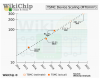
TSMC's N7 EUV is now in its second year of production and N5 is contributing to revenue for TSMC this quarter. N3 is scheduled for 2022 and I believe they have a good chance to reach that target.
1587737990547.png
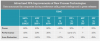
N7 performance is more or less understood.
1587739093721.png

This year and next year TSMC is mainly increasing capacity to meet demands.

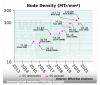
For Samsung the nodes are basically the same from 7LPP to 4 LPE, they just add incremental scaling boosters while the bulk of the tech is the same.

Samsung is already shipping 7LPP and will ship 6LPP in H2. Hopefully they fix any issues if at all.
They have two more intermediate nodes in between before going to 3GAE, most likely 5LPE will ship next year but for 4LPE it will probably be back to back with 3GAA since 3GAA is a parallel development with 7LPP enhancements.

1587739615344.png

Samsung's 3GAA will go for HVM in 2022 most likely, similar timeframe to TSMC's N3.
There are major differences in how the transistor will be fabricated due to the GAA but density for sure Samsung will be behind N3.
But there might be advantages for Samsung with regards to power and performance, so it may be better suited for some applications.
But for now we don't know how much of this is true and we can only rely on the marketing material.

This year there should be a lot more available wafers due to lack of demand from Smartphone vendors and increased capacity from TSMC and Samsung.
Lots of SoCs which dont need to be top end will be fabbed with N7 or 7LPP/6LPP instead of N5, so there will be lots of wafers around.

Most of the current 7nm designs are far from the advertized density from TSMC and Samsung. There is still potential for density increase compared to currently shipping products.
N5 is going to be the leading foundry node for the next couple of years.

For a lot of fabless companies out there, the processes and capacity available are quite good.

---------------------------------------------------------------------------------------------------------------------------------------------------


FEEL FREE TO CREATE A NEW THREAD FOR 2025+ OUTLOOK, I WILL LINK IT HERE
 
Last edited:

Doug S

Diamond Member
Feb 8, 2020
3,835
6,777
136
No one gonna list Intel's most quotable quote (at least as far as this thread is concerned) from their earnings call, from CFO David Zinsner?

I would tell you, on 14A, we're off to a great start. And if you look at 14A in terms of its maturity relative to 18A at that same point of maturity, we're better in terms of performance and yield. So we're off to an even better start on 14A. We just got to kind of continue that progress.

14A is a while out still, and 18A was rumored to be quite a mess early on (we're still not quite sure what state it is even now after entering mass production) so saying 14A is better at the same number of months out from planned mass production (that's how I interpret his "maturity" talk) is not the ringing endorsement it could be. But a step in the right direction, if, as he says, they continue that progress.
 

Hitman928

Diamond Member
Apr 15, 2012
6,754
12,500
136
That's not LBT's comments, that's a remark from Anton Shilov in that article.

LBT's comment from the Tomshardware article:


Intel CFO's comments:


And to put into context for the impact of a new node development on margin let's see TSMC's earnings call

Excerpt from TSMC Q3 Earnings Call:

Source: https://www.investing.com/news/tran...2025-shows-strong-revenue-growth-93CH-4291402

N3 family came up in 2023 just for context.

Various issues can come up during the initial phase of new node. This is not to say the issues at TSMC and Intel are exactly similar. But we need to give more time to assess the impact of the node. Anyway it seems the roadmaps of nodes and some of R&D have been reduced under LBT(that could also have impact(?)).
18A family is going to be a long node. Almost every product line esp. CPUs(server and client) and perhaps more products will have lots of 18A family utilization. Intel 10nm/7 is a margin destroyer as well. Ideally for them they need to gradually move from Intel 10nm/7 family towards their better nodes while the metrics of their nodes also progressing well.
Yes, was in a rush earlier and was sloppy with my post, the quote was the article’s summary of the comments from the C-suite.
 
  • Like
Reactions: Elfear

jdubs03

Golden Member
Oct 1, 2013
1,496
1,079
136

Doug S

Diamond Member
Feb 8, 2020
3,835
6,777
136
And there was talk that they’re only a few years away from EUV. Which even if true, they’d still be 5+ years behind.

🤡

More like 10 years.

China is also conducting research into alternate methods of achieving leading edge capability. I think FEL will end up being a far superior technology, but the west isn't putting any real money into researching it because we've got ASML's EUV, even though the path they're on is clearly financially unsustainable. There have been some recent advances in miniaturization and cost reduction of particle accelerators that will make FEL even more attractive.

That doesn't guarantee that China will succeed on that path, and there are other obstacles than the FEL technology itself - in particular nanometer accurate placement and stepping (something which reverse engineering is more likely to bear fruit since it is mostly mechanical with little software component, other than perhaps some temperature compensation they could figure out on their own)

I think China is on a fool's errand if they think they can reverse engineer ASML's EUV hardware (yes I know this involved a DUV machine) because of how long it took to develop. It is also a very brittle technology with any one of perhaps a dozen technological 'breakthroughs' that were required to make those Rube Goldberg machines work at scale not being properly reverse engineered leaving it useless, so they don't have to roll a 7 once but a dozen times in a row. Still I'm sure they are proceeding along multiple fronts and trying to figure out how to copy ASML's machines will be one of them, but I'm willing to bet FEL is where they are putting forth most of their resources as that's got the biggest potential payoff - much cheaper per wafer than EUV as well as a better roadmap to smaller feature sizes.
 

DrMrLordX

Lifer
Apr 27, 2000
23,222
13,300
136
And there was talk that they’re only a few years away from EUV. Which even if true, they’d still be 5+ years behind.

🤡

More like 10 years.

So long as ASML continues to make machines that self-destruct when disassembled by third parties, China is gonna have a hard time.

ASML will simply say No cause pretty sure it's not covered under warranty
Indeed, which was mentioned in the article. It's also a breach of contract.
 

Josh128

Golden Member
Oct 14, 2022
1,542
2,292
106
Them being caught red handed could mean ASML will stop sending them any scanners at all, as well as providing tech support and replacement components for their current ones.
ASML is in the business of making money. I doubt that will happen.
 
  • Like
Reactions: adamge

ToTTenTranz

Senior member
Feb 4, 2021
951
1,570
136
ASML is in the business of making money. I doubt that will happen.

Most people will assume that preventing an adversarial state who constantly breaks intellectual property rights from stealing their tech to eventually drive their operation into the ground (like the Chinese did with European/American cars, textiles, batteries, etc.) is a substantial part of their "business of making money".

Besides, ASML can't even sell EUV scanners to China, only older DUV ones.
 

Saylick

Diamond Member
Sep 10, 2012
4,121
9,641
136
Looks like Intel is going to poach a former TSMC / Intel exec as a consultant for their fab business:
Wei-Jen Lo, former senior vice president of Corporate Strategy Development at TSMC, who retired in July 2025, is reportedly being courted by Intel to head its R&D division. However, former TSMC executives expressed skepticism about the rumor. Since CEO Lip-Bu Tan took office, Intel has undergone a sweeping transformation, securing investment and equity deals with SoftBank, Nvidia, and the US government. The company recently posted a profit in the third quarter of 2025 after several quarters of losses. Industry sources believe that if Intel aims for a full turnaround, it must overhaul its wafer manufacturing and operational shortcomings. Continuous capital infusion is critical, as is strengthening its management and technical leadership. Recruiting former or even current TSMC veterans has become one of Intel's key strategies—hence the persistent reports of aggressive headhunting. With more than 40 years in the semiconductor industry, Lo was a key figure behind TSMC's process leadership. Notably, he spearheaded the adoption of extreme ultraviolet (EUV) lithography, a crucial step toward TSMC's high-yield 2nm production. Lo is also known for launching TSMC's "Nighthawk Force" project, a 24-hour continuous operation R&D model that enabled the successful mass production of 10nm chips. Before joining TSMC, Lo spent 18 years at Intel, where he served as director of technology development and a plant manager from 1997 to 2000. During his tenure, he and then executive vice president Mike Splinter established Intel's first 8-inch wafer fab and achieved successful mass production of the Intel 486 microprocessor. Nonetheless, retired TSMC executives suggested that even if the rumors were true, Lo would likely serve only as a technical advisor for foundry processes, subject to TSMC's approval. They also outlined three key reasons why it is improbable for Lo to assume a major R&D role. First, although Lo once worked at Intel, his experience dates back more than 20 years. Intel's operations, R&D, and organizational structure have changed dramatically since. Second, TSMC enforces a non-compete clause of up to two years, applicable to all employees regardless of nationality. Given Lo's crucial role in advancing TSMC's leading-edge process technologies, it would be unlikely—absent US political intervention—for him to join Intel's core R&D unit. Lastly, at 75, Lo would face a heavy burden if tasked with building new teams or leading large-scale R&D initiatives. In recent years, Intel has reportedly implemented large-scale workforce restructuring, with many of its former employees moving to TSMC, Samsung, and GlobalFoundries.
 

Doug S

Diamond Member
Feb 8, 2020
3,835
6,777
136
Good. Let that rotten government learn you can’t make or copy everything

There seems to be a lot of people with the sentiment that all China can do is copy. I remember the same being said about Japan was I was a kid in the 70s. America ignored their engineering progress to the eventual cost of the then-dominance of US manufacturing.

China has way more people than Japan, way more engineers, so it'll be a multiple of that scenario. They are doing plenty of original research, they "copy" because from the standpoint of individual products that can be the fastest way to get to market. But they are fully capable of developing what they are denied. The strategy of denying them the best tech is penny wise and pound foolish - it helps the west in the short run by protecting our companies but in the long run (say a decade or so) they're going likely to end up with technology that's superior and much cheaper per wafer than EUV. How are the Apples and Nvidias going to cope when Chinese companies are able to ship chips that are roughly on par (we'll assume Apple/Nvidia still beat them in design, but if the process they have access to is behind its basically a wash) for a fraction of the price?
 

desrever

Senior member
Nov 6, 2021
341
832
136
There seems to be a lot of people with the sentiment that all China can do is copy. I remember the same being said about Japan was I was a kid in the 70s. America ignored their engineering progress to the eventual cost of the then-dominance of US manufacturing.

China has way more people than Japan, way more engineers, so it'll be a multiple of that scenario. They are doing plenty of original research, they "copy" because from the standpoint of individual products that can be the fastest way to get to market. But they are fully capable of developing what they are denied. The strategy of denying them the best tech is penny wise and pound foolish - it helps the west in the short run by protecting our companies but in the long run (say a decade or so) they're going likely to end up with technology that's superior and much cheaper per wafer than EUV. How are the Apples and Nvidias going to cope when Chinese companies are able to ship chips that are roughly on par (we'll assume Apple/Nvidia still beat them in design, but if the process they have access to is behind its basically a wash) for a fraction of the price?
I think it will be more likely that the Chinese beat Apple and Nvidia at design than them beating ASML and TSMC on the foundry side.

Most likely paths for China is improving packaging, networking and memory so they can scale just as well but use more power due to weaker nodes, they can easily go this path due to their massive advantage in power generation and grid infrastructure. Power will likely become so cheap in China vs the US that they can be use 3x as much power in their data centers and still be cheaper to run. How would the US compete with that? The estimates for grid and power improvements for the US is in the trillions of $.
 
  • Like
Reactions: 511

jdubs03

Golden Member
Oct 1, 2013
1,496
1,079
136
China is also conducting research into alternate methods of achieving leading edge capability. I think FEL will end up being a far superior technology, but the west isn't putting any real money into researching it because we've got ASML's EUV, even though the path they're on is clearly financially unsustainable. There have been some recent advances in miniaturization and cost reduction of particle accelerators that will make FEL even more attractive.

That doesn't guarantee that China will succeed on that path, and there are other obstacles than the FEL technology itself - in particular nanometer accurate placement and stepping (something which reverse engineering is more likely to bear fruit since it is mostly mechanical with little software component, other than perhaps some temperature compensation they could figure out on their own)

I think China is on a fool's errand if they think they can reverse engineer ASML's EUV hardware (yes I know this involved a DUV machine) because of how long it took to develop. It is also a very brittle technology with any one of perhaps a dozen technological 'breakthroughs' that were required to make those Rube Goldberg machines work at scale not being properly reverse engineered leaving it useless, so they don't have to roll a 7 once but a dozen times in a row. Still I'm sure they are proceeding along multiple fronts and trying to figure out how to copy ASML's machines will be one of them, but I'm willing to bet FEL is where they are putting forth most of their resources as that's got the biggest potential payoff - much cheaper per wafer than EUV as well as a better roadmap to smaller feature sizes.
I would imagine that other countries that are also looking into this technology as well.

There seems to be a lot of people with the sentiment that all China can do is copy. I remember the same being said about Japan was I was a kid in the 70s. America ignored their engineering progress to the eventual cost of the then-dominance of US manufacturing.

China has way more people than Japan, way more engineers, so it'll be a multiple of that scenario. They are doing plenty of original research, they "copy" because from the standpoint of individual products that can be the fastest way to get to market. But they are fully capable of developing what they are denied. The strategy of denying them the best tech is penny wise and pound foolish - it helps the west in the short run by protecting our companies but in the long run (say a decade or so) they're going likely to end up with technology that's superior and much cheaper per wafer than EUV. How are the Apples and Nvidias going to cope when Chinese companies are able to ship chips that are roughly on par (we'll assume Apple/Nvidia still beat them in design, but if the process they have access to is behind its basically a wash) for a fraction of the price?
You have a fair point in your second paragraph. But, your first paragraph I mean, they really just did it to themselves. They’ve earned that reputation. One area, which they *haven’t* really copied is with EV’s. But their fighter jets are a prime example of *copying through* espionage. And also just look at Xiaomi and OnePlus. They’ve literally copied iOS. It’s blatant.

I think it will be more likely that the Chinese beat Apple and Nvidia at design than them beating ASML and TSMC on the foundry side.

Most likely paths for China is improving packaging, networking and memory so they can scale just as well but use more power due to weaker nodes, they can easily go this path due to their massive advantage in power generation and grid infrastructure. Power will likely become so cheap in China vs the US that they can be use 3x as much power in their data centers and still be cheaper to run. How would the US compete with that? The estimates for grid and power improvements for the US is in the trillions of $.
I doubt they’re gonna beat Apple or Qualcomm or nVidia for a very long time. These companies have the best CPU architects in the world. Sure China has a shit ton of engineers, but so does the West and they work for these companies. I don’t see them catching up let alone surpassing them.
 
Last edited:

Doug S

Diamond Member
Feb 8, 2020
3,835
6,777
136
I would imagine that other countries that are also looking into this technology as well.

Oh there are some token funds for academic research - at something like the levels that were being to devoted to EUV pre-Y2K when it was pie in the sky. But to my knowledge there is no one in the west trying to actually develop it as a real solution.

It isn't like there isn't tons of money floating around between TSMC on the foundry side (leaving out Samsung and Intel because at least for now they don't have billions to devote to a potential EUV replacement) and Samsung/Micron/et al on the DRAM side. Not to mention the major customers who ultimately bear the insane and ever growing cost of EUV: Apple, Nvidia, Qualcomm et al. Where is the TSMC+Samsung+Micron+Apple+Nvidia JV pouring a few billion a year into developing FEL?

The toolmakers have no incentive to do this. ASML has a worldwide monopoly on the only technology that delivers current and future leading edge nodes. Canon SHOULD want to do this, but they are still stupidly chasing all those sunk costs trying in vain to make nanoimprint work. So it is gonna be China that funds it to the level required to develop it, because they don't have any incumbents trying to protect monopolies and more importantly because they NEED it.
 

jdubs03

Golden Member
Oct 1, 2013
1,496
1,079
136
Oh there are some token funds for academic research - at something like the levels that were being to devoted to EUV pre-Y2K when it was pie in the sky. But to my knowledge there is no one in the west trying to actually develop it as a real solution.

It isn't like there isn't tons of money floating around between TSMC on the foundry side (leaving out Samsung and Intel because at least for now they don't have billions to devote to a potential EUV replacement) and Samsung/Micron/et al on the DRAM side. Not to mention the major customers who ultimately bear the insane and ever growing cost of EUV: Apple, Nvidia, Qualcomm et al. Where is the TSMC+Samsung+Micron+Apple+Nvidia JV pouring a few billion a year into developing FEL?

The toolmakers have no incentive to do this. ASML has a worldwide monopoly on the only technology that delivers current and future leading edge nodes. Canon SHOULD want to do this, but they are still stupidly chasing all those sunk costs trying in vain to make nanoimprint work. So it is gonna be China that funds it to the level required to develop it, because they don't have any incumbents trying to protect monopolies and more importantly because they NEED it.
Yeahh that’s the problem putting all of one’s eggs into a single basket. Monopolies suck.

They definitely do have the potential funding for such an endeavor. They would be foolish if they weren’t planning for something past Hyper-NA. It would be rank incompetency if they didn’t. But I do get the incentive to milk EUV and it’s iterations for as long as they can.
 

Khato

Golden Member
Jul 15, 2001
1,381
488
136
We'll have to see what comes of the xLight attempt at introducing FEL for the EUV source.

Also of note is that replacing the replacing the EUV source is only one component in producing a viable EUV scanner. My understanding is it gets all the attention because it's still the primary bottleneck in further ramping capacity. The requirements for the mirrors were similarly problematic to meet, but since Zeiss came up with a method to fully meet those requirements it doesn't get talked about any more.
 
  • Like
Reactions: moinmoin

desrever

Senior member
Nov 6, 2021
341
832
136
I doubt they’re gonna beat Apple or Qualcomm or nVidia for a very long time. These companies have the best CPU architects in the world. Sure China has a shit ton of engineers, but so does the west and they work for these companies. I don’t see them catching up let alone surpassing them.
I have no doubt they will beat them if given the opportunity. The engineering within China is much more competitive, it will just take some time. Silicon design is a lot more even of a playing field than all the parts that are needed for fabrication.

Xiaomi's first 3nm SOC is competitive with Qualcomm of example:

Although using ARM's core designs, they are still ahead of what other designs using the same cores are doing.
 

jdubs03

Golden Member
Oct 1, 2013
1,496
1,079
136
I have no doubt they will beat them if given the opportunity. The engineering within China is much more competitive, it will just take some time. Silicon design is a lot more even of a playing field than all the parts that are needed for fabrication.

Xiaomi's first 3nm SOC is competitive with Qualcomm of example:

Although using ARM's core designs, they are still ahead of what other designs using the same cores are doing.
If given the opportunity. I don’t think they’ll get that opportunity. You basically have a dichotomy of a lot of Chinese engineers for Chinese companies against a lot of various ethnicities (including Chinese folks) in Western companies. Just because China has 1.3 billion people doesn’t guarantee Xiaomi wins in the end. Combine the US, Europe, Japan, South Korea, India, and there are more people to choose from.

And that Xiaomi chip is not even used in their newly released flagship phones. It’s been surpassed by the Elite Gen 5. Now maybe when the Xiaomi 17 Ultra comes out they’ll use the next-gen XRing and it maybe competitive again, but even that is still half a year behind. It’s a good chip I’ll give them that especially for a first product release, but it doesn’t guarantee the next version has *a lot of* low-hanging fruit it can gobble up and match Apple for example.
 
Last edited: