[Kitguru]Nvidia`s big Pascal GP100 have taped out - Q1 2016 release

Page 6 - Seeking answers? Join the AnandTech community: where nearly half-a-million members share solutions and discuss the latest tech.

Sabrewings

Golden Member
Jun 27, 2015
1,942
36
51
I turned on my Maxwell 2 timer. If this card goes obsolete when Pascal launches and it seems I'm going to be on the NV boat for a while, I'll just jump over when Pascal launches and hand Maxwell 2 to the GF.

I hope it's at least a year so I can maintain my upgrade schedule and not hear the GF complain :D

Same. I'll slap the 980 Ti in my old PC for the wife and get Pascal. No reservations at all.
 

tviceman

Diamond Member
Mar 25, 2008
6,734
514
126
www.facebook.com
I just don't see how Nvidia's big Pascal die is taping out first on a new node after the last two generations (Kepler and Maxwell) had Nvidia release their small dies first. (And yes, GK107 launched before GK104. A few laptops went up for sale with GK107-based GPU's a week or two before GTX 680 reviews aired).

Perhaps Nvidia changed their naming scheme around this time and GP100 is the small-die Pascal. Being perf/w, mobile centric, and risk-management focused, high volume small-die first makes the most sense.
 

wand3r3r

Diamond Member
May 16, 2008
3,180
0
0
I'll believe Q1 2016 when I see it.

I'm pretty sure they'll milk out the low end and mid range (priced at high end, unfortunately successfully too it seems) first just like they past couple generations.

If it's true it would shake up the market quite a bit. I need a huge dose of salt to believe this though.
 

Qwertilot

Golden Member
Nov 28, 2013
1,604
257
126
There's some big super computer contracts I think? Quite plausible to imagine it taping out but at a low yield/mad cost basis - also for dual precision calculations elsewhere - and take quite a while to filter down to even Titan levels of 'affordability'.
 

Sabrewings

Golden Member
Jun 27, 2015
1,942
36
51
I will admit it's unlikely, but I wouldn't be mad. I'm still expecting a late 2Q 2016 big Pascal launch. If it manages to double my 980 Ti's performance for the same TDP (or lower), I'm on board.
 

jpiniero

Lifer
Oct 1, 2010
16,989
7,393
136
Perhaps Nvidia changed their naming scheme around this time and GP100 is the small-die Pascal. Being perf/w, mobile centric, and risk-management focused, high volume small-die first makes the most sense.

I'd say it'd be a smallish die (~200-250 mm2?), but the main focus is Tesla and DP. I'm sure they will release a Titan and new mobile parts though.

I will admit it's unlikely, but I wouldn't be mad. I'm still expecting a late 2Q 2016 big Pascal launch. If it manages to double my 980 Ti's performance for the same TDP (or lower), I'm on board.
That seems unlikely for games at least. I think 40-50% is optimistic.
 

railven

Diamond Member
Mar 25, 2010
6,604
561
126
Perhaps Nvidia changed their naming scheme around this time and GP100 is the small-die Pascal. Being perf/w, mobile centric, and risk-management focused, high volume small-die first makes the most sense.

Doing this would definitely throw a monkey wrench into the arguments of "GM204 for $550, you're paying $250 over Nvidia's Midrange chip LOL" which I have been guilty of saying. ():)

If GP100 comes out as the first chip and has improved perf over Maxwell2, it's name in the family tree won't mean diddly. GP200 can be big Pascal in a few months or a completely new family/tier.

They already segmented their product line once, won't hurt again, as they laugh to the bank.
 

dark zero

Platinum Member
Jun 2, 2015
2,655
140
106
I will admit it's unlikely, but I wouldn't be mad. I'm still expecting a late 2Q 2016 big Pascal launch. If it manages to double my 980 Ti's performance for the same TDP (or lower), I'm on board.
Hardly... if AMD with HBM couldn't deliver big gains (and considering they rebranded their chips), I doubt that nVIDIA can deliver 2X performance... at best could be 50%.
 

happy medium

Lifer
Jun 8, 2003
14,387
480
126
Hardly... if AMD with HBM couldn't deliver big gains (and considering they rebranded their chips), I doubt that nVIDIA can deliver 2X performance... at best could be 50%.

The reason AMD failed with Fuji is they ran out of die space. With this node shrink both Nvidia and AMD will have the power to take advantage of HMB.
I would put money on at least a 65% performance increase this time around. Nvidia will be first to market.
 

desprado

Golden Member
Jul 16, 2013
1,645
0
0
The reason AMD failed with Fuji is they ran out of die space. With this node shrink both Nvidia and AMD will have the power to take advantage of HMB.
I would put money on at least a 65% performance increase this time around. Nvidia will be first to market.

40% to 45% is max reality.
 

tviceman

Diamond Member
Mar 25, 2008
6,734
514
126
www.facebook.com
The reason AMD failed with Fuji is they ran out of die space. With this node shrink both Nvidia and AMD will have the power to take advantage of HMB.
I would put money on at least a 65% performance increase this time around. Nvidia will be first to market.

40% to 45% is max reality.

If GP104 (or whatever the 2nd tier Pascal chip is called) is exactly 2x perf/w over GM204, that would be a ~55% bump over Titan X (60% over 980 TI). So I'm predicting performance right in between the both of yours. :D I think with the new node + architectural improvements of Pascal + possible HBM for 2nd tier chip, it's very achievable for AT LEAST 50% over Titan X.
 
Last edited:

Sabrewings

Golden Member
Jun 27, 2015
1,942
36
51
Then I'll be good to wait another year, unless I run into specific issues. It's a large node jump so I'm hoping for the best. My "monitor" is a 1080p 55" LED TV and I'll have various VR headsets, so I don't really need anything beyond what I have now.

Though, StarVR has the potential to be a real GPU crusher with those huge displays and the need to be 90FPS or better.
 

Subyman

Moderator <br> VC&G Forum
Mar 18, 2005
7,876
32
86
Would love to see quick cycles again. I've found myself hopping between cards just for fun.
 

RussianSensation

Elite Member
Sep 5, 2003
19,458
765
126
The reason AMD failed with Fuji is they ran out of die space.

No, that almost has nothing to do with it. The 4 primary reasons why Fiji couldn't beat 980Ti are:

1) Old GPU architecture -- The GCN 1.2 architecture traces its roots back to December 22, 2011 (HD7970 Tahiti). It's more or less a 3.5-year-old architecture that has been refreshed (Tonga) going against a brand new Maxwell architecture made from the ground up to be a perf/watt architecture (i.e., NV's bottom-to-top approach to GPU design). It's practically a miracle that GCN has been able to withstand 3 brand new architectures from NV (Fermi, Kepler and Maxwell) but it's evident NV's 3rd new architecture is better than GCN 1.2. The only reason AMD is even in the game against a reference 980Ti is HBM. If they didn't have HBM for Fiji, the card would have been toast.

2) Unbalanced ASIC design -- specifically for Fiji, it seems to have too much shader/texture throughput and not enough pixel fill-rate/polygon horsepower. GM200 seems to be a better balanced design overall. This is why when Fiji wins, it doesn't win by a lot but when GM200 wins, it wins by 20-30%.

3) Clock speeds -- Fiji is clocked at 1050mhz and generally maxes out at 1150mhz on stock voltage. GM200 reference runs at 1200mhz out of the box, all day and after-market cards are easily cracking 1350-1380mhz out of the box. The higher clock speed gives GM200 an advantage since even if Fiji is competitive in perf/clock, it cannot compete against a 1350-1500mhz GM200 chip when its clocks are only 1050-1150mhz. That's just common sense when one chip has 20-30% overclocking headroom and the other less than 10%.

4) AMD's drivers -- greater DX11 CPU overhead ensures that NV continues to lead at lower resolutions and AMD's less than polishes drivers have Fiji with less than satisfactory frame times in games where R9 295X2 4GB has no issues.

Had AMD allowed for voltage control and the card could overclock to 1300-1400mhz like GM200, it would be much harder to claim a winner in this battle. The die size is easily the least important point in why Fiji lost the battle as of right now.

40% to 45% is max reality.

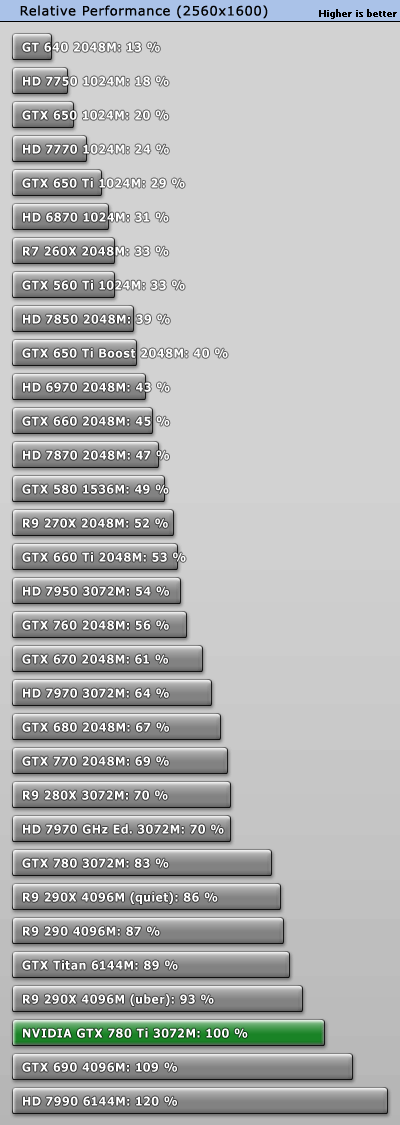
When NV introduced a new architecture + lower node (Fermi -> Kepler) we got a 2X increase in performance (GTX580-> GTX780Ti is 2x faster). We should expect flagship Pascal to be 80-100% faster than GM200 assuming NV retains 250W power usage and Pascal can overclock as well.

Fermi to Kepler is the most reasonable generation for us to look at (node shrink + new architecture).

GTX560Ti -> GTX680 (spiritual successor): 89% faster

perfrel_2560.gif


GTX580 -> GTX780Ti (spiritual successor): 104% faster

perfrel_2560.gif


This time NV also has HBM2 for 2.5-3X the memory bandwidth of GM200 (980Ti). GTX780Ti benefited far less in terms of memory bandwidth increase vs. GTX580 than Pascal should vs. 980Ti.

The only way NV delivers 40-45% higher performance at the top-end from 980Ti is if they either split the generation into 2-3 parts (i.e., they purposely low ball performance and slowly trickle down cards to make $$$ aka 680->780->780Ti) AND/OR if there is a major disaster with their GPU architecture/14-16nm node.

Even the 980 successor should easily outperform the 980Ti.

If Pascal flops (i.e., 45% increase in performance per watt), 980-> GTX1080:

69% x 1.45 = 100 => That's already 15% faster than a reference 980Ti. It'll likely have 8GB HBM2, NV's entire driver focus will shift to Pascal and NV should finally bump the tessellation performance which would mean GP204 (or w/e it's called) will make the 980Ti irrelevant next year.

If Pascal delivers (i.e., 80-100% increase in perf/watt), 980-> GTX1080:

69% x 1.9 = 131% (or at least 50% faster than a 980TI). < This is probably a realistic upper-end for the mid-range GTX980 Pascal successor.

perfrel_2560.gif


A lot of people low ball performance and almost no one believed that 980 was a mid-range card priced like a flagship at $550 and today a 980Ti completely mops the floor with a 980. Anyone who had an objective eye and followed NV's GPUs for the last 15+ years easily saw what the 680 and 980 were in the line-up (mid-range cards) a mile away. Similarly, people are low-balling Pascal's performance -- node shrink + new architecture + HBM2 -- there is no way it's only 40-45% faster in perf/watt at 250W power usage than a 980Ti unless NV fails. I guess it's hard for some people to believe that the newly released 980Ti/Fury will get dropped in 2016. Many couldn't fathom that NV's next gen mid-range (970/980) could obsolete the $699 780Ti in just 10 months but it happened because the next gen mid-range > last gen flagship happened every single NV generation since at least GeForce 2. If NV follows the same GPU design strategies used in the last 20 years, it's basically guaranteed that its next gen mid-range will obsolete 980Ti.
 
Last edited:

shady28

Platinum Member
Apr 11, 2004
2,520
397
126
There are really 3 metrics to determine what's high-end; price, performance, and die size.

The only one that matters to consumers is performance. Check, 980 got that one, thoroughly whipping its predecessor the 780 as well as its newer competition the 290X.

On price, mostly check, $500 is definitely high end although it was $150 less than the 780 was at launch.

On die size, the 980 has 392mm die which it lands between a 770 (294) and 780 (561). Only Titan and 980 Ti are larger (601).

I would say that any card that is over $300 with the performance to match that price is decidedly high-end. Most sites consider Nvidia x50 series cards to define entry into the mid-range, with x60 cards defining the top of the mid-range, and x70 / x80 cards to be high-end.

When you start talking about x80 Ti and Titan X, that's the extreme range.

There are a lot of people with those extreme cards here who lose all perspective. It's like being on a car forum with a bunch of BMW owners, and having the guy with a BMW 760i tell a guy with a Toyota Avalon that he has a midrange car, and then the guy with a decked out Accord that it's low-end. And all because the 760i owner views a base $50K 528i as a midrange car.

BTW, I have a decked out Accord (and a 750 Ti).
 

RussianSensation

Elite Member
Sep 5, 2003
19,458
765
126
There are really 3 metrics to determine what's high-end; price, performance, and die size.

You missed the most important areas -- where the card actually lands in terms of its code-name and its standing in the line-up. NV could take any chip it has and call it x50, x60, x70, x80. That tells us absolutely nothing. Using your logic, had NV delayed GTX460 and called it GTX480 and priced it at $499, you'd call that high-end. Same for 6600GT that smashed a 5950U or 680 that beat GTX580. Sorry, 680 and 980 are not high-end cards no matter how much you keep claiming they are. Just because NV priced them at $499-549 doesn't mean they were high-end. It's more akin to NV got away with pricing a mid-range x60 card and calling it an x80 card due to lack of competition.

Another common sense logic to this argument is never in the history of NV's generations did NV release a high-end card of the same architecture/gen only to then release a flagship card 40%+ faster. In that case, GTX780Ti is from the exact same generation as GTX680 and 680 is really a 660Ti and 780Ti is a 680. The same applies for 980 and 980Ti. 980 is really a 960Ti, nothing more nothing less.

The only one that matters to consumers is performance. Check, 980 got that one, thoroughly whipping its predecessor the 780 as well as its newer competition the 290X.

That's not how GPU generations work. I am sorry if you started following the graphics card industry only in the last 5 years but you are wrong. Had NV split its historical GPU generations into 2 halves (bifurcated a generation), then might as well start calling GeForce 4 Ti 4200 as GeForce 4800, GeForce 5700U as GeForce 5900U, etc.

On price, mostly check, $500 is definitely high end although it was $150 less than the 780 was at launch.

No, it's only high-end based on marketing. As 680 and 980 stand in the respective Kepler and Maxwell line-ups, these are historically speaking $250-300 mid-range chips, priced at $500-550. Price alone doesn't determine if the card is mid-range or high-end anymore after NV changed the way they market and split a generation.

Another evidence your entire post is wrong is NV has never released a next generation flagship that wasn't at least 40%+ faster than the last generation's flagship. By that account both the 680 and 980 cannot be considered true flagships, not to mention so many other metrics that already prove they are mid-range chips. Most of the forum will agree with my assessment.

On die size, the 980 has 392mm die which it lands between a 770 (294) and 780 (561). Only Titan and 980 Ti are larger (601).

By very definition of 980 being a 392mm die and GM200 being 601mm2 already proves that 980 is a mid-range and there is a flagship sitting above it with nearly 50% greater die size. You just contradicted your own post.

I know it's very hard for some people to accept that GTX680 and 980 are mid-range chips, I guess because some of them would be admitting to getting ripped off by buying a $500-550 mid-range GTX560Ti successor. In the case of a 680 vs. 780Ti, it's far worse than 560Ti and in that Fermi generation at best would be called a GTX560. 980 is clearly a mid-range $250 GTX960Ti:

$250 GTX560Ti (980) vs. $350 GTX570 vs. $500 580 (aka 980Ti/Titan X level):
http://www.legionhardware.com/articles_pages/gigabyte_geforce_gtx_560_ti_soc,12.html

I would say that any card that is over $300 with the performance to match that price is decidedly high-end.

It's only high-end from a marketing perspective, not engineering perspective. If tomorrow the top 5 audiophile manufacturers doubled the prices of their headphones, that would still make Sennheiser's HD598 low-end, HD650 mid-range and HD800 High-end.

Most sites consider Nvidia x50 series cards to define entry into the mid-range, with x60 cards defining the top of the mid-range, and x70 / x80 cards to be high-end.

This is only valid if the videocard's names actually meant anything in 2015 - in many cases, they don't. R9 390X isn't a true x90 series card from AMD. GTX960 is in no way shape or form a true x60 series card either. The names don't mean anything anymore and to get a true understanding one needs to dive into the GPU codename (GTX960 is the 3rd chip from the top so it's decidely low-end) while R9 390X is a 2nd chip from the top so it's mid-range and should have been called R9 380X.

Secondly, you are ignoring historical generational leaps. Both the R9 390X and GTX960, along with GTX980 are faux x90, x60 and x80 series cards as none of these live up to the expectations of a true x90 AMD card, x60 NV card or x80 NV card. All of these cards are branded incorrectly -- or I suppose correctly if we are talking marketing brainwashing to the masses who buy into the marketing names.

It's like being on a car forum with a bunch of BMW owners, and having the guy with a BMW 760i tell a guy with a Toyota Avalon that he has a midrange car, and then the guy with a decked out Accord that it's low-end. And all because the 760i owner views a base $50K 528i as a midrange car..

Sorry to break it to you but in BMW's stack 2-4 series is low-end, 5 series is mid-range and 6-7 series is high-end. Honda Accord is less luxurious than a compact/entry-level luxury sedans (i.e., 3 series, Audi A4, C-Class) so it's below low-end luxury segment. This is the same mistake you are making when comparing videocards -- you aren't comparing the product segmentation in the entire product line-up vs. the entire market. Honda Accord is a low-end car because essentially it's just barely a class above a Honda Civic/Mazda 3/Ford Focus with the primary differentiator being size, not much more luxury. Even if they made the Accord the size of the S-Class/7 Series, it would still be below the Audi A4/C-Class status because a car's size alone doesn't determine its luxury status.

Anyway, not sure what this has to do with Pascal's mid-range successor trouncing GTX980Ti other than you are really really trying to call that GP204 card High-end? I think you should really do some reading on NV's GPU generations going back to GeForce 2 before you provide any reasonable rebuttal. I suggest you start here and start matching next gen mid-range vs. last gen flagship to see what actually happens:

http://forums.anandtech.com/showthread.php?t=2298406

Now, since NV already got away with pricing its next generation mid-range chips/card at flagship prices with GTX680 and 980, it's a virtual guarantee that as long as the GP204 Pascal chip is even 5-15% faster than 980Ti, NV will slap a $500-550 price on it and market the hell out of it as an x80 series Pascal card. NV's new GPU strategy is 100% bullet-proof and I hope the top management in their marketing department is getting awesome bonuses.

I still remember certain posters defending GTX980 for the last 9 months, constantly claiming that it wasn't worth waiting for NV's/AMD's true flagship to launch. Boy, now a $680 MSI Gaming 6 980Ti is 49% faster than a reference $550 980 at 4K:

perfrel_3840.gif


I guess it's really hard for some people to accept they got ripped off buying a mid-range GM204 chip for $550 even when the evidence is staring in their face since the 980Ti dropped. Historically speaking, there should never be a perfectly linear price/performance relationship between a mid-range and a flagship card which means a 980 today should cost well below $450 because there is a certain premium/bragging rights attached to the 980Ti.

 
Last edited:

n0x1ous

Platinum Member
Sep 9, 2010
2,574
252
126
You missed the most important areas -- where the card actually lands in terms of its code-name and its standing in the line-up. NV could take any chip it has and call it x50, x60, x70, x80. That tells us absolutely nothing. Using your logic, had NV delayed GTX460 and called it GTX480 and priced it at $499, you'd call that high-end. Same for 6600GT that smashed a 5950U or 680 that beat GTX580. Sorry, 680 and 980 are not high-end cards no matter how much you keep claiming they are. Just because NV priced them at $499-549 doesn't mean they were high-end. It's more akin to NV got away with pricing a mid-range x60 card and calling it an x80 card due to lack of competition.

Another common sense logic to this argument is never in the history of NV's generations did NV release a high-end card of the same architecture/gen only to then release a flagship card 40%+ faster. In that case, GTX780Ti is from the exact same generation as GTX680 and 680 is really a 660Ti and 780Ti is a 680. The same applies for 980 and 980Ti. 980 is really a 960Ti, nothing more nothing less.


That's not how GPU generations work. I am sorry if you started following the graphics card industry only in the last 5 years but you are wrong. Had NV split its historical GPU generations into 2 halves (bifurcated a generation), then might as well start calling GeForce 4 Ti 4200 as GeForce 4800, GeForce 5700U as GeForce 5900U, etc.


No, it's only high-end based on marketing. As 680 and 980 stand in the respective Kepler and Maxwell line-ups, these are historically speaking $250-300 mid-range chips, priced at $500-550. Price alone doesn't determine if the card is mid-range or high-end anymore after NV changed the way they market and split a generation.

Another evidence your entire post is wrong is NV has never released a next generation flagship that wasn't at least 40%+ faster than the last generation's flagship. By that account both the 680 and 980 cannot be considered true flagships, not to mention so many other metrics that already prove they are mid-range chips. Most of the forum will agree with my assessment.


By very definition of 980 being a 392mm die and GM200 being 601mm2 already proves that 980 is a mid-range and there is a flagship sitting above it with nearly 50% greater die size. You just contradicted your own post.

I know it's very hard for some people to accept that GTX680 and 980 are mid-range chips, I guess because some of them would be admitting to getting ripped off by buying a $500-550 mid-range GTX560Ti successor. In the case of a 680 vs. 780Ti, it's far worse than 560Ti and in that Fermi generation at best would be called a GTX560. 980 is clearly a mid-range $250 GTX960Ti:

$250 GTX560Ti (980) vs. $350 GTX570 vs. $500 580 (aka 980Ti/Titan X level):
http://www.legionhardware.com/articles_pages/gigabyte_geforce_gtx_560_ti_soc,12.html


It's only high-end from a marketing perspective, not engineering perspective. If tomorrow the top 5 audiophile manufacturers doubled the prices of their headphones, that would still make Sennheiser's HD598 low-end, HD650 mid-range and HD800 High-end.


This is only valid if the videocard's names actually meant anything in 2015 - in many cases, they don't. R9 390X isn't a true x90 series card from AMD. GTX960 is in no way shape or form a true x60 series card either. The names don't mean anything anymore and to get a true understanding one needs to dive into the GPU codename (GTX960 is the 3rd chip from the top so it's decidely low-end) while R9 390X is a 2nd chip from the top so it's mid-range and should have been called R9 380X.

Secondly, you are ignoring historical generational leaps. Both the R9 390X and GTX960, along with GTX980 are faux x90, x60 and x80 series cards as none of these live up to the expectations of a true x90 AMD card, x60 NV card or x80 NV card. All of these cards are branded incorrectly -- or I suppose correctly if we are talking marketing brainwashing to the masses who buy into the marketing names.


Sorry to break it to you but in BMW's stack 2-4 series is low-end, 5 series is mid-range and 6-7 series is high-end. Honda Accord is less luxurious than a compact/entry-level luxury sedans (i.e., 3 series, Audi A4, C-Class) so it's below low-end luxury segment. This is the same mistake you are making when comparing videocards -- you aren't comparing the product segmentation in the entire product line-up vs. the entire market. Honda Accord is a low-end car because essentially it's just barely a class above a Honda Civic/Mazda 3/Ford Focus with the primary differentiator being size, not much more luxury. Even if they made the Accord the size of the S-Class/7 Series, it would still be below the Audi A4/C-Class status because a car's size alone doesn't determine its luxury status.

Anyway, not sure what this has to do with Pascal's mid-range successor trouncing GTX980Ti other than you are really really trying to call that GP204 card High-end? I think you should really do some reading on NV's GPU generations going back to GeForce 2 before you provide any reasonable rebuttal. I suggest you start here and start matching next gen mid-range vs. last gen flagship to see what actually happens:

http://forums.anandtech.com/showthread.php?t=2298406

Now, since NV already got away with pricing its next generation mid-range chips/card at flagship prices with GTX680 and 980, it's a virtual guarantee that as long as the GP204 Pascal chip is even 5-15% faster than 980Ti, NV will slap a $500-550 price on it and market the hell out of it as an x80 series Pascal card. NV's new GPU strategy is 100% bullet-proof and I hope the top management in their marketing department is getting awesome bonuses.

I still remember certain posters defending GTX980 for the last 9 months, constantly claiming that it wasn't worth waiting for NV's/AMD's true flagship to launch. Boy, now a $680 MSI Gaming 6 980Ti is 49% faster than a reference $550 980 at 4K:

perfrel_3840.gif


I guess it's really hard for some people to accept they got ripped off buying a mid-range GM204 chip for $550 even when the evidence is staring in their face since the 980Ti dropped. Historically speaking, there should never be a perfectly linear price/performance relationship between a mid-range and a flagship card which means a 980 today should cost well below $450 because there is a certain premium/bragging rights attached to the 980Ti.


The definitive post on low-mid-high end Nvidia cards. Its the codename not the marketing name that matters.
 

n0x1ous

Platinum Member
Sep 9, 2010
2,574
252
126
What if NV resets the names and next top card is code named GP100?

that would still make sense as long as the top chip ends in a zero (unless you meant the next midrange die being named X100)
GP100 GP200 GP110 would all indicate the big daddy.

Anything ending in 4 would indicate mid range
GP104 GP204

Nvidia has no reason to change up their code names. Enthusiasts know the truth which thankfully they aren't trying to fool us only the average buyer. with their current sales and market share they have no reason to change their chip codenames
 

railven

Diamond Member
Mar 25, 2010
6,604
561
126
that would still make sense as long as the top chip ends in a zero
GP100 GP200 GP110 would all indicate the big daddy.

Anything ending in 4 would indicate mid range
GP104 GP204

No, you misunderstand. What if they reset it with Pascal going forward.

Example:
GP100 == ~350mm2 chip

And then derivatives off that such as GP104 being a tad smaller.

Using today's release schedule a GP200 won't be seen for 9+ months which would be a bigger chip. But of course, we wouldn't know that just going off "the traditional names."

EDIT: To your EDIT.
It has nothing to do with fooling, it would just make it easier to segment series.

EDIT #2: Better example:
GK104 == GTX 680
GK110 == GTX 780/Ti

GM204 == GTX 980
GM200 == GTX 980 Ti

GP100 == GTX 1080 Ti
GP200 == GTX 1180 Ti
 
Last edited:

Headfoot

Diamond Member
Feb 28, 2008
4,444
641
126
You missed the most important areas -- where the card actually lands in terms of its code-name and its standing in the line-up. NV could take any chip it has and call it x50, x60, x70, x80. That tells us absolutely nothing. Using your logic, had NV delayed GTX460 and called it GTX480 and priced it at $499, you'd call that high-end. Same for 6600GT that smashed a 5950U or 680 that beat GTX580. Sorry, 680 and 980 are not high-end cards no matter how much you keep claiming they are. Just because NV priced them at $499-549 doesn't mean they were high-end. It's more akin to NV got away with pricing a mid-range x60 card and calling it an x80 card due to lack of competition.

Another common sense logic to this argument is never in the history of NV's generations did NV release a high-end card of the same architecture/gen only to then release a flagship card 40%+ faster. In that case, GTX780Ti is from the exact same generation as GTX680 and 680 is really a 660Ti and 780Ti is a 680. The same applies for 980 and 980Ti. 980 is really a 960Ti, nothing more nothing less.


That's not how GPU generations work. I am sorry if you started following the graphics card industry only in the last 5 years but you are wrong. Had NV split its historical GPU generations into 2 halves (bifurcated a generation), then might as well start calling GeForce 4 Ti 4200 as GeForce 4800, GeForce 5700U as GeForce 5900U, etc.


No, it's only high-end based on marketing. As 680 and 980 stand in the respective Kepler and Maxwell line-ups, these are historically speaking $250-300 mid-range chips, priced at $500-550. Price alone doesn't determine if the card is mid-range or high-end anymore after NV changed the way they market and split a generation.

Another evidence your entire post is wrong is NV has never released a next generation flagship that wasn't at least 40%+ faster than the last generation's flagship. By that account both the 680 and 980 cannot be considered true flagships, not to mention so many other metrics that already prove they are mid-range chips. Most of the forum will agree with my assessment.


By very definition of 980 being a 392mm die and GM200 being 601mm2 already proves that 980 is a mid-range and there is a flagship sitting above it with nearly 50% greater die size. You just contradicted your own post.

I know it's very hard for some people to accept that GTX680 and 980 are mid-range chips, I guess because some of them would be admitting to getting ripped off by buying a $500-550 mid-range GTX560Ti successor. In the case of a 680 vs. 780Ti, it's far worse than 560Ti and in that Fermi generation at best would be called a GTX560. 980 is clearly a mid-range $250 GTX960Ti:

$250 GTX560Ti (980) vs. $350 GTX570 vs. $500 580 (aka 980Ti/Titan X level):
http://www.legionhardware.com/articles_pages/gigabyte_geforce_gtx_560_ti_soc,12.html


It's only high-end from a marketing perspective, not engineering perspective. If tomorrow the top 5 audiophile manufacturers doubled the prices of their headphones, that would still make Sennheiser's HD598 low-end, HD650 mid-range and HD800 High-end.


This is only valid if the videocard's names actually meant anything in 2015 - in many cases, they don't. R9 390X isn't a true x90 series card from AMD. GTX960 is in no way shape or form a true x60 series card either. The names don't mean anything anymore and to get a true understanding one needs to dive into the GPU codename (GTX960 is the 3rd chip from the top so it's decidely low-end) while R9 390X is a 2nd chip from the top so it's mid-range and should have been called R9 380X.

Secondly, you are ignoring historical generational leaps. Both the R9 390X and GTX960, along with GTX980 are faux x90, x60 and x80 series cards as none of these live up to the expectations of a true x90 AMD card, x60 NV card or x80 NV card. All of these cards are branded incorrectly -- or I suppose correctly if we are talking marketing brainwashing to the masses who buy into the marketing names.


Sorry to break it to you but in BMW's stack 2-4 series is low-end, 5 series is mid-range and 6-7 series is high-end. Honda Accord is less luxurious than a compact/entry-level luxury sedans (i.e., 3 series, Audi A4, C-Class) so it's below low-end luxury segment. This is the same mistake you are making when comparing videocards -- you aren't comparing the product segmentation in the entire product line-up vs. the entire market. Honda Accord is a low-end car because essentially it's just barely a class above a Honda Civic/Mazda 3/Ford Focus with the primary differentiator being size, not much more luxury. Even if they made the Accord the size of the S-Class/7 Series, it would still be below the Audi A4/C-Class status because a car's size alone doesn't determine its luxury status.

Anyway, not sure what this has to do with Pascal's mid-range successor trouncing GTX980Ti other than you are really really trying to call that GP204 card High-end? I think you should really do some reading on NV's GPU generations going back to GeForce 2 before you provide any reasonable rebuttal. I suggest you start here and start matching next gen mid-range vs. last gen flagship to see what actually happens:

http://forums.anandtech.com/showthread.php?t=2298406

Now, since NV already got away with pricing its next generation mid-range chips/card at flagship prices with GTX680 and 980, it's a virtual guarantee that as long as the GP204 Pascal chip is even 5-15% faster than 980Ti, NV will slap a $500-550 price on it and market the hell out of it as an x80 series Pascal card. NV's new GPU strategy is 100% bullet-proof and I hope the top management in their marketing department is getting awesome bonuses.

I still remember certain posters defending GTX980 for the last 9 months, constantly claiming that it wasn't worth waiting for NV's/AMD's true flagship to launch. Boy, now a $680 MSI Gaming 6 980Ti is 49% faster than a reference $550 980 at 4K:

perfrel_3840.gif


I guess it's really hard for some people to accept they got ripped off buying a mid-range GM204 chip for $550 even when the evidence is staring in their face since the 980Ti dropped. Historically speaking, there should never be a perfectly linear price/performance relationship between a mid-range and a flagship card which means a 980 today should cost well below $450 because there is a certain premium/bragging rights attached to the 980Ti.

100% on the money. Except maybe the car analogies, since we know how well those usually go ;)
 

shady28

Platinum Member
Apr 11, 2004
2,520
397
126
This thread went straight to being ridiculous.

So lets say for arguments sake that 'code name' has something to do with where a product sits in the market.

I submit that's ludicrous, but lets start there.

GeForce GTX 570 December 7, 2010 GF110-275-A15 520mm2 40nm
GeForce GTX 580 November 9, 2010 GF110-375-A15 520mm2 40nm
GeForce GTX 670 May 10, 2012 GK104-325-A2 294mm2 28nm
GeForce GTX 680 March 22, 2012 GK104-400-A2 294mm2 28nm
GeForce GTX 770 May 30, 2013 GK104-425-A2 294mm2 28nm
GeForce GTX 780 May 23, 2013 GK110-300-A1 561mm2 28nm
GeForce GTX 970 September 18, 2014 GM204-200 398mm2 28nm
GeForce GTX 980 September 18, 2014 GM204-400 398mm2 28nm


Already you can see that the 980 fits in terms of Nvidia's internal nomenclature. Nvidia has since the 5xx series used either x10 or x04 to designate x70/x80 cards. They deviated from this with the GK110, which was 780/780Ti/Titan GPU. The 7xx series is the exception, not the rule.

So back to the argument that 'code name' means anything. It doesn't.

Using your logic, if Nvidia were to release a GP107 (same numbers as a 750/750Ti) that was 4mm2 and performed twice as fast as a 980 Ti, it would be a ripoff at $500 right?

Because the 107 means it's a low end card that should be $100-$150, right?

How about no.