
-
We’re currently investigating an issue related to the forum theme and styling that is impacting page layout and visual formatting. The problem has been identified, and we are actively working on a resolution. There is no impact to user data or functionality, this is strictly a front-end display issue. We’ll post an update once the fix has been deployed. Thanks for your patience while we get this sorted.
You are using an out of date browser. It may not display this or other websites correctly.
You should upgrade or use an alternative browser.
You should upgrade or use an alternative browser.
James Webb Telescope - First Pics
- Thread starter Paratus
- Start date
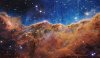
What blows my mind is that those wider blobs are entire galaxies. The scale here is just incomprehensible.The first scientific pics from JWST were made public today. They look amazing
JWST:

Stephan’s Quintet

Southern Ring Nebula

some pretty amazing shots.
They basically said the “deep field” shot at the top they took one morning. It would have taken Hubble days to weeks.

Brainonska511
Lifer
Not only that, but if I recall another article, there is a gravitational lens effect going on, so some of those galaxies are behind the central point - objects so massive that the light is literally bending around.What blows my mind is that those wider blobs are entire galaxies. The scale here is just incomprehensible.
thilanliyan
Lifer
I don't think this is mentioned in the bible...must be a liberal hoax 😛The Carina nebula one really blew me away
thilanliyan
Lifer
God only has time for one set of dumb asses 😀Things like this are also what make me essentially certain that other life exists in the universe. There are this many GALAXIES in something the size of a grain of sand in the night sky then just how many zillion opportunities are there for life to arise?

dank69
Lifer
Imgur all over it:


Amused
Elite Member

Fenixgoon
Lifer
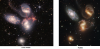
Resolution aside, JWST uses infrared light rather than visible light, so there are details and information that simply can't be captured by Hubble because its limited to the visible spectrum.For those of us that don't know astronomy, what is the main benefit? It is certainly less grainy then Hubble, but the images aren't drastically different to the lay person.
I think this is also beneficial as the further back we look in space/time, the more redshift occurs - to the point that some light will change to IR
[DHT]Osiris
Lifer
Speed of information gathering accelerates the scientific process. Increased resolution provides more information, and the power gap makes it so previously unobservable things will be observable. A lot of this stuff is just 'fan service' for the layman.For those of us that don't know astronomy, what is the main benefit? It is certainly less grainy then Hubble, but the images aren't drastically different to the lay person.
View attachment 64366
Just wait until they do a 2 week exposure of one of the hubble deep fields.

Paratus
Lifer
What Fenix said, but also JWST can take this pictures much faster than Hubble due to how much more light it captures. Also take a good look at both pictures and realize how many more stars there are in the background of the JWST image. It's just way more sensitive.For those of us that don't know astronomy, what is the main benefit? It is certainly less grainy then Hubble, but the images aren't drastically different to the lay person.
View attachment 64366

DarthKyrie
Golden Member
To my naked eye in the Hubble picture, there are only about 6 maybe 7 galaxies in that portion of the sky. James Webb's picture shows me that I was highly mistaken there are hundreds of galaxies in that portion of the sky.For those of us that don't know astronomy, what is the main benefit? It is certainly less grainy then Hubble, but the images aren't drastically different to the lay person.
View attachment 64366
These photos technically isn’t what JWST captures. It’s the scientists that match up each frequency to assign colours that we’re accustomed to seeing.For those of us that don't know astronomy, what is the main benefit? It is certainly less grainy then Hubble, but the images aren't drastically different to the lay person.
But being this is an infrared camera, the signal it’s capturing has been travelling for so long that it’s no longer in the visible light spectrum. So even though the images “look” the same, far different information being captured here. As empty space is, cosmic dust actually obstructs visible light. So JWST will be able to peer through densely packed globular clusters and detect stuff Hubble just can’t see.

Jaskalas
Lifer
What Fenix said, but also JWST can take this pictures much faster than Hubble due to how much more light it captures. Also take a good look at both pictures and realize how many more stars there are in the background of the JWST image. It's just way more sensitive.
Heheh... you said stars.
For our audience, those are galaxies. Most those points of light are billions of stars, each.
Jaskalas
Lifer
That single deep field image was worth the entire cost of the JWST, for how it will advance our understanding of physics. The gravitational lensing will hold a lot of information for how space-time works on that scale, at those distances. Science got a big win today, even if it'll take decades and AI to work the problem. Lot more information in that image than people realize.


woolfe9998
Lifer
First of all, I am happy the thing works! It was over-budget and time to begin with. Then when it launched, there was talk of a high probability of it failing because it is so much more complex than Hubble and a failure of any one of hundreds of components would cause a total failure, with no ability to repair in space. Props to NASA on successfully launching that beast and getting it to actually work. I think people often forget how difficult these achievements are.
Second of all, yeah those images are spectacular. If that deep field image only took a few hours of exposure time, imagine what they could do with days. We're going to be able to image galaxies much further out in the universe with this than we ever could with Hubble. Not just because JWST is larger, but because it is infra-red, and all that light travelling billions of light years has red-shifted.
Second of all, yeah those images are spectacular. If that deep field image only took a few hours of exposure time, imagine what they could do with days. We're going to be able to image galaxies much further out in the universe with this than we ever could with Hubble. Not just because JWST is larger, but because it is infra-red, and all that light travelling billions of light years has red-shifted.
Paratus
Lifer
Ok this gives a good idea of the of how far zoomed JWST can see.
dank69
Lifer
Didn't some space debris hit it soon after setup? I seem to remember an article saying the impact would shorten its useful lifetime.First of all, I am happy the thing works! It was over-budget and time to begin with. Then when it launched, there was talk of a high probability of it failing because it is so much more complex than Hubble and a failure of any one of hundreds of components would cause a total failure, with no ability to repair in space. Props to NASA on successfully launching that beast and getting it to actually work. I think people often forget how difficult these achievements are.
Second of all, yeah those images are spectacular. If that deep field image only took a few hours of exposure time, imagine what they could do with days. We're going to be able to image galaxies much further out in the universe with this than we ever could with Hubble. Not just because JWST is larger, but because it is infra-red, and all that light travelling billions of light years has red-shifted.
Edge mirror segment. So doesn’t affect image quality at all. If it was a middle segment and a far larger particle hitting, then uh ohDidn't some space debris hit it soon after setup? I seem to remember an article saying the impact would shorten its useful lifetime.
[DHT]Osiris
Lifer
'Shorten' meaning 'the fuel we burned to correct the attitude means we get less future corrections'. That could be shortening it by a few weeks, or more.Didn't some space debris hit it soon after setup? I seem to remember an article saying the impact would shorten its useful lifetime.
Amused
Elite Member
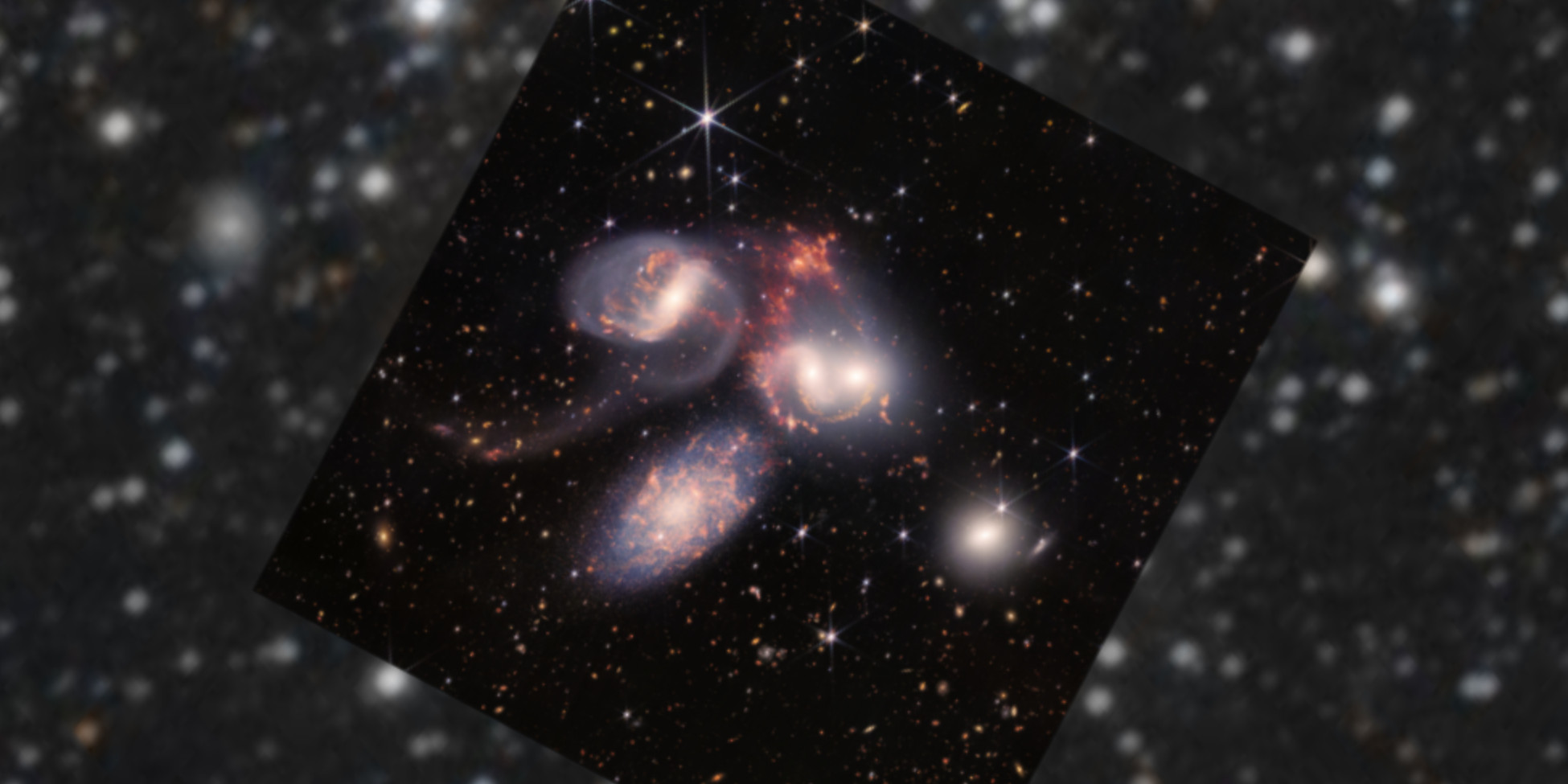
OK, this is huge. Go play with this. Zoom in and out and use the opacity slide to see just how much more the JWST can see.
 web.wwtassets.org
Explore JWST’s first images in full resolution!
Pan and zoom into the new images on a sky map using AAS WorldWide Telescope.
Last edited:
Can’t wait when they do detailed scans of great sections of the night sky. Can spend hours just scrolling and zooming inOK, this is huge. Go play with this. Zoom in and out and use the opacity slide to see just how much more the JWST can see.

Explore JWST’s first image in full resolution!
Pan and zoom into the new image on a sky map using AAS WorldWide Telescope.
TRENDING THREADS
-
 Discussion Zen 5 Speculation (EPYC Turin and Strix Point/Granite Ridge - Ryzen 9000)
- Started by DisEnchantment
- Replies: 25K
-
Discussion Intel Meteor, Arrow, Lunar & Panther Lakes + WCL Discussion Threads
- Started by Tigerick
- Replies: 24K
-
 Discussion Intel current and future Lakes & Rapids thread
- Started by TheF34RChannel
- Replies: 24K
-

-
