

Analog
Lifer
The atmosphere directly above the fault zone which produced Japan's recent devastating earthquake heated up significantly in the days before the disaster, a study has shown.
Before the March 11 earthquake, the total electron content in a part of the upper atmosphere, called the ionosphere, increased dramatically over the earthquake's epicentre, reaching a maximum three days before the quake struck.
It is believed that in the days before an earthquake, the stresses on geological faults in the Earth's crust causes the release of large amounts of radon gas.
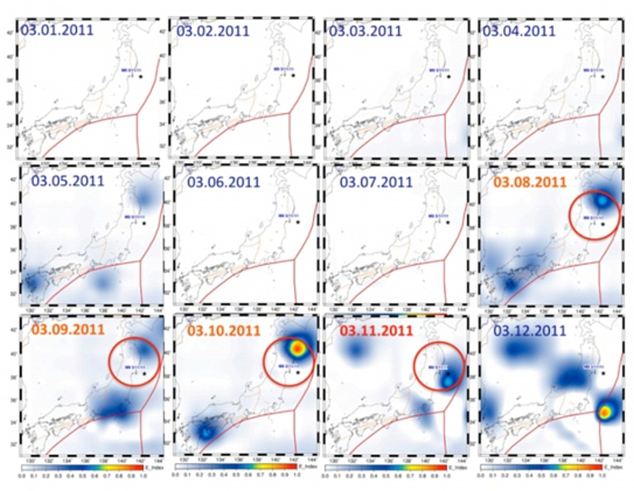 Satellite images showing changes in the heat of the atmosphere above the epicentre of the March 11 earthquake between March 1 and March 12. The total electron content in the ionosphere increased dramatically before the quake
This radioactive gas ionises the air, giving it a charge, and since water is polar it is attracted to the charged particles in the air.
This then leads to the water molecules in the air condensing (turning into liquid) - a process which releases heat.
Before the March 11 earthquake, the total electron content in a part of the upper atmosphere, called the ionosphere, increased dramatically over the earthquake's epicentre, reaching a maximum three days before the quake struck.
It is believed that in the days before an earthquake, the stresses on geological faults in the Earth's crust causes the release of large amounts of radon gas.
This radioactive gas ionises the air, giving it a charge, and since water is polar it is attracted to the charged particles in the air.
This then leads to the water molecules in the air condensing (turning into liquid) - a process which releases heat.
It was this excess heat which was observed in the form of infrared radiation in recordings taken three days before the deadly magnitude 9 earthquake struck.


