I'd wish, it was a whopping 33 points and took around 20 minutes to complete. Idle SOC consumption is 2.9W according to ThrottleStop, IB isn't able to do much at all with just 2.5W extra for its cores. Seems like a lot of improvements went into that with Haswell and Broadwell.40% of that.

-
We’re currently investigating an issue related to the forum theme and styling that is impacting page layout and visual formatting. The problem has been identified, and we are actively working on a resolution. There is no impact to user data or functionality, this is strictly a front-end display issue. We’ll post an update once the fix has been deployed. Thanks for your patience while we get this sorted.
You are using an out of date browser. It may not display this or other websites correctly.
You should upgrade or use an alternative browser.
You should upgrade or use an alternative browser.
Intel's Fastest Processor Ever.....
Page 2 - Seeking answers? Join the AnandTech community: where nearly half-a-million members share solutions and discuss the latest tech.

witeken
Diamond Member
Intel's Fastest Processor Ever.....and the Burst Mode Trick.
Hans.
If Intel were marketing their Core M processors like Qualcomm does, they could say it is a 4.3GHz CPU 😀.
Edit: I only read the first post, the IE thing makes more sense than some secret ultra high turbo.
Last edited:

TuxDave
Lifer
The benchmark can't see this either. It measures the "process-time"
when the processor is active and running at maximum frequency.
The benchmark doesn't measure the time when the processor is idle
and cooling down. Therefor you get a benchmark result as if the
processor is running always at maximum burst frequency.
I pity the benchmark that uses core clock cycles as a method of time keeping.
Definitely agree. Piroko's evidence shows at least one example of the ridiculousness of limiting TDP on a chip not designed for that limited TDP.You can measure unhalted and halted clocks with the performance counters and apply them accordingly.
IMO it would have been better if they were both compared at their defaults to emphasize the power savings of the newer processor.
For instance a car manufacturer making an economical car with 1BHP engine would possibly show how good mileage is, not take a Ferrari and set it to also run at 1BHP so it runs like a dog then possibly even say the economical car runs up to 50% faster than a "comparable" Ferrari.
Advertise it for what it is, an excellent low powered CPU with great battery life. Wonder how many people are going to miss the fine print and expect it to run 50% faster than the i5-4302Y it was compared to.
My humble g3258 does 124.5 in firefox and 63.1 in IE 11. Beat that 😛
But yeah I'm wondering if one of those tests was done in FF vs IE, cuz IE is twice as fast on this test. There is no conspiracy, IE is just much better built for JS, and not in benchmark only, My friend had a google book with 500 pages and like 100's of comments on each page, and it loaded like 100x faster on IE than on Chrome/FF
But yeah I'm wondering if one of those tests was done in FF vs IE, cuz IE is twice as fast on this test. There is no conspiracy, IE is just much better built for JS, and not in benchmark only, My friend had a google book with 500 pages and like 100's of comments on each page, and it loaded like 100x faster on IE than on Chrome/FF
Last edited:
monstercameron
Diamond Member
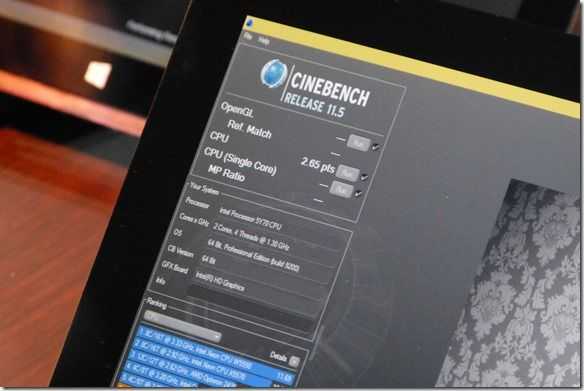
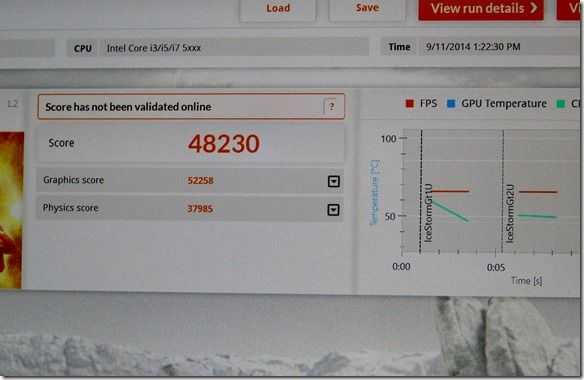
some perspective:
http://www.umpcportal.com/2014/09/q...Feed:+carrypadfullfeed+(UMPCPortal+Full+Feed)Note that these are the scores from a high-end 6W TDP Core M 5Y70. The 4.5W TDP Core M SoCs won’t perform this well and in a product with a less-than-perfect thermal design there could be heat issues that prevent Turbo Boost reaching these high levels.
GPU performance needs to be further tested and long-term gaming could impact Turbo Boost capability.
This is the best you’ll see from Core M at 2.8Ghz but it’s important to remember that this is best-of-Core M right now. I’m going to be pushing to get the new Lenovo Helix 2 in for testing so at that point we’ll get our first real-product results.
All Core M chips have 4.5W TDP. 25% above TDP (6W) is PL2 Turbo. Lots of denial in this thread. 🙂
The PL3 boost state allows the most amount of power that won't damage the system's battery, used for very short spikes as needed - the kind of time spans that are measured in milliseconds. PL2 is the standard burst limit, and PL1 represents the long-term system limit of sustainable power delivery. If necessary, duty cycle throttling can turn blocks of the processor on or off to minimize power usage and heat generation.
monstercameron
Diamond Member
Its unreal every time A TECH COMPANY does something good the tin foil hats come out. -snip-
FTFY.

Eug
Lifer
All Core M chips have 4.5W TDP. 25% above TDP (6W) is PL2 Turbo. Lots of denial in this thread. 🙂
6 watts is 33% higher than 4.5 watts.
FTFY.
The Apple thread is putting their faith in the gospel of Apple that A8 at least delivers what the powerpoint promises. So no, not any tech company.
Intel's Fastest Processor Ever.....and the Burst Mode Trick.
The tiny "4.5W" Core M seemingly humiliates the previous record holders,
including the Core i7 4790 Devil's Canyon running at a burst speed of 4.4GHz.

source

source
I guess we will see many claim that Intel's new 14nm process is now 20
times more power efficient as Intel's 22nm process or similar wild claims.
(Even though Intel itself never made such outrageous claims of course)
Those who know how Intel's Burst Mode work will understand how you
can produce these kind of miraculous benchmark result. They will wonder
instead if the new F-stepping can now officially be boosted to 4+GHz
for very short periods of time.
Here's explained how it works:

source
The figure at the bottom right with the three blue spikes explains it all.
The blue spikes mean that the processor is running at maximum frequency
while during the intervals the processor is basically halted.
Say with a single active core Broadwell at 14nm, running a 4+GHz requires
~18 Watt (would be very good!).
A power dissipation of 4.5 Watt would mean that the processor is bursting
at maximum frequency during 25% of the time and idle during 75% of the
time to cool down.
You can't measure this at the outside of the package because the on-
package voltage regulators and capacitors take care of the large power
and current spikes. From the outside you only see a processor using
4.5 Watt.
The benchmark can't see this either. It measures the "process-time"
when the processor is active and running at maximum frequency.
The benchmark doesn't measure the time when the processor is idle
and cooling down. Therefor you get a benchmark result as if the
processor is running always at maximum burst frequency.
Hans.
That is a lot of Potatoes into your brownies, the solution of this mystery is a lot simpler ... the number used in those chart use different Web Browser, Surface 3 pro ran with Chrome, while I used Internet Explorer ... IE is a lot faster at Sunspider than Chrome. IE is as well optimized as Safari for Sunspider, it makes it the right reference for this comparison.
A Surface pro 3 using IE gets around 110 to 130 depending of the models, The 4Ghz part is a nice piece of Science fiction, I wish I could get this in 6W (what the demo setting was), but I think this will be for an other day.
Francois
That is a lot of Potatoes into your brownies, the solution of this mystery is a lot simpler ... the number used in those chart use different Web Browser, Surface 3 pro ran with Chrome, while I used Internet Explorer ... IE is a lot faster at Sunspider than Chrome. IE is as well optimized as Safari for Sunspider, it makes it the right reference for this comparison.
A Surface pro 3 using IE gets around 110 to 130 depending of the models, The 4Ghz part is a nice piece of Science fiction, I wish I could get this in 6W (what the demo setting was), but I think this will be for an other day.
Francois
Then why do a deceitful benchmark where almost every other setup is running anything besides IE, and the Core M is using this web browser?

ShintaiDK
Lifer
Then why do a deceitful benchmark where almost every other setup is running anything besides IE, and the Core M is using this web browser?
The same applies when people cheer on Apples performance. Different browser as well.
anand said he used IE 11 for the sp3 i3 preview
http://www.anandtech.com/show/8287/first-look-the-799-microsoft-surface-pro-3-with-core-i3
see the last comment on page 1
http://www.anandtech.com/comments/8...9-microsoft-surface-pro-3-with-core-i3/411272
i am going to run sunspider on my ie11 and chrome browser tonight and post back
http://www.anandtech.com/show/8287/first-look-the-799-microsoft-surface-pro-3-with-core-i3
see the last comment on page 1
http://www.anandtech.com/comments/8...9-microsoft-surface-pro-3-with-core-i3/411272
i am going to run sunspider on my ie11 and chrome browser tonight and post back
anand said he used IE 11 for the sp3 i3 preview
http://www.anandtech.com/show/8287/first-look-the-799-microsoft-surface-pro-3-with-core-i3
see the last comment on page 1
http://www.anandtech.com/comments/8...9-microsoft-surface-pro-3-with-core-i3/411272
i am going to run sunspider on my ie11 and chrome browser tonight and post back
here is the sun spider 1.0.2 score of Surface 3 Pro Core i7 ...
pic.twitter.com/tneXKv7xph
Then why do a deceitful benchmark where almost every other setup is running anything besides IE, and the Core M is using this web browser?
Nothing deceitful ... using the default browser of the platform.
Take it easy.

Nothingness
Diamond Member
I'm not a hater, and I think Core M is great, but I will wait for benchmarks not selected by Intel 😉so net net the conclusion is CORE M is still ridiculously fast and a marvel of engineering. haters gonna hate

Nothingness
Diamond Member
Yes, it really looks sexy, I'm eagerly waiting for laptops using it 😛agreed. still gonna get one though
TRENDING THREADS
-
 Discussion Zen 5 Speculation (EPYC Turin and Strix Point/Granite Ridge - Ryzen 9000)
- Started by DisEnchantment
- Replies: 25K
-
Discussion Intel Meteor, Arrow, Lunar & Panther Lakes + WCL Discussion Threads
- Started by Tigerick
- Replies: 25K
-
 Discussion Intel current and future Lakes & Rapids thread
- Started by TheF34RChannel
- Replies: 24K
-

-
