• We’re currently investigating an issue related to the forum theme and styling that is impacting page layout and visual formatting. The problem has been identified, and we are actively working on a resolution. There is no impact to user data or functionality, this is strictly a front-end display issue. We’ll post an update once the fix has been deployed. Thanks for your patience while we get this sorted.

Intel unveils Knights Corner - 1 teraflop chip

Analog

Lifer
knightscorner.jpg


(PhysOrg.com) -- Rajeeb Hazra, Intel’s general manger of technical computing, surprised a group attending this year’s SC11 conference, at a steak house in Seattle this past week, by holding up a single chip and declaring "It's not a PowerPoint, it's a real chip." He was referring to the processing chip Intel has created that is capable of performing at 1 teraflops, called the Knights Corner, it is, unlike its rivals, based on the x86 architecture that still sits at the base of most desktop machines in use today.

The chip attains its high processing speeds by making use of multiple processors, or a Many Integrated Core - MIC architecture; in this case, more than 50, which pretty much puts to shame the quad-core technology being advertised for use in computers used by regular people. The new chip will first be installed in a machine at the Texas Advanced Computing Center, which expects the system to run at 10 petaflops.

http://www.physorg.com/news/2011-11-intel-unveils-knights-corner-.html
 
Last edited by a moderator:
Would it even be that fast in our desktops?

No matter how godly fast it is, it'd be severely bottlenecked by HDD.
 
Would it even be that fast in our desktops?

My opinion, technology has been stagnated for the past 3 or 4 years. Unlike in the 1990s, we are not seeing speeds double every year.

Maybe this new chip will bring with it a revolution in technology?

Dual, quad and hexacore are all small time improvements. Its time we see some 25 core or 30 core chips with a gig of cache on them. 50 cores on a single chip? That is pretty impressive. I will be more impressed when desktops get 10, 12,,, 20 core cpus.
 
I agree. Doesn't matter how fast the chip is, the hdd will definitely slow it down.

These are probably focused on HPC applications. In this case, it is largely assumed that the RAM at the nodes will be sufficient to hold the program and its data otherwise the delay in communicating with disk across the nodes would be incredibly large. The main bottleneck in this case becomes the time it takes to communicate data across different nodes that do not share the same physical memory.
 
About multiple cores on a chip, it has been the right way to go, but it's going about it all wrong. Need to have both specialized cores and generalized cores depending upon the workload. For x86 chips, we've had enough years to figure out more specialized cores to increase efficiency in computing tasks. The only "specialization" we have is basically an ALU and a FPU with our generalized cores. While these are great, they have only been the tip of the iceberg and no one has stepped forward to do more specialized chips for specialized functions.
 
My opinion, technology has been stagnated for the past 3 or 4 years. Unlike in the 1990s, we are not seeing speeds double every year.

We never saw speeds "double" every year. It only seems like that. If we really had doubling then you could pick any year and speed, say 1990 and 66 MHz and quickly see that it dont hold water. By 1995 we'd have had 2GHz. It actually took well over 10 years to go from 66 to 2000. The doubling was every 18 months or so.

And if you look at passmark charts you can see that scores are exploding now as much as they ever did. The new SB-E scores 3 times an old extreme edition Q9xxx. And the Q9xxx is still faster than what most people want or need. We're still doubling every 18 months.
 
About multiple cores on a chip, it has been the right way to go, but it's going about it all wrong. Need to have both specialized cores and generalized cores depending upon the workload. For x86 chips, we've had enough years to figure out more specialized cores to increase efficiency in computing tasks. The only "specialization" we have is basically an ALU and a FPU with our generalized cores. While these are great, they have only been the tip of the iceberg and no one has stepped forward to do more specialized chips for specialized functions.

I fear you vastly underestimate the costs involved in pursuing what you propose.

Would it be superior? Yes, no question.

Would it be more expensive to develop, implement, test, verify, bin, etc? Yes, no question.

Would it make software development all the more challenging, expensive, complicated, etc? Yes, no question.

The path we have been on is not one taken for its technical superiority above all others, but for its superiority in terms of performance and cost-effectiveness.

KIS = Keep It Simple (sometimes there is an extra S at the end 😉)

In engineering, business management, product development, sales, etc you have to do things that make sense in all regards, not just the things that make sense for one and damns all the others.

Its one thing if you are vertically integrated as a business, owning the chip to the platform to the software like Apple, its quite another to simply be a cog in an otherwise complex multi-business chain market where the success of your product critically depends on convincing other businesses to support your vision.

AMD and their APU's are facing the same uphill battle. Nvidia took the obvious route and elected to own both the hardware and software sides of the equation with CUDA and Tegra.

NVDA_CUDAforARM_TegraTesla_.jpg
 
We never saw speeds "double" every year. It only seems like that. If we really had doubling then you could pick any year and speed, say 1990 and 66 MHz and quickly see that it dont hold water. By 1995 we'd have had 2GHz. It actually took well over 10 years to go from 66 to 2000. The doubling was every 18 months or so.

And if you look at passmark charts you can see that scores are exploding now as much as they ever did. The new SB-E scores 3 times an old extreme edition Q9xxx. And the Q9xxx is still faster than what most people want or need. We're still doubling every 18 months.

What is missing right now, is that we can't utilize the power except in a few situations. I could have a 64 core SB, and it would only benefit me over what I have now in a few situations.

Now, if I had a 64Ghz SB, it would benefit me in many, many more situations (but still there are bottlenecks everywhere else), but it wouldn't a 1:1 improvement based on clock speed because the rest of my system would still be the same.
 
These are probably focused on HPC applications.

Yep, and whatever that can support many threads, correction, benefit from many threads.

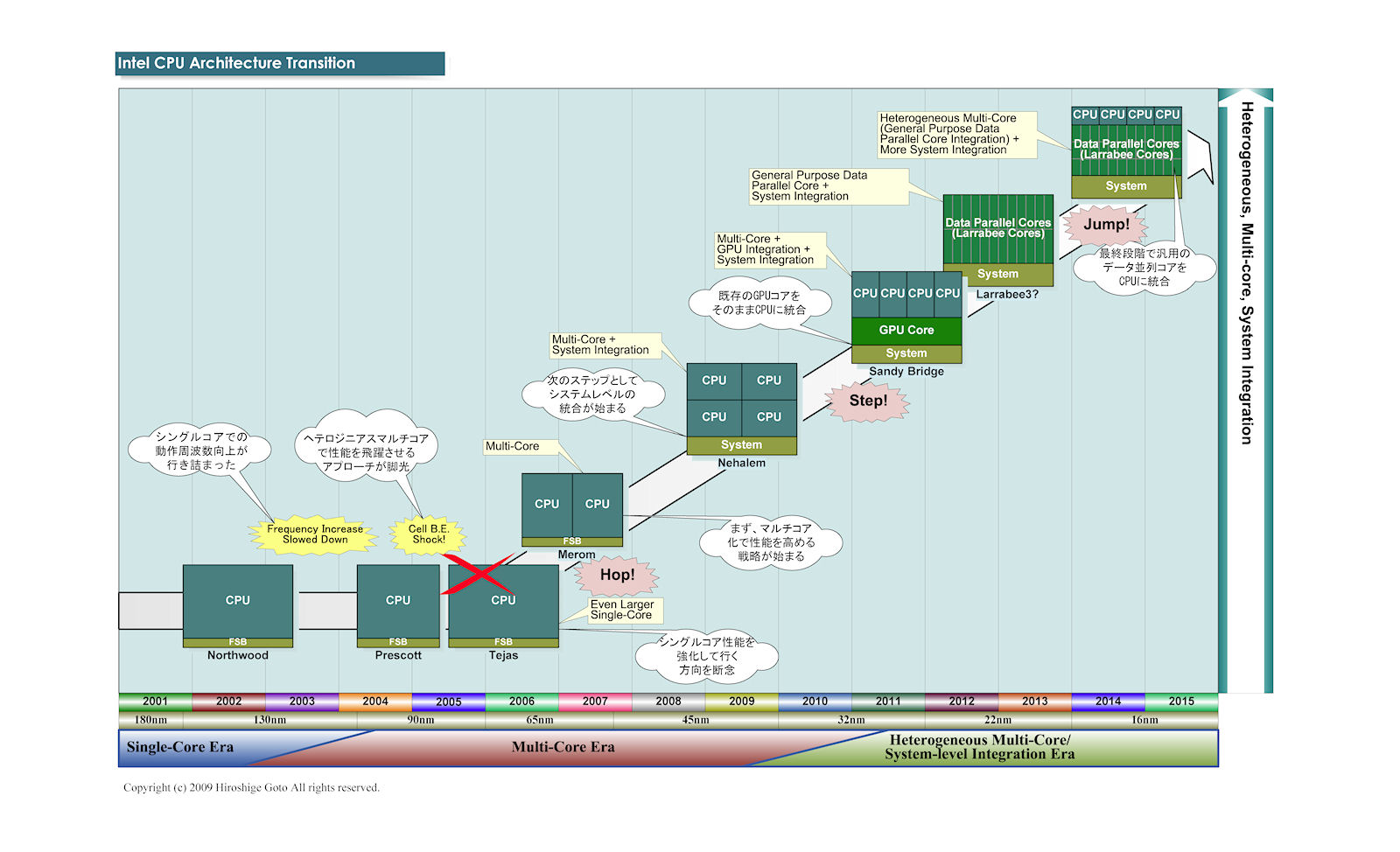
For those that don't know, the predecessor is Knights Ferry aka the original Larrabee project chip. Knights Corner takes out the unnecessary graphics portion like the texture units and repurposes it for compute.

They seemed to have changed the form factor from Video card format/PCI Express to CPU format/QuickPath Interconnect.
 
They seemed to have changed the form factor from Video card format/PCI Express to CPU format/QuickPath Interconnect.

Of course they changed since they fell flat on their faces. This newer KC looks to be good for HPC stuff and but not the typical desktop user.
 
They seemed to have changed the form factor from Video card format/PCI Express to CPU format/QuickPath Interconnect

That seems like a good idea on their part. Also seperates their products from Nvidia products (Tesla). It will be nice to have a dual socket 2011 with a IB Xeon in one and a KC in the other. 🙂

Anyone specualte on the price? Similar to Tesla (1500-2500) range?
 
is this the sort of technology we can expect on desktops after Ivy Bridge ??
(serious question)

There is speculation of sorts along the lines of thinking that Haswell or the next architecture (the tock after 14nm Rockwell's tick) will be some manner of a heterogenous architecture with a bevy of these little cores present to handle the exceedingly well-threaded applications (like VM and so on).

kaigai-02.jpg


kaigai1.jpg


kaigai5.jpg
 
Back
Top