Discussion Intel Meteor, Arrow, Lunar & Panther Lakes + WCL Discussion Threads

Page 451 - Seeking answers? Join the AnandTech community: where nearly half-a-million members share solutions and discuss the latest tech.

Tigerick

Senior member
Apr 1, 2022
908
828
106
Wildcat Lake (WCL) Preliminary Specs

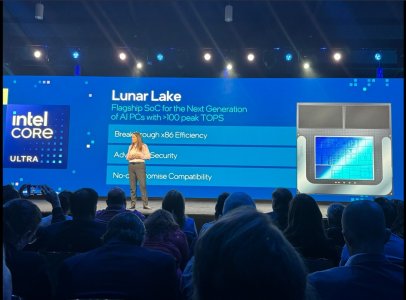
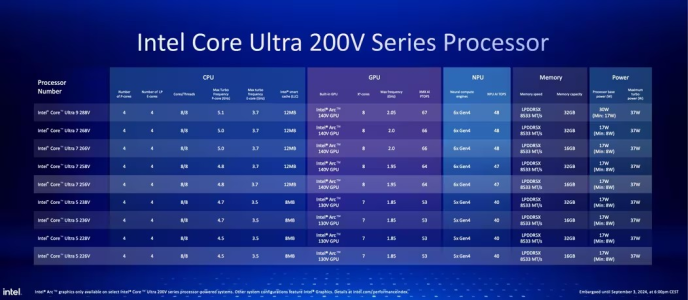
Intel Wildcat Lake (WCL) is upcoming mobile SoC replacing ADL-N. WCL consists of 2 tiles: compute tile and PCD tile. It is true single die consists of CPU, GPU and NPU that is fabbed by 18-A process. Last time I checked, PCD tile is fabbed by TSMC N6 process. They are connected through UCIe, not D2D; a first from Intel. Expecting launching in Q2/Computex 2026. In case people don't remember AlderLake-N, I have created a table below to compare the detail specs of ADL-N and WCL. Just for fun, I am throwing LNL and upcoming Mediatek D9500 SoC.

Intel Alder Lake - NIntel Wildcat LakeIntel Lunar LakeMediatek D9500
Launch DateQ1-2023Q2-2026 ?Q3-2024Q3-2025
ModelIntel N300?Core Ultra 7 268VDimensity 9500 5G
Dies2221
NodeIntel 7 + ?Intel 18-A + TSMC N6TSMC N3B + N6TSMC N3P
CPU8 E-cores2 P-core + 4 LP E-cores4 P-core + 4 LP E-coresC1 1+3+4
Threads8688
Max Clock3.8 GHz?5 GHz
L3 Cache6 MB?12 MB
TDP7 WFanless ?17 WFanless
Memory64-bit LPDDR5-480064-bit LPDDR5-6800 ?128-bit LPDDR5X-853364-bit LPDDR5X-10667
Size16 GB?32 GB24 GB ?
Bandwidth~ 55 GB/s136 GB/s85.6 GB/s
GPUUHD GraphicsArc 140VG1 Ultra
EU / Xe32 EU2 Xe8 Xe12
Max Clock1.25 GHz2 GHz
NPUNA18 TOPS48 TOPS100 TOPS ?


PPT1.jpg
PPT2.jpg
PPT3.jpg


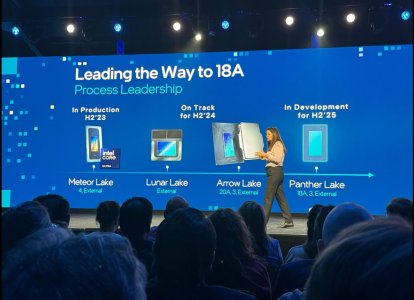
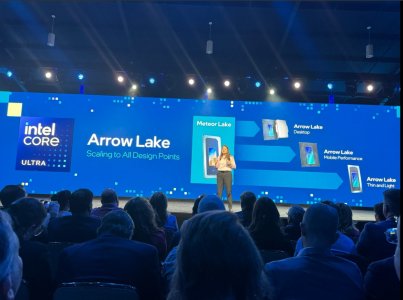
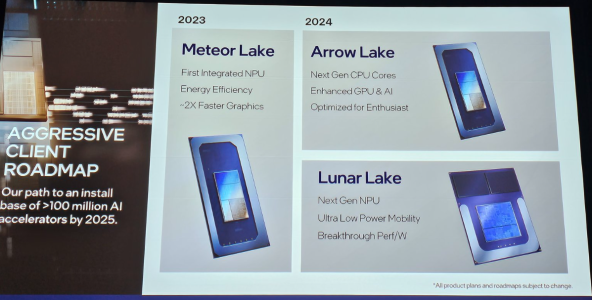
As Hot Chips 34 starting this week, Intel will unveil technical information of upcoming Meteor Lake (MTL) and Arrow Lake (ARL), new generation platform after Raptor Lake. Both MTL and ARL represent new direction which Intel will move to multiple chiplets and combine as one SoC platform.

MTL also represents new compute tile that based on Intel 4 process which is based on EUV lithography, a first from Intel. Intel expects to ship MTL mobile SoC in 2023.

ARL will come after MTL so Intel should be shipping it in 2024, that is what Intel roadmap is telling us. ARL compute tile will be manufactured by Intel 20A process, a first from Intel to use GAA transistors called RibbonFET.


LNL-MX.png
 

Attachments

  • PantherLake.png
    PantherLake.png
    283.5 KB · Views: 24,034
  • LNL.png
    LNL.png
    881.8 KB · Views: 25,527
  • INTEL-CORE-100-ULTRA-METEOR-LAKE-OFFCIAL-SLIDE-2.jpg
    INTEL-CORE-100-ULTRA-METEOR-LAKE-OFFCIAL-SLIDE-2.jpg
    181.4 KB · Views: 72,435
  • Clockspeed.png
    Clockspeed.png
    611.8 KB · Views: 72,321
Last edited:

DavidC1

Platinum Member
Dec 29, 2023
2,003
3,148
96
Dynamic splitting of threads per core. 2x IPC of RPL. Says this was from a face-to-face meeting with a verified Intel employee aware of the project.
2x over Raptorlake might not be super impressive if you consider the likely clock reduction and that it's probably going to be a late 2027 product. We still have to consider how Arctic Wolf does. If it achieves another 30% SpecInt gain then it'll be just 50% difference and Arctic Wolf should be 2026, a year earlier. Then if you consider a year later Royal Core Arctic Wolf's successor can pull off another 30% then what's the point of Royal Core really?

One Micron Optane presentation talked about how DRAM is a freight train that destroyed all the potential alternatives, most likely because of the immense intellectual, financial and manpower being already into advancing DRAM. At certain point it is preferred to continue an already existing technology because potential execution pitfalls make it safer to stay with what's already known.

There's a fine balance between how much revolution you can put into a product and the ability to execute. If you are going to take big risks then the reward better be huge.

By the way earlier MLID videos said Pat preferred promoting less revolutionary projects in favor of more guaranteed execution.
 
Last edited:
  • Like
Reactions: buttersdeif

jdubs03

Golden Member
Oct 1, 2013
1,328
929
136
2x over Raptorlake might not be super impressive if you consider the likely clock reduction and that it's probably going to be a late 2027 product. We still have to consider how Arctic Wolf does. If it achieves another 30% SpecInt gain then it'll be just 50% difference and Arctic Wolf should be 2026, a year earlier. Then if you consider a year later Royal Core Arctic Wolf's successor can pull off another 30% then what's the point of Royal Core really?

One Micron Optane presentation talked about how DRAM is a freight train that destroyed all the potential alternatives, most likely because of the immense intellectual, financial and manpower being already into advancing DRAM. At certain point it is preferred to continue an already existing technology because potential execution pitfalls make it safer to stay with what's already known.

There's a fine balance between how much revolution you can put into a product and the ability to execute. If you are going to take big risks then the reward better be huge.

By the way earlier MLID videos said Pat preferred promoting less revolutionary projects in favor of more guaranteed execution.
In the video, it was said to clock at 5.5/6.0. So not much different than ARL. IMO, they have the IP for it already, it’s likely they’ll fold in concepts throughout the next several years. I think Nova Lake will give us the first real indication of the outcome of this decision.
 
  • Like
Reactions: buttersdeif

DavidC1

Platinum Member
Dec 29, 2023
2,003
3,148
96
In the video, it was said to clock at 5.5/6.0. So not much different than ARL. IMO, they have the IP for it already, it’s likely they’ll fold in concepts throughout the next several years. I think Nova Lake will give us the first real indication of the outcome of this decision.
I wouldn't put full trust in MLID videos.

He claimed 19-28% for Lion Cove or something? And something also ridiculous for Zen 5? Him and many others also lavished praise for RDNA3. And what was the joke? "38% for Int and 68% on Skymont for FP is a decent improvement according to MLID sources"? I can't say he's totally wrong in everything either but when it comes to details he has been. RDNA3 misunderstanding tells me that him, Adored, and others do not have a full understanding of architecture.

This is also if Intel lives through their financial situation, which I believe less and less every day.
 
  • Like
Reactions: Tlh97 and del42sa

jdubs03

Golden Member
Oct 1, 2013
1,328
929
136
Yea that’s fair. I certainly don’t hold his words as 100 pct true. But I’d hope he actually did discuss with this person what he said he did. I mean over on Reddit we’ve seen my images that I posted where the info stated about Royal Core sounded very similar.

I get you on the improvement with Skymont though, if there is any silver lining it’s that IPC improvement is massive. The e-core side has clearly innovated more than the p-core recently and if given the room they will probably surpass them; and is probably why p-core is trying to block it.
 
  • Like
Reactions: Tlh97 and DavidC1

511

Diamond Member
Jul 12, 2024
5,008
4,522
106
Pat Gelsinger is definitely not the cause. He took over a company that was already ruined by the two biggest idiots in history: Brian Krzanich & Bob Swan.

The first one, Brian Krzanich, was responsible for all the 14+++++ debacle.

The second one, Bob Swan, was responsible for all the 10++++ mess.

Both these idiots made sure Intel will never be the real Intel again. And thats a fact. I can't envision a scenario where Intel will be the same old power house it used to be. It's adapting, changing, trying to shed baggage. Hopefully, it may evolve into something better in the future.
Brian was responsible for 14nm+++ and 10nm++ he cut the funding for nodes Ann Keller said in a interview that funding was not generous during BK/Swan
 

del42sa

Member
May 28, 2013
185
331
136
I know many here aren’t fans here of MILD, but he has commented on the Royal Core cancellation theme. If what he’s saying in the video is legit, it sounded pretty cool:
Dynamic splitting of threads per core. 2x IPC of RPL. Says this was from a face-to-face meeting with a verified Intel employee aware of the project.
he is a clown who is desperate for clicks ...

Intel confirms Core Ultra 200 Arrow and Lunar Lake not affected by “Vmin Shift Instability Issue”
 

Kocicak

Golden Member
Jan 17, 2019
1,177
1,232
136
The "clown" has a really disappointing information up:

If true and the quote of Mr. Gelsinger is correct, I really start to doubt that he is fit for the job... :(
 

jdubs03

Golden Member
Oct 1, 2013
1,328
929
136
I’ll say this. If I were any of the competitors I’d be looking to snap up AheadComputing pretty quickly. I mean Apple has $230bn in cash, seems like a no-brainer. Only thing is the IP isn’t there, just the concept to be reworked.
 
  • Like
Reactions: Racan

del42sa

Member
May 28, 2013
185
331
136
If true and the quote of Mr. Gelsinger is correct, I really start to doubt that he is fit for the job... :(
He is doing right thing. Intel is not in good shape and there´s no time to waste money on complicated exotic projects (e.g. Ponte Vecchio/Rialto Bridge/Rentable Unit/ etc.) History proves that this was the case with others as well ( Bulldozer with speculative multithreading / Nvidia Denver core /DEC Alpha 21464 )
 
Last edited:
  • Like
Reactions: buttersdeif

DokiDoki

Member
Aug 21, 2024
47
77
46
Engineering teams come up with novel ideas all the time; few of them end up being seriously considered, and even fewer end up being incorporated in the final product. There are multiple angles at play from concept to execution.

It is absurd to think that getting your ideas shot down is the motivating reason why you would leave a company, especially when the company is in trouble as is.

Making content out of second-hand "knowledge" about rumours and gossiping is even more pathetic.
 

jdubs03

Golden Member
Oct 1, 2013
1,328
929
136
Engineering teams come up with novel ideas all the time; few of them end up being seriously considered, and even fewer end up being incorporated in the final product. There are multiple angles at play from concept to execution.

It is absurd to think that getting your ideas shot down is the motivating reason why you would leave a company, especially when the company is in trouble as is.

Making content out of second-hand "knowledge" about rumours and gossiping is even more pathetic.
Keep in mind this project started several years ago. It wasn’t just an embryonic idea here, it was well established and moving apace.

In this instance: Jim Keller left after two years, 4 top senior established architects in their Advanced Architecture Development Group left to start their own company (all of them had over 15 years at Intel). It’s pretty understandable if you invested years of your time and intellect on a project for it to be abruptly cancelled, to then be willing to leave.

Regarding the rumors; usually when there is smoke there is fire, and this is unlikely to just be a coincidence.
 
  • Like
Reactions: SiliconFly

cebri1

Senior member
Jun 13, 2019
373
405
136
So much for the "18A has poor yields" stuff that has been going around recently.
Looks like yields are perfectly on track for HVM mid next year.

DD is only one factor to determine yield tho. But it does look better than what has been leaked. If the node is good, remains to be seen if they can ramp it up rapidly and efficiently because they bet the company on this. They need to recover margins with Diamond, PTL and Clearwater.
 

Kocicak

Golden Member
Jan 17, 2019
1,177
1,232
136
He is doing right thing. Intel is not in good shape and there´s no time to waste money on complicated exotic projects
Sorry, but having extra strong cores that can part their strenght into more threads only when it is needed is a great strategy for any consumer grade workloads you can imagine.

The only positive info in the video was that the project was nearly complete and it could be revived and finished, if Intel leadership comes to their senses again.
 
  • Like
Reactions: igor_kavinski
Jul 27, 2020
28,173
19,203
146
Actually most people credit Bob Swan as being the man responsible for stabilizing the company while the BoD was looking for a real leader. Quickly after Swan became CEO, the stuck pipeline started flowing.
Maybe but the fool couldn't figure out if Jim Keller was the one to listen to rather than the imposter Renduchintala so Keller left out of exasperation. With Keller advising Pat, things could have turned out a LOT different.
 
  • Like
Reactions: SiliconFly

Magio

Member
May 13, 2024
194
231
76
Sorry, but having extra strong cores that can part their strenght into more threads only when it is needed is a great strategy for any consumer grade workloads you can imagine.

The only positive info in the video was that the project was nearly complete and it could be revived and finished, if Intel leadership comes to their senses again.
The real positive from the video is that since it's MLID saying it you can safely assume it's entirely made up.
 

poke01

Diamond Member
Mar 8, 2022
4,553
5,847
106
imo, Lunar Lake should be the start of great laptop SoCs from Intel. I have very high expectations for Lunar. The efficiency and battery life need to be better than Strix Point and X Elite and I believe they will. If what Intel said is true then yeah, reviews will be really interesting and fun.
 

cannedlake240

Senior member
Jul 4, 2024
247
138
76
high expectations for Lunar
Yet again Intel overhyped the new product. What if it isn't actually better than M3 or X elite in battery life, because of much higher ST power or their media engine being less efficient? If they hadn't hyped it so much it'd just be praised as a major step over previous SoCs and AMD apus. But now it has to meet these lofty expectations of matching apple battery longevity
 
Jul 27, 2020
28,173
19,203
146
he is a clown who is desperate for clicks ...
Is it me or is the clown really trying to be known as "LeakJesus" ???

Five years ago, Jim Keller hinted at the concept of Rentable Units!

In 2019, during the Hot Chips conference, I had the privilege of attending an exclusive hot wings event where I met Jim Keller. I recorded his engaging conversation with Raj Kadori, which I highly recommend watching, especially for Keller referring to quantum computers as "pixie dust." I still cherish the badge I wore at the event as a reminder of that memorable interaction.

During our discussion, I gathered the courage to ask Keller about Intel's future CPU architectures, specifically about the possibility of combining threads to enhance IPC (instructions per cycle). Contrary to my expectations, he replied that the approach should be the opposite. I didn't grasp his meaning at the time, as I’m not a CPU architect, but the significance of his comments became clearer this month.

After releasing my videos on the Royal Core project, I spoke with a senior Intel official who wished to clarify the situation. This person confirmed several vital points: First, Beast Lake has indeed been canceled. Second, the decision to halt it was made earlier this year. Third, Keller's departure from Intel was due to internal political conflicts, which ultimately hurt the project. However, the individual emphasized that there were no intrinsic problems with the Royal Core; it was progressing smoothly and achieving its milestones until Pat Gelsinger decided to abruptly terminate it.

Gelsinger reportedly believed that high-performance cores were unnecessary, as he intended for CPUs to serve primarily as connections to GPUs. While this might reflect Nvidia's successful operational model, which currently doesn’t rely on high-performance CPU cores for competitiveness, I believe this perspective may be misguided for Intel. Gelsinger’s decision to terminate the Royal Core project, which was costly and complex, could hinder Intel's positioning as the landscape shifts toward AI.

Despite holding potential in AI and new technologies, Intel has missed crucial opportunities over the years, such as the recent GPU crash, while still investing significantly in underperforming projects like Arc. This misallocation of resources has led to a situation where Gelsinger’s decision to dissolve the Royal Core project may have dire long-term consequences for Intel's competitiveness in CPUs.

Recent reports indicate that many Intel CPU architects have left the company, particularly from the Royal Core design team in Oregon, who were frustrated by the lack of ambition toward high-performance cores and feared they would be relegated to minor projects. There were plans to eventually consolidate E-cores and P-cores into high-performance configurations, which Keller had been advocating for.

I have acquired extensive details about what Jim Keller had been working on that Gelsinger ultimately canceled. Information from various Intel sources corroborates the narrative that Beast Lake was poised to be a groundbreaking architecture. Initially, AOL Lake was to bridge to Royal Core but evolved as Intel faced challenges with hyperthreading.

The launch of Nova Lake in 2026 was anticipated to showcase Royal Core 1.0, featuring Rentable Units, emphasizing massive single-thread performance gains while forgoing hyperthreading. However, with the cancellation of Beast Lake, the fate of Nova Lake and associated designs remains uncertain, particularly regarding features like hyperthreading and Rentable Units.

Beast Lake was expected to reveal a design that utilized 12 performance cores (P-cores) and 16 efficiency cores (E-cores), potentially allowing cores to dynamically manage workloads. This design aimed for unprecedented performance, particularly in gaming, compelling several Intel employees to advocate for a focus on high-performing cores during Gelsinger’s tenure.

Looking forward, the outlook for Intel remains unclear. Rumors suggest Nova Lake might adopt different configurations but might not prioritize high efficiency or IPC anymore. The return of hyperthreading might indicate a shift away from developing advanced architectures like Royal Core, a concern for many looking at Intel's future viability in competitive CPU markets.

Despite cancellation setbacks, I remain cautiously optimistic. The groundwork for the core design is reportedly solid, with potential for future development of Rentable Units still existent. However, reinvestment in the design team and a commitment to advancing core performance will be crucial if Intel hopes to regain its footing under current leadership.
https://www.youtube.com/watch?v=gJcyqZ7NWWU
 

Nothingness

Diamond Member
Jul 3, 2013
3,340
2,430
136
Is it me or is the clown really trying to be known as "LeakJesus" ???

Five years ago, Jim Keller hinted at the concept of Rentable Units!

In 2019, during the Hot Chips conference, I had the privilege of attending an exclusive hot wings event where I met Jim Keller. I recorded his engaging conversation with Raj Kadori, which I highly recommend watching, especially for Keller referring to quantum computers as "pixie dust." I still cherish the badge I wore at the event as a reminder of that memorable interaction.

During our discussion, I gathered the courage to ask Keller about Intel's future CPU architectures, specifically about the possibility of combining threads to enhance IPC (instructions per cycle). Contrary to my expectations, he replied that the approach should be the opposite. I didn't grasp his meaning at the time, as I’m not a CPU architect, but the significance of his comments became clearer this month.

After releasing my videos on the Royal Core project, I spoke with a senior Intel official who wished to clarify the situation. This person confirmed several vital points: First, Beast Lake has indeed been canceled. Second, the decision to halt it was made earlier this year. Third, Keller's departure from Intel was due to internal political conflicts, which ultimately hurt the project. However, the individual emphasized that there were no intrinsic problems with the Royal Core; it was progressing smoothly and achieving its milestones until Pat Gelsinger decided to abruptly terminate it.

Gelsinger reportedly believed that high-performance cores were unnecessary, as he intended for CPUs to serve primarily as connections to GPUs. While this might reflect Nvidia's successful operational model, which currently doesn’t rely on high-performance CPU cores for competitiveness, I believe this perspective may be misguided for Intel. Gelsinger’s decision to terminate the Royal Core project, which was costly and complex, could hinder Intel's positioning as the landscape shifts toward AI.

Despite holding potential in AI and new technologies, Intel has missed crucial opportunities over the years, such as the recent GPU crash, while still investing significantly in underperforming projects like Arc. This misallocation of resources has led to a situation where Gelsinger’s decision to dissolve the Royal Core project may have dire long-term consequences for Intel's competitiveness in CPUs.

Recent reports indicate that many Intel CPU architects have left the company, particularly from the Royal Core design team in Oregon, who were frustrated by the lack of ambition toward high-performance cores and feared they would be relegated to minor projects. There were plans to eventually consolidate E-cores and P-cores into high-performance configurations, which Keller had been advocating for.

I have acquired extensive details about what Jim Keller had been working on that Gelsinger ultimately canceled. Information from various Intel sources corroborates the narrative that Beast Lake was poised to be a groundbreaking architecture. Initially, AOL Lake was to bridge to Royal Core but evolved as Intel faced challenges with hyperthreading.

The launch of Nova Lake in 2026 was anticipated to showcase Royal Core 1.0, featuring Rentable Units, emphasizing massive single-thread performance gains while forgoing hyperthreading. However, with the cancellation of Beast Lake, the fate of Nova Lake and associated designs remains uncertain, particularly regarding features like hyperthreading and Rentable Units.

Beast Lake was expected to reveal a design that utilized 12 performance cores (P-cores) and 16 efficiency cores (E-cores), potentially allowing cores to dynamically manage workloads. This design aimed for unprecedented performance, particularly in gaming, compelling several Intel employees to advocate for a focus on high-performing cores during Gelsinger’s tenure.

Looking forward, the outlook for Intel remains unclear. Rumors suggest Nova Lake might adopt different configurations but might not prioritize high efficiency or IPC anymore. The return of hyperthreading might indicate a shift away from developing advanced architectures like Royal Core, a concern for many looking at Intel's future viability in competitive CPU markets.

Despite cancellation setbacks, I remain cautiously optimistic. The groundwork for the core design is reportedly solid, with potential for future development of Rentable Units still existent. However, reinvestment in the design team and a commitment to advancing core performance will be crucial if Intel hopes to regain its footing under current leadership.
Isn’t it ironic that Jim Keller now does AI accelerators driven by moderately performing and classical RISC-V cores?
 

majord

Senior member
Jul 26, 2015
509
711
136
Yet again Intel overhyped the new product. What if it isn't actually better than M3 or X elite in battery life, because of much higher ST power or their media engine being less efficient? If they hadn't hyped it so much it'd just be praised as a major step over previous SoCs and AMD apus. But now it has to meet these lofty expectations of matching apple battery longevity
The primary driver for better battery life from those products is their ST power, so I don't understand how LnL will achieve these expectations.

The SoC may provide good idle , good HW accelerated video consumption numbers, but to get these into the real world battery life advantage will take very disciplined platform engineering, and without a program like Evo on steroids , and focusing their marketing on specific devices I don't think there'll be much to show for it. but we'll see.
 
Jul 27, 2020
28,173
19,203
146
This isn't the Intel I knew. If Pat doesn't pull a rabbit out of his hat real soon, he too might join the list as the third biggest knucklehead in Intel's history following Brian Krzanich & Bob Swan.
Arrow Lake and Lunar Lake must restore customer confidence in Intel. If these fail to do it, Intel's kaput!
 

coercitiv

Diamond Member
Jan 24, 2014
7,443
17,731
136
Arrow Lake and Lunar Lake must restore customer confidence in Intel. If these fail to do it, Intel's kaput!
Let's play a game, I'm the golden trickster fish and you're Pat Lucky. You found me while fishing, and you get one wish to save Intel from the ones below:
  • Intel gets best SoC of 2025 with Lunar Lake and Arrow Lake wins vs. Zen 5 in performance and efficiency (ARL refresh included)
  • Intel matches or beats TSMC with their fifth node in 4 years, and is set to win foundry contracts for short and mid term
Why am I the trickster golden fish, you ask? Because when you pick one, the other is automatically excluded. In a way this matches reality, it would take a miracle for both of the above to happen at the same time. So which one do you pick to save Intel? 🐡