Discussion Intel Meteor, Arrow, Lunar & Panther Lakes + WCL Discussion Threads

Page 672 - Seeking answers? Join the AnandTech community: where nearly half-a-million members share solutions and discuss the latest tech.

Tigerick

Senior member
Apr 1, 2022
911
829
106
Wildcat Lake (WCL) Preliminary Specs

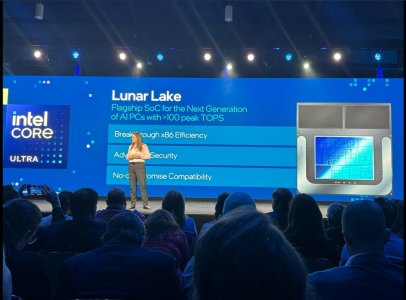
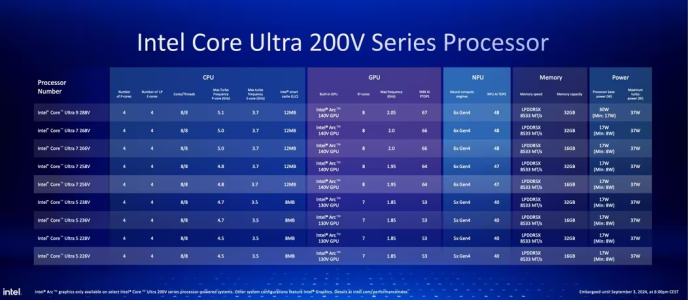
Intel Wildcat Lake (WCL) is upcoming mobile SoC replacing ADL-N. WCL consists of 2 tiles: compute tile and PCD tile. It is true single die consists of CPU, GPU and NPU that is fabbed by 18-A process. Last time I checked, PCD tile is fabbed by TSMC N6 process. They are connected through UCIe, not D2D; a first from Intel. Expecting launching in Q2/Computex 2026. In case people don't remember AlderLake-N, I have created a table below to compare the detail specs of ADL-N and WCL. Just for fun, I am throwing LNL and upcoming Mediatek D9500 SoC.

Intel Alder Lake - NIntel Wildcat LakeIntel Lunar LakeMediatek D9500
Launch DateQ1-2023Q2-2026 ?Q3-2024Q3-2025
ModelIntel N300?Core Ultra 7 268VDimensity 9500 5G
Dies2221
NodeIntel 7 + ?Intel 18-A + TSMC N6TSMC N3B + N6TSMC N3P
CPU8 E-cores2 P-core + 4 LP E-cores4 P-core + 4 LP E-coresC1 1+3+4
Threads8688
Max Clock3.8 GHz?5 GHz
L3 Cache6 MB?12 MB
TDP7 WFanless ?17 WFanless
Memory64-bit LPDDR5-480064-bit LPDDR5-6800 ?128-bit LPDDR5X-853364-bit LPDDR5X-10667
Size16 GB?32 GB24 GB ?
Bandwidth~ 55 GB/s136 GB/s85.6 GB/s
GPUUHD GraphicsArc 140VG1 Ultra
EU / Xe32 EU2 Xe8 Xe12
Max Clock1.25 GHz2 GHz
NPUNA18 TOPS48 TOPS100 TOPS ?


PPT1.jpg
PPT2.jpg
PPT3.jpg


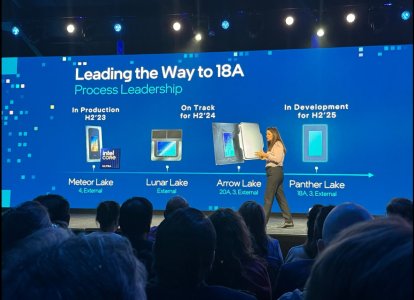
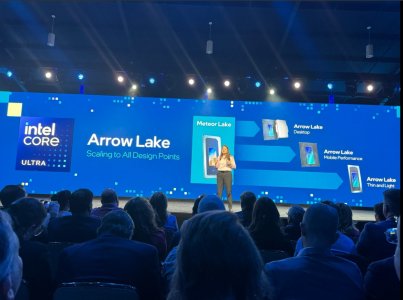
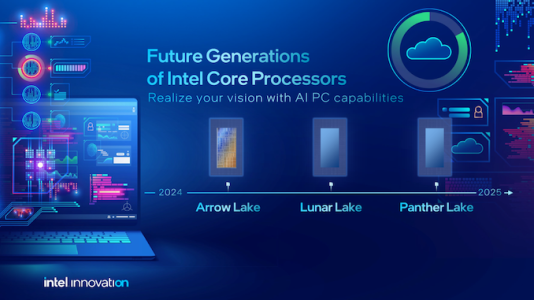
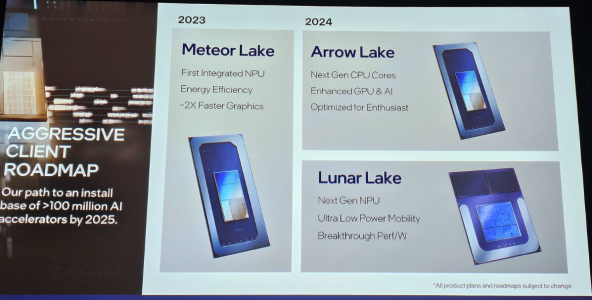
As Hot Chips 34 starting this week, Intel will unveil technical information of upcoming Meteor Lake (MTL) and Arrow Lake (ARL), new generation platform after Raptor Lake. Both MTL and ARL represent new direction which Intel will move to multiple chiplets and combine as one SoC platform.

MTL also represents new compute tile that based on Intel 4 process which is based on EUV lithography, a first from Intel. Intel expects to ship MTL mobile SoC in 2023.

ARL will come after MTL so Intel should be shipping it in 2024, that is what Intel roadmap is telling us. ARL compute tile will be manufactured by Intel 20A process, a first from Intel to use GAA transistors called RibbonFET.


LNL-MX.png
 

Attachments

  • PantherLake.png
    PantherLake.png
    283.5 KB · Views: 24,034
  • LNL.png
    LNL.png
    881.8 KB · Views: 25,527
  • INTEL-CORE-100-ULTRA-METEOR-LAKE-OFFCIAL-SLIDE-2.jpg
    INTEL-CORE-100-ULTRA-METEOR-LAKE-OFFCIAL-SLIDE-2.jpg
    181.4 KB · Views: 72,435
  • Clockspeed.png
    Clockspeed.png
    611.8 KB · Views: 72,321
Last edited:

511

Diamond Member
Jul 12, 2024
5,017
4,528
106
If Intel can't stop the bleeding of market share in the high margin DC with CWF, they are in trouble. My question is, will 288 cores of Skymont be enough to combat 192 cores on Turin Dense?
Should be enough cause the architecture is not a power hog and has better PPA tham zen at lower power levels like their P cores
 
Last edited:

511

Diamond Member
Jul 12, 2024
5,017
4,528
106
What is #1 based on? Not denying, just curious about the numbers.
TSMC N3B node and Advance packing N6 is cheap though and in their calls they said the same thing lower margin due to external foundry
 

DavidC1

Platinum Member
Dec 29, 2023
2,003
3,152
96
If Intel can't stop the bleeding of market share in the high margin DC with CWF, they are in trouble. My question is, will 288 cores of Skymont be enough to combat 192 cores on Turin Dense?
Theoretically, Clearwater Forest is a tour de force. I say theoretically, because Granite Rapids is suffering from scaling issues. It's rushed just like Arrowlake is. Intel says Arrowlake's performance issues can be mitigated, I don't know if that's true for Granite Rapids. 20% difference in MT would have been good. It's 40% in 2P. Unfortunately due to that the situation has not improved substantially over when they got Emerald Rapids.

Sierra Forest seems to have little bit of scaling issues too. Can't tell if that's tile immaturity or something to do with the Birch Stream platform. Remember CWF uses same socket as Sierra.

Again, since Skymont is essentially Zen 5c in Integer performance per clock, and in FP it's much closer. 288 cores is more than enough to make up for lack of SMT over a 192 core SMT enabled one. This is a theoretically very viable approach. Actually in some cases it is advantageous, because the total amount of threads are less.

As a product? It depends on how much the base Foveros cache layer will help with scaling that many cores. It depends on many minor details we don't know. How is the fabric? How does the memory controller scale? Bandwidth and latency of all the parts.

If it does well it won't just threaten Turin, but their own P core Xeon.
 

511

Diamond Member
Jul 12, 2024
5,017
4,528
106
As a product? It depends on how much the base Foveros cache layer will help with scaling that many cores. It depends on many minor details we don't know. How is the fabric? How does the memory controller scale? Bandwidth and latency of all the parts.

If it does well it won't just threaten Turin, but their own P core Xeon.
Which is a good thing cause the P cores are soo bad now in PPA
 

511

Diamond Member
Jul 12, 2024
5,017
4,528
106
Turin didn't, 9800X3D didn't . . . and the people that actually wanted vanilla Granite Ridge for productivity didn't even notice because it did not affect them.

Meanwhile, in Intel land, things are quite different.
Let them release the patch before we conclude if it was productivity that was hit or games or it is the hardware that has flaws 🙂 after that i can conclude
 

OneEng2

Senior member
Sep 19, 2022
951
1,163
106
What is #1 based on? Not denying, just curious about the numbers.

As for #2 I'm not sure DC make or breaks the desktop?
#1 is my strong "guess" and is based on the idea that as long as share prices are high (based on the promise of 18A and future products), it is expensive to purchase Intel .... and risky. Buy now and things go south and you eat billions upon billions of dollars loss on your investment (ie, Twitter).
Should be enough cause the architecture is not a power hog and has better PPA tham zen at lower power levels like their P cores
Yes, but not power per core and certainly not in MT. Per core licensing would make a Zen 5 solution highly preferable to a 288 core Skymont solution due to licensing costs.
Theoretically, Clearwater Forest is a tour de force. I say theoretically, because Granite Rapids is suffering from scaling issues. It's rushed just like Arrowlake is. Intel says Arrowlake's performance issues can be mitigated, I don't know if that's true for Granite Rapids. 20% difference in MT would have been good. It's 40% in 2P. Unfortunately due to that the situation has not improved substantially over when they got Emerald Rapids.

Sierra Forest seems to have little bit of scaling issues too. Can't tell if that's tile immaturity or something to do with the Birch Stream platform. Remember CWF uses same socket as Sierra.

Again, since Skymont is essentially Zen 5c in Integer performance per clock, and in FP it's much closer. 288 cores is more than enough to make up for lack of SMT over a 192 core SMT enabled one. This is a theoretically very viable approach. Actually in some cases it is advantageous, because the total amount of threads are less.

As a product? It depends on how much the base Foveros cache layer will help with scaling that many cores. It depends on many minor details we don't know. How is the fabric? How does the memory controller scale? Bandwidth and latency of all the parts.

If it does well it won't just threaten Turin, but their own P core Xeon.
Core per core, I can't see Skymont being anywhere near Zen 5c in DC workloads. It lacks SMT and AVX512. In fact, I could see Zen 5c being anywhere from 40% to 60% higher performance per core than Skymont in DC workloads.

So lets first look at just overall performance of a 192 core Zen 5c vs a 288 core Skymont under these assumptions. Skymont has 50% more cores, but Zen 5c performs 50% better per core .... so an even race but.......

Now look at it from a licensing standpoint. Skymont has 50% more cores and from an annual license costs 50% more per year to operate than Zen 5c.

Lots of assumptions here for sure, I just point out that Clearwater forest isn't necessarily a slam dunk for Intel.
 

Hulk

Diamond Member
Oct 9, 1999
5,210
3,839
136
Is it likely that until put more resources into the development of skymont because it does double duty, client and server? Whereas lion cove is pretty much just client.
 

511

Diamond Member
Jul 12, 2024
5,017
4,528
106
Core per core, I can't see Skymont being anywhere near Zen 5c in DC workloads. It lacks SMT and AVX512. In fact, I could see Zen 5c being anywhere from 40% to 60% higher performance per core than Skymont in DC workloads.
How are you calculating per core performance is AVX-512 included in them than yes elso no for pure integer workloads which many are both will be similar integer performance per thread
So lets first look at just overall performance of a 192 core Zen 5c vs a 288 core Skymont under these assumptions. Skymont has 50% more cores, but Zen 5c performs 50% better per core .... so an even race but.......

Now look at it from a licensing standpoint. Skymont has 50% more cores and from an annual license costs 50% more per year to operate than Zen 5c.

Lots of assumptions here for sure, I just point out that Clearwater forest isn't necessarily a slam dunk for Intel.
I agree for VM part but there are customers who disables SMT so it will give them more physical cores to work with
On a sidenote not a single site benchmarks the accelerator in Silicons they are niche but have decent use cases
 

cannedlake240

Senior member
Jul 4, 2024
247
138
76
In fact, I could see Zen 5c being anywhere from 40% to 60% higher performance per core than Skymont in DC workloads
Yeah, idk about that... Unless 18A is complete garbage(which is a possibility) 40-60% higher perf seems too optimistic outside niche HPC/AI workloads and Clearwater has more cores. Epyc Zen 4C had 50% higher perf per core... Against 8ch Sierra that had Crestmont and 100mb L3. CLF has Darkmont equipped with more L3 and likely faster 12ch DDR5. Crestmont was slower than Zen 4 in int perf let alone FP, but Skymont already narrowed that gap
 

ondma

Diamond Member
Mar 18, 2018
3,316
1,708
136
Oh yeah! X3D didn’t. Turin didn’t. Same as GNR didn’t. And Lunar Lake didn’t.

When Zen 5 desktop parts were launched it was a disaster requiring some agesa bios updates and windows 24H2 patches. Same like ARL now requires similar bios updates & possible windows patches.


Looks like some have either forgotten about it already or just want to ignore it.


Apparently, it was okay to wait for amd’s patches, but not now for Intel’s.
Well, with the exception of the x3D parts, Zen 5 is still a pretty mediocre release. They jury is still out on ARL, but I dont really expect some bios updates to sufficiently improve the horribly inconsistent gaming performance to make it competitive with current Zen 5 or previous x3D parts, much less 9000 x3D. There seems to just be something fundamentally wrong with ARL for gaming.
 
Jul 27, 2020
28,173
19,203
146
There seems to just be something fundamentally wrong with ARL for gaming.
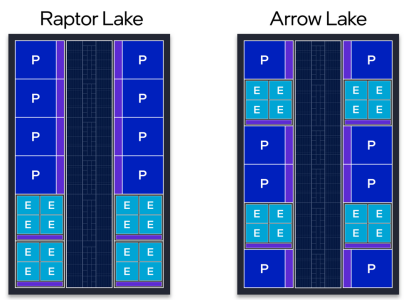
This is what's probably wrong:

1731359375345.png

I suppose they made this weird core layout in Arrow Lake to reduce the context switch latency as the threads jump from E-cores to P-cores during periods of high compute demand but Windows scheduler or GPU drivers or even game engines were not ready for such a radical change.
 

LightningZ71

Platinum Member
Mar 10, 2017
2,623
3,308
136
Yeah, idk about that... Unless 18A is complete garbage(which is a possibility) 40-60% higher perf seems too optimistic outside niche HPC/AI workloads and Clearwater has more cores. Epyc Zen 4C had 50% higher perf per core... Against 8ch Sierra that had Crestmont and 100mb L3. CLF has Darkmont equipped with more L3 and likely faster 12ch DDR5. Crestmont was slower than Zen 4 in int perf let alone FP, but Skymont already narrowed that gap
My biggest concern for Intel's very high core count 'mont server processors has nothing to do with the cores themselves, save if they can have a competitive AVX-512 implementation and remain compact and efficient enough, but is far more about Intel's mesh fabric connecting them all. 288 cores in clusters of 4 is still 72 reservation stations. How will the mesh affect performance for them?
 

tsamolotoff

Senior member
May 19, 2019
259
510
136
I suppose they made this weird core layout in Arrow Lake to reduce the context switch latency as the threads jump from E-cores to P-cores during periods of high compute demand but Windows scheduler or GPU drivers or even game engines were not ready for such a radical change.
In ring bus, every core is equal and latency does not depend on physical distance - data has to travel whole ring before any read/write happens
 
  • Like
Reactions: igor_kavinski

cannedlake240

Senior member
Jul 4, 2024
247
138
76
My biggest concern for Intel's very high core count 'mont server processors has nothing to do with the cores themselves, save if they can have a competitive AVX-512 implementation and remain compact and efficient enough, but is far more about Intel's mesh fabric connecting them all. 288 cores in clusters of 4 is still 72 reservation stations. How will the mesh affect performance for them?
It'll definitely affect memory and LLC latency same way it's on Granite rapids, but a larger local base tile cache and SNC3 mode probably compensate for that
 

Markfw

Moderator Emeritus, Elite Member
May 16, 2002
27,344
16,175
136
Oh yeah! X3D didn’t. Turin didn’t. Same as GNR didn’t. And Lunar Lake didn’t.

When Zen 5 desktop parts were launched it was a disaster requiring some agesa bios updates and windows 24H2 patches. Same like ARL now requires similar bios updates & possible windows patches.


Looks like some have either forgotten about it already or just want to ignore it.


Apparently, it was okay to wait for amd’s patches, but not now for Intel’s.
I don't know how you can justify saying Zen 5 at launch was a disaster. I was one of the first to buy Zen 5, and I have not updated bios or updated the OS or even BOOTED THE COMPUTER since it was new, and no issues months later.

This may be an Intel thread but at least you don't need to lie like crazy about AMD.
 

Hulk

Diamond Member
Oct 9, 1999
5,210
3,839
136
This is what's probably wrong:

View attachment 111456

I suppose they made this weird core layout in Arrow Lake to reduce the context switch latency as the threads jump from E-cores to P-cores during periods of high compute demand but Windows scheduler or GPU drivers or even game engines were not ready for such a radical change.
Intel said that the change in the P/E core layout was to reduce heat concentrations in high loads "like gaming." Yes, they said it. Ironic, no?
 

Hulk

Diamond Member
Oct 9, 1999
5,210
3,839
136
As I noted earlier Intel gave me two options for replacing my 14900K. Send mine in and they send the replacement about a week later.

Cross-ship but that will cost $25.

As someone here suggested I asked them that since is my 3rd defective part would they consider a refund or an Arrow Lake CPU replacement.

I'll let you all know how that turns out. Pretty sure they're going to say no and I'll have to resell the replacement and move to Zen or use the Raptor downclocked and bide my time.
 
Jul 27, 2020
28,173
19,203
146
use the Raptor downclocked and bide my time.
You could use the replacement normally since Intel says all kinks have been worked out. Could be a test to see how truthful Intel is being or if they are totally clueless about their own product.
 

DavidC1

Platinum Member
Dec 29, 2023
2,003
3,152
96
288 cores in clusters of 4 is still 72 reservation stations. How will the mesh affect performance for them?
Also keep in mind the 288 core Clearwater Forest is 12 dies of 24 cores each, with 24 cores being composed of 6x quad core clusters.
Intel said that the change in the P/E core layout was to reduce heat concentrations in high loads "like gaming." Yes, they said it. Ironic, no?
Arrowlake was supposed to be before Lunarlake, so not only it's basically their first try it's also run into development problems, so we likely cannot pinpoint any high level problem as a single major fault.