• We’re currently investigating an issue related to the forum theme and styling that is impacting page layout and visual formatting. The problem has been identified, and we are actively working on a resolution. There is no impact to user data or functionality, this is strictly a front-end display issue. We’ll post an update once the fix has been deployed. Thanks for your patience while we get this sorted.

Discussion Intel Meteor, Arrow, Lunar & Panther Lakes + WCL Discussion Threads

Page 471 - Seeking answers? Join the AnandTech community: where nearly half-a-million members share solutions and discuss the latest tech.

Tigerick

Senior member
Wildcat Lake (WCL) Specs

Intel Wildcat Lake (WCL) is upcoming mobile SoC replacing Raptor Lake-U. WCL consists of 2 tiles: compute tile and PCD tile. It is true single die consists of CPU, GPU and NPU that is fabbed by 18-A process. Last time I checked, PCD tile is fabbed by TSMC N6 process. They are connected through UCIe, not D2D; a first from Intel. Expecting launching in Q1 2026.
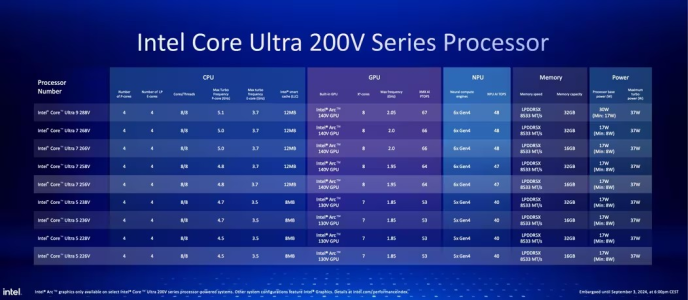
Intel Raptor Lake UIntel Wildcat Lake 15WIntel Lunar LakeIntel Panther Lake 4+0+4
Launch DateQ1-2024Q2-2026Q3-2024Q1-2026
ModelIntel 150UIntel Core 7 360Core Ultra 7 268VCore Ultra 7 365
Dies2223
NodeIntel 7 + ?Intel 18-A + TSMC N6TSMC N3B + N6Intel 18-A + Intel 3 + TSMC N6
CPU2 P-core + 8 E-cores2 P-core + 4 LP E-cores4 P-core + 4 LP E-cores4 P-core + 4 LP E-cores
Threads12688
Max Clock5.4 GHz4.8 GHz5 GHz4.8 GHz
L3 Cache12 MB6 MB12 MB12 MB
TDP15 - 55 W15 - 35 W17 - 37 W25 - 55 W
Memory128-bit LPDDR5-520064-bit LPDDR5x-7467128-bit LPDDR5x-8533128-bit LPDDR5x-7467
Size96 GB48 GB32 GB128 GB
Bandwidth83 GB/s60 GB/s136 GB/s120 GB/s
GPUIntel GraphicsIntel GraphicsArc 140VIntel Graphics
RTNoNoYESYES
EU / Xe96 EU2 Xe8 Xe4 Xe
Max Clock1.3 GHz2.6 GHz2 GHz2.5 GHz
NPUGNA 3.017 TOPS48 TOPS49 TOPS


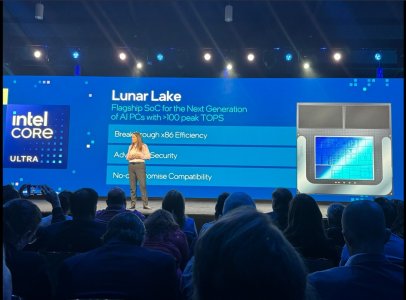
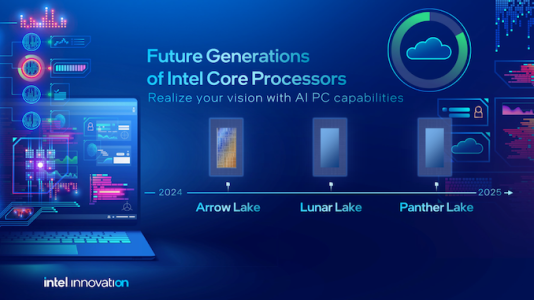
PPT1.jpg
PPT2.jpg
PPT3.jpg


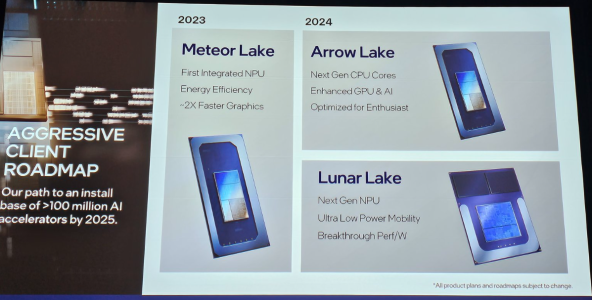
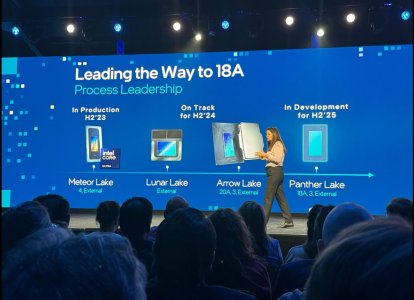
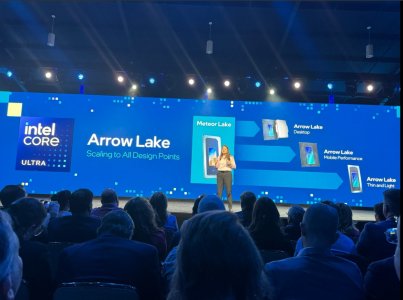
As Hot Chips 34 starting this week, Intel will unveil technical information of upcoming Meteor Lake (MTL) and Arrow Lake (ARL), new generation platform after Raptor Lake. Both MTL and ARL represent new direction which Intel will move to multiple chiplets and combine as one SoC platform.

MTL also represents new compute tile that based on Intel 4 process which is based on EUV lithography, a first from Intel. Intel expects to ship MTL mobile SoC in 2023.

ARL will come after MTL so Intel should be shipping it in 2024, that is what Intel roadmap is telling us. ARL compute tile will be manufactured by Intel 20A process, a first from Intel to use GAA transistors called RibbonFET.


LNL-MX.png
 

Attachments

  • PantherLake.png
    PantherLake.png
    283.5 KB · Views: 24,049
  • LNL.png
    LNL.png
    881.8 KB · Views: 25,534
  • INTEL-CORE-100-ULTRA-METEOR-LAKE-OFFCIAL-SLIDE-2.jpg
    INTEL-CORE-100-ULTRA-METEOR-LAKE-OFFCIAL-SLIDE-2.jpg
    181.4 KB · Views: 72,443
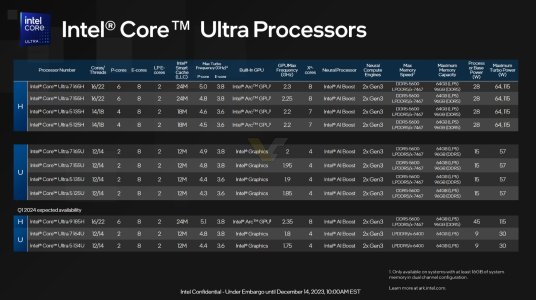
  • Clockspeed.png
    Clockspeed.png
    611.8 KB · Views: 72,329
Last edited:
So for Asus Zenbook S 14 (and similar premium low-power light-weight laptops), how much of the power consumption do we think is due to the display vs CPU when in low performance mode?

If the the display is what matters most, would it make sense to buy a variant with previous-generation CPU at lower cost?
 
I liked Pat as a choice initially. Now, I am not so sure. How many things can you cancel or sell off and still be a leading company?
Even Pat admitted everything hinges on 18A, and get the feeling that it is going to have problems as well.

As for Royal Core, maybe a low frequency, high IPC design would at least be very low power. Not sure how you can say it would have cost too much and had poor PPA without seeing a final product. Like I said in an earlier post, Intel is in a viscious spiral of needing a great product to turn them around, but dropping projects right and left. I dont see how they are going to turn things around like this. They are like a cancer patient who gets the worst possible prognosis at each step of diagnosis, while hoping desperately for a turn around.
 
Marketing speak aside, LNL is 10% faster than MTL @ 17W and 6% slower @ 23W. It loses steam fast, and that's with a node advantage. For the design target of 9W as declared by Intel the chip is very nice, but for 17W+ it could definitely use a bit more horsepower, either 4P6E or even 4P8E. That's why it's disappointing they're not following it up with another iteration.

Think of it this way, MTL loses to Hawk Point 8P/16T at 23W. LNL loses to MTL at 23W. We'll have independent numbers soon so I'd rather not try to extrapolate what happens at 17W, but it may not be the clear-cut win some were expecting.

That means Hawk Point will run the table on everything mobile Intel has @ 23W on up until Arrow Lake comes out (not counting high-wattage HX parts). And that doesn't even take Strix into account.

Oof if these are the yields for a 100mm2 chip on Intel 3
That would explain a few things about Sierra Forest. Doesn't bode well for Arrow Lake-U.
 
How many things can you cancel or sell off and still be a leading company?
With Intel? Plenty. Because in addition to stock buy backs and dividends buying up companies of potential interest/funding moonshot projects is all prior CEOs could think of to do with profits during the good years.

Royal had fanciful goals and hence it's of little surprise that there's still nothing to show after years of development.
 
That means Hawk Point will run the table on everything mobile Intel has @ 23W on up until Arrow Lake comes out (not counting high-wattage HX parts). And that doesn't even take Strix into account.

You didn't notice that LL is thin&light form factor soc with 9-17w tdp? It design priority might not have been performance @23w tdp.
 
Sounds like a good riddance then.
While it was absolutely interesting from an engineering POV, 40% in ST perf over ADL with nearly double the die area per core would have been a very bad combination, especially since ARL-S looks to have roughly 25% better ST perf with the same die area already so it'd be double the area for a normal generational gain in ST perf, not exactly a great achievement.
Sometimes things get canned simply because they aren't as good as previously thought, looks like that's what happened here.
 
If you go back a handful of years ago, Intel was likely thinking that they would have higher transistor densities available than they currently do. Those transistor counts wouldn't seem out of line in that world.
 
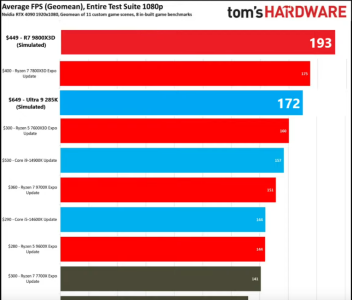
MLID (lol) believes Arrow Lake will end up just below the 7800X3D in the stack for gaming:
1725629350584.png

Only a little over a month until we can either roast him for being wrong or be disappointed that he was on the money.
 
So for Asus Zenbook S 14 (and similar premium low-power light-weight laptops), how much of the power consumption do we think is due to the display vs CPU when in low performance mode?

If the the display is what matters most, would it make sense to buy a variant with previous-generation CPU at lower cost?
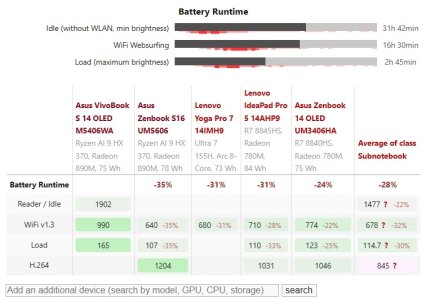
This is a very good representation of how much display consumes relative to CPU. Strix 370 gets 35% better battery runtimes going to 14" OLED from 16". It kind of wipes the floor with everything else. So yes, it makes a huge difference.

https://www.notebookcheck.net/Asus-VivoBook-S-14-OLED-laptop-review-Successful-performance-of-the-Ryzen-AI-9-HX-370.880476.0.html

HX370 8-28-24.jpg
 
This is a very good representation of how much display consumes relative to CPU. Strix 370 gets 35% better battery runtimes going to 14" OLED from 16". It kind of wipes the floor with everything else. So yes, it makes a huge difference.

https://www.notebookcheck.net/Asus-VivoBook-S-14-OLED-laptop-review-Successful-performance-of-the-Ryzen-AI-9-HX-370.880476.0.html

View attachment 106945
They test at 150 nits as well and the biggest problem what I find with oled is dark mode if someone uses light scheme he is bound to get drained quicker
 
Sounds like a good riddance then.
While it was absolutely interesting from an engineering POV, 40% in ST perf over ADL with nearly double the die area per core would have been a very bad combination, especially since ARL-S looks to have roughly 25% better ST perf with the same die area already so it'd be double the area for a normal generational gain in ST perf, not exactly a great achievement.
Sometimes things get canned simply because they aren't as good as previously thought, looks like that's what happened here.
Are you saying ARL will have 25% better ST performance than ADL? Pretty optimistic, to put it mildly.
 
I am gonna call BS on that as there is no way Intel would have ramped up SRF and GNR if yields were that bad.

I've mentioned this before... I think they are using the YOLO strategy. The yields/defect rate probably doesn't matter as much as you think. It helps that the die should be very salvageable. Helps make some money off of the node.

At this point, any Xeon customers left are the types that aren't going to buy AMD even with AMD's products being so much better. So if Intel can't supply Granite, they'll just supply Sapphire or Emerald.
 
Back
Top