• We’re currently investigating an issue related to the forum theme and styling that is impacting page layout and visual formatting. The problem has been identified, and we are actively working on a resolution. There is no impact to user data or functionality, this is strictly a front-end display issue. We’ll post an update once the fix has been deployed. Thanks for your patience while we get this sorted.

Discussion Intel Meteor, Arrow, Lunar & Panther Lakes + WCL Discussion Threads

Page 137 - Seeking answers? Join the AnandTech community: where nearly half-a-million members share solutions and discuss the latest tech.

Tigerick

Senior member
Wildcat Lake (WCL) Specs

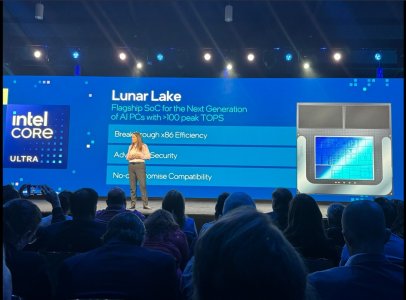
Intel Wildcat Lake (WCL) is upcoming mobile SoC replacing Raptor Lake-U. WCL consists of 2 tiles: compute tile and PCD tile. It is true single die consists of CPU, GPU and NPU that is fabbed by 18-A process. Last time I checked, PCD tile is fabbed by TSMC N6 process. They are connected through UCIe, not D2D; a first from Intel. Expecting launching in Q1 2026.
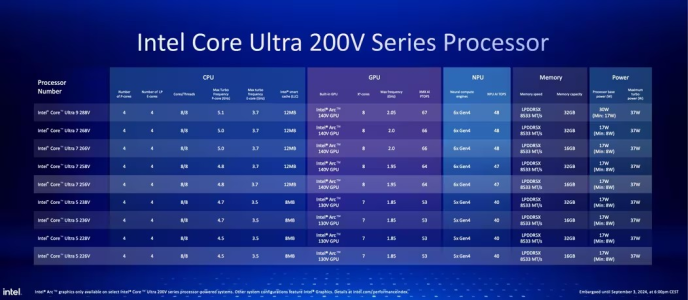
Intel Raptor Lake UIntel Wildcat Lake 15WIntel Lunar LakeIntel Panther Lake 4+0+4
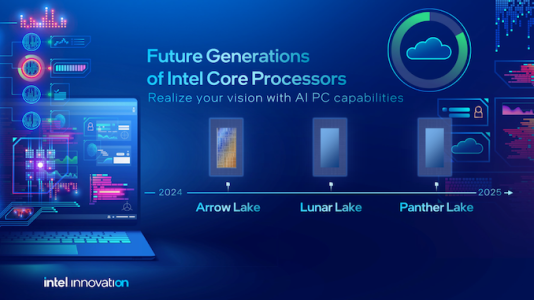
Launch DateQ1-2024Q2-2026Q3-2024Q1-2026
ModelIntel 150UIntel Core 7 360Core Ultra 7 268VCore Ultra 7 365
Dies2223
NodeIntel 7 + ?Intel 18-A + TSMC N6TSMC N3B + N6Intel 18-A + Intel 3 + TSMC N6
CPU2 P-core + 8 E-cores2 P-core + 4 LP E-cores4 P-core + 4 LP E-cores4 P-core + 4 LP E-cores
Threads12688
Max Clock5.4 GHz4.8 GHz5 GHz4.8 GHz
L3 Cache12 MB6 MB12 MB12 MB
TDP15 - 55 W15 - 35 W17 - 37 W25 - 55 W
Memory128-bit LPDDR5-520064-bit LPDDR5x-7467128-bit LPDDR5x-8533128-bit LPDDR5x-7467
Size96 GB48 GB32 GB128 GB
Bandwidth83 GB/s60 GB/s136 GB/s120 GB/s
GPUIntel GraphicsIntel GraphicsArc 140VIntel Graphics
RTNoNoYESYES
EU / Xe96 EU2 Xe8 Xe4 Xe
Max Clock1.3 GHz2.6 GHz2 GHz2.5 GHz
NPUGNA 3.017 TOPS48 TOPS49 TOPS


PPT1.jpg
PPT2.jpg
PPT3.jpg


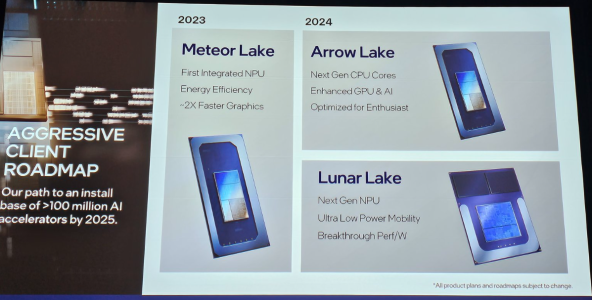
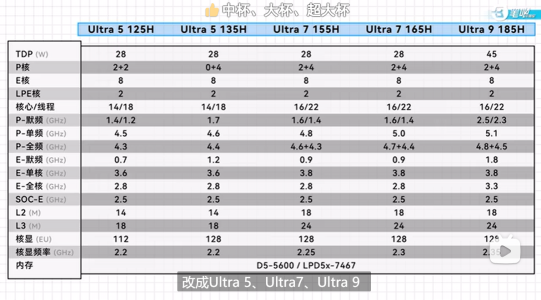
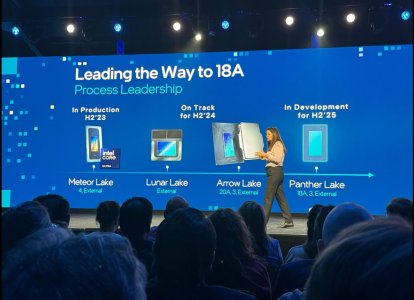
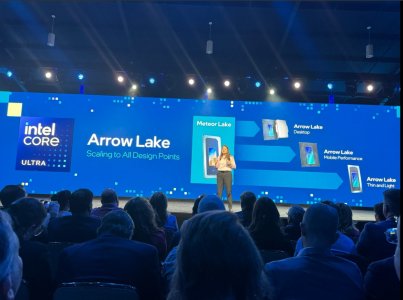
As Hot Chips 34 starting this week, Intel will unveil technical information of upcoming Meteor Lake (MTL) and Arrow Lake (ARL), new generation platform after Raptor Lake. Both MTL and ARL represent new direction which Intel will move to multiple chiplets and combine as one SoC platform.

MTL also represents new compute tile that based on Intel 4 process which is based on EUV lithography, a first from Intel. Intel expects to ship MTL mobile SoC in 2023.

ARL will come after MTL so Intel should be shipping it in 2024, that is what Intel roadmap is telling us. ARL compute tile will be manufactured by Intel 20A process, a first from Intel to use GAA transistors called RibbonFET.


LNL-MX.png
 

Attachments

  • PantherLake.png
    PantherLake.png
    283.5 KB · Views: 24,049
  • LNL.png
    LNL.png
    881.8 KB · Views: 25,534
  • INTEL-CORE-100-ULTRA-METEOR-LAKE-OFFCIAL-SLIDE-2.jpg
    INTEL-CORE-100-ULTRA-METEOR-LAKE-OFFCIAL-SLIDE-2.jpg
    181.4 KB · Views: 72,443
  • Clockspeed.png
    Clockspeed.png
    611.8 KB · Views: 72,329
Last edited:
Wasn't it a given that actual availability of Meteor Lake in Q4 2023 would be nearly non-existent and very expensive?
True. But I get why the OEMs might be furious. Intel announced MTL officially so a lot of people may have put their laptop buying plans on hold to get the latest Intel thing. So not only do the OEMs not have MTL laptops to sell but what they do have in the channel may also see decreased sales. Intel double whammied them.
 
Comparing mobile parts even after official release is hard enough because every system throttles to some extent. Trying to compare them before release introduces even greater variability since we don't know if these are retail parts QS, or whatever, we don't know clocks, memory subsystems, etc... I suggest we wait until release before we start arguing about what a giant fail or success this is for Intel.
 
Comparing mobile parts even after official release is hard enough because every system throttles to some extent. Trying to compare them before release introduces even greater variability since we don't know if these are retail parts QS, or whatever, we don't know clocks, memory subsystems, etc... I suggest we wait until release before we start arguing about what a giant fail or success this is for Intel.
Yep, will reserve my opinions till release.
 
A
It's been like that pretty much through the entire Zen era. AMD ships some mobile SoCs but you never really know where they're going. Availability at retail is bad for months on end.
Actually, you can find excellent AMD laptops in Alienware, Razer Blade, Asus ROG, Acer Predator, Nitro, HP Omen, etc.
 
A

Actually, you can find excellent AMD laptops in Alienware, Razer Blade, Asus ROG, Acer Predator, Nitro, HP Omen, etc.
Nah, those are gamer bricks using heavier PSU than the laptop itself (yeah, I pushed it but you get the idea).
Thin & Light yet performing (relative to their thin & light constitution of course) is a lot harder.
 
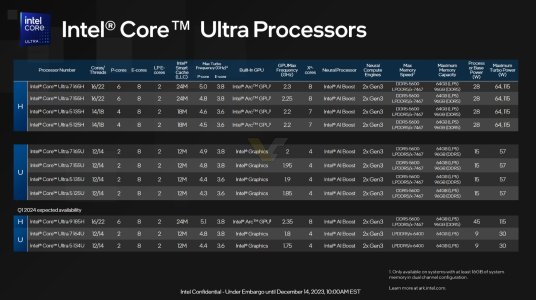
Geekbench 6 is calibrated to give 2500 score on a desktop 12700 in the ST tests.

Since it is performing essentially the same as a desktop 12700, considering the variability of Geekbench runs on a laptop, I would say it's performing as expected.

The MT score is really impressive, considering 8+4 for the 12700 vs 6+8 for the Meteor Lake chip, with the obvious caveat that it's not known what the LP Island E-cores do when the CPU is run at full tilt. Lower boost frequency of the E-cores in general may also be a factor.
 
with the obvious caveat that it's not known what the LP Island E-cores do when the CPU is run at full tilt.
I read that they generally do not take part in MT workloads unless you force them to participate through process affinity. Even then, their contribution to the MT performance is nothing to write home about.
 
Last edited:
ST is worse on MTL. Because of the same IPC and roughly ~300 Mhz less peak frequency it is not a surprise anymore. Also the tile architecture seems to introduce some extra latency over Raptor Lake which contributes to it. ST isn't the most important if it's just a 5% slowdown. Efficiency/Battery life matters much more.
 

If the reference laptop is any indication of final performance, there is "some" hope for MTL to not be a failure. Notice the MTL chip being on Stepping 4. Got delayed by silicon bug fixes, I guess?

Not that bad compared to a 13700H but still getting beat pretty badly in some tests: https://browser.geekbench.com/v6/cpu/compare/3435865?baseline=2772108

The fact that is loses the single threaded tests but does pretty well in MT makes me think it is more power efficient and able to maintain higher boost than RPL.
 

If the reference laptop is any indication of final performance, there is "some" hope for MTL to not be a failure. Notice the MTL chip being on Stepping 4. Got delayed by silicon bug fixes, I guess?

Not that bad compared to a 13700H but still getting beat pretty badly in some tests: https://browser.geekbench.com/v6/cpu/compare/3435865?baseline=2772108
IMO MTL is more about going to a modular approach with more or less the same stuff than anything else.
I'm not pointing the finger at Intel, quite the opposite: it is wise not to do to much at the same time.

If this is a success on a manufacturing PoV (including yield etc) : good. Intel will move to the next goal.

It is clear though than from a pure performance PoV, MTL isn't earth shattering to say the least but IMO this wasn't the point at all. And it is OK to me.
 
Also regarding power consumption - the 12700 has a PL2 of 180 W. Considering the 28-35 W TDP of these Meteor Lake CPUs for which I really doubt that PL2 would be set much higher than 65 W (which is a reasonable assumption given that RPL-P chips have their PL2 set at 64 W as per spec), we are potentially seeing ~1/3 power consumption at iso-frequency and similar performance levels.
 
3, 3 wide decoders sounds pretty weird tbh. And one of the decoders is disabled for a total of 8 wide?
Maybe they want SKMT to target extremely low power so they could power gate to just 2 or 3 wide decoders if they want to, idk

I would assume the decoders are 9 wide total, but something right after them is 8 wide. 3x3 decode doesn't get you 9 ops every clock, there will be mispredictions etc. If there's room to buffer a bit between them, if you have for example 8 wide rename, going 9 wide in the decode still probably win you a little, even if it's impossible to maintain 9 ops per cycle every cycle.
 
The fact that is loses the single threaded tests but does pretty well in MT makes me think it is more power efficient and able to maintain higher boost than RPL.
Of course it is more efficient. All these people are dooming it without understanding that the chip sips power.

Also, this isn’t even the fastest SKU. Get back to me when the 185 sku has a good GB run.
 
Of course it is more efficient. All these people are dooming it without understanding that the chip sips power.

Same thing happened with Ice Lake. I'm guessing they loosened the bins as far as possible to get enough chips. So it may not be more efficient than Raptor Lake.
 
Do we have any more recent indication as to what kind of volume MTL might be shipping? Meme volume sure but anything quantitative or guesses?

Also *when*, particularly for < 35W. I’m guessing we’ll see Q1-Q3 ‘24 for serious availability.
 
IMO MTL is more about going to a modular approach with more or less the same stuff than anything else.
I'm not pointing the finger at Intel, quite the opposite: it is wise not to do to much at the same time.

If this is a success on a manufacturing PoV (including yield etc) : good. Intel will move to the next goal.

It is clear though than from a pure performance PoV, MTL isn't earth shattering to say the least but IMO this wasn't the point at all. And it is OK to me.
Agree RE. Performance. Efficiency under load and idle efficiency are just far more important right now
 
A

Actually, you can find excellent AMD laptops in Alienware, Razer Blade, Asus ROG, Acer Predator, Nitro, HP Omen, etc.
Those are all gaming or beefy laptops. I hope this is facetious about how piss poor AMD is on mobile laptops 15-35W that the average person might want to use lol. It’s still atrocious honestly especially in the US.
 
Back
Top