• We’re currently investigating an issue related to the forum theme and styling that is impacting page layout and visual formatting. The problem has been identified, and we are actively working on a resolution. There is no impact to user data or functionality, this is strictly a front-end display issue. We’ll post an update once the fix has been deployed. Thanks for your patience while we get this sorted.

Discussion Intel Meteor, Arrow, Lunar & Panther Lakes + WCL Discussion Threads

Page 132 - Seeking answers? Join the AnandTech community: where nearly half-a-million members share solutions and discuss the latest tech.

Tigerick

Senior member
Wildcat Lake (WCL) Specs

Intel Wildcat Lake (WCL) is upcoming mobile SoC replacing Raptor Lake-U. WCL consists of 2 tiles: compute tile and PCD tile. It is true single die consists of CPU, GPU and NPU that is fabbed by 18-A process. Last time I checked, PCD tile is fabbed by TSMC N6 process. They are connected through UCIe, not D2D; a first from Intel. Expecting launching in Q1 2026.
Intel Raptor Lake UIntel Wildcat Lake 15WIntel Lunar LakeIntel Panther Lake 4+0+4
Launch DateQ1-2024Q2-2026Q3-2024Q1-2026
ModelIntel 150UIntel Core 7 360Core Ultra 7 268VCore Ultra 7 365
Dies2223
NodeIntel 7 + ?Intel 18-A + TSMC N6TSMC N3B + N6Intel 18-A + Intel 3 + TSMC N6
CPU2 P-core + 8 E-cores2 P-core + 4 LP E-cores4 P-core + 4 LP E-cores4 P-core + 4 LP E-cores
Threads12688
Max Clock5.4 GHz4.8 GHz5 GHz4.8 GHz
L3 Cache12 MB6 MB12 MB12 MB
TDP15 - 55 W15 - 35 W17 - 37 W25 - 55 W
Memory128-bit LPDDR5-520064-bit LPDDR5x-7467128-bit LPDDR5x-8533128-bit LPDDR5x-7467
Size96 GB48 GB32 GB128 GB
Bandwidth83 GB/s60 GB/s136 GB/s120 GB/s
GPUIntel GraphicsIntel GraphicsArc 140VIntel Graphics
RTNoNoYESYES
EU / Xe96 EU2 Xe8 Xe4 Xe
Max Clock1.3 GHz2.6 GHz2 GHz2.5 GHz
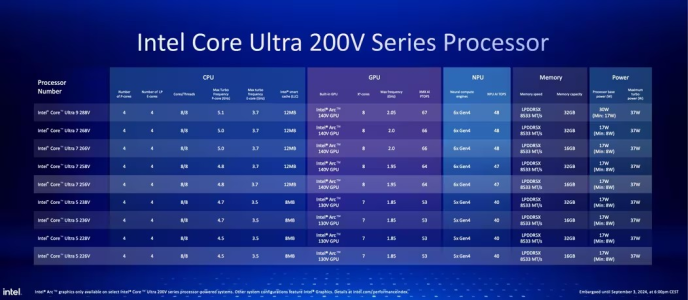
NPUGNA 3.017 TOPS48 TOPS49 TOPS


PPT1.jpg
PPT2.jpg
PPT3.jpg


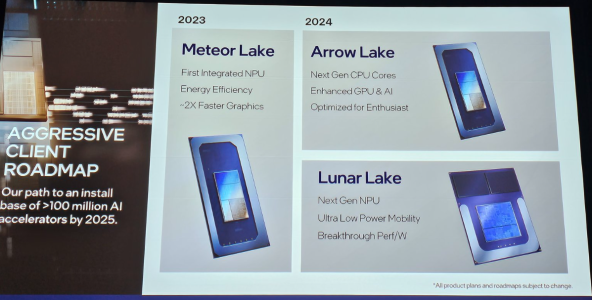
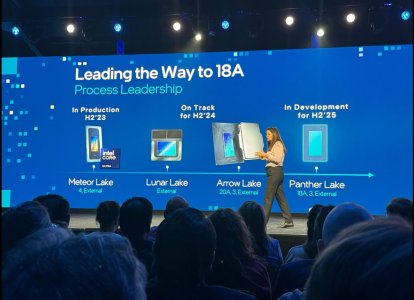
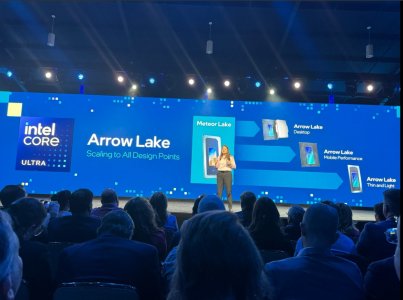
As Hot Chips 34 starting this week, Intel will unveil technical information of upcoming Meteor Lake (MTL) and Arrow Lake (ARL), new generation platform after Raptor Lake. Both MTL and ARL represent new direction which Intel will move to multiple chiplets and combine as one SoC platform.

MTL also represents new compute tile that based on Intel 4 process which is based on EUV lithography, a first from Intel. Intel expects to ship MTL mobile SoC in 2023.

ARL will come after MTL so Intel should be shipping it in 2024, that is what Intel roadmap is telling us. ARL compute tile will be manufactured by Intel 20A process, a first from Intel to use GAA transistors called RibbonFET.


LNL-MX.png
 

Attachments

  • PantherLake.png
    PantherLake.png
    283.5 KB · Views: 24,049
  • LNL.png
    LNL.png
    881.8 KB · Views: 25,534
  • INTEL-CORE-100-ULTRA-METEOR-LAKE-OFFCIAL-SLIDE-2.jpg
    INTEL-CORE-100-ULTRA-METEOR-LAKE-OFFCIAL-SLIDE-2.jpg
    181.4 KB · Views: 72,443
  • Clockspeed.png
    Clockspeed.png
    611.8 KB · Views: 72,329
Last edited:
Given Intel's classic aversion to low console margins, I doubt they'll be making any deals with Valve. Plus Meteor Lake parts are going to be expensive for awhile.
 
MTL should beat Phoenix. MLID was correct...
I wouldn't be too surprised if the iGPU synthetics look pretty good... only to be a lackluster when looking at perf in games themselves. From what I hear, that's the general trend with Intel's iGPUs recently
Also, MTL beating phoenix, overall, as a product? Doubt. Guessing it's going to be close though.
 
I wouldn't be too surprised if the iGPU synthetics look pretty good... only to be a lackluster when looking at perf in games themselves. From what I hear, that's the general trend with Intel's iGPUs recently
Also, MTL beating phoenix, overall, as a product? Doubt. Guessing it's going to be close though.
Hope its close enough though, but even if it isn't, it still offers similar features I think, and still has more availability than Phoenix later down the line
 
Hope its close enough though, but even if it isn't, it still offers similar features I think, and still has more availability than Phoenix later down the line
Only reason it might end up having more availability than Phoenix wouldn't be because Intel is pumping out MTL, but because AMD just sucks at mobile volume. I think the existence of RPL and RPL-R mobile and MTL launching so late is pretty indicative of that.
 
Only reason it might end up having more availability than Phoenix wouldn't be because Intel is pumping out MTL, but because AMD just sucks at mobile volume. I think the existence of RPL and RPL-R mobile and MTL launching so late is pretty indicative of that.
I'm just waiting on MTL efficiency benchmarks anyways since my real interest is Arrow Lake, I want a desktop replacement laptop with ARL lol
 
I wouldn't be too surprised if the iGPU synthetics look pretty good... only to be a lackluster when looking at perf in games themselves. From what I hear, that's the general trend with Intel's iGPUs recently
Also, MTL beating phoenix, overall, as a product? Doubt. Guessing it's going to be close though.


With a 2x improvement over Iris Xe they can easily match Phoenix. When it comes to 3dmark I would use timespy graphics, I think it needs roughly 3500 points to match Phoenix. This is based on A380 vs RX6400. A380 scores 15-20% higher whereas in real world they are evenly matched. The fastest Phoenix 780M devices score 2800-2900 points. 15-20% higher than this gives roughly 3500 points. I think this is doable for MTL-H tGPU at 2.2 Ghz.
 
With a 2x improvement over Iris Xe they can easily match Phoenix. When it comes to 3dmark I would use timespy graphics, I think it needs roughly 3500 points to match Phoenix. This is based on A380 vs RX6400. A380 scores 15-20% higher whereas in real world they are evenly matched. The fastest Phoenix 780M devices score 2800-2900 points. 15-20% higher than this gives roughly 3500 points. I think this is doable for MTL-H tGPU at 2.2 Ghz.
It probably is doable at 2.2GHz, but what I want to know is the power limit for that frequency.
If 35-45W is enough for that then great, If more is needed then not great.
 
It probably is doable at 2.2GHz, but what I want to know is the power limit for that frequency.
If 35-45W is enough for that then great, If more is needed then not great.


Phoenix requires more than 50W to reach 2800-2900 points, the fastest one use 70-80W.
 
MT score is... questionable, though we don't know what TDP is used
ST score of >5%. Not good, but not bad either. Intel doesn't need a massive ST bump to compete with Phoenix, so it's not too disappointing.

Oh also, talk on Twitter from Raichu +Bionic is that :
ARL-H GPU tile uses N4P, and it has some improvements and is not a complete refresh of the MTL-H iGPU die (doubled L2 and XMX). Though it's not BMG.
ARL-S reuses the 64 EU GPU tile of MTL though
 
I wouldn't be too surprised if the iGPU synthetics look pretty good... only to be a lackluster when looking at perf in games themselves. From what I hear, that's the general trend with Intel's iGPUs recently
Also, MTL beating phoenix, overall, as a product? Doubt. Guessing it's going to be close though.
What’s considered beating Phoenix overall? You don’t think it’ll manage a 15-20% boost to performance at isopower sub 55W?

Edit: That link you posted has an odd MT score. Crestmont has ~5% IPC increase and most MTL SKUs will have similar (or greater) e-core clocks over RPL. This benchmark had to be power or thermal limited.
 
Last edited:
Probably, low power limit generates low MT score.
I'm very optimistic about MTL MT performance.

By the way, I have a great interest in 5.6% ST score boost rather than low MT score.
Intel said that Redwood Cove has Rapter Cove's IPC on the whole, didn't it?
I don't think 5.6% ST boost is small difference....
Intel provided sloppy explanation about Redwood Cove, RIGHT?
I'd like to see other ST benchmark cautiously.
 
Probably, low power limit generates low MT score.
I'm very optimistic about MTL MT performance.

By the way, I have a great interest in 5.6% ST score boost rather than low MT score.
Intel said that Redwood Cove has Rapter Cove's IPC on the whole, didn't it?
I don't think 5.6% ST boost is small difference....
Intel provided sloppy explanation about Redwood Cove, RIGHT?
I'd like to see other ST benchmark cautiously.
5.6% ST increase seems too good to be true tbh. I doubt that ends up being a representative result.
 
What’s considered beating Phoenix overall? You don’t think it’ll manage a 10-12% boost to performance at isopower sub 55W?
It's closer to 15-20%, which is cutting it really close. I think it will tie or maybe even slightly lose to Phoenix tbh. Also, in single core perf/watt (for RWC), I believe it will be worse there as well.
In iGPU, it appears to be better
In battery life, I mean Intel claims 2x, but that's highly dependent on how they test battery life. I expect a massive improvement, but there's a lot of ground to cover too.
And in ST peak performance, I expect them to be roughly tied.

This isn't an overall win over Phoenix, since they have some areas where they might lose (albeit slightly) or be tied in. What's even worse is how much later it's coming compared to Phoenix as well, and how much more expensive it looks to be too. At best one could say this is a slightly buffed Phoenix, depending on what metric you are comparing it for.
 
It's closer to 15-20%, which is cutting it really close. I think it will tie or maybe even slightly lose to Phoenix tbh. Also, in single core perf/watt (for RWC), I believe it will be worse there as well.
In iGPU, it appears to be better
In battery life, I mean Intel claims 2x, but that's highly dependent on how they test battery life. I expect a massive improvement, but there's a lot of ground to cover too.
And in ST peak performance, I expect them to be roughly tied.

This isn't an overall win over Phoenix, since they have some areas where they might lose (albeit slightly) or be tied in. What's even worse is how much later it's coming compared to Phoenix as well, and how much more expensive it looks to be too. At best one could say this is a slightly buffed Phoenix, depending on what metric you are comparing it for.
Btw doesn't Meteor Lake's NPU has better software support than AMD's Xilinx NPU from their demo? They at least also have better software support compared to AMD in that area
 
Btw doesn't Meteor Lake's NPU has better software support than AMD's Xilinx NPU from their demo? They at least also have better software support compared to AMD in that area
Tbh completely forgot about the entire AI element of both Intel and AMD mobile chips. No idea ¯\_(ツ)_/¯
 
Phoenix requires more than 50W to reach 2800-2900 points, the fastest one use 70-80W.
You don't need that much power.

Ryzen Z1 Extreme => PL4:53W, PL2:43W, PL1:30W
Time Spy Graphics: 2854 points
PL4 duration is ~10s
PL2 duration is ~450s
csm_cb_loop_bfe5975e2f.jpg

TimeSpy will finish within PL2 duration, so 43W highest for Phoenix.

Comparable performance at ~45W would be great for Meteor Lake.
 
It's closer to 15-20%, which is cutting it really close. I think it will tie or maybe even slightly lose to Phoenix tbh. Also, in single core perf/watt (for RWC), I believe it will be worse there as well.
In iGPU, it appears to be better
In battery life, I mean Intel claims 2x, but that's highly dependent on how they test battery life. I expect a massive improvement, but there's a lot of ground to cover too.
And in ST peak performance, I expect them to be roughly tied.

This isn't an overall win over Phoenix, since they have some areas where they might lose (albeit slightly) or be tied in. What's even worse is how much later it's coming compared to Phoenix as well, and how much more expensive it looks to be too. At best one could say this is a slightly buffed Phoenix, depending on what metric you are comparing it for.
I'd take that outcome tbh. Phoenix is on N4P, arguably the best TSMC has to offer at the moment. It's also going against Zen 4, probably the best overall core design in the past 10 years. If it matches Phoenix efficiency (+ or - 5%) I would say that's the best position Intel has had in a while especially since they can actually provide volume and support.
 
Last edited:
Tbh completely forgot about the entire AI element of both Intel and AMD mobile chips. No idea ¯\_(ツ)_/¯
Part of the main selling point of both Meteor Lake and Phoenix Point is the AI element I'm pretty sure(even though most people don't care instead)
 
You don't need that much power.

Ryzen Z1 Extreme => PL4:53W, PL2:43W, PL1:30W
Time Spy Graphics: 2854 points
PL4 duration is ~10s
PL2 duration is ~450s
csm_cb_loop_bfe5975e2f.jpg

TimeSpy will finish within PL2 duration, so 43W highest for Phoenix.

Comparable performance at ~45W would be great for Meteor Lake.


This is a special binned and tuned model for handheld only. In a regular notebook most OEMs go for performance to gain just a few percent which require 20-40W more power, although I would expect a handheld OEM even with a regular SKU won't be so crazy.


Oh also, talk on Twitter from Raichu +Bionic is that :
ARL-H GPU tile uses N4P, and it has some improvements and is not a complete refresh of the MTL-H iGPU die (doubled L2 and XMX). Though it's not BMG.
ARL-S reuses the 64 EU GPU tile of MTL though

He also said the GT3 version had been cancelled. This was expected to me. GT2 with unchanged 128EUs is disappointing if true. This comes with a limited increase in GPU performance in the next generation. ADM is also unlikely without GT3. It's a poor execution that they couldn't switch to Xe2, Lunar Lake gets it in a similar launch timeframe.
 
Last edited:
Back
Top