Discussion Intel Meteor, Arrow, Lunar & Panther Lakes + WCL Discussion Threads

Page 806 - Seeking answers? Join the AnandTech community: where nearly half-a-million members share solutions and discuss the latest tech.

Tigerick

Senior member
Apr 1, 2022
919
834
106
Wildcat Lake (WCL) Preliminary Specs

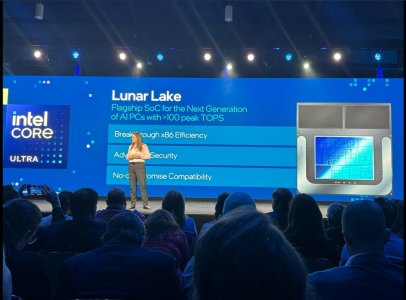
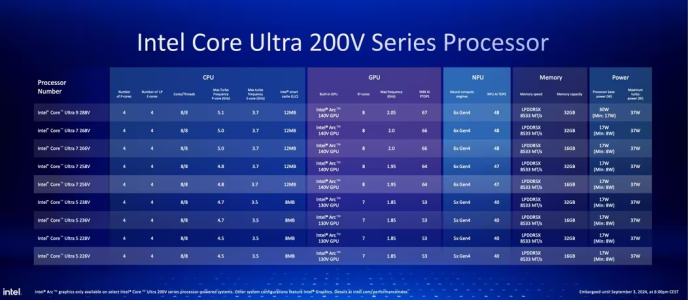
Intel Wildcat Lake (WCL) is upcoming mobile SoC replacing ADL-N. WCL consists of 2 tiles: compute tile and PCD tile. It is true single die consists of CPU, GPU and NPU that is fabbed by 18-A process. Last time I checked, PCD tile is fabbed by TSMC N6 process. They are connected through UCIe, not D2D; a first from Intel. Expecting launching in Q2/Computex 2026. In case people don't remember AlderLake-N, I have created a table below to compare the detail specs of ADL-N and WCL. Just for fun, I am throwing LNL and upcoming Mediatek D9500 SoC.
Intel Alder Lake - NIntel Wildcat LakeIntel Lunar LakeMediatek D9500
Launch DateQ1-2023Q2-2026 ?Q3-2024Q3-2025
ModelIntel N300?Core Ultra 7 268VDimensity 9500 5G
Dies2221
NodeIntel 7 + ?Intel 18-A + TSMC N6TSMC N3B + N6TSMC N3P
CPU8 E-cores2 P-core + 4 LP E-cores4 P-core + 4 LP E-coresC1 1+3+4
Threads8688
Max Clock3.8 GHz?5 GHz
L3 Cache6 MB?12 MB
TDP7 WFanless ?17 WFanless
Memory64-bit LPDDR5-480064-bit LPDDR5-6800 ?128-bit LPDDR5X-853364-bit LPDDR5X-10667
Size16 GB?32 GB24 GB ?
Bandwidth~ 55 GB/s136 GB/s85.6 GB/s
GPUUHD GraphicsArc 140VG1 Ultra
EU / Xe32 EU2 Xe8 Xe12
Max Clock1.25 GHz2 GHz
NPUNA18 TOPS48 TOPS100 TOPS ?


PPT1.jpg
PPT2.jpg
PPT3.jpg


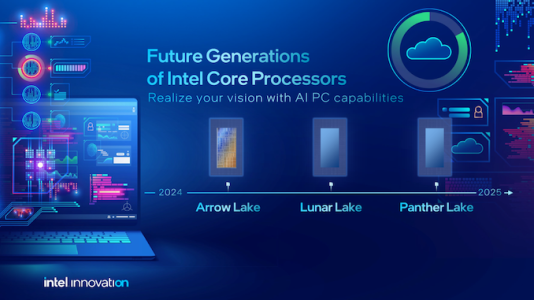
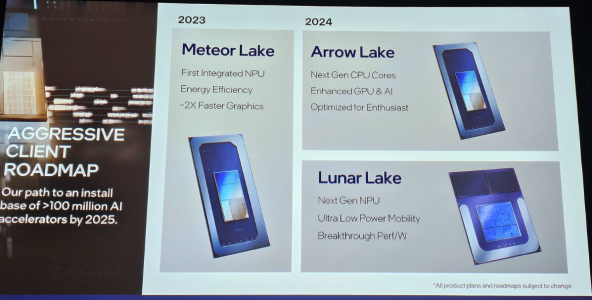
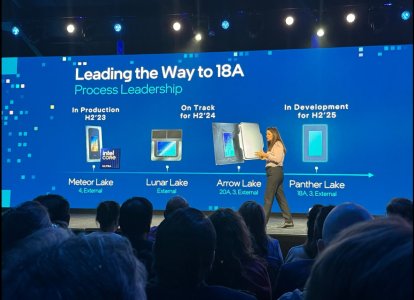
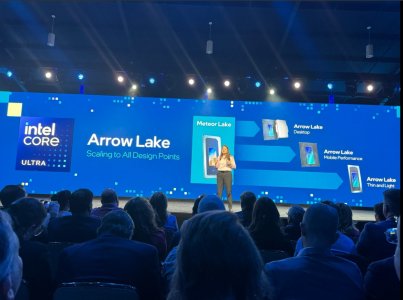
As Hot Chips 34 starting this week, Intel will unveil technical information of upcoming Meteor Lake (MTL) and Arrow Lake (ARL), new generation platform after Raptor Lake. Both MTL and ARL represent new direction which Intel will move to multiple chiplets and combine as one SoC platform.

MTL also represents new compute tile that based on Intel 4 process which is based on EUV lithography, a first from Intel. Intel expects to ship MTL mobile SoC in 2023.

ARL will come after MTL so Intel should be shipping it in 2024, that is what Intel roadmap is telling us. ARL compute tile will be manufactured by Intel 20A process, a first from Intel to use GAA transistors called RibbonFET.


LNL-MX.png
 

Attachments

  • PantherLake.png
    PantherLake.png
    283.5 KB · Views: 24,034
  • LNL.png
    LNL.png
    881.8 KB · Views: 25,527
  • INTEL-CORE-100-ULTRA-METEOR-LAKE-OFFCIAL-SLIDE-2.jpg
    INTEL-CORE-100-ULTRA-METEOR-LAKE-OFFCIAL-SLIDE-2.jpg
    181.4 KB · Views: 72,435
  • Clockspeed.png
    Clockspeed.png
    611.8 KB · Views: 72,321
Last edited:

Joe NYC

Diamond Member
Jun 26, 2021
3,951
5,481
136
I think Skymont can play a solid role...

... in scenarios where performance does not matter.

In scenarios where performance matters, P-Core always beats E-Core and P-Cores can also execute threads where performance does not matter. Which means E-Cores are redundant on desktop.

Looking at Amazon Top sellers, the top Intel processor is at #14 (behind 13 processors from AMD), and that processor is Alder Lake 12700KF with 8 P-cores and 4 E-cores. Which is a good hint that E-Cores are a waste of silicon.

Continuing on the list of top CPUs, then there are #15, #16, #21, #25 (first Arrow Lake), #27 are all processors with 8 P-cores. Buyers just want to max out on P-cores and don't care about E-Cores.
 

DavidC1

Platinum Member
Dec 29, 2023
2,021
3,157
96
Continuing on the list of top CPUs, then there are #15, #16, #21, #25 (first Arrow Lake), #27 are all processors with 8 P-cores. Buyers just want to max out on P-cores and don't care about E-Cores.
That depends on the usage scenario, which is extremely vast on a general purpose GPU. If they significantly lost MT performance, then the top sales would be all AMD.

Buyers also preferred $300 Nvidia GPU over $200 AMD GPU even if the latter performed better. That doesn't tell you much about how the two products fair technically.

I also remember 1P+16E being one of the best performing config in gaming.

Skymont outperforms Lion Cove in branch prediction. It's one part where real smarts and engineering is shown. In Raptorlake, the gap was big enough, but the fact that little tweaking can allow mostly Skymont to outperform default configuration in gaming out of everything suggests the situation is much, much different in Arrowlake.
 
Last edited:

coercitiv

Diamond Member
Jan 24, 2014
7,447
17,752
136
Does anyone still have a source to this 1P+16E demo in gaming? I remember it, but can't find it via search.
 

coercitiv

Diamond Member
Jan 24, 2014
7,447
17,752
136
Have to find it I was the one who shared it iirc 😂🤣
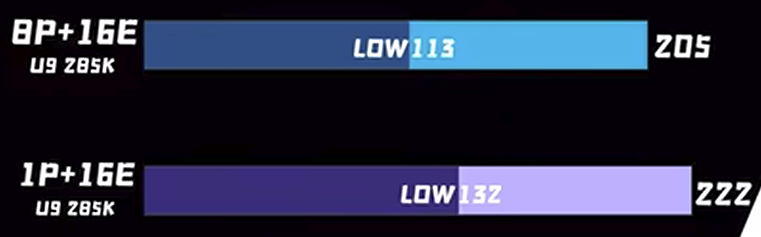
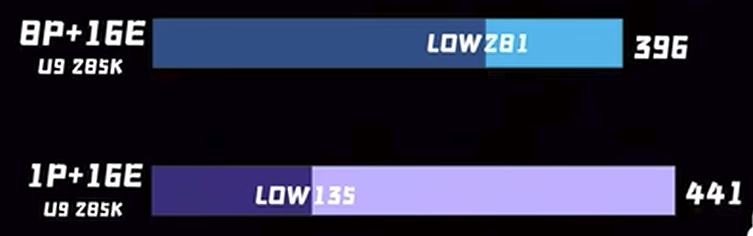
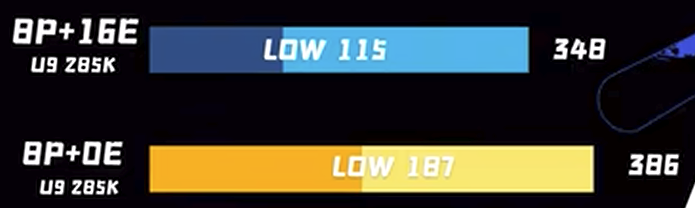
Yeah, I was searching the web, should have searched the forum instead. Here's the original source for the claims, the 1P+16E benchmarks start at 3:40

They test two games, CP2077:
1750144026501.png

and Baldur's Gate 3:
1750144081472.png

Some observations here:
  • for CP2077 - ARL performance in this game improved drastically after the Dec 24 updates, to the tune of 20-30% depending on testing conditions (example)
  • for BG3 - the benchmark data in the review is very odd, both GPU load and power draw are significantly lower through the 1P+16E run ~10% higher FPS. That's not how it works. Baldur Gate was also another game that benefited from the Intel performance patches in Oct and Dec 24, meaning we would need to re-test performacne for both configs.
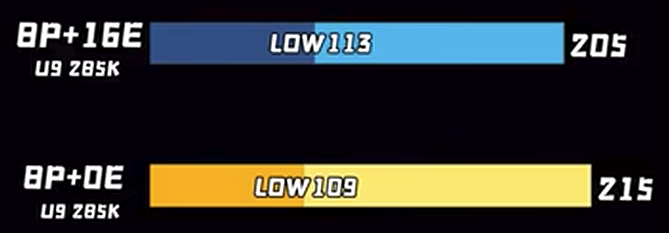
The review goes on to compare 8P+16E vs. 8P+0E

CP2077:
1750145080156.png

Counter Strike 2:
1750145152459.png

These results don't tell us much, CP2077 sees a small perf delta while CS2 is likely hard to benchmark consistently. I wish they kept BG3 as second benchmark. Still they contribute to the idea that ARL had inconsistent performance at launch.

TO summ this up, I would be skeptical that ARL 1P+16E with Skymont OC is still a better gaming CPU than ARL 8P+16E, I think we would need a proper proof with more than 2 games and updated software.
 
Last edited:

DavidC1

Platinum Member
Dec 29, 2023
2,021
3,157
96
The point of 1P+16E and what surprised me was that in no way it should have been possible to be a winner in any case if the gap was as big between two cores as in previous generation.

The fact that you can find corner case scenarios that can, means the gap has shrunk to the point where the situation is much different. Now, the two cores are in the same ballpark, and things like how caches are shared, and whether there's more caches available compared to 8+16 because some are disabled are starting to matter.
 
  • Like
Reactions: Io Magnesso
Jul 27, 2020
28,173
19,203
146
I think one reason why 1P+16E is so much better is because of Win11's scheduler (my theory) due to it bumping game threads around everywhere. With 16 E-cores, there's either less chance that the critical thread gets bounced outside of an E-core cluster (and thus has to undergo a very expensive context switch involving refilling of caches) or the Intel Thread Director keeps the critical thread pinned to the lone P-core by sending hints to the Win11 scheduler and since the scheduler can't find any other P-cores, it has no choice but to not interfere with the critical thread and this reduces expensive context switches.

A very easy way to debunk my theory would be to show 1P+16E vs. 8P+16E results on Linux where the scheduler is not a complete A-hole like Win11's and both results are more or less similar.
 
  • Like
Reactions: Io Magnesso

MS_AT

Senior member
Jul 15, 2024
913
1,830
96
on Linux where the scheduler is not a complete A-hole like Win11's and both results are more or less similar.
Did anyone test this? I don't mean to say Win11's scheduler is fine, but I have not seen any measurements that would show Linux kernel is doing better job. Phoronix is usually doing Linux vs Windows comparisons, but these are usually whole system benches, not testing for kernel behaviour specifically. Plus iirc he leaves default security on, which takes its tall and it's not exactly kernel's fault;)
 
  • Like
Reactions: Io Magnesso

OneEng2

Senior member
Sep 19, 2022
959
1,173
106
So is this image suggesting that NVL will be produced on BOTH processes?
The logic itself is extremely small to enable SMT:
https://images.anandtech.com/reviews/cpu/intel/nehalem/uarch/HTlogic.jpg
Registers and buffers are essentially caches, at tiny capacities. The commonly quoted number is 3-5% at the core level, so excluding L2 in this case. I think even 3% might be too high.

What really matters is the increased complexity in validation, to make everything work without corner case bugs and erratas. And you have to do that for every new design. I'm 95% convinced that SMT is one reason the x86 vendors are falling further and further behind.
I have read SMT adds more like 15% to a core. AMD's implementation gains it about 40% performance in highly MT applications though, so it is space well spent.

Intel never did get as big a boost from their HT (SMT) as AMD did though. Perhaps they did a poor mans version that did only add 5%? Still, IIRC Intel got a solid 15-20% MT improvement. Not bad for 5% area (if that is the case).

In DC, I think SMT is a critical design requirement. With such high core counts, all those parallel execution paths would just be sitting there doing nothing without SMT.

For this reason, I believe Intel was foolish for removing SMT from its designs.
Not happening sadly at least with DDR 6 we will have our generational upgrade.
I didn't think we would be seeing DDR6 in the next gen desktop. The timing doesn't seem to work out IIRC. DDR5 8000 is what I think the next gen desktop will be using.
Lion Cove/P cores just suck, that's it. You can compare to AMD. Zen 5 is on a worse node and the core area is significantly smaller. And Zen 4 was way better than Golden Cove that's used in both Alderlake and Refreshlake(also re-Refreshlake)
Can't argue with your PPA logic. Still, I am not so sure that Lion Cove isn't being crippled by the latency issues. I just can't see Intel engineering falling so far as to make such a bad design.

When AMD first did Zen 2 and chiplets, the latency got to them as well. It wasn't until Zen 3 the the design really started to breath. Perhaps NVL will "breath" better?
At 5.7GHz clocks it has to be the best cell. Arrowlake would have been a lot worse if it wasn't for Skymont.
Possibly; however, I would argue that Skymont only helps in limited situations in the desktop. In the laptop segment, it might lighten up the battery load a good deal.
ARL problem is that it sucks in games, and Skymont does nothing there.
ARL problems IMO are much more about how much it costs Intel to make, and how badly the latency hurts the P cores. Gaming isn't that big a deal to most consumers of x86 chips.
Well, the E-core is not very useful in games.
However, do you think PCs are only used for games? lol
Indeed. Games are likely one of the least used applications on x86.
... in scenarios where performance does not matter.

In scenarios where performance matters, P-Core always beats E-Core and P-Cores can also execute threads where performance does not matter. Which means E-Cores are redundant on desktop.

Looking at Amazon Top sellers, the top Intel processor is at #14 (behind 13 processors from AMD), and that processor is Alder Lake 12700KF with 8 P-cores and 4 E-cores. Which is a good hint that E-Cores are a waste of silicon.

Continuing on the list of top CPUs, then there are #15, #16, #21, #25 (first Arrow Lake), #27 are all processors with 8 P-cores. Buyers just want to max out on P-cores and don't care about E-Cores.
First, I agree with your assertion on P and E core performance; however, on some desktop applications that are very highly threaded, the E cores do help. I agree that this is a small minority of apps and effects an even smaller minority of users.

Amazon, on the other hand, is a horrible source for x86 sales volume.

Still, if you use the quarterly report and Mercury Research, etc, you still find that AMD is gaining market share and Intel is losing it in x86.

The biggest change in market share and profitability for AMD is coming from its increased share in DC though.

I have to wonder how well Crystal Lake is going to fare against Turin D. I am guessing that this is where Intel has a chance to shore up its profits (or lack thereof).
 
  • Like
Reactions: Io Magnesso

Io Magnesso

Senior member
Jun 12, 2025
578
165
71
So is this image suggesting that NVL will be produced on BOTH processes?

I have read SMT adds more like 15% to a core. AMD's implementation gains it about 40% performance in highly MT applications though, so it is space well spent.

Intel never did get as big a boost from their HT (SMT) as AMD did though. Perhaps they did a poor mans version that did only add 5%? Still, IIRC Intel got a solid 15-20% MT improvement. Not bad for 5% area (if that is the case).

In DC, I think SMT is a critical design requirement. With such high core counts, all those parallel execution paths would just be sitting there doing nothing without SMT.

For this reason, I believe Intel was foolish for removing SMT from its designs.

I didn't think we would be seeing DDR6 in the next gen desktop. The timing doesn't seem to work out IIRC. DDR5 8000 is what I think the next gen desktop will be using.

Can't argue with your PPA logic. Still, I am not so sure that Lion Cove isn't being crippled by the latency issues. I just can't see Intel engineering falling so far as to make such a bad design.

When AMD first did Zen 2 and chiplets, the latency got to them as well. It wasn't until Zen 3 the the design really started to breath. Perhaps NVL will "breath" better?

Possibly; however, I would argue that Skymont only helps in limited situations in the desktop. In the laptop segment, it might lighten up the battery load a good deal.

ARL problems IMO are much more about how much it costs Intel to make, and how badly the latency hurts the P cores. Gaming isn't that big a deal to most consumers of x86 chips.

Indeed. Games are likely one of the least used applications on x86.

First, I agree with your assertion on P and E core performance; however, on some desktop applications that are very highly threaded, the E cores do help. I agree that this is a small minority of apps and effects an even smaller minority of users.

Amazon, on the other hand, is a horrible source for x86 sales volume.

Still, if you use the quarterly report and Mercury Research, etc, you still find that AMD is gaining market share and Intel is losing it in x86.

The biggest change in market share and profitability for AMD is coming from its increased share in DC though.

I have to wonder how well Crystal Lake is going to fare against Turin D. I am guessing that this is where Intel has a chance to shore up its profits (or lack thereof).
Well, on x86, I wouldn't say that the game workload is a minority...
(There is also a game machine if it is called x86 machine, and of course there is also an arcade game machine for incorporation)
Intel's SMT implementation doesn't seem to be very good Of course, it can be said that AMD's SMT implementation is newer.
Therefore, even if SMT removal is good for consumers, Intel may need to reconsider to improve the implementation of SMT
 

Io Magnesso

Senior member
Jun 12, 2025
578
165
71
Also, Lion Cove is not directly installed in Xeon However In an interview with Intel engineers at Computex in 2024
For consumers, SMT has been deleted, but they said they didn't remove SMT from the Lion Cove architecture itself.
 
Last edited:

OneEng2

Senior member
Sep 19, 2022
959
1,173
106
Are you nuts?

You are being serious?
Please provide sales numbers or some marketing that would suggest that Desktop gaming is some significant portion of sales for x86. Everything I can find suggests the exact opposite.

Desktop in general is a shrinking market of x86. It is also less profitable than DC. The lion's share of x86 volume is in OEM sales (and laptop) and I believe the largest share of that is for corporate use.

I look forward to some analysis vs. "Are you nuts".
 

coercitiv

Diamond Member
Jan 24, 2014
7,447
17,752
136
Please provide sales numbers or some marketing that would suggest that Desktop gaming is some significant portion of sales for x86.
There's a nuance here that was not there in your previous post, you made no reference to Desktop gaming.
Gaming isn't that big a deal to most consumers of x86 chips.
Games are likely one of the least used applications on x86.
Here's some data on combined gaming PC sales for 2023, they made up 17% of consumer x86 market. Keep in mind not all systems bought with the intent to "also" game are labeled as gaming machines by manufacturers. My last laptop bought with the intention to work & play was considered a "Multimedia Laptop".

I think we can safely assume that at least 1 out of 4 new x86 systems bought today include gaming as target use. This does not fall under "least used applications on x86".
 
Last edited:

OneEng2

Senior member
Sep 19, 2022
959
1,173
106
20-30% of x86 sales are desktop processors.

25% of those are purchased for games (your number).

That means that gaming accounts for only ~ 6% of x86 sales.

I don't consider any laptop to be a "gaming" system, but we could consider some small percentage of laptops to be purchased for the purpose of mobile gaming.

Perhaps I am looking at this all wrong, but it seems like gaming isn't that big of a consideration for the x86 market. I'll give it to you that the gamers that buy a computer for gaming pay a premium which helps with the margins and profitability of x86 chips.
 

Thunder 57

Diamond Member
Aug 19, 2007
4,207
6,995
136
20-30% of x86 sales are desktop processors.

25% of those are purchased for games (your number).

That means that gaming accounts for only ~ 6% of x86 sales.

I don't consider any laptop to be a "gaming" system, but we could consider some small percentage of laptops to be purchased for the purpose of mobile gaming.

Perhaps I am looking at this all wrong, but it seems like gaming isn't that big of a consideration for the x86 market. I'll give it to you that the gamers that buy a computer for gaming pay a premium which helps with the margins and profitability of x86 chips.

What about all of those younger people (students come to mind) that can only afford one device and want to do some gaming but also need something they can take on the go? Those people just don't count?